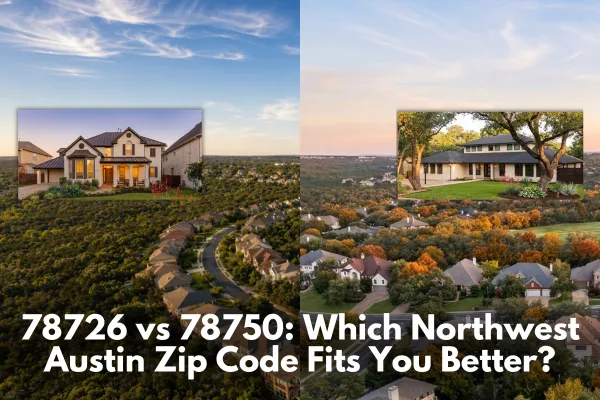
78750 vs 78729: Which Northwest Austin Zip Code Fits You Better?
If you are deciding between 78750 and 78729, you are not really choosing between two random zip codes on a map.
You are choosing between two different versions of Northwest Austin-area living.
That is what makes this a very real buyer comparison.
Both zip codes can appeal to people who want established neighborhoods, practical access to North Austin and Northwest Austin routes, detached homes, and a location that still works well for everyday life. But once buyers get more specific about what they want, the differences start to matter. One often feels more tied to broader Northwest Austin decision-making, school-related search behavior, and established neighborhood identity. The other often feels more practical, more flexible, and more connected to Anderson Mill-side and Westwood-related search patterns.
That is why this is not really a “which zip code is better?” question. It is a “which one fits the way I actually want to live?” question.
Why buyers compare 78750 and 78729
This comparison usually comes up when buyers are trying to narrow the northwest side of the Austin market in a more useful way.
Some are balancing school-related search behavior with commute practicality.
Some want an established Northwest Austin feel, but are trying to decide how much neighborhood identity matters compared with broader day-to-day flexibility.
Some are comparing different kinds of residential environments while still trying to stay connected to North Austin employers, Apple, Parmer, 183, or the broader northwest corridor.
And some are simply trying to answer:
where do I get the best mix of neighborhood feel
school-related search relevance
route logic
house-first livability
long-term fit
That is what makes this a strong real-world comparison.
These two zip codes can overlap in buyer searches, but they usually solve for different priorities.
Best Neighborhoods in 78750: How Buyers Usually Narrow the Search
The biggest difference: 78750 often feels more like a broader Northwest Austin hub, while 78729 often feels more practical and more tied to Anderson Mill-side decision-making
That is the cleanest way to frame it.
78750 often appeals to buyers who want a more established Northwest Austin search with strong overlap into school-driven, relocation, and neighborhood-character decision-making.
78729 often appeals to buyers who want a practical Northwest/North Austin search area with good neighborhood options, strong day-to-day functionality, and more direct overlap with Anderson Mill and Westwood-related buyer behavior.
That does not make one better.
It just means buyers are usually drawn to them for different reasons.
Best Neighborhoods in 78729, Austin
What 78750 usually appeals to
78750 often draws buyers who want a more established Northwest Austin search area that can support multiple priorities at once.
It tends to appeal to buyers who want:
recognizable Northwest Austin identity
established neighborhoods
practical access to major roads and North Austin routes
overlap with school-driven searches
a location that often feels more plugged into the broader Northwest Austin decision map
a mix of neighborhood character and everyday usability
Neighborhoods and search areas that often shape the 78750 conversation include:
Balcones Village Living in Balcones Village, Austin
Anderson Mill Estates Living in Anderson Mill Estates, Austin
Spicewood-related pockets Living in Spicewood Estates, Austin
other established Northwest Austin-feeling sections within the zip
For many buyers, 78750 works because it can feel like a useful middle ground. It is established, practical, and broad enough to support several different buyer goals without feeling overly central or overly far out.
What 78729 usually appeals to
78729 often attracts buyers who want a practical and flexible search area with strong overlap into some of the most common real-life northwest buyer decisions.
It tends to appeal to buyers who want:
established residential neighborhoods
practical day-to-day livability
good access to the North Austin corridor
overlap with Anderson Mill and Westwood-related searches
a search area where neighborhood fit often matters more than zip-code identity
a location that can work well for both family-oriented and commute-oriented priorities
For many buyers, 78729 is less about a strong “Northwest Austin brand” and more about finding the right combination of:
neighborhood
home style
school-related fit
route logic
daily usability
That makes it very relevant, even if buyers describe it differently.
Neighborhood feel: this is where buyers usually separate the two
This is often where the comparison gets clearer.
78750 often feels more tied to broader Northwest Austin identity. Buyers may still be comparing specific neighborhoods within it, but the zip itself often has stronger pull as a recognized part of the Northwest Austin map.
78729 often feels more practical in a useful way. Buyers are often less attached to the zip code as an identity and more focused on which specific neighborhoods within it make the most sense.
That does not mean 78729 lacks neighborhood appeal.
It means the decision logic is often different.
78750 often wins when buyers want:
stronger Northwest Austin association
more character-driven or established-neighborhood appeal
practical access with a little more location identity
78729 often wins when buyers want:
broader flexibility
useful school-related and family-oriented search behavior
practical fit over zip-code recognition
Commute and location logic
This is one of the biggest decision points.
78750 often makes sense if your priority is:
broader Northwest Austin access
school-related search overlap
practical route access toward Apple, North Austin, and the northwest corridor
a location that often feels more connected to multiple buyer decision lanes at once
78729 often makes sense if your priority is:
Anderson Mill-side search behavior
Westwood-related relevance Best Neighborhoods Near Westwood High School: How Buyers Usually Narrow the Search
practical day-to-day movement around the northwest / north side
a zip code that supports flexible house-first searching
a less identity-driven and more function-driven choice
These are not absolute rules, but they are useful patterns.
Housing style and search behavior
This is another place where the two zip codes tend to separate.
Buyers drawn to 78750 often prioritize:
a more established Northwest Austin feel
neighborhoods with stronger overall identity
school-related relevance
a location that works for both character and access
broader Northwest Austin flexibility
Buyers drawn to 78729 often prioritize:
practical neighborhood choice
family-oriented livability
good route logic
value in the overall fit
finding the right house and neighborhood combination without needing the stronger 78750 identity
In other words, 78750 often wins on broader Northwest Austin positioning, while 78729 often wins on practical flexibility.
Which zip code may fit different buyers better?
78750 may fit better if you want:
stronger Northwest Austin identity
more overlap with broader school-related and relocation searches
established neighborhoods with more classic Northwest Austin appeal
a location that feels more connected to the wider Northwest Austin cluster
a balance between neighborhood character and practical access
78729 may fit better if you want:
practical neighborhood flexibility
stronger Anderson Mill and Westwood-related overlap
useful day-to-day livability
a house-first search guided more by fit than by zip identity
a zip code that works well for real-world family and commute decisions
What sellers should understand about this comparison
If you are selling in either zip code, buyers are usually not just comparing your home to nearby listings.
They are also comparing:
78750 versus 78729
broader Northwest Austin identity versus practical flexibility
school-related relevance versus neighborhood-level fit
route logic versus neighborhood character
a more recognized Northwest Austin location versus a more function-driven search zone
That means the marketing should do more than mention the zip code.
In 78750, it often makes sense to emphasize established Northwest Austin appeal, school-search relevance, practical access, and why that location works for multiple buyer priorities.
In 78729, it often makes sense to emphasize practical livability, useful neighborhood choice, Westwood- and Anderson Mill-side relevance, and why the specific area makes sense for daily life.
The common mistake buyers make
The biggest mistake is assuming these two zip codes are basically interchangeable because both sit in the broader Northwest Austin search area.
They are not.
A buyer who loves 78750 may be looking for stronger Northwest Austin identity and broader cluster relevance.
A buyer who loves 78729 may care more about practical fit, neighborhood flexibility, and real-life livability.
The better questions are:
Do I care more about broader Northwest Austin identity or practical neighborhood flexibility?
How much does school-related search behavior matter?
Am I choosing primarily for neighborhood environment, route logic, or zip-code positioning?
Which one feels more aligned with the way I actually want to live?
Those questions usually make the answer much clearer.
My practical take
If you want a stronger overall Northwest Austin feel with broader school and relocation relevance, I would usually keep 78750 high on the list.
If you want a more practical, flexible search area with strong overlap into Anderson Mill and Westwood-related buyer behavior, 78729 deserves serious attention.
And for many buyers, the right answer becomes obvious only once they stop comparing zip codes abstractly and start comparing the neighborhoods and daily routines those zip codes actually support.
Final thought
78750 and 78729 can both be strong choices, but they usually win for different reasons.
78750 often wins when buyers want broader Northwest Austin relevance, established neighborhood appeal, and a zip code that supports several major buyer priorities at once.
78729 often wins when buyers want practical neighborhood options, strong school-related overlap, and a search area that feels flexible and grounded in day-to-day livability.
The better fit usually is not the one that sounds best on paper.
It is the one that makes more sense once you picture how you actually want to live.
78726 vs 78750: Which Northwest Austin Zip Code Fits You Better?
78759 vs 78729: Which Northwest Austin Zip Code Fits You Better?
Northwest Austin vs Avery Ranch: Which Fits You Better?
FAQ
Is 78750 or 78729 better for living in Northwest Austin?
That depends on what you want. 78750 often appeals to buyers who want stronger Northwest Austin identity and broader school-related or relocation relevance. 78729 often appeals to buyers who want practical neighborhood flexibility and stronger overlap with Anderson Mill and Westwood-related searches.
Is 78750 more “Northwest Austin” than 78729?
In many buyer conversations, yes. 78750 often feels more directly tied to the broader Northwest Austin cluster, while 78729 often feels more practical and more driven by neighborhood-level fit.
Is 78729 a good zip code for families?
For many buyers, yes. 78729 often comes up because it offers practical neighborhood choices, established residential areas, and strong overlap with school-related and day-to-day livability decisions.
Is 78750 better for school-related searches?
Often, yes. 78750 tends to have stronger overlap with broader Northwest Austin school and relocation search behavior, though 78729 is also very relevant depending on the specific school and neighborhood priorities.
Which zip code is better for Apple or North Austin tech-corridor buyers?
Both can work, but 78750 often makes more sense for buyers who want broader Northwest Austin flexibility, while 78729 can be very attractive for buyers whose priorities lean more toward practical fit, Westwood-related overlap, and everyday functionality.
Should buyers search by zip code or neighborhood?
Usually by neighborhood once the general geography is narrowed down. Zip codes are useful for shrinking the map, but in this part of Austin, the neighborhood usually tells you more than the zip code alone.
