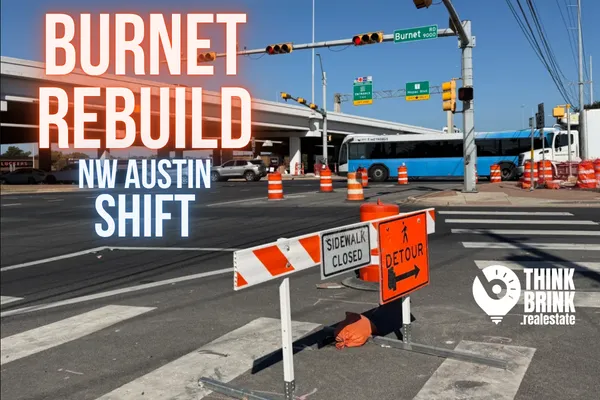
Burnet Road Is Being Rebuilt From Koenig to MoPac: $64 Million, Three Segments, Finished by Late 2028
Burnet Road has been on the city's list since 2011, back when The Domain was still mostly an idea and Q2 Stadium did not exist yet, and after roughly fifteen years of studies, phasing, and bond cycles it is finally being rebuilt in earnest. The City of Austin held a groundbreaking on March 5, 2026, and there are now three separate construction contracts running on the stretch between Koenig Lane and MoPac, adding up to about $64 million of work that finishes between mid-2027 and late 2028.
If you live along that corridor, own property on it, or are shopping anywhere in the neighborhoods that feed into it, this one is worth understanding in detail, because the construction window and the finished corridor are two very different things for your property, and right now they are roughly two years apart.
What is actually under construction right now
All of this is funded by the 2016 Austin Mobility Bond, which set aside $482 million for corridor improvements across nine corridors citywide, and Burnet Road is one of them. The city describes the overall project extent as Koenig Lane, which is RM 2222, north to MoPac Expressway, roughly five miles. It is being delivered in segments, and as of this fall three of them are active at the same time.
C2: White Horse Trail to US 183
This is the piece that broke ground in March, and the city's own scope language describes the start as approximately 2.7 linear miles of rescoped corridor improvements from Koenig Lane to US 183. The budget is $12 million and construction runs from February 2026 into July 2027. The work includes sidewalks, shared use paths, curb and gutter, minimal driveway reconstruction, and upgraded traffic signal infrastructure, with signal and intersection improvements specifically at White Horse Trail, Justin Lane and Pegram Avenue, Northcross Drive and St. Joseph Boulevard, and Anderson Lane.
C4: US 183 to Bright Verde Way
This is about 1.2 miles and it is the segment sitting in the Q2 Stadium and Domain orbit. Council awarded the construction contract on December 11, 2025 to DeNucci Constructors for $20,459,217, with a $2,045,922 contingency on top, for a total not to exceed $22,505,139. The scope covers shared use paths, curb and gutter, pavement widening, intersection improvements, driveway reconstruction, bus stop improvements, pavement mill and overlay, traffic signal improvements, markings and signage, drainage improvements, and utility adjustments. Construction runs into late 2027.
C3: Bright Verde Way to MoPac
This is the largest of the three and the one most people in the north part of the corridor will feel. It covers roughly 1.5 miles, Council approved the contract on January 22, 2026, again with DeNucci Constructors, for $26,691,025 plus a $2,669,103 contingency, for a total not to exceed $29,360,128. The funding splits $28,527,881 from Transportation and Public Works and $832,247 from Austin Water, which tells you there is meaningful utility work bundled into it. Construction started in June 2026 and runs to December 2028, with intersection and traffic signal improvements at Bright Verde Way, Braker Lane, Kramer Lane, Esperanza Crossing, Solaris Street, Palm Way, Gault Lane, and Gracy Farms Lane.
The segment that already finished tells you what to expect
The stretch from Koenig Lane up to White Horse Trail was completed back in May 2023, and the city has now published several years of after data on it, which is unusual and genuinely useful. Comparing post-construction conditions to the baseline collected between 2017 and 2022, crashes on that segment are down 42 percent.
The cost side is just as concrete. Crashes on that stretch ran about $2.5 million annually in comprehensive crash costs, which combine economic losses with quality of life losses, in the July 2017 through June 2022 window. Since construction wrapped in May 2023, the total through January 2026 was $764,796, a savings of roughly $1.7 million. That is the closest thing to a preview anyone has for what the rest of the corridor looks like once the cones come down.
What the corridor actually gets
Across the segments, the improvements are consistent, and they are the things Burnet has been missing for decades while it carried increasingly urban traffic on an old state highway cross section.
ADA compliant curb ramps and continuous sidewalks
Shared use paths for pedestrians and cyclists
Pedestrian hybrid beacons and improved crossings
Upgraded traffic signals and reconfigured intersections
Bus stop accessibility improvements
Stormwater detention and water quality structures, addressing flooding the corridor has dealt with for years
Driveway reconstruction, pavement widening in places, mill and overlay
Landscaping, including street trees along the new pedestrian and bike facilities
Why Burnet matters more than a typical corridor project
Burnet carries up to 37,000 vehicles per day, and it is one of the few continuous routes that runs from Cedar Park and Round Rock all the way into downtown without funneling onto an interstate. With I-35 under reconstruction for years to come, the parallel surface routes carry more weight than they used to, and Burnet is the most important of them on the west side of the freeway.
The second reason is what is being built alongside it. The North Burnet and Gateway district, which I have written about as Austin's second downtown, is planned under a master plan that anticipates roughly 40,000 residential units, 12 to 13 million square feet of office and commercial space, and 3,000 to 4,000 hotel rooms at buildout. The CapMetro Red Line runs through the district, McKalla Station is operating, and Broadmoor Station is planned. Every one of those local trips has to touch a surface street, and the surface street is Burnet. The C3 and C4 segments overlap that district directly, which is why the northern contracts are the larger ones.
What this means if you are buying or selling along Burnet
The honest version is that this cuts both ways depending on your timing, and the specific segment your property sits on matters more than the headline.
If you are selling in the next eighteen months anywhere between White Horse Trail and US 183, you are selling into an active construction zone, and buyers will notice lane shifts, temporary detours, and periodic driveway access disruption. That is a real, if temporary, drag on showing experience, and it is something to price and message around rather than ignore. If you are north of 183, particularly on the Bright Verde Way to MoPac stretch, the window is longer, because that segment does not finish until December 2028.
If you are buying, the flip side is that you are buying ahead of a completed corridor rather than after it. Continuous sidewalks, shared use paths, functioning drainage, and rebuilt intersections are durable improvements that do not get undone, and the neighborhoods that back up to Burnet between Anderson Lane and Braker have historically been priced as if the corridor were a liability rather than an amenity. I would not tell anyone to pay a premium today for a benefit that arrives in 2028, but I would tell you not to discount the corridor permanently for a condition that has an end date on it.
The drainage piece deserves its own mention. Burnet has had chronic flooding problems tied to a roadway that was never built with proper stormwater infrastructure, and the detention and water quality structures going in are the kind of improvement that shows up in insurance conversations and in the viability of the older commercial lots lining the road, which is where a lot of the corridor's redevelopment potential sits.
Timeline at a glance
Koenig Lane to White Horse Trail: complete as of May 2023
C2, White Horse Trail to US 183: $12 million, February 2026 to July 2027
C4, US 183 to Bright Verde Way: up to $22.5 million, contract awarded December 2025, finishing late 2027
C3, Bright Verde Way to MoPac: up to $29.4 million, contract awarded January 2026, June 2026 to December 2028
Frequently asked questions
When did construction start on Burnet Road?
The City of Austin held its groundbreaking on Thursday, March 5, 2026, and construction on the segment running from Koenig Lane to US 183 began that same week. The northernmost segment, from Bright Verde Way to MoPac, started in June 2026.
How much is the Burnet Road project costing?
About $64 million across the three active segments, funded through the 2016 Austin Mobility Bond. That bond allocated $482 million to corridor improvements across nine corridors citywide, and Burnet is one of the nine. You may still see a $45 million to $55 million range quoted in older coverage, which was the city's estimate before the two northern construction contracts were awarded.
When will Burnet Road construction be finished?
It depends on your segment. The stretch from White Horse Trail to US 183 is scheduled to wrap in July 2027, the US 183 to Bright Verde Way segment finishes in late 2027, and the Bright Verde Way to MoPac segment runs to December 2028.
Is Burnet Road being widened?
Not primarily. Pavement widening appears in the scope for the US 183 to Bright Verde Way segment, but this is a corridor mobility and safety project rather than a capacity expansion. The bulk of the money goes to sidewalks, shared use paths, signals, intersections, bus stops, and drainage, essentially bringing an old state highway up to urban standards.
Does road construction hurt home values?
During the construction window it can affect how a property shows and how quickly it sells, particularly for homes and businesses with direct frontage or driveway access on the corridor. The completed segments tell a different story, though, and the finished corridor improvements are permanent while the disruption is not. What matters for your specific situation is which segment you are on and where that segment sits in its schedule.
If you are on or near this corridor
The construction window and the finished road are two entirely different stories for your property value, and most of the people I talk to on Burnet do not know which one they are currently in. If you own along the corridor, or you are looking at a neighborhood that feeds into it, I can tell you exactly which segment you are in, what the schedule is for that segment, and how I would time a sale around it. Reach out and we will look at it together.
