How Long Does Downsizing Usually Take in Austin? A Realistic Timeline for Longtime Homeowners
If you are thinking about downsizing from a longtime Austin-area home, one of the first questions is usually:
How long does this actually take?
Not just the sale.
The whole thing.
Sorting through decades of belongings. Talking with family. Deciding where to go next. Figuring out whether to fix up the house or sell as-is. Understanding your property tax situation. Preparing the home. Finding the right next place. Coordinating the sale and the move.
That is why downsizing often takes longer than people expect.
For some homeowners, the process can move fairly quickly. For others, especially those who have lived in a home for 20, 30, or 40 years, a thoughtful downsizing plan may take several months or even longer.
The goal is not to drag it out.
The goal is to avoid being forced into rushed decisions that affect your money, your home, and your next chapter.
Best Low-Maintenance Housing Options in Northwest Austin for Downsizers
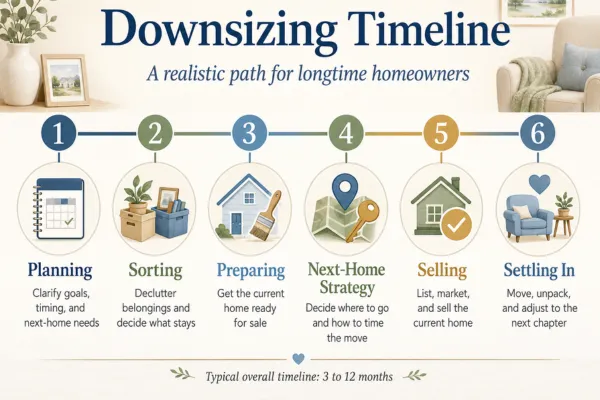
The honest answer: downsizing often takes 3 to 12 months
There is no single perfect timeline, but for many longtime homeowners in Austin, a realistic downsizing process often takes somewhere between 3 and 12 months from first serious thought to being settled in the next home.
That does not mean the house is on the market for that entire time.
In fact, the actual listing and sale may be one of the shorter phases.
The longer parts are usually:
deciding what you really want next
sorting through belongings
involving family
preparing the current home
timing the sale and purchase
emotionally getting comfortable with the move
That is especially true for homeowners in established areas like Northwest Austin, Cedar Park, Round Rock, and other parts of the metro where people may have lived in the same home for decades.
Northwest Austin vs Round Rock for Downsizers: Which Fits the Next Chapter Better?
Why downsizing takes longer than a typical move
A standard move may begin with:
“I got a new job.”
“We need a bigger house.”
“We want a shorter commute.”
Downsizing is often different.
It may begin with:
“The house is becoming too much.”
“We do not use half these rooms anymore.”
“The stairs are getting old.”
“I want to be closer to the grandkids.”
“We should probably do this before we have to.”
“I have no idea what to do with all this stuff.”
That is a more layered decision.
It involves logistics, but it also involves identity, family, memory, finances, and lifestyle.
That is why a good downsizing process should be intentional, not reactive.
What to Do With a House Full of Stuff Before Downsizing in Northwest Austin
A realistic downsizing timeline
Here is how I would think about it for a longtime Austin homeowner.
Phase 1: The thinking and planning stage
Typical timing: 1 to 3 months
This is the stage where you are not necessarily ready to list, but you are beginning to admit that a change may be coming.
You may be asking:
Should I stay in this home or downsize?
Should I age in place instead?
Where would I go if I moved?
Do I want to stay in Northwest Austin?
Would Cedar Park or Round Rock make more sense?
Do I need to be closer to family?
What will my property taxes look like if I move?
Can I afford the kind of next home I want?
This stage matters.
A lot of people skip it and jump straight to browsing listings. But if you have not figured out what problem the next home needs to solve, online home shopping can create more confusion than clarity.
What to do during Phase 1
Write down what is becoming difficult about the current home.
Identify what you most want to preserve: family proximity, doctors, routines, neighborhood feel, church, friends.
Think about whether you want continuity or a more intentional reset.
Get a rough idea of your current home’s value.
Start learning what next-home options exist.
Review your property tax situation if you are over 65 or have long-held exemptions.
Talk with family if their location or support matters to the move.
This is the stage where you define the destination before creating the plan.
Should You Sell As-Is or Fix Up a Long-Time Home in Northwest Austin?
Phase 2: The sorting and decluttering stage
Typical timing: 1 to 4 months
For longtime homeowners, this is often the slowest phase.
If you have lived in a home for decades, downsizing is not just packing. It is editing a lifetime of belongings.
You may need to work through:
closets
attic
garage
paperwork
family photos
holiday décor
tools
furniture
inherited items
things adult children left behind
items you once used but no longer need
This is where people often underestimate the timeline.
A house full of stuff rarely gets handled well in one weekend.
What to do during Phase 2
Start with low-emotion areas first.
Use simple categories: keep, family, donate/sell, discard.
Ask adult children what they truly want and set pickup deadlines.
Decide early if you need a professional organizer, estate sale company, donation pickup, or junk removal.
Avoid renting storage unless it has a clear short-term purpose.
Keep your next home in mind so you do not move furniture and belongings that will not fit.
This stage can move quickly with help, or it can stretch out if you do it slowly and independently. Neither is wrong. The important thing is to start before the move becomes urgent.
Aging in Place vs Downsizing in Northwest Austin: Which Makes More Sense?
Phase 3: The home-preparation stage
Typical timing: 2 to 8 weeks
Once the home has been significantly decluttered, you can make much smarter decisions about preparing it for sale.
This is when you decide:
Should we sell as-is or do targeted updates?
What should be repaired?
Should we paint?
Should we replace carpet?
Do we need landscaping cleanup?
Should we get a pre-listing inspection?
What will matter most to buyers?
For a longtime home, preparation can be very light or more involved depending on condition. But the best strategy is usually selective preparation, not trying to remodel the entire property.
What to do during Phase 3
Walk through the home with a seller-focused strategy.
Prioritize safety, function, and anything that scares buyers.
Deep clean.
Improve lighting.
Address odors.
Simplify furniture placement.
Consider targeted paint or flooring work if it materially improves presentation.
Clean up curb appeal.
Prepare the home for listing photography and showings.
A home that has been lived in for decades often benefits tremendously from a focused 2- to 8-week preparation period.
What Happens to Your Property Taxes When You Downsize in Texas?
Phase 4: The next-home strategy stage
Typical timing: overlaps with Phases 1–3
This part should not wait until the house is listed.
You need to think about the next home while you are planning and preparing the current one.
Key questions include:
Do I need to buy before I sell?
Should I sell first and rent temporarily?
Would a leaseback help?
Do I need sale proceeds to buy?
How specific is my next-home search?
What locations and home types are realistic?
If you are looking for a one-story home, lower-maintenance property, patio home, or something close to family in a specific area, the right fit may take time to find.
What to do during this stage
Narrow your preferred areas.
Decide what kind of home truly solves the downsizing problem.
Get lender or financial guidance if needed.
Understand whether buy-first, sell-first, or sell-then-rent makes the most sense.
Begin watching inventory so you know what is realistic.
Consider property taxes, HOA dues, upkeep, and long-term living—not just purchase price.
This stage can be the difference between a confident move and a rushed one.
Is Northwest Austin a Good Place to Downsize?
Phase 5: Listing and selling the current home
Typical timing: market-dependent, often several weeks to a few months
Once the home is prepared, pricing is set, and the next-step plan is clear, the property can go on the market.
How long it takes to sell will depend on:
pricing
condition
neighborhood
current buyer demand
competition
how well the home is presented
the broader Austin-area market at that moment
The important thing is that the listing phase should not be the first time you start thinking seriously about where you will go.
That creates unnecessary pressure.
What to do during Phase 5
Launch the home with strong marketing.
Keep showings manageable.
Review offers not just by price, but also by timing and terms.
Consider whether a leaseback or flexible closing helps.
Keep the next-home plan active as the sale moves forward.
Downsizing in Northwest Austin After Living in Your Home for 20+ Years
Phase 6: The move and settling-in stage
Typical timing: 2 to 8 weeks
This part is often overlooked.
Even once the sale is done, downsizing is not truly complete until you are settled in the next home.
There may still be:
unpacking
furniture decisions
utility setup
address changes
extra donation pickups
family items still being claimed
adjusting to a new layout
learning new errands and routines
emotionally settling into the next chapter
For someone leaving a longtime home, this adjustment period matters.
You are not just unpacking boxes.
You are establishing a new normal.
A practical 6-month downsizing timeline
If someone tells me, “I think I may want to downsize sometime this year,” this is a very reasonable six-month model.
Months 1–2: Clarify the move
Decide why you are downsizing.
Explore neighborhoods and home types.
Review finances, taxes, and rough home value.
Talk with family.
Months 2–4: Declutter and prepare
Sort belongings room by room.
Ask family what they want.
Schedule estate sale, donation, or junk removal if needed.
Begin deciding what repairs or improvements matter.
Month 4: Finalize sale strategy
Decide sell as-is versus targeted prep.
Complete high-impact prep work.
Photography, pricing, and listing plan.
Months 5–6: List, sell, and move
Put the home on the market.
Negotiate offer timing.
Coordinate next home, leaseback, or rental plan.
Move and begin settling in.
That is a strong, calm timeline.
Could it be faster? Yes.
Should it always be faster? Not necessarily.
What if you need to downsize quickly?
Sometimes the timeline is compressed by:
health changes
loss of a spouse
family caregiving needs
financial pressure
a home becoming unsafe or unmanageable
a sudden desire to move closer to children
In that case, the process can move faster, but the strategy has to simplify.
You may need to:
sell more as-is
hire more professional help
use an estate sale company or senior move manager
focus on the next home’s safety and layout above all else
accept that not every decision will be perfectly optimized
A faster downsizing move is possible.
But it usually costs more in stress, money, or tradeoffs than a move planned ahead.
What slows downsizing down the most?
The biggest delays are usually not market-related.
They are decision-related.
Common bottlenecks include:
not agreeing on whether to move
not knowing where to go next
avoiding the belongings
waiting for adult children to make decisions
debating repairs endlessly
assuming the current home is easier to sell than it is
assuming the next home will be easy to find
refusing outside help when the project is too large
waiting for a “perfect” time that never arrives
This is why an early plan matters so much.
It creates momentum.
When should you start if you may want to move next year?
Now.
Not necessarily with contractors or showings.
But with planning.
If you think there is a decent chance you will downsize in the next 12 to 18 months, it is completely reasonable to begin:
sorting belongings slowly
learning your options
watching neighborhoods
understanding your tax situation
talking with family
getting a preliminary home-value conversation
identifying what repairs may matter someday
You do not have to be “ready to sell” to start making the future move easier.
What adult children should understand about the timeline
If you are helping a parent downsize, the process may feel slower than you expect.
That does not always mean they are avoiding the decision.
They may be processing:
leaving a family home
letting go of belongings
fear of losing independence
uncertainty about the next home
concern about money
worry about burdening family
Pushing too hard can backfire.
A better approach is to help create small next steps:
one room
one family conversation
one home-value meeting
one list of next-home priorities
Downsizing often moves forward when it stops feeling like one massive decision.
Helping Parents Downsize in Austin: What Adult Children Should Know
My practical take
For a longtime Austin homeowner, I would treat downsizing like a project with phases, not a single real estate event.
A rushed move often starts with:
“Let’s just list the house and figure it out.”
A well-planned move usually starts with:
“What do we want life to look like next, and what steps get us there with the least regret?”
That is the better path.
What Happens to Your Equity When You Downsize in Austin?
Final thought
So, how long does downsizing usually take in Austin?
For many longtime homeowners, 3 to 12 months is a realistic planning range, with the exact timeline depending on belongings, home condition, next-home needs, family involvement, and whether the move is proactive or urgent.
The sale itself may be fast.
The decision-making, preparation, and transition are what take time.
And that is okay.
Downsizing is not just about getting out of one house. It is about moving thoughtfully into the next chapter of life.
Cost of Living in Austin for Retirees
FAQ
How long does downsizing usually take in Austin?
For many longtime homeowners, a realistic downsizing process takes about 3 to 12 months from first serious planning to being settled in the next home. The timeline depends on belongings, home prep, next-home needs, and whether the move is proactive or urgent.
What part of downsizing takes the longest?
For many homeowners, sorting through belongings takes the longest. Decisions about family items, inherited belongings, storage, donations, and what will fit in the next home can take more time than the actual real estate transaction.
When should I start downsizing if I want to move next year?
Start now with planning and light decluttering. You do not need to list immediately, but understanding your next-home goals, tax situation, home value, and belongings will make the eventual move much easier.
Can downsizing be done in 30 to 60 days?
Yes, but usually only if the home is already fairly ready, the next-home plan is clear, and the homeowner is willing to move quickly or hire significant help. A compressed timeline often creates more stress and fewer options.
Should I find my next home before preparing my current home?
You should think about your next-home needs early, even if you do not buy immediately. Knowing where you want to go and what type of home fits next can help guide the sale timing, decluttering, and prep strategy.
What causes downsizing plans to stall?
The biggest delays are usually indecision, avoiding belongings, uncertainty about where to move, waiting on family decisions, debating repairs too long, and not starting until the move becomes urgent.
