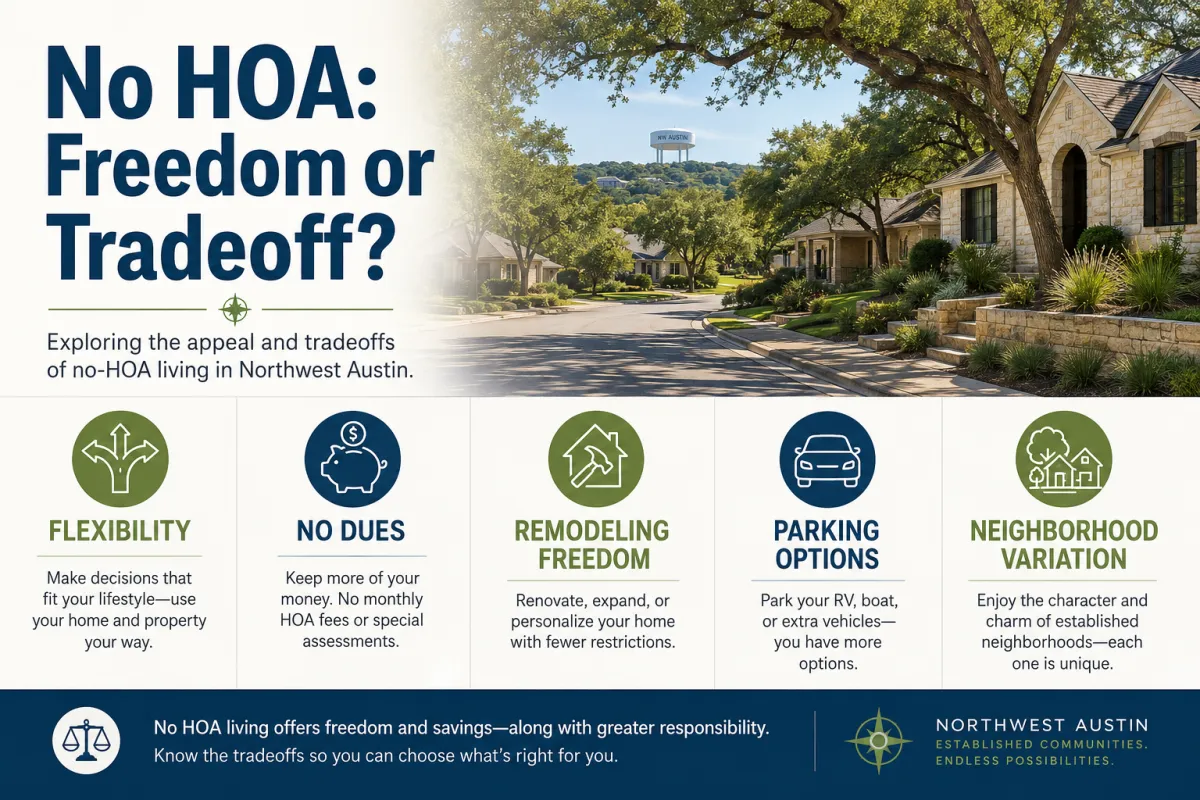
No-HOA Neighborhoods in Northwest Austin: What Buyers Should Know
For a lot of buyers, the phrase “no HOA” sounds like freedom.
No monthly HOA dues. No architectural committee. No one telling you what color your front door can be. No approval process for every fence, shed, paint color, or landscaping choice.
And in Northwest Austin, no-HOA neighborhoods can be especially appealing because many of them are older, more established, and full of the kind of character buyers do not always find in newer subdivisions.
But no HOA is not automatically better.
It is simply different.
For some buyers, it is exactly what they want. For others, the lack of an HOA can create surprises around neighborhood consistency, property upkeep, parking, short-term rentals, remodeling, additions, or how much control neighbors have over what happens next door.
The better question is not:
“Is no HOA good or bad?”
It is:
“Does a no-HOA neighborhood match the way I want to live, maintain my property, and protect my investment?”
Why buyers look for no-HOA neighborhoods
Buyers usually want no-HOA neighborhoods for one of several reasons.
They may want:
fewer rules
lower monthly costs
more flexibility
fewer restrictions on exterior changes
the ability to park a boat, trailer, or work vehicle
more freedom with landscaping
fewer architectural approvals
less neighborhood uniformity
older homes with more character
the ability to remodel or personalize the property
Those are real advantages.
For buyers who dislike cookie-cutter communities or do not want a management company involved in neighborhood rules, a no-HOA neighborhood can feel refreshing.
Northwest Austin has several established areas where this kind of flexibility is part of the appeal.
The first thing to know: no HOA does not mean no rules
This is the biggest misunderstanding.
Even without an HOA, a property may still be subject to:
city ordinances
county rules where applicable
zoning
permitting requirements
deed restrictions
easements
drainage rules
tree rules
building codes
utility easements
short-term rental rules
sign, parking, or nuisance rules
So no HOA does not mean you can do anything you want.
It means there may not be a private homeowners association enforcing neighborhood-specific rules.
That distinction matters.
Before buying, review available restrictions, title documents, survey matters, and local rules that may affect your intended use.
Why no-HOA neighborhoods can feel more authentic
Many buyers like no-HOA neighborhoods because they often feel less manufactured.
In Northwest Austin, older no-HOA or low-restriction areas may have:
mature trees
different home styles
varied lot sizes
additions and remodels over time
homes with more personality
less uniform streetscapes
long-term owners
a more organic neighborhood feel
That can be a major plus.
A street where every home looks slightly different can feel more established and real than a newer subdivision with identical rooflines and strict exterior standards.
For some buyers, that character is exactly the point.
The tradeoff: less uniformity
The same flexibility that makes no-HOA neighborhoods appealing can also create inconsistency.
You may see:
different levels of property maintenance
boats, trailers, or work vehicles parked visibly
varied exterior paint colors
home additions of mixed quality
different fencing styles
less consistent landscaping
homes in very different conditions
neighbors using properties in ways you may not love
That does not mean the neighborhood is bad.
It means you need to be comfortable with more individual expression and less centralized control.
If you want uniformity, no HOA may frustrate you.
If you want flexibility, no HOA may be a great fit.
Northwest Austin areas where no-HOA or older-neighborhood searches may come up
Exact HOA status can vary by property, section, and subdivision, so buyers should always verify details before making an offer.
That said, no-HOA or older, less-uniform neighborhood searches often come up in and around areas such as:
Mesa Park
Jollyville
Anderson Mill pockets
Barrington Oaks
Oak Forest
parts of 78759
parts of 78750
older North Austin pockets near The Domain and Burnet
certain established neighborhoods west and northwest of 183
This does not mean every home in those areas has no HOA.
It means these are the kinds of areas where buyers often start asking the question because the homes and streets may feel more established, varied, and less master-planned than newer suburban communities.
Always verify property by property.
What If Your Northwest Austin Home Needs Too Much Work to Sell?
Why no HOA can be great for remodeling
If you are buying an older Northwest Austin home, you may want to update it over time.
No-HOA neighborhoods can sometimes make that easier because you may avoid architectural review layers that exist in HOA communities.
That can help if you want to:
remodel the exterior
change paint colors
add a covered patio
install different landscaping
replace fencing
expand the home
add a detached structure
redesign the driveway
personalize the property
But again, no HOA does not mean no approval process.
You may still need permits, setbacks, code compliance, tree review, drainage considerations, or other local approvals.
The advantage is not unlimited freedom.
The advantage is fewer private association restrictions.
Why no HOA can be tricky for buyers who care about neighborhood appearance
If you are particular about surrounding property condition, no HOA deserves careful thought.
In an HOA neighborhood, there may be rules about:
lawn maintenance
exterior paint
fencing
visible storage
parking
trash cans
exterior modifications
short-term rentals
landscaping standards
In a no-HOA neighborhood, those rules may be looser or enforced only through city rules, deed restrictions, or neighbor action.
So if you are the type of buyer who gets frustrated by an unkempt yard or a neighbor’s trailer parked out front, a no-HOA neighborhood may not give you the control you want.
You need to know yourself.
What People Don’t Know About Downsizing in Northwest Austin
The cost question: no HOA may save monthly dues, but not necessarily money overall
No HOA can mean no monthly or annual HOA dues.
That can be attractive.
But do not confuse no HOA with lower total cost.
In an HOA community, dues may cover certain shared expenses, amenities, common areas, or maintenance responsibilities depending on the neighborhood.
In a no-HOA neighborhood, you may have more individual responsibility.
You may need to budget for:
private yard maintenance
tree trimming
drainage
fences
exterior repairs
private amenities if you want them
maintenance that an HOA might cover elsewhere
no shared community amenity support
For many buyers, no HOA still saves money and gives more freedom.
But the comparison should be based on total lifestyle cost, not just monthly dues.
What sellers should know if their home has no HOA
If you are selling a no-HOA home in Northwest Austin, that can be a powerful marketing point.
Some buyers actively search for it.
But it should be positioned correctly.
Strong buyer angles may include:
no HOA dues
flexibility
mature neighborhood feel
more property freedom
established Northwest Austin location
ability to personalize the home
fewer private association restrictions
room for certain uses, subject to local rules
But do not overstate it.
A listing should not imply buyers can do anything they want. A better phrase is:
“No HOA - buyer to verify restrictions, permitting, and intended use.”
That protects the tone and sets expectations.
Can You Downsize in Northwest Austin Without Giving Up the Area You Love?
No HOA can matter more for certain buyer types
Buyers with boats, trailers, or work vehicles
Some buyers want flexibility for parking.
But even in no-HOA neighborhoods, city rules, driveway space, visibility, and neighbor expectations still matter.
Buyers who want to remodel
No HOA may simplify some exterior decision-making, but code and permits still apply.
Buyers who dislike uniform communities
No-HOA neighborhoods may feel more authentic, varied, and established.
Buyers who want lower monthly obligations
Avoiding HOA dues can help monthly budget, but maintenance responsibility still remains.
Buyers who want more land-use flexibility
Some no-HOA properties may offer more flexibility, but intended uses should be verified carefully.
Buyers who want strict neighborhood standards
These buyers may be better served by an HOA community where expectations are clearer and more enforceable.
The short-term rental question
Some buyers assume no HOA means short-term rentals are automatically allowed.
Be careful.
Short-term rental rules can involve:
city regulations
zoning
licensing
deed restrictions
neighborhood restrictions
local ordinances
enforcement changes over time
If short-term rental use is part of your plan, you need to verify it before buying.
Do not rely on “no HOA” as your answer.
The ADU question
Accessory dwelling units are another area where buyers need to be careful.
A no-HOA property may be more appealing if you want an ADU, guest house, studio, or separate workspace.
But feasibility depends on:
lot size
zoning
setbacks
impervious cover
utilities
tree constraints
driveway and parking
permitting
local rules
deed restrictions
No HOA may remove one possible obstacle, but it does not guarantee the project works.
When Is the Right Time to Downsize Your Northwest Austin Home?
The parking question
Parking flexibility is one of the big reasons buyers ask about no-HOA neighborhoods.
But before assuming a property works for your needs, look at:
driveway size
street width
city parking rules
garage usability
slope
visibility
whether neighbors already park similarly
whether deed restrictions address vehicles
A no-HOA home with a short steep driveway may not solve the parking issue you care about.
The physical property still matters.
The neighborhood consistency question
This is probably the biggest lifestyle tradeoff.
In no-HOA neighborhoods, property condition can vary more widely.
That can mean opportunity.
It can also mean unpredictability.
You may see:
beautifully remodeled homes next to very dated homes
active renovation
long-term owners
investor activity
rental properties
homes with very different curb appeal
creative landscaping
visible storage
unique additions
Some buyers love that.
Some buyers do not.
The best way to know is to drive the neighborhood slowly, more than once, and at different times of day.
How to Prepare an Older Northwest Austin Home for Inspection Before Selling
How to evaluate a no-HOA neighborhood before buying
1. Drive the neighborhood at different times
Do not rely only on the showing visit.
Drive it:
weekday morning
evening
weekend
after work hours
when people are actually home
You will learn more about parking, noise, traffic, and neighborhood rhythm.
2. Look at nearby property condition
Are homes mostly maintained?
Is there a wide range?
Are there obvious issues that would bother you?
Remember, in a no-HOA setting, you may have less control over nearby appearance.
3. Review restrictions carefully
Ask for available deed restrictions, title documents, survey information, and any known limitations.
No HOA does not mean no deed restrictions.
4. Check local rules for your intended use
If you want to add an ADU, park an RV, run a home business, build a workshop, or use the home as a rental, verify before buying.
5. Understand the street
Pay attention to:
cut-through traffic
parking patterns
road noise
drainage
tree canopy
lighting
sidewalks
how close homes sit to each other
whether the street feels cared for
The street matters as much as the neighborhood name.
Should You Buy Your Next Home Before Selling Your Northwest Austin Home?
What buyers often get wrong
The biggest mistake is treating no HOA as automatically positive.
It may be positive for you.
But it depends on your personality and plans.
No HOA is great if you value flexibility and can tolerate variation.
No HOA may be frustrating if you want consistency, control, and strong appearance standards.
The second mistake is assuming no HOA means no restrictions at all.
That can be expensive if you buy based on a use that turns out not to be allowed.
What adult children and downsizers should consider
For downsizers, no-HOA neighborhoods can be appealing because they often feel established and familiar.
But downsizers should also think about:
yard maintenance
tree maintenance
exterior responsibility
lack of shared maintenance
whether the home is truly easier to manage
whether a patio home, condo, or HOA community might actually reduce more burden
No HOA gives freedom.
It does not necessarily reduce responsibility.
For some downsizers, that is fine. For others, an HOA or lower-maintenance community may better match the next chapter.
How no-HOA homes compare with HOA homes
No-HOA homes may offer:
more flexibility
no HOA dues
more neighborhood variety
fewer private association rules
more freedom to personalize
older established character
HOA homes may offer:
more consistent appearance
clearer community standards
shared amenities
possible common-area maintenance
more predictable neighborhood rules
architectural control
Neither is automatically better.
They serve different buyers.
Questions to ask before buying a no-HOA home
Before buying, ask:
Why do I want no HOA?
What do I want to do with the property?
Are there deed restrictions?
Are there city rules that limit my plans?
How does the street look and feel?
Am I comfortable with variation in nearby property upkeep?
Do I want freedom more than uniformity?
Am I willing to manage all maintenance myself?
Would an HOA community actually fit my lifestyle better?
Is no HOA a true need or just a nice-to-have?
The answers will tell you whether no HOA is a lifestyle fit or just a search filter.
The common mistake sellers make
Sellers sometimes assume no HOA is enough by itself.
It helps, but buyers still care about:
condition
street
yard
parking
roof
HVAC
drainage
trees
noise
commute
nearby properties
resale value
So if you are selling a no-HOA home, do not rely only on that feature.
Market the full lifestyle:
Northwest Austin location
mature trees
flexibility
no HOA dues
access
lot usability
remodel potential
neighborhood character
That is a stronger positioning strategy.
What to Do With a House Full of Stuff Before Downsizing in Northwest Austin
My practical take
No-HOA neighborhoods in Northwest Austin can be a great fit for the right buyer.
They often offer more character, flexibility, and individuality than newer HOA communities. They can be especially appealing if you want mature trees, established streets, and the ability to personalize your property.
But no HOA is not a free pass.
You still need to verify restrictions, understand local rules, evaluate street conditions, and be honest about whether you prefer flexibility or consistency.
For some buyers, no HOA is freedom.
For others, it is unpredictability.
Know which one it is for you before you buy.
Final thought
No-HOA neighborhoods in Northwest Austin can offer something many buyers love: more freedom, more character, and less of the uniform feel that comes with some newer communities.
But they also require buyers to do more homework.
The lack of an HOA can mean fewer dues and more flexibility, but it can also mean more variation in property condition, fewer appearance controls, and a greater need to verify what you can actually do with the property.
The smart move is not simply choosing no HOA.
The smart move is choosing the right no-HOA home, on the right street, with the right expectations.
FAQ
Are there no-HOA neighborhoods in Northwest Austin?
Yes, there are established areas and individual properties in Northwest Austin where no HOA may be part of the appeal. However, HOA status can vary by property and subdivision, so buyers should always verify before making an offer.
Does no HOA mean I can do whatever I want with my property?
No. You may still be subject to city rules, zoning, permitting, deed restrictions, easements, building codes, tree rules, and other limitations.
Why do buyers want no-HOA homes?
Buyers often want no-HOA homes for flexibility, fewer dues, fewer private association rules, more ability to personalize, and a more established neighborhood feel.
What are the downsides of no-HOA neighborhoods?
Possible downsides include less consistent property maintenance, fewer neighborhood appearance controls, more variation in parking or exterior use, and less predictability in how nearby homes are maintained.
Are no-HOA homes better for remodeling?
They can be easier in some ways because there may be no architectural review committee, but buyers still need to follow local permitting, code, zoning, deed restrictions, and other rules.
Should downsizers buy in a no-HOA neighborhood?
Maybe. No HOA can offer freedom and familiar neighborhood character, but downsizers should consider whether they actually want the maintenance responsibility that often comes with full property control.
