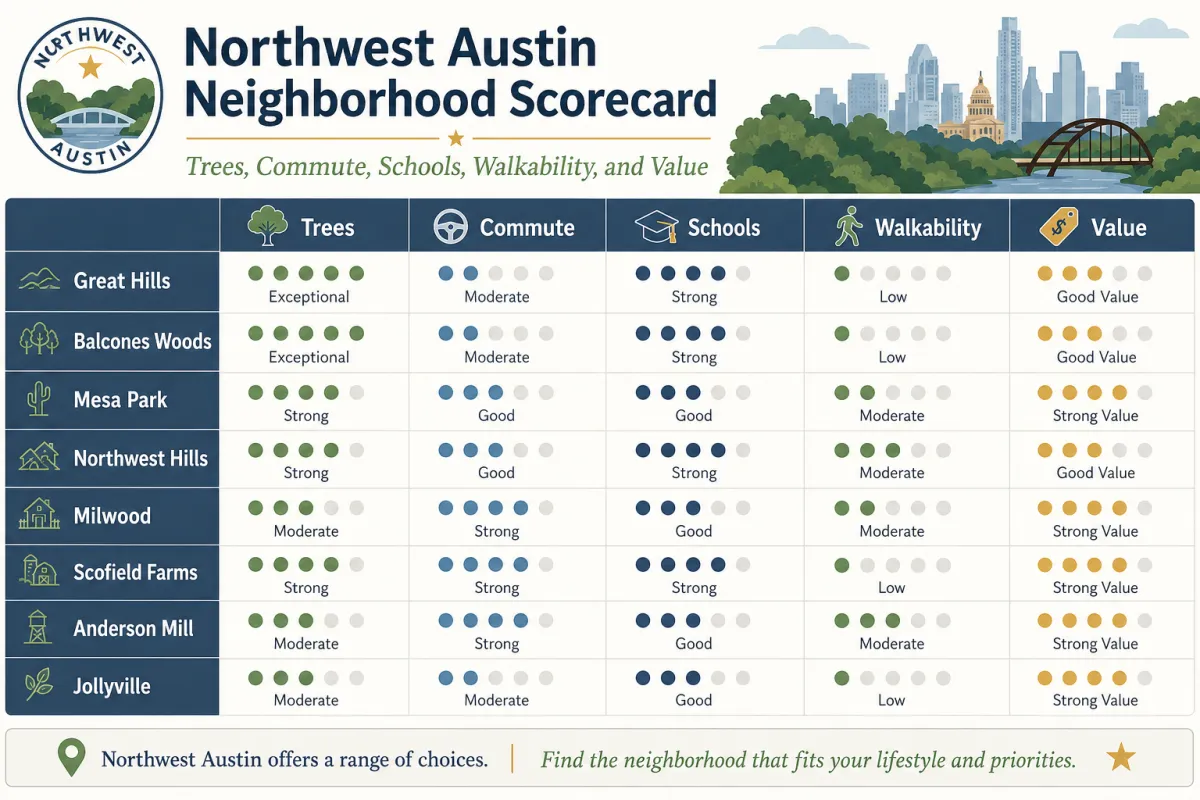
Northwest Austin Neighborhood Scorecard: Trees, Commute, Schools, Walkability, and Value
Northwest Austin is not one single type of place.
That is one of the biggest things buyers miss.
Two neighborhoods can both be “Northwest Austin” and feel completely different day to day. One may have mature trees and quiet streets but a tougher commute. Another may have better access to The Domain, Apple, or MoPac, but less charm. Another may offer school reputation, but homes may be older, more expensive, or more competitive. Another may be a strong value play, but not as polished online.
That is why ranking Northwest Austin neighborhoods is tricky.
The better approach is not to ask:
“What is the best neighborhood in Northwest Austin?”
The better question is:
“Which Northwest Austin neighborhood fits the way I actually live?”
This scorecard breaks down several Northwest Austin neighborhoods across five practical categories:
trees and neighborhood character
commute convenience
schools and family appeal
walkability and daily convenience
value relative to location
This is not about declaring one winner. It is about helping buyers understand the tradeoffs.
What’s Changing Around Gateway and the Arboretum in Northwest Austin?
Why a Northwest Austin scorecard matters
Northwest Austin has a mix of neighborhoods that appeal to different people for different reasons.
Some buyers want:
mature trees
one-story homes
strong school reputation
quick access to The Domain or Apple
larger lots
a quiet residential feel
better value than closer-in Austin
low-maintenance living
proximity to Cedar Park or Round Rock
access to 183, MoPac, 620, Parmer, or 45
The challenge is that no neighborhood wins every category.
A neighborhood with the best trees may not have the easiest commute.
A neighborhood with the strongest school reputation may not be the best value.
A neighborhood near The Domain may not be the quietest.
A neighborhood with a bigger yard may come with more maintenance.
That is why buyers need to compare neighborhoods based on priorities, not just vibes.
How to use this scorecard
This is a practical buyer guide, not a mathematical ranking.
For each neighborhood, I am looking at five categories:
Trees and neighborhood character
Does the neighborhood feel established, shaded, and rooted?
Commute convenience
How practical is access to major employment corridors and roads like 183, MoPac, Parmer, Burnet, 620, and 45?
Schools and family appeal
Does the area tend to attract buyers thinking about school reputation, family lifestyle, parks, and neighborhood stability?
Walkability and daily convenience
Can you easily access groceries, restaurants, coffee, parks, services, or The Domain/Gateway/Arboretum area?
Value relative to location
Does the neighborhood offer strong practical value compared with its access, amenities, and buyer demand?
No neighborhood is perfect. The point is to understand where each one tends to shine.
Great Hills
Great Hills is one of the stronger all-around Northwest Austin options for buyers who want mature character, convenience, and access.
It tends to appeal to people who want to be near Arboretum, Gateway, The Domain, 183, MoPac, and major North Austin employers, but still want a residential neighborhood feel.
Trees and neighborhood character
Strong
Great Hills has a mature, established feel in many sections. Some streets have great tree cover, interesting lots, and a more classic Northwest Austin personality than newer suburban neighborhoods.
Commute convenience
Strong
This is one of the big reasons buyers like Great Hills. Access to 183, MoPac, Arboretum, Gateway, and The Domain can be very practical depending on the specific street.
Schools and family appeal
Strong in many pockets
Great Hills often attracts family-oriented buyers, but school assignments can vary by exact address. Buyers need to verify schools for any specific property.
Walkability and daily convenience
Moderate to strong
You may be close to restaurants, shops, and services, but much of the neighborhood is still car-oriented. Convenience is strong. True walkability depends heavily on the specific location.
Value relative to location
Strong, but competitive
Great Hills is not usually a secret. Buyers understand the location, so good homes can be competitive.
Best fit
Great Hills is a good fit for buyers who want Northwest Austin character with strong access to major roads, employers, shopping, and restaurants.
Living in Great Hills Austin - What to Expect
Balcones Woods
Balcones Woods is one of the neighborhoods I would often put on the list for buyers who want access to The Domain and North Austin, but still want a real neighborhood.
Trees and neighborhood character
Strong
Balcones Woods has an established residential feel with mature trees and a neighborhood identity that feels very different from the high-density areas nearby.
Commute convenience
Strong
The location is a major strength. Access to The Domain, MoPac, 183, Braker, and North Austin employers can be very practical.
Schools and family appeal
Moderate to strong
The neighborhood can appeal to families because of its residential feel and access, though buyers should always verify school assignments and priorities by address.
Walkability and daily convenience
Moderate
You are close to a lot, but that does not mean every home is walkable to it. Like much of North Austin, daily life is often still car-based.
Value relative to location
Strong
Balcones Woods can offer a compelling balance: established single-family living near one of Austin’s most important lifestyle and employment hubs.
Best fit
Balcones Woods is a good fit for buyers who want proximity to The Domain and major employers, but still want a yard, trees, and a neighborhood feel.
Living in Balcones Woods, Austin
Mesa Park
Mesa Park is one of the more practical neighborhoods in this broader search.
It may not always get the same attention as Great Hills or Northwest Hills, but that can be part of the opportunity.
Trees and neighborhood character
Moderate to strong
Mesa Park has an established feel, though it may not have the same level of polish or prestige as some other Northwest Austin neighborhoods.
Commute convenience
Strong
This is one of Mesa Park’s biggest strengths. It can offer practical access to The Domain, North Austin employers, MoPac, 183, Burnet, and nearby commercial areas.
Schools and family appeal
Moderate
Family appeal can depend on the buyer’s school preferences and exact address. Some buyers are drawn more by location and value than school reputation alone.
Walkability and daily convenience
Moderate
Convenience is good by car. Walkability varies by street and destination.
Value relative to location
Strong
Mesa Park can be a smart area to watch for buyers who care about access and practicality more than neighborhood name recognition.
Best fit
Mesa Park is a good fit for practical buyers who want North/Northwest Austin access, single-family homes, and potentially better value than some better-known nearby areas.
Barrington Oaks
Barrington Oaks offers a more classic established Northwest Austin feel.
For buyers who want mature trees, a quieter residential setting, and a neighborhood that feels rooted, this area deserves attention.
Trees and neighborhood character
Strong
This is one of the main appeals. Mature trees, established streets, and traditional neighborhood character are part of the draw.
Commute convenience
Moderate to strong
Access depends heavily on where you are within the neighborhood and where you are commuting. It can be practical for 183, 620, and Northwest Austin routes, but it may not be as central to The Domain as Balcones Woods or Mesa Park.
Schools and family appeal
Strong in many buyer conversations
Barrington Oaks often appeals to buyers looking for a stable residential setting and family-friendly environment. As always, school assignments should be verified by address.
Walkability and daily convenience
Moderate
This is more of a residential neighborhood feel than a walkable urban setup. Daily errands are generally car-based.
Value relative to location
Moderate to strong
The value depends on condition, updates, lot, and exact location. Homes with mature trees and strong character can attract buyers who specifically want that established feel.
Best fit
Barrington Oaks is a good fit for buyers who want trees, quiet, neighborhood character, and a more traditional Northwest Austin residential environment.
Living in Barrington Oaks, Austin
Oak Forest
Oak Forest shares some similarities with Barrington Oaks and can appeal to buyers who want established Northwest Austin character.
Trees and neighborhood character
Strong
Mature trees and established streets are a major part of the appeal.
Commute convenience
Moderate to strong
Access can be useful for 183, 620, Parmer, and other Northwest Austin routes, depending on exact location.
Schools and family appeal
Strong in many pockets
Like nearby neighborhoods, Oak Forest can attract buyers who want a stable, residential feel and established surroundings.
Walkability and daily convenience
Moderate
This is generally not a high-walkability neighborhood. The appeal is more about home, lot, trees, and residential feel.
Value relative to location
Moderate to strong
Good homes can be attractive because buyers like the combination of established neighborhood feel and Northwest Austin access.
Best fit
Oak Forest is a good fit for buyers who want mature trees, a calmer residential setting, and access to Northwest Austin without living in a denser urban environment.
Northwest Hills
Northwest Hills is one of the classic Austin neighborhoods that still carries strong emotional appeal.
It is not the cheapest or easiest search, but for buyers who want mature trees, established character, and a more central Northwest Austin feel, it remains a major part of the conversation.
Trees and neighborhood character
Very strong
This is one of Northwest Hills’ biggest strengths. Mature trees, hills, older homes, and classic Austin character are part of the identity.
Commute convenience
Strong, depending on destination
Northwest Hills can be convenient to central Austin, MoPac, Far West, Burnet, and other key corridors. For some North Austin destinations, it works well. For others, exact commute routes matter.
Schools and family appeal
Strong
This area often comes up for buyers who care about established neighborhoods and school reputation. Buyers should verify exact school assignments.
Walkability and daily convenience
Moderate
There are conveniences nearby, but many homes are still car-oriented. Some pockets are more convenient than others.
Value relative to location
Moderate
Northwest Hills is desirable, and that is reflected in pricing. The value is often in character, location, and long-term appeal rather than bargain pricing.
Best fit
Northwest Hills is a good fit for buyers who want classic Austin character, mature trees, strong neighborhood identity, and are willing to pay for location.
Living in Northwest Hills Austin
Milwood
Milwood is a major North Austin neighborhood for buyers who want access to the tech corridor, Apple, Parmer, MoPac, 183, and The Domain.
It has a more practical suburban feel than some older Northwest Austin pockets, but that practicality is exactly why many buyers like it.
Trees and neighborhood character
Moderate
Milwood has established areas and neighborhood character, though the tree canopy can vary by section.
Commute convenience
Strong
This is one of Milwood’s biggest strengths. It is well-positioned for Apple, Parmer corridor employers, The Domain, MoPac, 183, and North Austin job centers.
Schools and family appeal
Strong for many buyers
Milwood often attracts buyers who are thinking about schools, family lifestyle, and suburban functionality. Exact school assignments should always be confirmed.
Walkability and daily convenience
Moderate
There is good access to shopping, employers, and services, but most day-to-day life is car-based.
Value relative to location
Strong
Milwood can offer a compelling mix of location, home size, and access relative to some closer-in or more heavily branded areas.
Best fit
Milwood is a good fit for buyers who want practical North Austin living, access to major employers, and more house than they may find closer to The Domain.
Living in Milwood (Amherst), Austin
Scofield Farms
Scofield Farms is another practical North Austin option, especially for buyers who want access to The Domain, Apple, Parmer, and major employment corridors.
Trees and neighborhood character
Moderate
The character can vary by section. It may feel more suburban and practical than classic older Austin neighborhoods.
Commute convenience
Strong
Scofield Farms can work very well for buyers whose daily life is tied to North Austin employers, Parmer, MoPac, 183, or The Domain.
Schools and family appeal
Moderate to strong
It can appeal to buyers who want suburban convenience and access. School assignments should be verified property by property.
Walkability and daily convenience
Moderate
Convenience is generally good by car, but walkability depends heavily on the specific location.
Value relative to location
Strong
Scofield Farms can be a strong value candidate for buyers prioritizing access and practical living.
Best fit
Scofield Farms is a good fit for buyers who want North Austin convenience, employer access, and a suburban neighborhood feel without needing the classic tree-heavy Northwest Austin aesthetic.
Anderson Mill
Anderson Mill and nearby 78750 pockets can be a strong consideration for buyers who want Northwest Austin access, more suburban practicality, and potentially more approachable options depending on budget and inventory.
Trees and neighborhood character
Moderate to strong
Many pockets have an established feel and mature trees, though it varies by street and section.
Commute convenience
Moderate to strong
Anderson Mill can offer practical access to 183, 620, Cedar Park, Northwest Austin, and parts of the tech corridor. Commute quality depends heavily on exact destination and timing.
Schools and family appeal
Strong in many buyer conversations
This area often comes up for buyers considering school districts, family lifestyle, and suburban access. Exact schools need to be verified.
Walkability and daily convenience
Moderate
There are conveniences nearby, but most buyers should expect a car-based lifestyle.
Value relative to location
Strong
For buyers who want Northwest Austin access without paying for the most expensive pockets, Anderson Mill can be worth watching.
Best fit
Anderson Mill is a good fit for buyers who want suburban function, established neighborhoods, and access to Northwest Austin, Cedar Park, 183, and 620.
Living in Anderson Mill, Austin
Canyon Creek
Canyon Creek can appeal to buyers who want a more distinct, quieter, and scenic Northwest Austin setting.
It is not the same type of search as Balcones Woods or Mesa Park. It has a different feel.
Trees and neighborhood character
Strong
Canyon Creek offers mature surroundings and a more scenic residential feel in many areas.
Commute convenience
Moderate
It can work well for some Northwest Austin and west-side routes, but buyers should test real drive times carefully.
Schools and family appeal
Strong in many buyer conversations
The area often appeals to families looking for a neighborhood setting and school reputation. Verify school assignments by address.
Walkability and daily convenience
Lower to moderate
This is more of a neighborhood and home-focused area than a walkable convenience area.
Value relative to location
Moderate
The value depends on the buyer’s priorities. If you want a scenic, established environment, it can make sense. If you want quick access to The Domain or central North Austin, it may feel less convenient.
Best fit
Canyon Creek is a good fit for buyers who want a quieter, more scenic Northwest Austin environment and are willing to trade some convenience for setting.
What’s It Like to Live in Canyon Creek?
River Place
River Place has a distinct lifestyle feel that can be very appealing to buyers who want scenery, hills, and a more dramatic residential setting.
Trees and neighborhood character
Strong
River Place has strong character, scenic surroundings, and a neighborhood feel that stands apart from flatter North Austin neighborhoods.
Commute convenience
Moderate
This depends heavily on destination. It may be great for some west and northwest routes, but less ideal for buyers who need frequent access to The Domain, Apple, or central North Austin.
Schools and family appeal
Strong in many buyer conversations
River Place often appeals to families who want a more scenic and established residential environment. Confirm school assignments by property.
Walkability and daily convenience
Lower to moderate
The area is not usually chosen for walkability. It is more about neighborhood feel, scenery, and lifestyle.
Value relative to location
Moderate
The value depends on whether the buyer values the setting enough to accept the drive patterns and maintenance considerations that can come with hills, trees, and larger homes.
Best fit
River Place is a good fit for buyers who want a scenic, quieter, more distinctive Northwest Austin lifestyle and are less concerned about being right next to The Domain or core North Austin employers.
What’s It Like to Live in River Place?
Jollyville
Jollyville can be an interesting option for buyers who want Northwest Austin access without necessarily chasing the most expensive or best-known neighborhood names.
Trees and neighborhood character
Moderate to strong
Some areas have established character and mature trees. The feel can vary significantly by street.
Commute convenience
Strong
Jollyville can offer practical access to 183, Oak Knoll, Research, Arboretum, Gateway, Great Hills, and broader Northwest Austin routes.
Schools and family appeal
Moderate
Family appeal depends on exact location, school assignments, and buyer priorities.
Walkability and daily convenience
Moderate
Some conveniences are close by, but most buyers should evaluate actual daily routes.
Value relative to location
Strong
Jollyville can be a useful option for buyers who want access, trees, and a more established feel without limiting themselves to better-known neighborhoods.
Best fit
Jollyville is a good fit for buyers who want practical Northwest Austin access and are willing to evaluate the street-by-street differences carefully.
Quick Northwest Austin Neighborhood Scorecard Summary
Best for mature trees and established character
Northwest Hills
Great Hills
Balcones Woods
Barrington Oaks
Oak Forest
Balcones Village and Spicewood-area pockets
Canyon Creek
River Place
Best for access to The Domain and North Austin employers
Balcones Woods
Mesa Park
Milwood
Scofield Farms
Great Hills
Jollyville
Best for practical value relative to location
Mesa Park
Jollyville
Anderson Mill
Scofield Farms
Milwood
Best for buyers wanting a quieter residential feel
Barrington Oaks
Oak Forest
Canyon Creek
River Place
parts of Northwest Hills
parts of Great Hills
Best for buyers who want Northwest Austin character and convenience
Great Hills
Balcones Woods
Northwest Hills
Jollyville
Barrington Oaks/Oak Forest
Best for tech-corridor access
Milwood
Scofield Farms
Mesa Park
Balcones Woods
Great Hills
What buyers should watch out for
1. Neighborhood names can be misleading
A neighborhood name gives you a general idea, but it does not tell you the whole story.
Within the same neighborhood, one street may be quiet and shaded while another gets more traffic, noise, or cut-through activity.
Always evaluate the specific street and lot.
2. Mature trees can mean maintenance
Tree canopy is beautiful, but buyers should also think about:
trimming
roof debris
gutter maintenance
roots
shade affecting grass
storm cleanup
tree health
Trees are a benefit, but they are not maintenance-free.
3. Older homes need careful evaluation
Many Northwest Austin homes are older, and that can mean:
dated finishes
roof age
HVAC age
older windows
drainage issues
foundation questions
older plumbing or electrical
remodeling quality differences
Do not confuse character with condition. Both matter.
4. Walkability is not the same as proximity
You may be close to restaurants or shops by car, but that does not mean you will walk there comfortably.
Check sidewalks, crossings, road speeds, distance, shade, and how the route feels at night or in summer heat.
5. Commute depends on exact destination
A neighborhood may be great for Apple but less ideal for downtown. Great for The Domain but less convenient for Southwest Austin. Good for 183 but frustrating for MoPac.
Test the drive at the times that matter to you.
How sellers can use this scorecard
If you are selling a home in Northwest Austin, this is how buyers are thinking.
They are not just looking at beds, baths, and square footage.
They are comparing:
trees
commute
schools
convenience
value
condition
lifestyle fit
street feel
future resale
That means the marketing should tell the right story.
For example:
A Balcones Woods home may be marketed around single-family living near The Domain.
A Great Hills home may be marketed around character, convenience, and Northwest Austin access.
A Mesa Park home may be marketed around practical North Austin location and value.
A River Place home may be marketed around scenery, quiet, and lifestyle.
The strongest listing strategy is not generic. It matches what buyers actually value in that neighborhood.
The common mistake buyers make
The biggest mistake is asking other people:
“What is the best neighborhood in Northwest Austin?”
That question creates bad answers.
The best neighborhood for a tech worker who wants Domain access may not be the best neighborhood for a family prioritizing schools.
The best neighborhood for a downsizer wanting one-story living may not be the best neighborhood for someone wanting nightlife nearby.
The best neighborhood for mature trees may not be the best neighborhood for someone who hates yard maintenance.
The better question is:
“Which neighborhood fits my priorities best?”
That is how you make a smarter decision.
My practical take
If I were comparing Northwest Austin neighborhoods, I would not start with the neighborhood name.
I would start with the lifestyle.
Ask:
Do I care most about trees?
Do I care most about commute?
Do I care most about school reputation?
Do I care most about value?
Do I care most about walkability?
Do I want quiet or convenience?
Do I want updated or am I open to projects?
Do I want a one-story home?
Do I want a yard, or do I want low maintenance?
Once those answers are clear, the right neighborhoods become much easier to compare.
Final thought
Northwest Austin has no single “best” neighborhood.
It has different neighborhoods that win for different reasons.
Great Hills, Balcones Woods, Mesa Park, Milwood, Scofield Farms, Barrington Oaks, Oak Forest, Northwest Hills, Anderson Mill, Canyon Creek, River Place, and Jollyville can all make sense depending on what you value.
The real win is not finding the neighborhood everyone else says is best.
It is finding the one that fits your daily life, budget, commute, and long-term plans.
That is where a scorecard becomes useful.
Not because it gives one perfect answer, but because it helps you ask the right questions.
FAQ
What is the best neighborhood in Northwest Austin?
There is no single best neighborhood for everyone. Great Hills, Balcones Woods, Northwest Hills, Mesa Park, Milwood, Scofield Farms, Barrington Oaks, Oak Forest, Anderson Mill, Canyon Creek, River Place, and Jollyville all fit different buyer priorities.
Which Northwest Austin neighborhoods are best for mature trees?
Neighborhoods often known for mature trees and established character include Northwest Hills, Great Hills, Balcones Woods, Barrington Oaks, Oak Forest, Balcones Village, Spicewood-area pockets, Canyon Creek, and River Place.
Which Northwest Austin neighborhoods are best for commuting to The Domain?
Balcones Woods, Mesa Park, Great Hills, Milwood, Scofield Farms, and Jollyville are often worth considering for buyers who want access to The Domain and North Austin employers.
Which Northwest Austin neighborhoods may offer better value?
Mesa Park, Jollyville, Anderson Mill, Scofield Farms, and Milwood may be worth watching for buyers focused on practical value relative to location, depending on market conditions and specific homes.
Is Northwest Austin walkable?
Some pockets are more convenient than others, but much of Northwest Austin is still car-oriented. Buyers should test actual walking routes instead of assuming that proximity equals walkability.
What should buyers watch out for in Northwest Austin?
Buyers should watch for older-home maintenance, traffic patterns, road noise, lot slope, drainage, tree maintenance, school assignment boundaries, and street-by-street differences.
