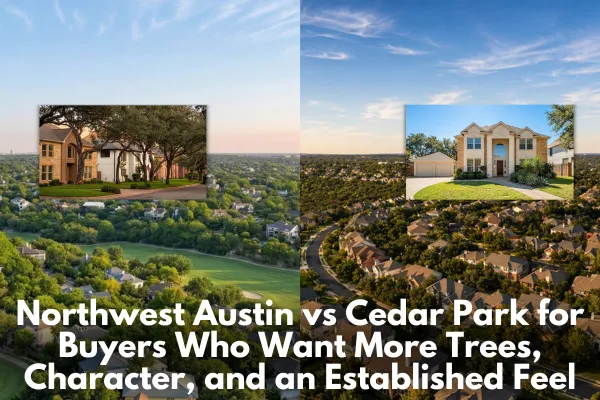
comparing Northwest Austin and Cedar Park neighborhoods buyers often consider when looking for more trees, character, and an established feel, including Northwest Hills, Great Hills, Spicewood/Balcones, Buttercup Creek, Forest Oaks, Twin Creeks, and Ranch at Cypress Creek.

Northwest Austin vs Cedar Park for Buyers Who Want More Trees, Character, and an Established Feel

May 05, 202611 min read

If you are deciding between Northwest Austin and Cedar Park, but already know you want more trees, more neighborhood character, and a more established feel, your search usually gets better fast.

Because at that point, you are no longer just comparing Austin versus suburb.

You are comparing two different versions of what “home” can feel like.

That is what makes this such a real buyer decision. A lot of people like Cedar Park for the convenience, schools, and suburban functionality. A lot of people like Northwest Austin for the mature trees, established neighborhoods, and stronger Austin feel. But once buyers get more specific about what they want day to day, the choice usually becomes less about city lines and more about neighborhood environment.

That is what this search is really about.

If you want more trees, character, and an established feel, here is how buyers usually think through Northwest Austin versus Cedar Park.

Is Northwest Austin a Good Place to Live?

Best Neighborhoods in Northwest Austin

Best Neighborhoods in Cedar Park TX

Why buyers compare Northwest Austin and Cedar Park this way

This comparison comes up a lot because both areas can work well, but they usually appeal for different reasons.

Buyers making this choice are often balancing:

  • mature trees versus newer polish

  • established neighborhood feel versus suburban predictability

  • a more classic Austin setting versus a more structured suburban environment

  • emotional pull versus pure practicality

  • long-term neighborhood character versus newer-feeling housing stock

That matters.

A lot of buyers assume this is just a price or commute comparison. It is not. For buyers who care about trees and character, this is often a “what kind of environment do I want to live in every day?” decision.

The first thing to understand: Northwest Austin and Cedar Park usually deliver “established feel” in different ways

That is the cleanest way to frame it.

Northwest Austin often appeals to buyers who want:

  • mature trees

  • stronger topography

  • more variation from street to street

  • neighborhoods that feel more rooted in Austin

  • a more classic, long-established residential feel

Cedar Park often appeals to buyers who want:

  • more suburban functionality

  • neighborhoods that may still feel established, but usually in a more organized way

  • easier daily patterns for some households

  • a more predictable suburban environment

  • a choice between older-established pockets and newer-feeling planned neighborhoods

That does not make one better.

It means the kind of “character” buyers feel in each area is often different.

What Northwest Austin usually appeals to

Northwest Austin tends to attract buyers who care a lot about neighborhood feel.

It often appeals to people who want:

  • mature trees and landscaping

  • more established streetscapes

  • stronger neighborhood identity

  • more topography and natural variation

  • a more classic Austin residential environment

  • detached-home neighborhoods that feel less uniform

For many buyers, Northwest Austin wins because it feels like the neighborhood itself is a major part of the value.

This is often where buyers focus when they want:

These are not all the same, but they often share a more rooted and more distinct neighborhood feel than many buyers expect elsewhere.

What Cedar Park usually appeals to

Cedar Park tends to attract buyers who want suburban convenience, but still want neighborhoods that do not feel too generic.

It often appeals to people who want:

  • practical daily livability

  • neighborhoods with more shade and more settled feel than brand-new areas

  • a more predictable suburban structure

  • detached-home living with strong everyday functionality

  • a location that can still feel established without needing to feel especially “Austin”

For many buyers, Cedar Park works when they want a neighborhood that feels comfortable and livable, but with a little more suburban order and less of the organic variation that defines classic Northwest Austin.

This is often where buyers focus when they want:

  • Buttercup Creek

  • Forest Oaks

  • Twin Creeks

  • Ranch at Cypress Creek Living in Ranch at Brushy Creek, Cedar Park

  • Cypress Canyon

  • Hunters Glen

  • other older Cedar Park pockets with stronger tree cover and neighborhood feel

For the right buyer, that balance works very well.

The biggest difference: Northwest Austin usually wins on character and natural feel, while Cedar Park often wins on suburban ease

That is usually the real split.

Northwest Austin often feels:

  • more mature

  • more varied

  • more topographic

  • more rooted in place

  • more distinctly “Austin”

Cedar Park often feels:

  • more orderly

  • more suburban

  • more straightforward to navigate

  • more predictable in layout

  • more practical for buyers who want function with some established feel

That difference matters more than people expect.

A buyer who says they want “trees and character” may still choose Cedar Park if what they really want is a quieter suburban life with some maturity to it.

A buyer who says they want “established feel” may still choose Northwest Austin if what they really mean is classic Austin neighborhood identity.

Best-fit Northwest Austin neighborhoods for buyers who want trees and character

If the buyer is leaning Northwest Austin, the strongest fit often comes from neighborhoods like:

Northwest Hills

For buyers who want mature canopy, stronger topography, and classic Austin residential character.

Great Hills

For buyers who want established Northwest Austin feel plus practical access.

Spicewood and Balcones-area neighborhoods

For buyers who want mature surroundings, strong identity, and a more rooted long-term feel.

Jester Estates

For buyers who want a more distinct and memorable neighborhood setting.

Barrington Oaks / Oak Forest

For buyers who want established neighborhood feel in a more understated and livable way.

Balcones Village

For buyers who want mature landscaping and a quieter established setting.

These neighborhoods often work best for buyers who want the environment itself to feel like part of the reward.

Best-fit Cedar Park neighborhoods for buyers who want more established feel

If the buyer is leaning Cedar Park, the strongest fit often comes from neighborhoods like:

Buttercup Creek

For buyers who want one of the clearest examples of older, more established Cedar Park feel.

Forest Oaks

For buyers who want mature surroundings and a more settled neighborhood environment.

Twin Creeks

For buyers who want stronger neighborhood identity with suburban livability.

Ranch at Cypress Creek

For buyers who want more shade and a rooted feel without giving up Cedar Park practicality.

Cypress Canyon and Hunters Glen

For buyers who want practical everyday livability with less sameness and more mature neighborhood feel.

These neighborhoods often work best for buyers who want suburban convenience, but not the most generic suburban version of it.

How buyers usually narrow the choice

If the priority is strongest neighborhood character

Buyers usually lean Northwest Austin.

That often means:

  • Northwest Hills

  • Great Hills

  • Spicewood / Balcones

  • Jester Estates

These tend to make the most sense when the neighborhood itself needs to feel distinctive and emotionally compelling.

If the priority is trees and shade, but with suburban practicality

Buyers often lean Cedar Park.

That often means:

  • Buttercup Creek

  • Forest Oaks

  • Ranch at Cypress Creek

  • Twin Creeks

These usually make sense when the buyer wants some maturity and more neighborhood feel, but still prefers a suburban format.

If the priority is a classic Austin feel

Buyers almost always lean Northwest Austin.

That is usually where mature trees, topography, and neighborhood identity come together most clearly.

If the priority is easier suburban daily living

Buyers often lean Cedar Park.

That is usually where the structure and predictability of the area become part of the value.

What usually matters most in this decision

Tree canopy

Some buyers care deeply about this. If mature shade and more established landscaping matter a lot, that usually narrows the field quickly.

Streetscape variation

Northwest Austin often wins here. Cedar Park can still offer strong options, but usually in a more orderly suburban way.

Neighborhood identity

Some buyers want a neighborhood that feels unmistakable. Others just want something pleasant, mature, and livable. That difference matters.

Daily life

A neighborhood can have great character, but if the day-to-day pattern does not fit your life, it may not be the right move.

Long-term fit

A lot of buyers searching this way are not making a short-term move. They want a place that still feels good years from now.

What sellers should understand about this comparison

If you are selling in either Northwest Austin or Cedar Park, buyers are often not just comparing homes.

They are comparing:

  • mature Austin character versus suburban practicality

  • neighborhood identity versus everyday predictability

  • tree cover versus newer finishes

  • established feel versus cleaner suburban layout

  • emotional pull versus practical ease

That means the marketing should do more than say the home is in a desirable area.

The better strategy is to explain what kind of experience the neighborhood offers.

If the home is in Northwest Austin, lean into:

  • mature trees

  • established surroundings

  • neighborhood character

  • classic Austin feel

If the home is in Cedar Park, lean into:

  • comfortable suburban livability

  • shade and established feel

  • stronger-than-average neighborhood character for the suburb setting

  • practical day-to-day ease

That difference matters because buyers in this lane are often making an emotional choice wrapped inside a practical one.

The common mistake buyers make

The biggest mistake is assuming Northwest Austin automatically wins on character, or Cedar Park automatically loses on it.

That is too simplistic.

Northwest Austin often has stronger overall neighborhood character, yes.

But Cedar Park has neighborhoods that feel much more established and much less generic than buyers expect.

The better move is to ask:

  • Do I want classic Austin feel or strong suburban livability?

  • Do I want the neighborhood to feel emotionally distinctive, or just pleasantly established?

  • How much do I care about topography, tree canopy, and variation?

  • Which side fits the life I actually want, not just the image I like online?

That usually makes the right answer clearer.

My practical take

If you want the strongest trees, character, and classic established feel, I would usually keep Northwest Austin high on the list.

If you want a more practical suburban environment but still want neighborhoods with more shade and more established feel than the generic suburban default, Cedar Park deserves serious attention.

And for many buyers, the answer becomes obvious once they drive both and compare not just homes, but the way each area actually feels.

Final thought

Northwest Austin and Cedar Park can both work for buyers who want more trees, character, and an established feel, but they usually win for different reasons.

Northwest Austin often wins when buyers want classic Austin neighborhood identity, mature trees, stronger setting, and more emotional pull.

Cedar Park often wins when buyers want suburban ease, practical daily living, and a neighborhood that still feels more rooted than the newer, more uniform alternatives.

The better fit usually is not the one that sounds best in theory.

It is the one that matches the kind of place you actually want to come home to.

FAQ

Is Northwest Austin or Cedar Park better for buyers who want more trees and character?

That depends on what kind of character you want. Northwest Austin often appeals to buyers who want classic Austin neighborhood identity, mature trees, and stronger setting. Cedar Park often appeals to buyers who want suburban practicality with some established feel and more shade than newer areas.

Does Cedar Park have neighborhoods with an established feel?

Yes. Neighborhoods like Buttercup Creek, Forest Oaks, Twin Creeks, Ranch at Cypress Creek, and other older Cedar Park pockets often appeal to buyers who want a more established suburban environment.

Is Northwest Austin more “character-driven” than Cedar Park?

In many buyer conversations, yes. Northwest Austin often has stronger neighborhood identity, more topography, and a more classic Austin feel. But that does not mean Cedar Park lacks good established neighborhoods.

Which area has more mature trees, Northwest Austin or Cedar Park?

Northwest Austin often has the edge overall, especially in neighborhoods like Northwest Hills, Great Hills, and Spicewood/Balcones-area neighborhoods. Cedar Park still has good options for buyers who prioritize shade and more mature landscaping.

Should buyers choose Northwest Austin for feel and Cedar Park for practicality?

That is often the tradeoff, though not always. Northwest Austin usually wins on neighborhood character and classic Austin feel, while Cedar Park often wins on suburban structure and day-to-day ease.

Should buyers compare neighborhoods directly instead of just comparing cities?

Usually yes. This is one of those searches where neighborhood feel matters much more than the city label alone. Driving both sides usually makes the right answer much clearer.

Back to Blog