Northwest Austin vs Cedar Park: Which One Actually Fits Your Situation?
This is one of the most common buyer decisions in the Austin metro, and it deserves a straight answer rather than a post that talks around the tradeoffs to avoid offending either side.
Buyers who end up researching both Northwest Austin and Cedar Park are usually in a specific situation: they're targeting Apple, the Domain, or the 183 corridor, they have families or are planning for them, they've identified that both areas have strong schools, and they're trying to figure out whether the price premium that Northwest Austin commands is actually justified for their specific life and priorities.
Sometimes it is. Sometimes it isn't. This post gives you the framework to figure out which answer is yours.
Is Northwest Austin a Good Place to Live? What Buyers Should Actually Know
The Geographic Reality: How Close Are They Actually?
Before you can compare them, you need to understand where each one is relative to the employers and amenities you'll actually be using.
Northwest Austin for the purposes of this comparison means the established neighborhoods in 78750, 78759, and 78726 - Spicewood Estates, Balcones Woods, Canyon Creek, Great Hills, and the other neighborhoods covered in this content library. These neighborhoods sit west of MoPac, south of 183, and in some cases adjacent to the Balcones Canyonlands Preserve. They are inside or at the edge of Austin proper.
Cedar Park is a separate city in Williamson County, north of Austin along the 183 and 183A corridors. The main Cedar Park residential areas sit roughly 5 to 10 miles north of the established Northwest Austin neighborhoods, accessible via 183 or the 183A toll road.
That distance sounds modest and in some directions it is. In other directions it matters more than buyers expect. Cedar Park's positioning further north and slightly east means it sits closer to some destinations and meaningfully further from others.
Price: The Most Obvious Difference
Let's start with the number that drives most buyers to evaluate Cedar Park in the first place.
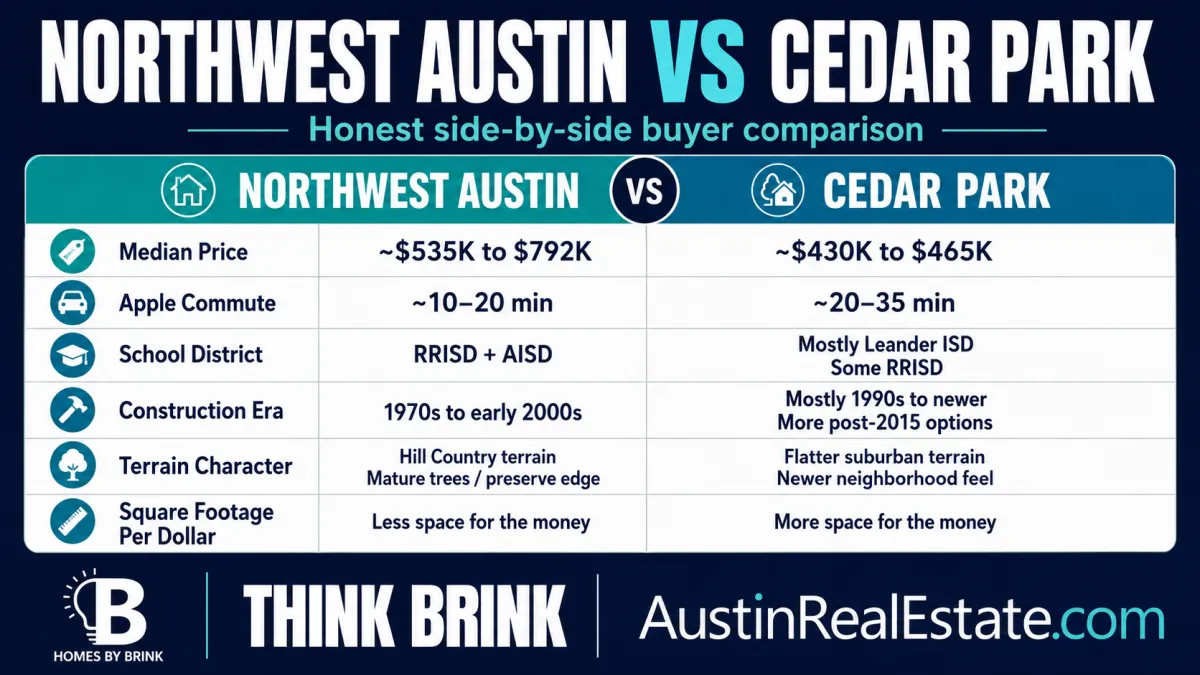
The median home price in Cedar Park runs approximately $430,000 to $465,000 in current market data. Northwest Austin's established neighborhoods run meaningfully higher - 78750 is currently at approximately $535,000 median, 78759 runs higher at around $698,000 across all property types, and the 78726 neighborhoods like Canyon Creek average around $792,000.
That spread is real and in some cases dramatic. For buyers at the $500,000 to $600,000 budget, Cedar Park offers substantially more home for the money. A $500,000 budget in Cedar Park buys a well-maintained four-bedroom house with updated finishes on a reasonable lot in a neighborhood with solid schools. The same $500,000 budget in 78759 buys original-condition 1980s inventory or a smaller home in one of the more accessible sections. In 78750 or 78726, $500,000 is the entry floor for most single-family inventory.
For buyers at the $650,000 to $800,000 range, the gap shifts somewhat. Cedar Park has inventory in this range but it increasingly runs into the higher-end new construction and larger custom home tier. Northwest Austin at that budget opens up well-maintained or partially updated inventory in the core neighborhoods with confirmed school feeder access.
The price differential is approximately $100,000 to $200,000 for comparable square footage depending on which specific neighborhoods you're comparing. Whether that premium is worth paying is the core question this post is designed to help you answer.
Living in Ranch at Brushy Creek, Cedar Park
What That Price Premium Is Actually Buying You in Northwest Austin
This is the question that matters. The premium isn't random - it reflects specific things that buyers are paying for. Understanding what those things are helps you evaluate whether they matter enough to your situation to justify the cost.
The terrain. Northwest Austin's established neighborhoods sit in the Balcones Escarpment where the Hill Country terrain begins - elevation changes, limestone outcroppings, mature live oak canopy, canyon views, and in some neighborhoods direct adjacency to the Balcones Canyonlands Preserve. Cedar Park is geographically flatter and generally north of where the terrain character is most pronounced. Some Cedar Park neighborhoods have pleasant suburban landscaping and reasonable lots, but the physical character of the land is different from what the established Northwest Austin neighborhoods offer. If terrain matters to you - views, canopy, the Hill Country feeling - the premium reflects that and Northwest Austin delivers something Cedar Park doesn't have at any price.
Established neighborhood maturity. The neighborhoods in 78750, 78759, and 78726 were built from the 1970s through the early 2000s. They have 30 to 50 years of established landscaping, mature trees, community character, and neighborhood identity. Cedar Park has some established neighborhoods from the same era - Round Rock ISD Cedar Park addresses particularly - but the majority of Cedar Park's housing stock is newer, and the neighborhood character is newer suburban rather than established residential. Buyers who specifically want a neighborhood that has been a neighborhood for 30 years and feels like it will be one for another 30 tend to find Northwest Austin delivers this and Cedar Park delivers it inconsistently depending on which section you're in.
School feeder access without a long commute to the employment corridor. Both areas have strong schools, but the specific school premium in Northwest Austin's established neighborhoods - the Westwood IB feeder in RRISD, the Anderson pathway in AISD - is particularly concentrated in a way that doesn't require going far north of the employment corridor. Cedar Park's access to the same RRISD campuses requires being in the specific Cedar Park addresses that are zoned to RRISD rather than Leander ISD, and those addresses also tend to price at a premium within Cedar Park. Most of Cedar Park is Leander ISD.
Proximity to Apple and the western Parmer corridor. Northwest Austin neighborhoods west of MoPac are genuinely closer to Apple's Parmer Lane campus than Cedar Park is. From the established 78750 and 78759 neighborhoods, Apple is 10 to 20 minutes in normal traffic. From most Cedar Park addresses, Apple is 20 to 30 minutes or more depending on routing and traffic. That difference compounds over a career of daily commuting.
Living in Avery Ranch, Austin - What Buyers and Sellers Should Know
What Cedar Park Offers That Northwest Austin Doesn't Match
This is where the honest version of this comparison matters. Cedar Park has real advantages that aren't just consolation prizes for buyers who couldn't afford Northwest Austin.
New construction availability. If you want a home built after 2015 with an open floor plan, modern kitchen finishes, energy-efficient systems, and a builder warranty, Cedar Park has abundant options. Northwest Austin's established neighborhoods are primarily 1970s through early 2000s housing stock. New construction in Northwest Austin proper is rare - most of it sits further north or in specific infill situations. Cedar Park buyers who want a new home have multiple builders and multiple master-planned communities to choose from. Northwest Austin buyers who want new construction typically have to look at specific newer sections of 78726 or move further north.
More square footage per dollar. A $550,000 budget in Cedar Park buys a four or five bedroom home in the 2,500 to 3,200 square foot range with a reasonable yard. The same budget in Northwest Austin buys meaningfully less square footage or requires accepting more significant updates. For buyers who specifically need space - a dedicated home office, multiple kids, or a lifestyle that requires square footage - Cedar Park's value equation can be genuinely compelling.
The 183A toll road. Cedar Park's primary commute artery is the 183A toll road, which runs from Cedar Park south and east toward the 183/MoPac area and the Domain. For buyers whose employer is along the 183 corridor or at the Domain specifically, Cedar Park's 183A access is a meaningful commute advantage - the toll road tends to move faster and more predictably than surface streets or MoPac during peak hours. For the Domain specifically, Cedar Park buyers report 15 to 25 minute commutes via 183A that compete favorably with what some Northwest Austin buyers experience.
Leander ISD schools. Leander ISD has been growing rapidly and maintaining strong ratings through that growth. Cedar Park High School and Vista Ridge High School both earn A ratings. The district offers a different set of programs and a different culture from RRISD, but it is a legitimately strong district that has produced consistently good outcomes for students. For buyers who have done their research and are comfortable with Leander ISD rather than specifically requiring RRISD, Cedar Park's school access is a real advantage rather than a compromise.
Lower property taxes. Cedar Park's effective property tax rate runs slightly lower than Travis County's rate for comparable homes in Northwest Austin. The difference isn't dramatic but on a $500,000 home it can represent $1,000 to $2,000 per year in savings. Over a 10-year ownership period, that accumulates to $10,000 to $20,000 - not nothing.
Cedar Park vs Round Rock for Buyers Who Work Near Apple and Want More House
The Commute Comparison: Where It Gets Specific
Both areas have reasonable commute access to North Austin employers, but the routing and the timing differ in ways that matter depending on your specific employer.
Apple Campus (Parmer Lane near MoPac): Northwest Austin wins clearly. From the established 78750 and 78759 neighborhoods west of MoPac, Apple is 10 to 20 minutes in normal traffic via MoPac north or surface streets. From Cedar Park, Apple is 20 to 35 minutes depending on routing - most Cedar Park buyers route via 183A south to MoPac or via Parmer Lane directly. For a five-day-per-week Apple commuter, the Northwest Austin proximity advantage adds up to meaningful time savings over a year.
The Domain (183/MoPac intersection area): Cedar Park is competitive here via the 183A toll road. Cedar Park to Domain runs approximately 15 to 25 minutes in normal conditions, and the 183A tends to flow better during peak hours than some Northwest Austin surface routes. This is the employer destination where Cedar Park's commute advantage is most pronounced.
Downtown Austin: Both areas are roughly similar - 30 to 45 minutes in peak traffic depending on specific location and time of day. MoPac is the primary route from Northwest Austin; 183A to 183 to downtown is the standard Cedar Park routing. Neither area is a downtown commute play.
Dell (Round Rock campus): Cedar Park has a slight edge - the 183A north to I-35 and then to Round Rock is a more direct route than most Northwest Austin buyers have. Both areas are reasonable for Dell commutes, but Cedar Park's Williamson County positioning reduces the travel time slightly for buyers working specifically at Dell.
Work from home: If you're primarily working from home, the commute question drops in priority and the lifestyle, space, and value questions become dominant. Cedar Park's value per dollar and new construction availability are more compelling for full WFH buyers. Northwest Austin's terrain and neighborhood character are more compelling for buyers who want to enjoy where they live when they're not commuting.
The School Question: RRISD vs Leander ISD
Both areas have access to RRISD and Leander ISD, which creates a comparison within the comparison that many buyers don't fully understand.
RRISD is the dominant school district in the established Northwest Austin neighborhoods. The Westwood High School IB World School feeder - Spicewood or Canyon Vista feeder campuses through Canyon Vista Middle to Westwood - is consistently among the most sought-after public school pathways in the Austin metro. Canyon Creek Elementary in 78726 earns a 10 out of 10 on major rating platforms.
Cedar Park is primarily Leander ISD, though some Cedar Park addresses near the Travis/Williamson County line fall in RRISD. Leander ISD's Cedar Park High School and Vista Ridge High School both earn A ratings. The district is well-funded, growing, and has maintained strong ratings through rapid enrollment growth. Vandegrift High School, which serves some Leander ISD addresses in the broader 78726 area, has climbed to 3rd among Austin area public high schools in recent rankings.
The honest comparison: RRISD and the Westwood pathway has a longer track record and a specifically earned reputation that Leander ISD is still building at the high school level. Buyers who have specifically researched Westwood's IB program and want that specific pathway tend to favor Northwest Austin for that reason. Buyers who have researched both districts with open minds tend to find Leander ISD's Cedar Park campuses competitive and in some cases offer specific programs or environments that fit their student better than the Westwood alternative.
If you have a specific school requirement - a specific IB program, a specific district, a specific campus you've researched - that requirement should drive your geographic decision more than any other factor. If you're evaluating school districts without a specific requirement, both areas offer strong options and neither is clearly superior for every family.
Best Neighborhoods Near Westwood High School: How Buyers Usually Narrow the Search
The Neighborhood Character Question: Established vs New
This is the factor that buyers sometimes underweight because it's harder to quantify than price or commute time, and it ends up mattering more than they expected once they're living with the decision.
Northwest Austin's established neighborhoods - particularly the 78750 and 78759 neighborhoods built from the 1970s through the 1990s - have a specific character that comes from decades of maturity. The trees are old. The neighbors have been there for years. The streets are named after the terrain they wind through. The neighborhood association meetings have history. The community pools have swim teams that have been running for 30 years. There is a sense of place that is earned rather than designed, and buyers who move into it tend to feel it relatively quickly.
Cedar Park's newer master-planned communities have a different character. They're clean, functional, well-amenitized, and consistent in ways that established neighborhoods aren't always. The trails are maintained, the community centers are modern, the schools are new buildings. The tradeoff is that the community identity is still being built - the neighborhood that's three years old has three years of shared history, not thirty.
There's no wrong answer here. Buyers who came from fast-growing newer suburbs elsewhere often find Cedar Park's character familiar and comfortable. Buyers who specifically wanted something different from that experience - who moved to Austin in part to get out of the newer master-planned suburb aesthetic - often find the established Northwest Austin neighborhoods more satisfying.
The way to know which category you're in is to tour both types and pay attention to how you feel in each one. The terrain and the trees and the winding streets of the established neighborhoods either resonate with you or they don't. The clean functional character of newer Cedar Park communities either appeals to you or it feels generic. That gut response, taken seriously, is meaningful data.
The Decision Framework: How to Actually Choose
Rather than a ranking, here's a set of questions that tend to clarify the decision efficiently:
Where specifically is your primary employer, and what is the daily commute from each area at your actual departure time? Drive both routes on a representative weekday morning before you make a decision. The commute that looks reasonable on Google Maps at 2pm on Saturday is not the commute you'll be doing at 7:30am on Tuesday.
Do you have a specific school district or campus requirement? If RRISD and Westwood specifically is a firm requirement, Northwest Austin's established neighborhoods deliver it most consistently. If you're open to Leander ISD's strong campuses, Cedar Park opens up significantly.
What does your budget actually buy in each area? Get current active listings in both markets at your specific price point and compare what you're actually getting on square footage, condition, lot size, and neighborhood location. The abstract median comparison is less useful than seeing the specific inventory available to you right now.
How important is terrain and established neighborhood character to your daily quality of life? If the answer is very important - if the Hill Country feel and mature trees and winding streets are part of why you want to be in Northwest Austin rather than Cedar Park - that's a legitimate factor worth paying for. If the answer is it doesn't matter much as long as the house is nice and the commute works, Cedar Park's value case becomes much stronger.
Are you planning to stay long-term or is this a 5-to-7-year move? For longer-term holds, Northwest Austin's established neighborhoods have historically shown stronger value retention through multiple market cycles, partly because the terrain and mature character can't be replicated by new construction. For shorter holds, Cedar Park's lower entry price and new construction inventory can be advantageous on resale depending on market conditions at exit.
Best Neighborhoods Near Anderson High School: How Buyers Usually Narrow the Search
The Honest Summary
Northwest Austin costs more than Cedar Park and delivers specific things for the premium - Hill Country terrain, established neighborhood maturity, and for most addresses closer Apple commute access. Cedar Park costs less, offers new construction and more square footage per dollar, and has strong schools in Leander ISD with good 183A commute access to the Domain and the broader 183 corridor.
Neither is a better choice in the abstract. They're different choices for different priorities. The buyer who lands in Northwest Austin and feels it was the right call typically values the terrain, the established character, and the specific school feeder more than the price difference. The buyer who lands in Cedar Park and feels it was the right call typically values the new construction, the space, and the value per dollar more than the established neighborhood experience.
Both sets of buyers exist and both are right for their situations. The question is which one you are - and the framework above is designed to help you answer that specifically rather than generally.
Frequently Asked Questions
Is Northwest Austin or Cedar Park better for Apple employees?
Northwest Austin has a commute advantage for Apple specifically. From the established 78750 and 78759 neighborhoods, Apple's Parmer Lane campus is 10 to 20 minutes in normal traffic. From most Cedar Park addresses, budget 20 to 35 minutes. For a five-day-per-week Apple commuter, that difference adds up over time. For hybrid or partial Apple commuters, the gap matters less and Cedar Park's value equation becomes more competitive.
What is the price difference between Northwest Austin and Cedar Park?
Cedar Park's median home price runs approximately $430,000 to $465,000. Northwest Austin's established neighborhoods range from approximately $535,000 in 78750 up to $698,000 median in 78759 and $792,000 median in Canyon Creek in 78726. The premium for comparable square footage in Northwest Austin over Cedar Park is typically $100,000 to $200,000 depending on specific neighborhoods compared.
Are Cedar Park schools as good as Northwest Austin schools?
Both areas have strong public schools. Northwest Austin's established neighborhoods primarily feed RRISD with the Westwood High School IB pathway - one of the most sought-after in the metro. Cedar Park is primarily Leander ISD with Cedar Park High School and Vista Ridge High School both earning A ratings. Buyers who specifically research Westwood's IB program tend to favor Northwest Austin for that specific pathway. Buyers who evaluate both districts with open minds tend to find Leander ISD competitive and in some cases preferable depending on the specific programs and environment they want for their student.
Is there new construction available in Northwest Austin?
New construction in the established Northwest Austin neighborhoods - 78750, 78759, 78726 - is limited. The vast majority of inventory is 1970s through early 2000s housing stock. Buyers who specifically want post-2015 construction with modern finishes and builder warranties will find Cedar Park has significantly more options. Some newer construction exists in specific sections of 78726 and in adjacent areas, but it is not the dominant inventory type in established Northwest Austin.
How does the 183A toll road affect the Cedar Park commute?
The 183A toll road runs from Cedar Park south toward the 183/MoPac intersection and the Domain area. It moves faster and more predictably than surface street alternatives during peak hours, and Cedar Park to Domain commutes via 183A typically run 15 to 25 minutes. For buyers specifically targeting the Domain, the 183A makes Cedar Park genuinely competitive with Northwest Austin on commute time. For buyers targeting Apple on the western Parmer corridor, Northwest Austin's MoPac positioning still holds the advantage.
Which area has better property tax rates?
Cedar Park sits in Williamson County with a slightly lower effective property tax rate than Travis County addresses in Northwest Austin. The difference is typically $1,000 to $2,000 per year on homes in the $500,000 to $700,000 range. Both areas have meaningfully higher property taxes than states with Proposition 13-style caps like California, and neither has state income tax.
How do I decide between Northwest Austin and Cedar Park?
Start with your employer location and run the actual commute from both areas at your departure time. Then clarify your school district priorities - RRISD specifically or open to Leander ISD. Then determine what your budget actually buys in each area by looking at current inventory rather than medians. Finally, tour neighborhoods in both areas and pay attention to how the physical character and community feel resonates with what you want from where you live. Those four inputs together usually produce a clear answer.
