Northwest Austin vs Round Rock: Which One Actually Fits Your Situation?
The Northwest Austin vs Round Rock comparison has a wrinkle that the Northwest Austin vs Cedar Park comparison doesn't: both areas are primarily served by Round Rock ISD. That shared school district changes the comparison in important ways - the school factor that often drives buyers toward one area or the other isn't the differentiator here that it is in other Austin suburban comparisons.
What is the differentiator is geography, terrain, lifestyle, and a price gap that for many buyers is the most important number in the decision. This post gives you the honest version of how the two areas compare and a framework for figuring out which one makes sense for your specific situation.
Is Northwest Austin a Good Place to Live? What Buyers Should Actually Know
The Geographic Reality: What's Actually Different
Northwest Austin for this comparison means the established neighborhoods in 78750, 78759, and 78726 - Spicewood Estates, Balcones Woods, Great Hills, Canyon Creek, and the surrounding neighborhoods covered in this content library. These sit west of MoPac in Travis County, adjacent to the Balcones Canyonlands Preserve, inside or at the edge of Austin proper.
Round Rock is a separate city in Williamson County, anchored by Dell's global headquarters and sitting directly on I-35 approximately 20 miles north of downtown Austin. It's larger in population than most buyers realize - it functions more like a mid-size city with its own identity than a bedroom suburb of Austin. The Dell Diamond minor league baseball park, the La Frontera development, University Boulevard's restaurant and retail corridor, and a growing downtown core give Round Rock a community infrastructure that stands somewhat independently from Austin in ways that Cedar Park and Leander don't quite match.
The distance between the two areas is not dramatic on a map - Round Rock sits roughly 10 to 15 miles north and east of the established Northwest Austin neighborhoods. But the commute experience between them and the destinations buyers care about diverges significantly depending on where you're going.
Cedar Park vs Round Rock for Buyers Who Work Near Apple and Want More House
Price: The Most Significant Difference
The price gap between Northwest Austin and Round Rock is wider than the Cedar Park comparison and is the primary reason buyers put Round Rock on their list when they're researching Northwest Austin.
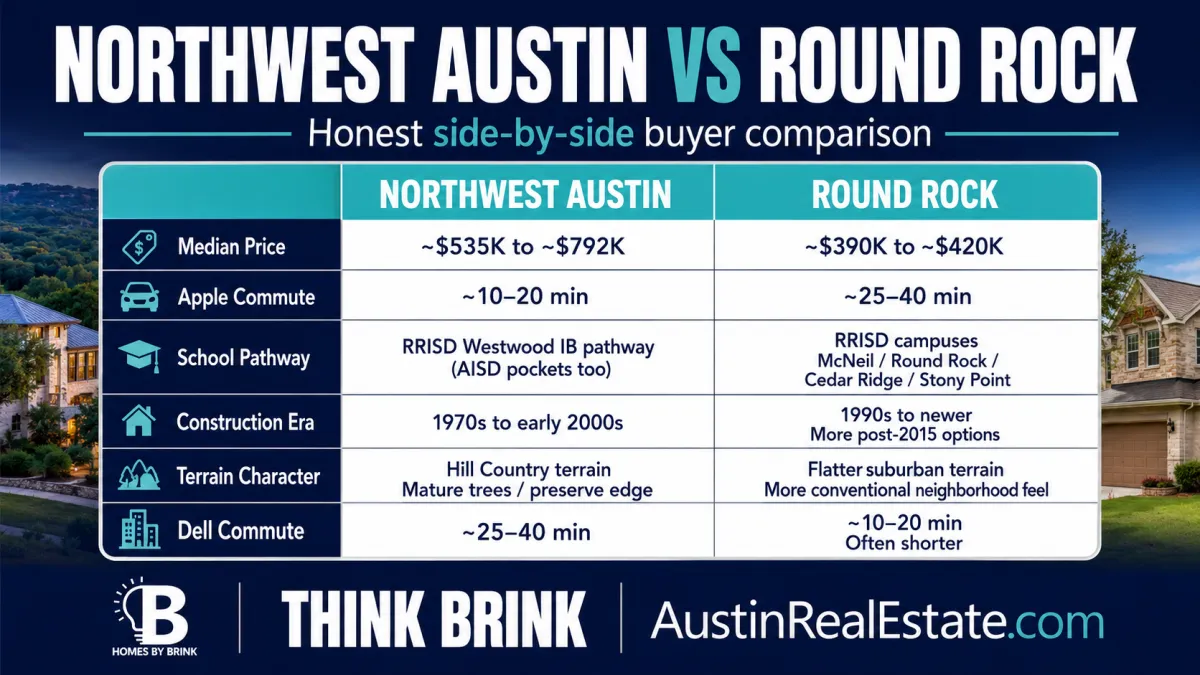
Round Rock's median home price currently runs approximately $390,000 to $420,000 with luxury neighborhoods pushing into the $495,000 to $565,000 range. Northwest Austin's established neighborhoods run $535,000 median in 78750, approximately $698,000 median in 78759, and around $792,000 median in the Canyon Creek area of 78726.
That's a gap of $100,000 to $400,000 depending on which Northwest Austin neighborhood you're comparing Round Rock against. For a buyer with a $500,000 budget, Round Rock offers a four or five bedroom home in the 2,500 to 3,500 square foot range with a reasonable lot in an established neighborhood. The same $500,000 in Northwest Austin buys original-condition 1980s inventory in the more accessible sections of 78759, or sits at the entry floor of 78750 and 78726.
What that price difference buys you in Round Rock is primarily square footage, lot size at the mid-budget range, and in many neighborhoods newer construction than what's available at comparable Northwest Austin price points. What you're giving up for that value is the terrain character, the established maturity of the specific Northwest Austin neighborhoods, and in most cases proximity to Apple and the western Parmer corridor.
The School District Comparison: Shared but Not Identical
Here is the nuance that many buyers miss: both Northwest Austin and Round Rock are substantially served by Round Rock ISD. RRISD is the same district regardless of whether the address is in Travis County or Williamson County. A buyer in Round Rock proper feeds the same RRISD system as a buyer in Scofield Farms or most of 78750.
But - and this matters - the specific campuses are different. Northwest Austin's RRISD addresses in 78750 feed Spicewood Elementary, Canyon Vista Middle, and Westwood High School. Northwest Austin's 78726 addresses feed Canyon Creek Elementary and Westwood via Noel Grisham Middle. Round Rock proper feeds different RRISD campuses - the high school assignment in Round Rock is McNeil High School, Stony Point High School, Cedar Ridge High School, or Round Rock High School depending on the specific address.
RRISD is a strong district with A-rated TEA accountability across the system. But within the district, the specific campuses matter to buyers who have researched deeply enough to know which pathway they want. Westwood's IB World School designation and consistent top-two metro-area ranking is specific to addresses that feed Westwood - and those addresses are concentrated in the Northwest Austin neighborhoods, not in Round Rock proper.
For buyers who specifically want RRISD broadly, both areas deliver it. For buyers who specifically want the Westwood IB pathway, Northwest Austin's 78750 and 78726 neighborhoods deliver it and Round Rock doesn't. That distinction is worth understanding before you make a school-driven decision about geography.
Best Neighborhoods Near Westwood High School: How Buyers Usually Narrow the Search
The Commute Comparison: Where This Decision Often Gets Made
This is where the Northwest Austin vs Round Rock comparison diverges most clearly, and where buyers who don't do their homework before choosing are most likely to be surprised.
Apple Campus (Parmer Lane near MoPac): Northwest Austin wins significantly. From the established 78750 and 78759 neighborhoods, Apple is 10 to 20 minutes in normal traffic. From Round Rock, budget 25 to 40 minutes in normal conditions - routing south on I-35 to 45 to MoPac, or surface streets with varying traffic. For a five-day-per-week Apple commuter, this difference adds up to an hour or more of driving per week compared to living in Northwest Austin. Over a year of daily commuting, that's 50 to 60 hours of additional drive time. Whether that's worth the price differential is a personal calculation, but it deserves to be made explicitly rather than assumed away.
Dell (Round Rock campus): Round Rock wins clearly. Dell's headquarters is in Round Rock, and for Dell employees, Round Rock's local presence is a genuine advantage - many residents work locally without a meaningful commute at all. Northwest Austin buyers commuting to Dell's Round Rock campus are typically adding 25 to 40 minutes each way depending on specific neighborhoods and traffic conditions. For Dell employees, the Round Rock value case is at its most compelling.
The Domain (183/MoPac area): Both areas are roughly competitive but via different routes. Northwest Austin reaches the Domain via surface streets or MoPac in 15 to 25 minutes. Round Rock reaches the Domain via I-35 south to 45 to MoPac or 183 in approximately 25 to 40 minutes in normal traffic - longer during peak hours on I-35. The I-35 traffic reality is the honest variable here.
I-35 peak hours: This deserves explicit treatment because it's the factor that Round Rock listings don't emphasize and that buyers who visit on weekends don't experience. I-35 from Round Rock to downtown Austin or to the central employment corridor is one of the most congested stretches of highway in Texas during morning and evening rush. A 20-mile drive that takes 25 minutes at 10am can take 50 to 60 minutes or more at 7:30am. Buyers who are commuting south on I-35 from Round Rock daily need to drive that route at their actual departure time before they commit. The commute experience on I-35 at peak hours is not the same as the distance on a map suggests.
Downtown Austin: Round Rock to downtown via I-35 in peak traffic runs 40 to 60 minutes or more. Northwest Austin to downtown via MoPac runs 25 to 40 minutes. Neither area is a downtown commute play but Northwest Austin's MoPac access gives it a time advantage for buyers whose employer is in or near downtown.
Work from home: The commute comparison drops in priority for full WFH buyers. In this scenario, the decision becomes primarily about what daily life looks like in each place - the terrain and neighborhood character of Northwest Austin versus the space and value of Round Rock.
What Round Rock Offers That Northwest Austin Doesn't Match
Round Rock's advantages are real and should be stated clearly rather than treated as second-best options.
The value per square foot. At $390,000 to $450,000, Round Rock offers four and five bedroom homes with 2,500 to 3,500-plus square feet and reasonable lots in established neighborhoods. This is a genuinely compelling value case for buyers who need space and are price-constrained in a way that Northwest Austin doesn't accommodate.
New construction availability. Round Rock has active builder inventory in master-planned communities and infill development. Buyers who want post-2015 construction with modern floor plans, energy-efficient systems, and builder warranties have meaningful options in Round Rock that Northwest Austin's established neighborhoods can't match.
An established city identity. Round Rock functions more independently from Austin than most Austin suburbs. The Dell Diamond, the downtown development along Round Rock Avenue, the La Frontera retail and dining corridor, Kalahari Resorts, and Round Rock's own commercial infrastructure mean residents have meaningful options for dining, entertainment, and retail without driving into Austin. This is a genuine quality-of-life advantage for buyers who want a more self-contained suburban experience.
Dell proximity. For the significant employer base at Dell's Round Rock campus, living in Round Rock eliminates a commute that Northwest Austin residents have to absorb. At roughly 7,400 local Dell employees, this is a meaningful buyer segment for whom Round Rock's employer adjacency is a primary decision factor.
Brushy Creek Regional Trail and parks. Round Rock's Brushy Creek Lake Park and the regional trail system provide substantial outdoor recreation infrastructure within the city. It's not the Hill Country terrain and Balcones Canyonlands Preserve adjacency that Northwest Austin offers, but it's a functional and well-maintained outdoor resource that Round Rock residents use regularly.
Living in Round Rock vs. Cedar Park - Which Is Right for You?
What Northwest Austin Offers That Round Rock Doesn't Match
The Northwest Austin premium over Round Rock reflects specific things that buyers in these neighborhoods are paying for.
The terrain. The Balcones Escarpment, the Hill Country views, the mature live oak canopy, the canyon corridors, and the Balcones Canyonlands Preserve adjacency that define the established Northwest Austin neighborhoods do not exist in Round Rock. Round Rock's terrain is flatter, more conventionally suburban, and the natural character of the landscape is meaningfully different. Buyers for whom the Hill Country feel is a primary quality-of-life factor - the winding streets, the elevation, the trees, the wildlife - are buying something in Northwest Austin that Round Rock cannot replicate at any price point.
Established neighborhood maturity. The neighborhoods in 78750, 78759, and 78726 were built from the 1970s through the early 2000s and have been established communities for 30 to 50 years. The mature trees, the community identity, the neighbor relationships, and the sense of place that comes from decades of shared history distinguish these neighborhoods from the newer development that characterizes much of Round Rock's growth. Round Rock does have established neighborhoods from the same era - and some of them are genuinely appealing - but the overall character of the city is more heavily weighted toward newer construction than Northwest Austin's established core.
The Westwood IB pathway specifically. For buyers who have specifically researched Westwood High School's IB World School program and want that specific pathway, the addresses that feed Westwood are concentrated in Northwest Austin's 78750 and 78726 neighborhoods. Round Rock's RRISD addresses feed different high school campuses. Both are RRISD - but they're not the same RRISD experience.
Apple and western Parmer corridor proximity. For buyers commuting to Apple or other employers along the western Parmer corridor, Northwest Austin's positioning west of MoPac delivers a commute advantage that compounds meaningfully over a career of daily driving.
Living in Avery Ranch Austin - What to Expect
The Lifestyle Question: What Daily Life Actually Looks Like
This is the factor that the price and commute analysis doesn't fully capture, and it's worth addressing directly.
Northwest Austin's daily life centers on the residential neighborhood - the winding streets, the established canopy, the neighborhood parks and trails, the school community, and the urban access that the Arboretum and the Domain provide. It's car-dependent but the car gets you to places that are consistently accessible without long drives. The terrain makes it feel like somewhere rather than anywhere.
Round Rock's daily life centers more on the city's own infrastructure - the retail and dining corridors, the parks system, the Dell Diamond, the school community. It has the feel of a developed suburb that is more self-contained than most Austin bedroom communities. Residents describe it as a place with its own identity rather than just a place near Austin, and longtime residents tend to value that identity.
The question worth asking is which version of suburban life fits how you actually want to spend your weekday evenings and weekend mornings. If the answer involves Hill Country trail systems, preserve adjacency, and established neighborhood character - Northwest Austin. If the answer involves a larger home, more square footage, established city amenities, and a self-contained suburban environment - Round Rock.
Both are legitimate versions of Northwest Austin-area suburban life. The right one depends on your specific priorities rather than a ranking of which is objectively better.
The Decision Framework: How to Actually Choose
Where specifically is your employer, and what does the commute look like from each area at your actual departure time? Drive both at 7:30am on a Tuesday before you commit. Round Rock's I-35 southbound at peak hours is the most common surprise for buyers who researched on weekends. Northwest Austin's MoPac northbound at peak hours has its own congestion. Know what you're actually signing up for.
Do you specifically want the Westwood IB pathway, or are you comfortable with RRISD broadly? Both areas are RRISD. Only Northwest Austin's 78750 and 78726 neighborhoods deliver the Westwood specific pathway. If Westwood specifically is a requirement, that settles the geographic question. If RRISD broadly satisfies the school requirement, Round Rock opens up significantly.
What does your budget actually buy in each area at your specific price point? Look at current active inventory at your price range in both markets. A $550,000 budget in Round Rock and a $550,000 budget in Northwest Austin buy meaningfully different homes in terms of size, condition, and lot character. See the specific inventory rather than comparing medians.
How important is terrain and established neighborhood character to your daily quality of life? If you came to Northwest Austin specifically for the Hill Country character - the terrain, the trees, the Balcones Canyonlands Preserve adjacency - that factor justifies the premium and Round Rock doesn't replicate it. If you're more focused on the school district and the general suburban quality of life and the terrain is a secondary consideration, Round Rock's value case becomes compelling.
How long are you planning to stay? For longer-term holds, Northwest Austin's established neighborhood character and terrain have historically produced stronger value retention through market cycles partly because those things can't be replicated by new construction. Round Rock's value and new construction availability can produce competitive shorter-term outcomes depending on market conditions at exit.
Living in 78726: The Northwest Austin Zip Code Guide Buyers Should Read Before They Start Searching
The Honest Summary
Northwest Austin costs more than Round Rock and delivers specific things for the premium - Hill Country terrain and Balcones Canyonlands Preserve adjacency, established neighborhood maturity, and for most addresses closer proximity to Apple and the western Parmer corridor. Both areas are primarily RRISD, but the specific campuses differ - Westwood's IB pathway is available in Northwest Austin and not in Round Rock proper.
Round Rock costs meaningfully less and delivers more square footage per dollar, new construction availability, Dell employer adjacency, and a self-contained suburban city identity with its own retail, dining, and entertainment infrastructure. The I-35 commute reality during peak hours is Round Rock's primary honest tradeoff for buyers heading south toward Austin's employment corridors.
The buyer who chooses Northwest Austin and feels it was right typically values terrain, established character, and Apple proximity enough to justify the premium. The buyer who chooses Round Rock and feels it was right typically values space, value per dollar, and a self-contained suburban experience - and often has Dell as their primary employer or works from home most days.
Both buyers are right for their situations. The framework above is designed to help you figure out which one you are.
Frequently Asked Questions
Is Northwest Austin or Round Rock in the same school district?
Both areas are substantially served by Round Rock ISD, but the specific campuses differ. Northwest Austin's 78750 and 78726 neighborhoods feed Westwood High School IB World School via Spicewood Elementary and Canyon Vista or Canyon Creek Elementary and Grisham pathways. Round Rock proper feeds McNeil, Stony Point, Cedar Ridge, or Round Rock High School depending on the specific address. Both are RRISD - but the Westwood IB pathway specifically is available in Northwest Austin and not in Round Rock proper.
How much cheaper is Round Rock than Northwest Austin?
Round Rock's median home price runs approximately $390,000 to $420,000 versus Northwest Austin's range of $535,000 in 78750 up to $792,000 median in Canyon Creek. The gap for comparable square footage is typically $100,000 to $300,000 depending on which specific neighborhoods are compared.
How long is the commute from Round Rock to Apple Campus?
From most Round Rock addresses to Apple's Parmer Lane campus, budget 25 to 40 minutes in normal conditions via I-35 south to 45 to MoPac. From Northwest Austin's established neighborhoods, Apple is 10 to 20 minutes. For a five-day-per-week Apple commuter, that difference represents meaningful additional drive time annually.
What is I-35 like from Round Rock during peak hours?
I-35 southbound from Round Rock toward Austin during morning rush is one of the most congested stretches of highway in Texas. A 20-mile drive that takes 25 minutes at 10am can take 50 to 60 minutes or more at 7:30am. Buyers whose daily commute involves southbound I-35 during peak hours should drive that specific route at their actual departure time before committing to a Round Rock address.
Is Dell still a major employer in Round Rock?
Yes. Dell Technologies has had its global headquarters in Round Rock since 1994 and employs approximately 7,400 people locally. Dell's continued local presence is a stabilizing force in Round Rock's economy and a primary reason many tech buyers choose Round Rock over alternatives. For Dell employees specifically, Round Rock's local employer adjacency is a genuine lifestyle advantage.
Does Round Rock have its own retail and entertainment, or do residents drive to Austin for everything?
Round Rock has developed its own retail and dining infrastructure more than most Austin bedroom suburbs. The La Frontera development, the University Boulevard restaurant corridor, the Dell Diamond for baseball, and Kalahari Resorts give Round Rock residents meaningful local options. Most residents still drive to Austin regularly, but the local infrastructure reduces the frequency compared to smaller suburbs.
Which area has better terrain and outdoor access?
Northwest Austin has a clear advantage on terrain. The Balcones Escarpment, Hill Country views, mature live oak canopy, and Balcones Canyonlands Preserve adjacency define the established Northwest Austin neighborhoods. Round Rock's terrain is flatter and more conventionally suburban, with good parks infrastructure through Brushy Creek but without the Hill Country character that Northwest Austin's western neighborhoods deliver.
How do I decide between Northwest Austin and Round Rock?
Start with employer location and drive both commutes at peak hours. Then determine whether you specifically need the Westwood IB pathway or RRISD broadly. Then compare current inventory at your actual budget in both markets. Then evaluate how much the terrain and established neighborhood character matters to your daily quality of life. Those four inputs together typically produce a clear answer.
