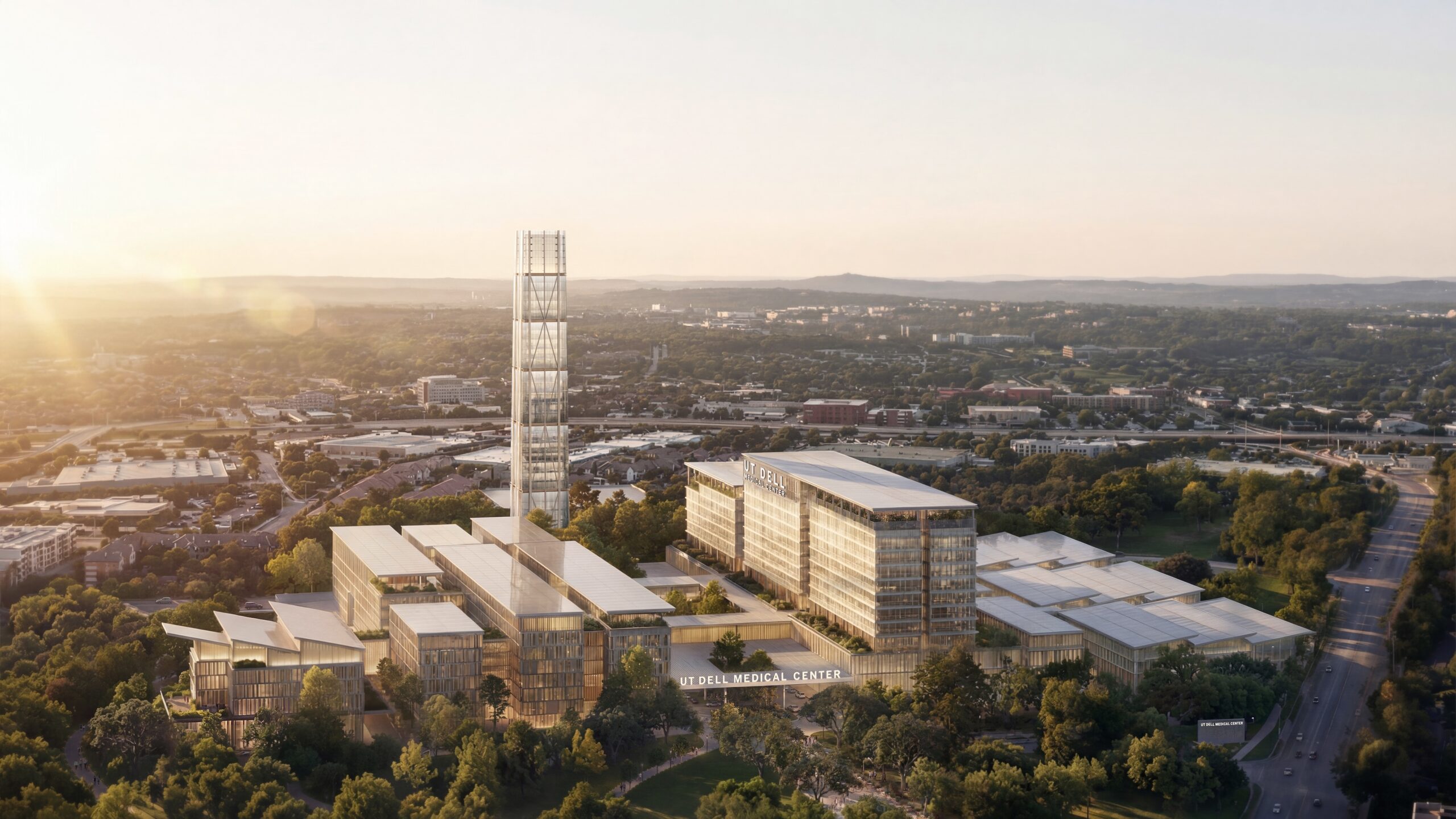
UT Dell Medical Center at MoPac and Braker: Budget, Timeline, and What Gets Built First
On August 12, 2026, the University of Texas System Board of Regents approved the first phase of the UT Dell Medical Center, and with that single vote a project that had been talked about for two years turned into a construction schedule with real dates on it. The total price tag is $5 billion, the first phase alone is authorized at up to $1 billion, and the site sits in North Austin at MoPac and West Braker Lane, which puts one of the largest institutional investments in Texas history about ten minutes from a lot of the neighborhoods I work in every week.
I have been covering this story on video since February, when it first became clear that UT was walking away from the downtown site, so I want to put the whole thing in one place with the actual numbers, the actual schedule, and the parts that still have not been announced.
The project was supposed to go downtown, and then it did not
The original plan put the medical center on the site of the demolished Frank Erwin Center, near the existing Dell Medical School and the emerging downtown medical district, and on paper that made a certain amount of sense because it clustered everything UT already had. In practice, university leadership talked themselves out of it in public.
At a Real Estate Council of Austin luncheon in February 2026, UT System Chancellor John Zerwas said building the medical center at the Erwin Center site would give him sleepless nights, and he pointed at exactly the things anyone who drives that stretch already knows. There is a football game on Saturdays, there is a rival crowd filling every road around the site several times a season, and I-35 is under construction and will be for years. When a cancer patient is trying to get to an infusion appointment, none of that is a small problem.
Claudia Lucchinetti, dean of the Dell Medical School and senior vice president for medical affairs at UT Austin, made the other argument, which was about room to grow, and she framed it as a question of whether you squeeze a once in a generation opportunity into a footprint that cannot expand. Peter Pisters, president of MD Anderson, added the clinical version of the same point, which is that cancer care brings a long list of ancillary specialties with it, and all of those specialties need space in the same place so patients are not driving across town between appointments.
Kevin Eltife, chairman of the UT System Board of Regents, said it more plainly when the location was finally confirmed, telling reporters that for patient care, ease of access, and future expansion, being in North Austin was just common sense.
Where it is actually going
The medical center occupies 27 acres southwest of the intersection of West Braker Lane and MoPac, on the parcel a lot of longtime Austinites still call the old MCC campus, which is the wooded tract on the west side of the highway. The J.J. Pickle Research Campus sits directly across MoPac to the east, and the Domain is a few minutes north of that, so the hospital lands on the 78759 side of the freeway while the research and retail density everyone associates with this corridor sits on the 78758 side.
Those 27 acres are a small piece of something much larger. UT is developing the whole area as the UT Dell Campus for Advanced Research, a campus of more than 300 acres straddling MoPac that folds in the existing Pickle Research Campus along with new research facilities, student housing, and support for the Texas Advanced Computing Center. The city rezoned the university land under the North Burnet/Gateway Regulating Plan into a Research and Sciences Mixed Use subdistrict covering roughly 475 acres, with building heights permitted between 120 and 491 feet depending on how a given project participates in the area density bonus program.
That zoning detail matters more than it sounds, because it means the tall buildings are not a rumor or a rendering, they are an entitlement that already exists on the books.
Skidmore, Owings and Merrill is leading the design, and Lucchinetti has talked repeatedly about using the mature tree canopy on the old MCC site rather than clearing it, on the theory that light and nature are part of how people actually heal. UT looked at selling that tract for redevelopment years ago and backed off partly because of those trees, so there is some history to the idea.
What gets built
The program calls for roughly 2.5 million square feet of gross building space, which is a genuinely large number for a single campus in Austin, and inside that footprint the plan includes a hospital tower with 300 to 500 beds, outpatient facilities, and a full service emergency department.
The clinical focus is cancer first, through the MD Anderson partnership, and then neurosciences, cardiovascular disease, multiorgan conditions, and rare or complex illnesses. MD Anderson will operate the hospital, it is contributing financially to the project, and it plans to relocate some of its existing faculty from Houston to Austin. That last part is the piece people skip over, because it means this is not a satellite clinic with a famous name on the sign, it is an operating partnership with staff moving into the market.
The reason that matters to Central Texas is simple and a little uncomfortable. Thousands of Austin area residents currently drive or fly to Houston every year for cancer treatment they cannot get here, and for a metro of this size that is an unusual gap. Closing it is the entire point of the project.
The AI-native part is not marketing language
UT is describing this as the country's first AI-native hospital, meaning the artificial intelligence and advanced computing infrastructure is designed into the building from the first drawing rather than bolted on afterward. In practice, the specifics they have described include ambient AI that handles clinical documentation while a physician is talking to a patient, real time monitoring of patient data across the hospital, and predictive modeling that flags patient risk before a situation becomes an emergency.
The credibility behind that claim sits across the highway. The Texas Advanced Computing Center at the Pickle campus is home to Horizon, which UT describes as the nation's largest academic supercomputer, funded through a National Science Foundation Leadership-Class Computing Facility award and entering production in spring 2026. UT crossed 5,000 GPUs in late 2025 as part of the same buildout. When a university says it is building an AI-native hospital and it already operates the largest academic computing facility in the country a quarter mile away, that is a different kind of statement than a press release.
Where the first billion goes
The Phase I authorization is worth understanding in detail, because a lot of people are going to see the headline and assume the hospital is going up next year. It is not. The first billion is almost entirely preparation, and the breakdown submitted to the regents looked like this:
$650 million for site development
$100 million for architectural and design services
$85.2 million for project contingency
$60 million for fixed equipment
$52 million for institutionally managed work
$50 million for furniture and movable equipment
$2.8 million for project management
Site development at $650 million covers clearing, excavation, subgrade structure preparation, and the procurement of long lead materials and equipment, which is the category that includes the components you have to order years ahead because the manufacturing queue is that long. Spending nearly two thirds of a billion dollars before a single patient floor is framed tells you how much dirt work and utility infrastructure a project of this scale requires.
The funding mechanism is worth noting too. Phase I is financed through the university revenue financing system bonds, with annual debt repayment of roughly $56 million coming out of clinical revenues rather than the construction budget itself.
UT Austin President James Davis summarized the vote by saying it gives the university the authority to begin spending so the project opens on time and on budget, which is administrator language for the fact that the money is now unlocked.
The schedule
The construction timeline approved by the regents runs like this. Notice to proceed and early site work begin in fall 2026, with September named as the target month. Substantial completion is scheduled for July 2030. Final completion is scheduled for December 2030. The opening target has consistently been stated as 2030, and the full slate of specialty programs is expected to phase in by 2032.
So from the first bulldozer to a fully operating academic health system is about six years, and anyone buying or selling a home in the corridor between now and then is living through the construction half of that window, not the finished half.
How the money came together
The anchor gift is $750 million from the Michael and Susan Dell Foundation, announced in April 2026, which pushed the Dells past $1 billion in lifetime giving to UT Austin and made them the university's first billion dollar donors. Their earlier $50 million gift in 2013 is what launched the Dell Medical School in the first place, so this is a continuation rather than a new relationship.
There is also a $100 million gift from Tench Coxe, a longtime Nvidia board member, and his wife Simone Coxe. Given that the project is being built around AI and advanced computing, the source of that particular check is not a coincidence.
UT has set a $10 billion fundraising goal for the overall effort, with a stated ambition of reaching top ten medical center status within ten years. The total project cost also moved, and it is worth being honest about that, because the initial estimate was roughly $2.9 billion and the current figure is $5 billion.
What has not been announced
I want to be careful here, because there is a version of this story circulating that puts specific job numbers and specific economic impact figures on the project, and those numbers have not come from UT. As of early September 2026, the university has not published a permanent employment count for the medical center, and it has not published a construction employment figure either.
What is known on the workforce side is that Dell Medical School currently has roughly 200 active students and nearly 500 residents and fellows, and that MD Anderson will be bringing faculty from Houston. Everything beyond that is estimation, and I would rather tell you the number does not exist yet than repeat one that somebody made up.
The exact street address of the medical center has also never been formally announced, though the site description of 27 acres southwest of Braker and MoPac, west of the Pickle campus, narrows it to one parcel.
Frequently asked questions
When does construction actually start on the UT Dell Medical Center?
Early site work is scheduled to begin in fall 2026, with September 2026 named as the target for notice to proceed. The regents approved the authorization to spend on August 12, 2026.
When will the hospital open?
Substantial completion is targeted for July 2030 and final completion for December 2030, with the opening consistently stated as 2030. Full specialty programs are expected to be phased in by 2032.
Where exactly is the UT Dell Medical Center being built?
On 27 acres southwest of West Braker Lane and MoPac in North Austin, on the west side of the highway, across from the J.J. Pickle Research Campus and just south of the Domain area.
How many beds will it have?
Current plans call for 300 to 500 beds, plus outpatient facilities and a full service emergency department, inside roughly 2.5 million square feet of gross building space.
Is this the same thing as Dell Medical School or Dell Children's?
No. Dell Medical School is the existing UT medical school near downtown, and Dell Children's Medical Center is a separate children's hospital system. The UT Dell Medical Center is a new adult academic hospital and health system being built in North Austin in partnership with MD Anderson.
Why did UT move it out of downtown?
University leadership cited patient access, game day and I-35 construction traffic around the Erwin Center site, a constrained footprint with no room to expand, and the need to house many specialties in one location.
Who is paying for it?
A $750 million gift from the Michael and Susan Dell Foundation, a $100 million gift from Tench and Simone Coxe, financial contribution from MD Anderson, and university revenue financing system bonds for Phase I, with roughly $56 million in annual debt service coming from clinical revenues.
The short version
A $5 billion academic medical center with an MD Anderson partnership is being built on 27 acres at MoPac and Braker, inside a 300 plus acre research campus that already houses the largest academic supercomputer in the country, and the money to start moving dirt was authorized in August. That is a permanent institutional anchor landing in North Austin, and it is going to be part of how this part of the city gets described for the next thirty years.
What it means for property values, for the neighborhoods closest to the site, and for anyone deciding whether to buy or sell in this corridor between now and 2030 is a longer conversation, and I wrote a separate piece on exactly that.
If you own a home in Northwest or North Austin and you are trying to figure out how this fits into your timing, I am happy to walk through it with you. That conversation costs you nothing and I am not going to try to list your house on the phone.
