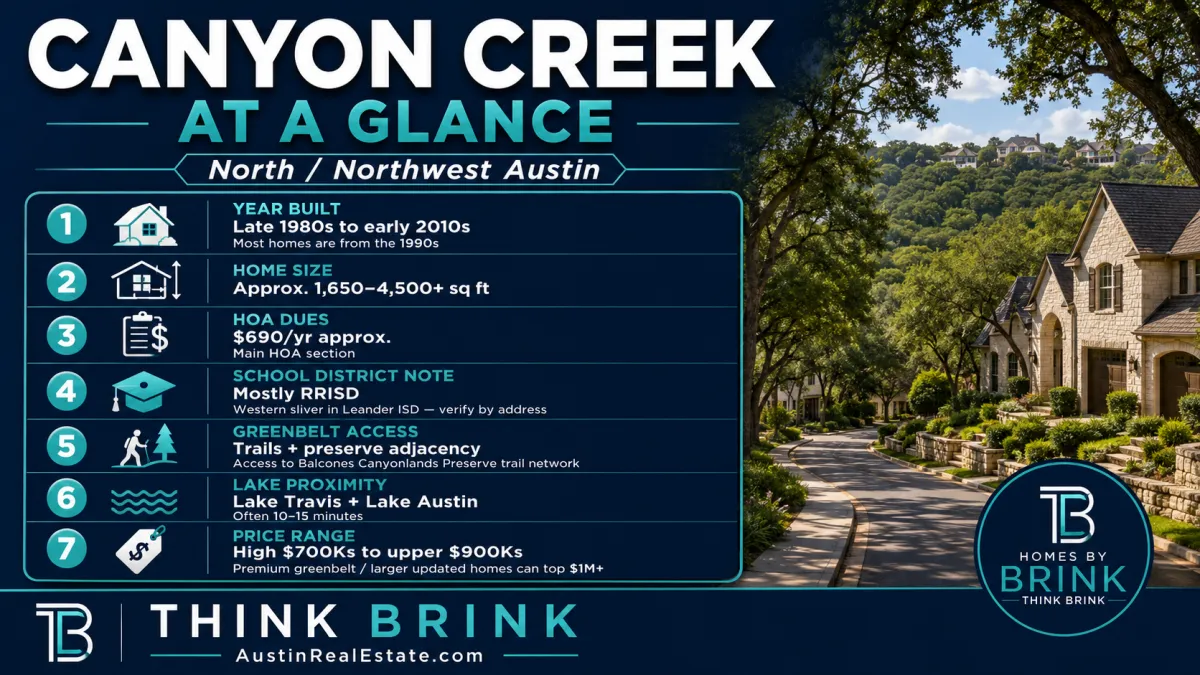
"Canyon Creek at a Glance" card - key callouts covering year built range, home size range, HOA dues, school district note, greenbelt access, lake proximity, and price range. Think Brink branding, no map.

What Buyers Should Know About Canyon Creek Before Making an Offer

July 01, 202618 min read

Canyon Creek is the most searched neighborhood in 78726 and one of the most consistently sought-after addresses in Northwest Austin. It has the school access, the community infrastructure, the lot character, and the preserve adjacency that buyers in this part of the metro are specifically looking for - and it has all of those things in a package that has held its value through multiple market cycles.

But Canyon Creek is not a simple neighborhood to buy into. It has internal sections that feel meaningfully different from each other. It has a school district split that catches buyers off guard regularly. It has greenbelt-backing lots that command a genuine premium and interior lots that don't. And it has an HOA with real teeth and real expectations.

This guide is for buyers who are getting serious about Canyon Creek and want to understand what they're actually buying before they make an offer. The sections, the school situation, the lot hierarchy, the community infrastructure, what homes are trading for, and what to check before you go under contract.

Living in 78726: The Northwest Austin Zip Code Guide Buyers Should Read Before They Start Searching


What Canyon Creek Actually Is and Where It Came From

Canyon Creek was developed starting in the late 1980s on former ranch and hunting land - much of it once a working cattle ranch owned by former US Congressman J.J. Pickle. The Blanton Company, led by Perry Blanton, developed it as a fully master-planned community: homes, parks, trails, and amenity infrastructure built in together from the beginning rather than added as an afterthought.

That planning origin matters because it explains why Canyon Creek feels different from other Northwest Austin neighborhoods of the same era. The trail system, the two community centers with junior Olympic pools, the tennis and pickleball courts, the maintained common areas, the wide tree-lined streets, the landscaped entrances - these weren't retrofitted after the fact. They were the point of the development from day one, and they've been maintained and managed by an active HOA ever since.

The neighborhood is bordered by RM 2222 to the south, RM 620 to the west, Anderson Mill Road to the north, and a major tributary of Bull Creek to the east along with the Balcones Canyonlands National Wildlife Refuge. Boulder Lane is the primary internal loop, entering and exiting the neighborhood at both the north and south ends off 620.


The Internal Sections: Not All of Canyon Creek Is the Same

This is the most important thing buyers miss when they search "Canyon Creek" as a single entity. The neighborhood has meaningfully different internal sections, and understanding which you're buying in matters for price, lot character, school assignment, and day-to-day feel.

The main Canyon Creek HOA covers the majority of the neighborhood and is managed by Spectrum Association Management with annual dues currently running around $690. This section contains the bulk of the single-family homes built in the 1990s and early 2000s, the two community centers and pools, and the trail network that connects to the Balcones Canyonlands Preserve trailhead.

Canyon Creek West is a distinct sub-section with its own self-managed HOA. It sits on the western edge of the broader neighborhood and has some of the largest lots in the Canyon Creek area - some approaching and exceeding a half acre. Canyon Creek West tends to have more greenbelt-adjacent inventory and some of the most private lots in the broader neighborhood. Buyers specifically seeking larger lots and greenbelt backing should not overlook Canyon Creek West as part of their search.

Corbe Estates is a premium section within Canyon Creek known for larger homes on cul-de-sac lots, several of which back directly to the preserve. These command the highest prices in the Canyon Creek ecosystem and represent the upper end of what the neighborhood offers in terms of lot quality and privacy.

Canyon Creek also includes two gated sections with detached garden-home and townhome-style products. These attract a different buyer - often empty nesters or buyers who want lower maintenance without leaving the neighborhood - and they price and trade differently from the single-family sections.

When you're evaluating a specific Canyon Creek address, knowing which section it's in tells you a lot about what to expect on lot size, lot character, HOA structure, and price positioning.

Is Northwest Austin Still Worth the Premium?


The School District Split: The Thing Most Buyers Get Wrong

The majority of Canyon Creek is in Round Rock ISD, feeding Canyon Creek Elementary, Noel Grisham Middle School, and Westwood High School. Canyon Creek Elementary earned an A rating with a TEA score of 92 in 2025 - one of the stronger elementary ratings in the Northwest Austin corridor. The full RRISD pathway through Canyon Creek Elementary, Grisham, and Westwood is one of the most sought-after K-12 sequences in the Austin metro and is a primary driver of Canyon Creek's price premium.

A western sliver of Canyon Creek - primarily sections closer to 620 - falls in Leander ISD, with the feeder running through Grandview Hills Elementary, Four Points Middle School, and Vandegrift High School. Vandegrift is a strong school that has climbed significantly in Austin-area rankings in recent years. But it is a different pathway from Westwood, in a different district, and buyers who specifically need RRISD and Westwood cannot assume that a Canyon Creek address delivers that.

The practical implication: before you make any offer on a Canyon Creek home, verify the school district assignment at the specific address with both RRISD and Leander ISD directly. Do not rely on listing descriptions, automated portal school tags, or neighborhood generalizations. A home marketed as "Canyon Creek" with no district specified could be in either district. The price differential between an RRISD-confirmed Canyon Creek home and a Leander ISD Canyon Creek home is real and measurable. Know which you're buying before you negotiate on price.

Some buyers in the Leander ISD sections of Canyon Creek have successfully transferred into RRISD through open enrollment processes. This is possible but not guaranteed, requires annual renewal in many cases, and should not be relied upon as a substitute for verified RRISD assignment.

Best Neighborhoods Near Westwood High School: How Buyers Usually Narrow the Search


The Lot Hierarchy: What the Premium Lots Actually Offer

Canyon Creek lot values are not uniform, and understanding the hierarchy before you start making offers helps you evaluate whether a specific home's pricing makes sense.

Greenbelt-backing lots are at the top of the Canyon Creek value ladder. Homes that back directly to the HOA greenbelt or to the Balcones Canyonlands Preserve have permanent open space behind them that will never be built on. They offer privacy, wildlife viewing, natural views, and in some cases trail access directly from the backyard. These lots command a consistent premium - typically $75,000 to $150,000 or more above otherwise comparable interior lots depending on the specific position and what the greenbelt view delivers.

Cul-de-sac lots with greenbelt backing, particularly in Corbe Estates, are the most premium combination in the neighborhood. Minimal street traffic plus permanent open space behind creates a combination that rarely comes available and prices accordingly when it does.

Interior lots on quiet streets are the core of the Canyon Creek market - the largest volume of inventory and the most comparable transactions. These are solid purchases in a well-run neighborhood but don't carry the greenbelt premium.

Lots that back to other homes on busier internal streets or that have less favorable orientations sit at the lower end of the Canyon Creek value range. They often look similar in photos and square footage to better-positioned lots but trade lower when the market is honest about it.

The practical takeaway: when you're evaluating Canyon Creek pricing, the lot position is not a minor factor. It is a primary factor. Two homes of identical square footage and similar condition on the same street can have a $100,000 or more value difference based solely on whether one backs to the greenbelt and one backs to another house.


The Community Infrastructure: What Your HOA Dues Are Buying

This is one of the genuine differentiators between Canyon Creek and comparable-price neighborhoods in Northwest Austin. The HOA infrastructure here is not nominal - it's actively used and well-maintained.

The two community centers each have junior Olympic-sized pools open from April through October, tennis courts, and pickleball courts. The trail network runs throughout the neighborhood and connects to the Balcones Canyonlands Preserve trailhead - a regional trail system that extends well beyond the neighborhood boundary. Trailhead Park is open to the public and serves as a hub for the neighborhood trail system.

The HOA runs organized community events including a Fall Festival, a Memorial Day Run, a Spring Garage Sale, seasonal swim team activity through the Canyon Creek Cyclones, and other events that have run for years and have become genuine neighborhood traditions. The level of community identity and event activity here is meaningfully higher than in most neighborhoods of comparable age and price.

HOA dues run approximately $690 annually - around $57 per month - which is on the reasonable end for what the infrastructure delivers. The HOA is managed by Spectrum Association Management and has an active board and architectural control committee. The deed restrictions are enforced. Buyers who are sensitive to HOA governance should review the specific deed restrictions before going under contract - Canyon Creek's HOA is active enough that restrictions around landscaping, exterior modifications, and property maintenance have real consequences.

The greenbelt maintenance is also covered by the HOA, which means the open space that backs many of the most desirable lots is actively managed rather than left to accumulate debris. The HOA website specifically addresses greenbelt maintenance expectations including owner responsibilities adjacent to HOA property.

Estates of Brentwood vs Canyon Creek: Which 78726 Neighborhood Fits You Better?


Commute Reality from Canyon Creek

Canyon Creek sits at the far northwest edge of Austin, and buyers who don't drive the specific commute routes at actual commute hours before they buy are sometimes surprised by what the distance means in practice.

Apple Campus on Parmer Lane is typically 25 to 35 minutes from most of Canyon Creek in morning traffic. The standard routing involves 620 to Anderson Mill or 183 to MoPac north. This is a workable commute for buyers who prioritize what Canyon Creek offers, but it's longer than what buyers in 78750 or 78759 deal with daily. If you're commuting to Apple five days a week, add up what that extra 15 to 20 minutes each way costs you in time over a year before you decide whether the Canyon Creek premium is worth it.

The Domain is typically 20 to 30 minutes from Canyon Creek depending on routing and time of day. The 620 corridor carries meaningful congestion at peak hours, particularly around the 183 and Anderson Mill intersections.

Downtown Austin runs 30 to 45 minutes in peak traffic via MoPac. The express toll lanes help during congested periods.

Lake Travis and Lake Austin are genuinely close - one of Canyon Creek's lifestyle advantages that more centrally positioned neighborhoods can't match. Both are typically 10 to 15 minutes from most of the neighborhood. For buyers who use the lakes regularly, that proximity is a real quality-of-life factor.

The Four Points area at 620 and 2222 provides the primary retail and dining hub for Canyon Creek residents. The H-E-B Plus at 620 and Anderson Mill Road is close and well-stocked. The Cinemark at Four Points, additional restaurant and service retail along 620, and the broader shopping options at Lakeline Mall on 183 round out the convenience picture.


What Homes Look Like and What to Expect

Canyon Creek homes were built primarily from the late 1980s through the early 2010s, with the majority dating from the 1990s. The predominant styles are traditional and new traditional, with brick and stone exteriors common. Home sizes run from roughly 1,650 to over 4,500 square feet, with a median around 3,100 square feet. The typical Canyon Creek home has four bedrooms and three bathrooms - a layout profile that has worked well for the family buyer pool that drives most of the neighborhood's demand.

The 1990s construction era means buyers in Canyon Creek are dealing with the same updates question that applies throughout Northwest Austin's established neighborhoods. Some Canyon Creek homes have been substantially renovated - kitchen overhauls, primary bath updates, new flooring, updated windows - and show well against newer construction. Others still carry original late-1980s or 1990s finishes. The gap between a well-updated Canyon Creek home and an original-condition one can be $100,000 or more depending on size, and that gap is legitimate rather than just cosmetic.

One thing Canyon Creek does better than most comparable neighborhoods is lot width and street character. Boulder Lane and the major internal streets are genuinely wide with sidewalks and mature tree canopy. The neighborhood doesn't feel cramped. Buyers coming from denser or narrower-street neighborhoods often comment on this when they first tour Canyon Creek, and it's a genuine quality-of-life factor that photos don't fully capture.

The work-from-home factor is worth noting. Data consistently shows an unusually high percentage of Canyon Creek residents working from home relative to other neighborhoods - a combination of the tech employer base that draws buyers to the area and the quality of the neighborhood's day-to-day environment making WFH sustainable long-term. For buyers who work from home fully or partially, Canyon Creek's trail access, community amenities, and residential feel make it a functional choice beyond just the home itself.


What Homes Are Trading For

Canyon Creek pricing has been running in the high $700,000s to upper $900,000s for typical well-maintained single-family inventory, with greenbelt-backing lots and larger updated homes pushing above $1 million. Smaller or original-condition homes without premium lot positions have been trading at the lower end of that range. The Corbe Estates and premium cul-de-sac greenbelt lots have traded above $1 million and in some cases significantly above that.

The Canyon Creek West section has its own pricing dynamics - the larger lots there sometimes carry premiums that don't show up in neighborhood-wide medians, and buyers focused on that section need lot-specific comparable analysis rather than zip-code or neighborhood averages.

One useful data point: Canyon Creek median home prices have been running at or just above $1 million in recent periods when you include the full range of inventory. That figure is influenced by the premium sections and greenbelt lots at the high end. Buyers at the $750,000 to $900,000 range will find more typical single-family inventory; buyers at $600,000 to $750,000 are looking at smaller or original-condition homes or the gated townhome sections.

The current market in Canyon Creek rewards accurate pricing and penalizes optimism just as it does throughout the Northwest Austin corridor. Homes that are clean, well-presented, and priced to current comparable sales are moving. Homes priced to 2022 peak values are sitting and eventually making reductions.


What to Check Before You Make an Offer

Run through this before you go under contract on any Canyon Creek home:

Which section is this - main Canyon Creek HOA, Canyon Creek West, Corbe Estates, or one of the gated sections? Each has different HOA governance, lot character, and pricing context.

What is the specific school district assignment at this address - RRISD or Leander ISD? Verify directly with both districts. Do not rely on the listing or portal data.

What is the lot position relative to the greenbelt? Back to greenbelt, back to interior lots, cul-de-sac, or busy internal street are all meaningfully different purchases that should be priced differently.

What is the condition of the major systems? Homes from the late 1980s through early 2000s are now 25 to 40 years old. HVAC, roof, water heater, and windows have each likely been through at least one replacement - but not always. Know the history.

What is the updates level and is the pricing consistent with it? An original-condition Canyon Creek home and a renovated one are different value propositions. Make sure you're evaluating them against the right comparables.

Review the HOA deed restrictions before you go under contract, not after. Canyon Creek's HOA is active and enforces its standards. If you have plans for the property - an addition, a fence change, a landscaping modification - know whether those are permissible under the specific section's deed restrictions before you're committed.

What are the HOA dues and transfer fees for the specific section? Main Canyon Creek dues are approximately $690 annually with a $200 transfer fee. Canyon Creek West is self-managed and has its own structure. Gated sections have their own fee schedules. Confirm before you close.

If the home is on or near the greenbelt, understand the maintenance boundary. The HOA website specifies which portions of the greenbelt are maintained by the HOA and which fall to adjacent property owners. Buyers who assume the greenbelt behind them is entirely the HOA's responsibility should read the greenbelt maintenance guidelines specifically.

78726 vs 78750: Which Northwest Austin Zip Code Fits You Better?


The Buyer Fit Check

Canyon Creek tends to work well for buyers who:

  • Want a master-planned community with genuine amenity infrastructure - pools, trails, courts, organized events - not just an HOA that sends letters

  • Are specifically targeting the Canyon Creek Elementary - Grisham - Westwood RRISD feeder and have verified RRISD assignment for the specific address

  • Want a larger-than-average home on a lot with character in a neighborhood that has maintained its standards over 30-plus years

  • Work at Apple or western Parmer corridor employers and can absorb the 25 to 35 minute commute

  • Value lake proximity - Lake Travis and Lake Austin within 10 to 15 minutes

  • Are comfortable at the $750,000 to $1 million-plus price range

  • Work from home and want a neighborhood that supports that lifestyle

Canyon Creek tends to be a harder fit for buyers who:

  • Specifically need a Leander ISD address and haven't verified - portions of Canyon Creek deliver RRISD, not Leander

  • Want a short Apple commute above all else and aren't willing to drive 25 to 35 minutes daily

  • Are looking for new construction or fully updated inventory without a targeted search - it exists but requires filtering

  • Need to be below $700,000 and want single-family with meaningful lot character - the inventory at that price point in Canyon Creek is limited

  • Are HOA-averse - Canyon Creek's HOA is real, active, and enforced


The Honest Summary

Canyon Creek has earned its reputation. The master-planned infrastructure, the greenbelt access, the RRISD school feeder, and the lot character on the better-positioned homes add up to something that has held value and appeal across multiple market cycles. The buyers who regret their Canyon Creek purchase are usually the ones who didn't verify school district, didn't understand the lot hierarchy and overpaid for an interior lot at greenbelt-lot pricing, or didn't account honestly for what the 620 corridor commute means on a daily basis.

Go in knowing which section, knowing the school assignment, knowing the lot position, and knowing what the condition of the home implies for the price. If those things align, Canyon Creek is a defensible purchase with a long track record of performing.


Frequently Asked Questions

Is Canyon Creek in Round Rock ISD or Leander ISD?
The majority of Canyon Creek is in RRISD, feeding Canyon Creek Elementary, Noel Grisham Middle, and Westwood High School. A western sliver of the neighborhood is in Leander ISD, feeding Grandview Hills Elementary, Four Points Middle, and Vandegrift High School. Always verify by specific address with both districts before making school-based decisions.

What is the Canyon Creek HOA fee?
The main Canyon Creek HOA currently collects approximately $690 annually, managed by Spectrum Association Management. Canyon Creek West is self-managed with its own structure. The gated sections have separate fee schedules. Confirm the specific section's dues and transfer fees before closing.

What are the Canyon Creek community amenities?
Two community centers with junior Olympic-sized pools open April through October, tennis courts, pickleball courts, a trail network connecting to the Balcones Canyonlands Preserve, Trailhead Park, and organized community events including a Fall Festival, Memorial Day Run, Spring Garage Sale, and swim team activity through the Canyon Creek Cyclones.

What is Canyon Creek West?
A distinct sub-section of the broader Canyon Creek area with its own self-managed HOA. It tends to have larger lots than the main Canyon Creek sections, more greenbelt-adjacent inventory, and some of the most private lots in the broader neighborhood. It prices and trades somewhat independently from the main HOA sections.

What are typical home prices in Canyon Creek?
Typical well-maintained single-family inventory has been trading in the high $700,000s to upper $900,000s, with greenbelt-backing lots and larger updated homes above $1 million. Smaller or original-condition homes without premium lot positions sit at the lower end of that range. Corbe Estates and premium cul-de-sac greenbelt lots have traded above $1 million.

How far is Canyon Creek from Apple Campus?
Typically 25 to 35 minutes in normal morning traffic, routing via 620 to Anderson Mill or 183 to MoPac north. This is meaningfully longer than buyers in 78750 or 78759 neighborhoods deal with, and is the primary commute tradeoff of choosing Canyon Creek over more centrally positioned Northwest Austin zip codes.

Does Canyon Creek back to the Balcones Canyonlands Preserve?
Yes - the eastern boundary of Canyon Creek runs along a Bull Creek tributary adjacent to the Balcones Canyonlands National Wildlife Refuge. Homes that back to the greenbelt or preserve edge have permanent open space behind them. The HOA trail system connects to the preserve trailhead, giving all residents access to trails that extend beyond the neighborhood.

What is the biggest mistake buyers make in Canyon Creek?
Two equally common ones. First, not verifying school district assignment at the specific address - a Canyon Creek address can be RRISD or Leander ISD and buyers regularly assume RRISD without checking. Second, not understanding the lot hierarchy and paying greenbelt-lot pricing for an interior lot because both carried the Canyon Creek address. Both mistakes are avoidable with basic due diligence before the offer.

Back to Blog