What Buyers Should Know About the Jollyville Corridor in Northwest Austin Before Making an Offer
When buyers say they're looking in "Jollyville," they usually mean one of three different things - and which one they mean shapes the entire home search. Some are referring to the Jollyville Road corridor itself, a stretch of Northwest Austin that runs through the western portion of 78759. Some are using Jollyville as shorthand for the broader pocket of established neighborhoods that sit along and off that road. And some are specifically targeting Jollyville Elementary, an RRISD school whose feeder zone has become a search anchor in its own right.
All three uses are legitimate, and all three describe something real. But they don't always describe the same homes, the same streets, or the same school situation - and that distinction matters before you start making offers.
This guide covers the Jollyville corridor as buyers actually use that term: the western pocket of 78759 that runs roughly along Jollyville Road from 183 down toward Spicewood Springs, including the named neighborhoods that sit on either side of it. What these neighborhoods are, how they differ from each other, what the school situation actually looks like, what homes are trading for, and what to check before you go under contract.
Best Neighborhoods Near Round Rock ISD Schools in Northwest Austin
What the Jollyville Corridor Actually Is
Jollyville Road runs roughly north-south through the western portion of 78759, connecting 183 at the north end down toward Spicewood Springs Road and the Great Hills area at the south. It's a surface arterial - not a highway, not a quiet neighborhood street. It carries real traffic during peak hours, has commercial development at intervals, and functions as the spine of a corridor that has several distinct residential neighborhoods feeding off it.
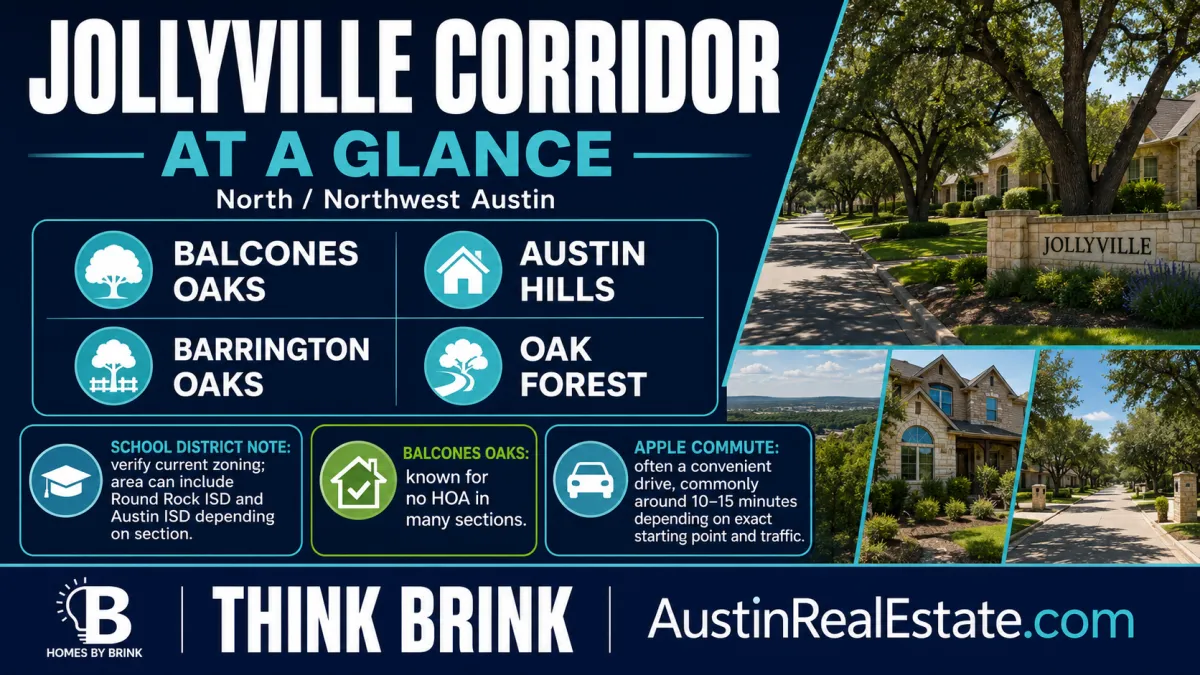
The neighborhoods that most buyers are referring to when they say "Jollyville" in a home search context include Balcones Oaks, Austin Hills, Barrington Oaks, Oak Forest, and the sections of Great Hills and Westover Hills that are closest to the road. Some listings in this area also carry addresses on Jollyville Road itself, which means buyers may be looking at homes directly on the arterial rather than on interior streets - and that distinction is worth paying attention to before you tour.
The broader Jollyville label also bleeds into 78729 on the north end near 183, where the Jollyville Elementary School campus sits and where the apartment density is meaningfully higher. That 78729 portion has a different character from the 78759 residential sections covered in this guide. If you're specifically looking for detached single-family homes in an established neighborhood feel, you want to be clear about which part of the Jollyville area you're targeting.
The Neighborhoods: What's Actually Along This Corridor
Balcones Oaks sits off Jollyville Road near Oak Forest and Barrington Oaks. It has an unusual internal character - two distinct construction eras coexist here, with original 1970s homes in one section and a smaller cluster of David Weekley homes built in 2015 in another. The two sections feel different from each other, and they price differently. The newer Weekley section tends to carry a premium. The original section has the larger lots and more established trees but also carries the maintenance considerations that come with 1970s construction. The neighborhood has no HOA, which is genuinely notable for 78759, and the cul-de-sac layout keeps internal traffic light. Balcones Oaks is served by Round Rock ISD.
Austin Hills is one of the newer-construction pockets in this corridor, with most homes built in the 1980s and 1990s off Jollyville Road near 183. Lots run a quarter to a third of an acre, and the hilly terrain gives some properties partial greenbelt views. The neighborhood has wide streets with sidewalks throughout, which is not universal in this part of Northwest Austin. Austin Hills is served by Austin ISD - which matters, because many buyers searching this corridor assume RRISD and are surprised when they verify the specific address. The Domain is about 10 minutes from most of Austin Hills.
Barrington Oaks and Oak Forest sit on the northern portion of the corridor, closer to 183, with 1970s and 1980s construction and established canopy that's one of the genuinely appealing features of this side of 78759. Both neighborhoods have been seeing buyer interest from people who want a 78759 address at a price point that sits below Great Hills. The school situation varies by specific address across both neighborhoods - another place where verification is essential before you assume.
Living in Barrington Oaks, Austin, TX
Living in Oak Forest, Austin, TX
Great Hills sections nearest Jollyville Road are technically Great Hills but are more accessible on price than the deeper, hillier portions of that neighborhood. Buyers who get priced out of prime Great Hills sometimes find that the sections closer to Jollyville Road offer a more approachable entry point into the same zip code and school access. These homes tend to have less dramatic views than the deeper Great Hills lots but benefit from the same location and in many cases the same school feeder.
Living in Great Hills Austin - What to Expect
The road itself is worth calling out explicitly. Some homes have Jollyville Road addresses, meaning they front directly onto the arterial rather than sitting on interior streets that feed off it. Buyers who are searching by neighborhood name rather than by specific street can end up touring homes on the road itself without fully realizing it until they show up. Always check whether the address is on Jollyville Road directly or on a street that runs off it - the difference in noise, traffic, and day-to-day feel is significant.
The School Situation: More Complex Than Most Buyers Expect
This is the part of the Jollyville corridor that catches the most buyers off guard, and it's worth spending real time on.
The Jollyville corridor straddles the RRISD/AISD boundary, which means that homes within a few blocks of each other can be in different districts. Buyers who come into this area assuming consistent RRISD coverage - because they associate Jollyville with Jollyville Elementary, which is an RRISD campus - are sometimes surprised when a specific address comes back as AISD. The reverse also happens: buyers who don't realize RRISD coverage extends into parts of this corridor miss out on homes that would have satisfied their school requirement.
Within RRISD, the feeder pattern for much of the Jollyville corridor runs through Jollyville Elementary, then to Canyon Vista Middle School, then to Westwood High School. That Jollyville Elementary - Canyon Vista - Westwood feeder is one of the most sought-after in the Austin metro. Westwood carries an IB World School designation and has ranked among the top two public high schools in the Austin area consistently. Buyers specifically targeting that feeder are a meaningful and consistent segment of the Jollyville corridor buyer pool, and homes that carry confirmed Westwood assignment show it in how they price and how quickly they move.
Within AISD, some sections of the corridor feed Hill Elementary, Murchison Middle, and Anderson High School. Anderson is a strong high school in its own right, and buyers who want AISD specifically or whose priority is the Anderson feeder will find options here. But they need to verify that the specific address feeds Anderson and not another AISD campus - the AISD boundary is not uniform across this area.
The practical rule: verify school assignment at the specific address with the relevant district before you make any assumptions. Don't rely on listing descriptions, automated portal school tags, or neighborhood generalizations. The stakes are too high and the errors in online data are too common in this particular corridor.
Best Neighborhoods Near Anderson High School: How Buyers Usually Narrow the Search
Commute Reality From the Jollyville Corridor
The Jollyville corridor is one of the better-positioned residential areas in Northwest Austin for buyers who work at multiple employer locations, because it sits in a zone with legitimate access in several directions without being firmly committed to one routing.
Apple Campus (Parmer near MoPac): From most of the Jollyville corridor, Apple is 10 to 20 minutes in normal conditions. The southern sections of the corridor closer to Spicewood Springs Road have slightly tighter access via MoPac. The northern sections near 183 can route directly on 183 to MoPac. Both work. This is one of the better commutes to Apple in the established Northwest Austin single-family market.
The Domain: About 10 to 20 minutes from most of the corridor depending on time of day. Close enough to use regularly - dinner, shopping, the occasional errand - without treating it as a destination trip.
183 corridor employers: The northern end of the Jollyville corridor sits practically on top of 183, which gives buyers in that section very direct access to employers along that road. For buyers whose employer is on 183, this positioning is a genuine advantage.
Downtown Austin: MoPac is the primary routing and it covers roughly 20 to 30 minutes in normal peak traffic from most of the corridor. The express lanes on MoPac help during congested periods.
Jollyville Road itself during peak hours: This deserves its own mention because buyers sometimes underestimate it. Jollyville Road carries meaningful commute traffic and is not a free-flowing road during morning and evening rush. If your daily route in or out of the neighborhood requires travel on Jollyville Road itself for any distance, drive it at 7:30am and 5:30pm before you commit. Interior streets that connect to cross-streets rather than routing back to Jollyville Road can make a real difference in daily driving experience.
What Homes Look Like and What to Expect
The housing stock across the Jollyville corridor spans roughly five decades of construction - from 1970s originals in Barrington Oaks, Oak Forest, and the older Balcones Oaks section, through 1980s and 1990s builds in Austin Hills and Great Hills sections, to the 2015 David Weekley homes in the newer Balcones Oaks section. That range means buyers need to calibrate expectations differently depending on which part of the corridor they're looking in.
1970s construction in this corridor tends to have the largest lots and the most established tree coverage - mature live oaks and cedar in particular that can't be replicated with younger stock. It also carries the most significant updates question. Homes in original or near-original condition from this era can have dated systems, older windows, and layouts that don't match what contemporary buyers expect. That's priced in to some degree, but not always fully.
1980s and 1990s construction hits the middle ground that moves most consistently in this market - old enough to have established character and lots, young enough that a well-maintained home doesn't feel ancient. This is the majority of the corridor's single-family inventory and where most buyer activity concentrates.
The 2015 Weekley homes in Balcones Oaks represent a different product entirely - newer construction on an established street in an established neighborhood. They price at a premium to the surrounding 1970s homes and attract a different buyer who wants newer finishes without moving to a far-north suburb.
Lot sizes across the corridor generally run from a quarter acre to a half acre for single-family, with some larger lots in the older sections. This is meaningfully more generous than comparable-era neighborhoods further east, and it's one of the consistent reasons buyers who discover the Jollyville corridor tend to stay focused on it.
What Makes This Corridor Different From Nearby Alternatives
Buyers who are researching the Jollyville corridor are usually also looking at Balcones Woods to the south, Mesa Park to the east, or Great Hills deeper into the zip. Here's how the Jollyville pocket compares honestly:
Compared to Balcones Woods, the Jollyville corridor sections tend to have more price variation and more school district complexity but also more lot variety and in some cases better Apple commute positioning on the northern end. Balcones Woods has a more consistent neighborhood feel and a clearer HOA structure in sections where that matters to buyers.
Compared to Mesa Park, the Jollyville corridor offers generally larger lots, more tree character, and in many sections better school access via RRISD. Mesa Park is the more accessible entry point on price but gives up some of what makes the western 78759 sections distinctive.
Compared to Great Hills proper, the Jollyville corridor sections are more accessible on price and less topographically dramatic. Buyers who want the Hill Country terrain and views that Great Hills delivers at its best need to go further west and south into the neighborhood. The Jollyville-adjacent Great Hills sections are flatter and more straightforwardly suburban.
Price Range and What the Market Is Doing
Pricing across the Jollyville corridor varies significantly by neighborhood section and condition, which makes any single number misleading. The range runs from the mid-$400,000s for smaller original-condition homes in the older sections of Barrington Oaks and Oak Forest, through the mid-to-upper $600,000s for well-maintained or updated single-family in Balcones Oaks and Austin Hills, with Great Hills-adjacent and premium-lot homes going above that.
The current market in this corridor rewards correct pricing and clean, well-presented homes. Buyers have more time to evaluate than they did in 2021 and 2022, days on market have extended from the peak pace, and homes that are priced optimistically relative to actual condition tend to sit. The homes that are moving are the ones that are priced honestly for what they are and show well from the first day of listing.
For buyers, the extended market time in the current environment is actually useful in this corridor - there's room to evaluate specific streets, verify school assignments, and complete proper due diligence without the pressure of a 48-hour decision window. Take advantage of it.
What to Check Before You Make an Offer
Run through this before you go under contract on any home in the Jollyville corridor:
Is this address on Jollyville Road itself or on an interior street? If it's on the road, drive it at commute hours before you decide. Noise and traffic exposure from a frontage address is meaningfully different from an interior street.
What school district is this specific address in - RRISD or AISD? Verify with both districts directly. Do not rely on listing descriptions or portal school tags. This is the highest-stakes verification in this corridor.
If RRISD - which feeder pattern? Jollyville Elementary - Canyon Vista - Westwood is the most sought-after RRISD pattern in this corridor. Not every RRISD address in the area feeds this specific path. Confirm the full feeder chain, not just the district.
What decade was this home built and what systems have been updated? A 1973 home and a 1994 home in the same corridor are different purchases. Know what you're walking into on HVAC, roof, windows, and plumbing.
What is the lot character and what surrounds it? Backs to Jollyville Road, to a commercial property, to another neighborhood, or to a greenbelt are all very different situations. Check the specific lot context, not just the neighborhood name.
Is there an HOA and what does it cover? Balcones Oaks has no HOA. Other sections in this corridor vary. Confirm for the specific address.
What is the slope and drainage situation on this lot? The hilly terrain that gives some Jollyville corridor lots their character also creates drainage considerations. Lots on slopes or in low-lying positions relative to surrounding properties deserve attention during inspection.
What is the fiber internet situation at this specific address? Remote workers should confirm before going under contract, not after.
The Buyer Fit Check
The Jollyville corridor tends to work well for buyers who:
Work at Apple, western Parmer corridor employers, or from home
Specifically want the Jollyville Elementary - Canyon Vista - Westwood RRISD feeder and have verified it for the specific address
Want a detached single-family home with a larger-than-average lot in an established 78759 location
Are comfortable with 1970s through 1990s housing stock and either want updated inventory or plan to update over time
Value proximity to the Arboretum, the Domain, and 183 corridor retail without living adjacent to it
Want no-HOA options in an established Northwest Austin zip code (Balcones Oaks specifically)
The Jollyville corridor tends to be a harder fit for buyers who:
Need absolute clarity on a consistent school district without careful address-by-address verification
Are sensitive to arterial noise and haven't verified which specific streets avoid Jollyville Road exposure
Want new construction or fully updated inventory without a search process - it exists but requires filtering
Need large square footage and are working with a limited budget - the larger homes in this corridor price accordingly
The Honest Summary
The Jollyville corridor in 78759 offers something that's genuinely hard to replicate elsewhere in the Austin market at this price range - established lots with real trees, a central Northwest Austin location with strong Apple and Domain commute access, and in the RRISD sections one of the strongest school feeders in the metro. The complexity is real too. The school district split, the arterial noise question on specific streets, and the range of construction eras across the corridor all require careful homework before you commit.
Buyers who do that homework and find a home in the right section of this corridor with the right school assignment tend to be very satisfied long-term. The ones who regret it usually either didn't verify the school situation before they bought, didn't drive the street at peak hours, or didn't fully account for what they were inheriting in terms of deferred maintenance on older inventory.
Go in with specific questions and the willingness to verify everything. That's the right approach for this corridor.
Frequently Asked Questions
Is the Jollyville area in Round Rock ISD or Austin ISD?
Both. The RRISD/AISD boundary runs through the Jollyville corridor and does not follow visible street lines consistently. Some neighborhoods along the corridor are primarily RRISD, others are AISD, and some have homes in both districts within a few blocks of each other. Always verify the specific address with the relevant district.
What is the Jollyville Elementary school feeder pattern?
Jollyville Elementary is an RRISD campus whose feeder runs through Canyon Vista Middle School and then Westwood High School IB World School. This is one of the most sought-after RRISD feeder patterns in the Northwest Austin market. Not all RRISD addresses in the Jollyville corridor feed Jollyville Elementary specifically - the feeder chart varies by address.
How close is the Jollyville corridor to Apple Campus?
From most of the Jollyville corridor in 78759, Apple's Parmer Lane campus is 10 to 20 minutes in normal traffic. The northern sections near 183 route directly via 183 to MoPac. The southern sections closer to Spicewood Springs use MoPac north. Both work well for daily Apple commutes.
What neighborhoods are in the Jollyville corridor?
The primary residential neighborhoods along and off Jollyville Road in 78759 include Balcones Oaks, Austin Hills, Barrington Oaks, Oak Forest, and portions of Great Hills closest to the road. Each has a different construction era, price point, and school district situation.
Does Balcones Oaks have an HOA?
No. Balcones Oaks is one of the no-HOA options in the Jollyville corridor, which is notable in a part of Northwest Austin where many neighborhoods do carry HOA governance. The cul-de-sac layout keeps internal traffic light.
What are home prices like in the Jollyville corridor?
The range is wide - from the mid-$400,000s for smaller original-condition 1970s homes in the older sections up through the mid-to-upper $600,000s for well-maintained or updated inventory, with Great Hills-adjacent and premium-lot homes going above that. Condition and school assignment are the two biggest pricing variables in this corridor.
What is the biggest mistake buyers make in the Jollyville area?
Assuming consistent school district coverage without verifying the specific address. The RRISD/AISD split in this corridor is not intuitive and the online portal data is frequently wrong or outdated. Buyers who assume they're buying into a specific feeder pattern without verifying it at the address level have ended up in the wrong district. Call the district with the address before you make any school-based decisions.
Are there newer homes available in the Jollyville corridor?
Yes, in Balcones Oaks specifically - a section of David Weekley homes built in 2015 sits within an otherwise 1970s neighborhood. These homes are larger, more updated, and priced at a premium to the surrounding original construction. Other than that section, the corridor is primarily 1970s through 1990s housing stock with varying levels of updates.