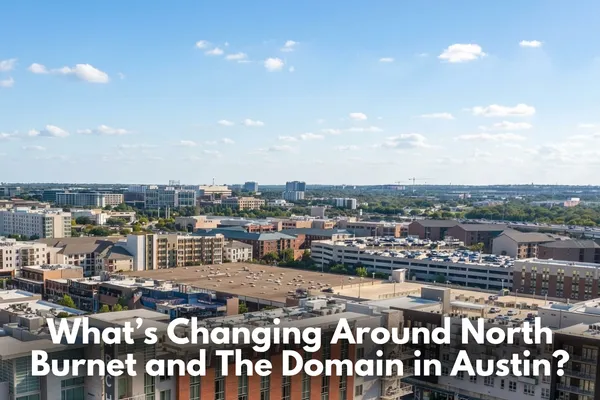
What’s Changing Around North Burnet and The Domain in Austin?
If you’ve been watching North Burnet and The Domain, you’ve probably noticed something:
👉 This area is still evolving fast.
The short answer:
👉 North Burnet / Gateway is still being built toward the long-term “second downtown” vision, with more density, more mixed-use projects, more redevelopment near transit, and major corridor improvements underway. The City of Austin still frames the North Burnet/Gateway plan as a long-range framework for infrastructure, code changes, transit coordination, and private development across roughly 2,300 acres.
For buyers, sellers, and people just trying to understand where this part of Austin is headed, that matters.
Not because every proposal gets built tomorrow.
But because the direction of the area is very clear.
What Is North Burnet / Gateway, Exactly?
North Burnet / Gateway is the large planning district that includes and surrounds major pieces of North Austin like The Domain, Q2 Stadium-adjacent areas, Burnet Road redevelopment zones, and other nearby commercial and mixed-use tracts. The City of Austin defines the district as roughly bounded by Walnut Creek to the north, Metric Boulevard to the east, U.S. 183 to the south and southwest, Braker Lane to the northwest, and MoPac to the west.
So when people say:
“The Domain area is growing”
…what they usually mean is something bigger than just The Domain itself, they mean the larger North Burnet / Gateway corridor is continuing to urbanize.
Why People Keep Calling It Austin’s “Second Downtown”
That phrase is not just marketing.
Community Impact has repeatedly described North Burnet / Gateway as Austin’s “second downtown,” and that tracks with what the planning framework is actually trying to do: allow more height, more density, more mixed-use development, and stronger transit connections than a typical suburban commercial district.
In plain English, this area is being shaped to function more like an urban district than a traditional office-park corridor. That does not mean it will look like downtown Austin tomorrow, but it does mean the city has been steering it toward a denser, more walkable, more transit-oriented future for years.
What’s Actually Changing Right Now?
A few things stand out.
1) More mixed-use and residential entitlement activity
In February 2026, Community Impact reported that Austin City Council approved rezoning for a nearly 7-acre site near Q2 Stadium from warehouse mixed use to commercial mixed use, opening the door for high-density residential and retail uses.
That matters because it is not an isolated idea.
It fits the broader pattern of older industrial, warehouse, apartment, and office properties in the North Burnet / Gateway area being reconsidered for denser mixed-use redevelopment. Community Impact also reported in 2024 on 825 multifamily units being greenlit east of Q2 Stadium and on a Domain-area apartment complex being slated for mixed-use redevelopment with retail, multifamily, and hotel uses.
2) Taller buildings are still part of the story
Taller, denser developments are being planned across the district, with city officials continuing to push the area toward a more urban form. That article also noted that Austin’s skyline in this part of town is poised to get taller.
That is important because height is not just a visual change.
It usually signals:
more people
more mixed-use intensity
more retail support
more pressure to improve streets, mobility, and public realm
3) Burnet Road is getting a real mobility upgrade
In March 2026, construction began on the Burnet Road Corridor Project, a roughly $64 million effort that includes upgraded traffic signals, improved intersections, pedestrian and bike infrastructure, and bus stop improvements. The project is expected to roll out in segments through 2027 and 2028.
This is a big deal. A lot of redevelopment conversations sound abstract until streets and mobility infrastructure actually start changing on the ground.
What About Transit?
Transit is still part of the long-term story, even if the exact buildout is not something to oversimplify.
The City of Austin’s North Burnet / Gateway planning materials explicitly tie the district to transit coordination, and the planning vision has long included concentrating more intensity around higher-capacity transit and station areas. City documents and prior rezoning coverage also show the TOD-Gateway framework being used to focus denser development closer to transit.
So the clean way to say it is: North Burnet is still being planned as a more transit-oriented district than a typical North Austin commercial corridor.
That is the right takeaway, even if specific transit components continue to evolve over time.
Why The Domain Still Matters in All of This
The Domain is still one of the anchor pieces of the whole story.
Even when the headlines are about rezoning near Q2, Burnet Road upgrades, or land-use changes elsewhere in the district, The Domain remains one of the best-known examples of what this area is becoming: more urban, more mixed-use, more employment-heavy, and more lifestyle-driven than the older version of North Austin most people remember. Community Impact also reported in 2025 that Wise expanded significantly in Domain Tower 2, which is another reminder that the office and employment component here is still active.
So when people ask:
“What’s changing around The Domain?”
The honest answer is:
Not just The Domain itself. The whole district around it is continuing to densify and reposition.
What This Means for Buyers
For buyers, the takeaway is not:
“You need to buy here because everything is exploding.”
That is too hypey and too simplistic.
The better takeaway is:
If you like urban-style convenience, access to major employers, retail, restaurants, entertainment, and continued area investment, North Burnet / The Domain is still one of the clearest examples of that in Austin.
That does not make it the right fit for everyone, but it does make it a very specific lifestyle and location play.
What This Means for Sellers and Owners Nearby
For sellers and owners nearby, this is more of a positioning advantage than a magic wand.
You still have to price correctly.
You still have to present the home well.
You still have to compete with what buyers can get elsewhere.
But ongoing reinvestment, zoning momentum, and infrastructure improvements help reinforce that this area is not stale. The combination of active rezonings, corridor work, and continued planning support tells a stronger story than “this is near The Domain.”
That is useful.
A Real-World Perspective
North Burnet / The Domain is not “finished.”
This part of Austin is still in the middle of becoming what planners, developers, and city officials have been pushing toward for years: a denser, more connected, more mixed-use urban district in North Austin. The evidence is not just one flashy tower rendering. It is the ongoing combination of code framework, rezonings, redevelopment proposals, transit-oriented planning, and major street improvements already underway.
A Better Way to Think About It
Instead of asking:
“Is North Burnet changing?”
Ask:
“How much more urban, connected, and built-out is this area likely to become over time?”
That is the better question.
And based on the planning framework and recent approvals, the answer is quite a bit more than it is today. That is an inference from the city’s long-term plan, recent rezonings, and corridor investment, not a guarantee that every proposed project gets built exactly as imagined.
Final Thoughts
What’s changing around North Burnet and The Domain is pretty straightforward:
more mixed-use redevelopment
more residential intensity
more urban-scale entitlement activity
more investment in streets and mobility
continued movement toward the long-discussed “second downtown” vision
For buyers, sellers, and anyone watching North Austin, that is worth paying attention to.
Because this area is not drifting, rather it is still being actively shaped.
Frequently Asked Questions
What is the North Burnet / Gateway district?
It is a roughly 2,300-acre planning district in North Austin bounded by Walnut Creek, Metric Boulevard, U.S. 183, Braker Lane, and MoPac, with a long-range framework for infrastructure, transit coordination, and private development.
Why do people call it Austin’s second downtown?
Because the area is being planned for higher density, more mixed-use development, and stronger transit orientation than a typical suburban commercial district. Community Impact has repeatedly used that phrase in its coverage.
What are some current examples of change there?
Recent examples include rezoning for a mixed-use residential project near Q2 Stadium and the start of the Burnet Road Corridor Project with safety and mobility upgrades.
Does this matter for nearby real estate?
It can. Ongoing redevelopment and infrastructure investment can strengthen the area’s convenience and long-term appeal, although the effect on any specific property still depends on price, product, location, and timing. That conclusion is an inference based on the planning framework and current investment activity.
