Living in 78750 and 78759: The Northwest Austin Zip Code Guide Buyers and Sellers Should Bookmark
If you're searching for a home in Northwest Austin and your search keeps pulling up zip codes 78750 and 78759, you're looking at the two zips that define the core of what makes this part of Austin worth the premium it commands. These aren't interchangeable with the broader "Northwest Austin" label that gets applied loosely to a much wider geography. They are specific, established, and for the right buyer, genuinely hard to beat.
This guide is for buyers who want a straight answer about what these two zips actually contain, how they differ from each other, what the neighborhoods are really like, what schools serve them, what homes are trading for, and how to figure out which specific neighborhood fits what you're actually looking for. It's also useful for sellers who want to understand how buyers are evaluating this market and what separates homes that move from homes that sit.
There's a lot of generic content about Northwest Austin online. This is not that.
Is Northwest Austin Still Worth the Premium?
The Geography: What 78750 and 78759 Actually Cover
These two zip codes sit side by side in the heart of Northwest Austin, west of MoPac and south of 183, with 360 forming the western boundary for much of their combined footprint.
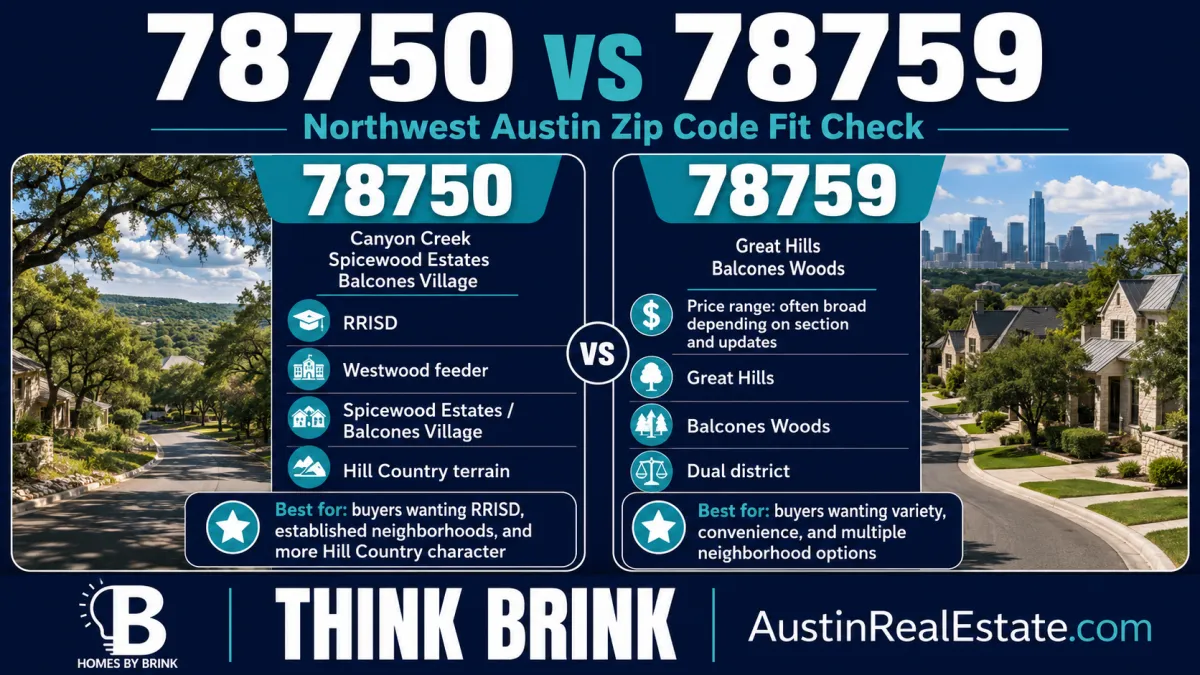
78759 is the larger and more varied of the two. It runs roughly from MoPac on the east to 360 on the west, and from 183 on the north to Spicewood Springs Road on the south. The neighborhoods inside 78759 range from the hillier, more prestigious Great Hills and Westover Hills sections to the more accessible and family-oriented Balcones Woods, Mesa Park, Barrington Oaks, and Oak Forest pockets. Sixteen distinct neighborhoods carry a 78759 address, and the range in price, character, and topography between them is significant.
78750 sits to the northwest of 78759, bordered roughly by 360 to the west, 183 to the north, and Spicewood Springs Road to the south, with some overlap into the Anderson Mill area. It's a smaller zip geographically but carries some of the most sought-after addresses in the Northwest Austin corridor - Canyon Creek, Spicewood Estates, Balcones Village, and the Estates of Brentwood among them - along with the feeder schools that draw buyers from across the metro.
Together, these two zips form the residential core of what buyers mean when they say they want to be "in Northwest Austin" rather than "near Northwest Austin." The distinction matters more than most buyers realize before they start touring.
Why These Two Zips Keep Coming Up in Buyer Searches
The short answer is that 78750 and 78759 sit at the intersection of several things buyers are looking for simultaneously, and that combination is genuinely hard to replicate elsewhere in the Austin market.
The employer proximity is real. Apple's Parmer Lane campus, the broader Parmer tech corridor, and the Domain are all accessible from these zips without the kind of commute math that forces buyers further north or east to compromise on location. From most neighborhoods in 78750 and 78759, Apple is a 10 to 20 minute drive in normal conditions. The Domain is 15 to 25 minutes. Downtown is 20 to 35 minutes via MoPac. That's a commute profile that buyers who chose Cedar Park or Leander instead often wish they had.
The school situation is a genuine draw. Both zips sit at an unusual crossroads of two strong districts - Round Rock ISD on one side and Austin ISD on the other - with specific campuses in each that rank among the strongest in the Austin metro. Westwood High School in RRISD carries an IB World School designation and has been ranked among the top two public high schools in the Austin area. Anderson High School in AISD has its own strong programs and a long-established reputation. Buyers who are specifically chasing a high school assignment often end up narrowing to one of these two zips as a result.
The physical character is something that takes buyers time to fully appreciate before they buy but that long-term residents consistently cite as the reason they stayed. The Hill Country terrain that defines the western portion of these zips - the elevation changes, the canyon views, the mature live oaks and cedars - doesn't exist in the flat suburban neighborhoods that were built further north and east in the same era. You can't recreate it with new construction. Buyers who discover it tend to stop looking elsewhere.
78759: What's Inside and How It Breaks Down
Sixteen named neighborhoods carry a 78759 address. Most buyers don't need to know all of them - they need to know the ones that are likely to fit their situation.
Great Hills is the neighborhood most associated with 78759 in general buyer conversation, and for good reason. It covers a large footprint in the central and western portion of the zip, includes the Great Hills Golf Club, and has some of the most dramatic Hill Country views and elevation changes of any established neighborhood in Austin proper. Homes range widely - from more modest townhome and patio home products on the lower end up to custom and semi-custom single-family homes well above a million dollars on premium lots. The school situation in Great Hills crosses both RRISD and AISD depending on specific address, which matters and requires verification before you commit.
Balcones Woods sits in a different character category than Great Hills - more accessible price point, more consistent single-family product, established trees, and a neighborhood feel that draws buyers who want the 78759 location without the topographic complexity. Balcones Woods has an active neighborhood association and a community pool, and tends to appeal to buyers who want a functional, established neighborhood over a prestige address.
Mesa Park is the most accessible entry point in 78759. Smaller homes, more modest lots compared to Great Hills, but the same 78759 location and similar school access. Buyers who are priced out of the higher-end 78759 sections sometimes find Mesa Park hits the value case they need.
Barrington Oaks and Oak Forest sit on the northern edge of 78759 near 183, with a mix of 1970s and 1980s construction and established canopy that's genuinely appealing. Both neighborhoods have been seeing buyer interest from people who want the zip code at a price point that's lower than what Great Hills commands.
Westover Hills, Canyon Mesa, and the hillier western sections of 78759 carry the most dramatic terrain and typically the highest price points. Westover Hills in particular has custom homes on large lots with views that are genuinely unusual for this close to the urban core.
Jollyville is worth calling out separately because it's both a neighborhood name and a road name in this area, which creates confusion. The Jollyville neighborhood loosely refers to sections of 78759 that run along and near Jollyville Road, primarily on the western side of the zip. These sections have a mix of older construction and occasional newer infill, and the surrounding commercial context on Jollyville Road itself is something buyers need to account for when evaluating specific streets.
The price range across 78759 as a whole is genuinely wide - from the high $300,000s in the most accessible Mesa Park sections up through the mid-$700,000s for median-range Great Hills inventory and well above that for premium custom homes on the western hillside. Knowing which section you're in matters as much as knowing the zip code.
Best Neighborhoods in 78759, Austin - What Buyers and Sellers Should Know
78750: What's Inside and How It Breaks Down
78750 is smaller geographically but carries a concentrated cluster of neighborhoods that consistently rank among the most desirable in the Northwest Austin corridor.
Canyon Creek is the flagship neighborhood of 78750 for most buyer conversations. Built primarily in the 1990s by a mix of builders, Canyon Creek has larger lots than most Northwest Austin neighborhoods of the same era, significant tree coverage including some genuinely mature oak canopy, and a price point that reflects all of it. A well-maintained Canyon Creek home in good condition is trading at a meaningful premium over comparable square footage elsewhere in the zip code, and that premium has been relatively stable over time. The neighborhood has an HOA, community amenities, and a level of internal consistency that buyers coming from outside Austin tend to respond well to.
Spicewood Estates is the neighborhood that tends to surprise buyers who discover it. Tucked off Spicewood Springs Road west of 183, it's smaller than Canyon Creek but has lot sizes that run from a fifth of an acre up to a full acre in some cases - unusually generous for a neighborhood this close to the urban core. Homes here are not cookie-cutter. The architectural variation, the Hill Country terrain, the adjacency to the Balcones Canyonlands Preserve, and the views that some lots carry make Spicewood Estates a neighborhood where buyers who find it tend to stop looking. It feeds the Westwood High School feeder through RRISD via Spicewood Elementary and Canyon Vista Middle School, which is a consistent draw.
Balcones Village sits adjacent to Spicewood Estates and shares some of the same character - established single-family homes, RRISD schools, proximity to the preserve and Bull Creek corridor. It's a neighborhood that's been in the shadow of Canyon Creek in buyer searches but deserves more attention than it typically gets.
Estates of Brentwood is the newest-construction neighborhood in the 78750 cluster, built primarily in the late 1990s by Morrison Homes and D.R. Horton. Homes here are larger than most of the 78750 inventory, lots are generous, and the RRISD school connection is consistent. Buyers who want larger square footage at a 78750 location sometimes find Estates of Brentwood threads the needle between the more dated inventory in Spicewood Estates and Canyon Creek and the price tag of a newer far-north suburb.
Anderson Mill sections in 78750 give buyers access to the zip code at a generally lower price point than Canyon Creek or Spicewood Estates, with a mix of 1970s and 1980s construction and the school variation that comes with being at the edge of multiple district boundaries. Always verify school assignment by specific address in Anderson Mill sections - the RRISD/AISD boundary runs through portions of this area.
The price range in 78750 runs from the high $400,000s for modest original-condition inventory in Anderson Mill sections up through the mid-$600,000s for typical Canyon Creek single-family, with Spicewood Estates premium lots and larger Canyon Creek homes going above that.
Best Neighborhoods in 78750: How Buyers Usually Narrow the Search
The School Picture: What Buyers Need to Understand
This is where buyers in 78750 and 78759 need to be especially careful, because the school situation in these two zips is more complex than most online resources communicate.
Both zips sit at the boundary of Round Rock ISD and Austin ISD. The dividing line is not the zip code boundary - it runs through neighborhoods, sometimes through blocks, and the assignment for a specific address is the only thing that matters. Two homes across the street from each other can be in different districts. This is not an exaggeration - it's the lived reality in parts of both zips.
Within RRISD, the campuses most associated with these zips are Spicewood Elementary, Canyon Vista Middle School, and Westwood High School IB World School. This feeder pattern is one of the most sought-after in the Austin metro and has been consistently strong for well over a decade. Westwood's IB program in particular draws buyers who are specifically targeting it - and the real estate premium that comes with confirmed Westwood assignment is real and measurable.
Within AISD, the campuses most associated with these zips include Hill Elementary and Summitt Elementary on the grade school side, with paths to Anderson High School on the high school end. Anderson is a strong school in its own right and draws buyers who want AISD specifically or who are drawn to the neighborhoods that happen to feed Anderson.
The practical implication: when you are evaluating any specific home in 78750 or 78759, verify the school assignment at that address with the relevant district before you make any assumptions. Don't rely on the listing description, the automated school tags on real estate portals, or neighborhood generalizations - including this guide. Assignment boundaries have shifted over time and can shift again. Call the district with the address.
Commute and Access: The Real Numbers
One of the primary reasons buyers pay the premium to be in 78750 and 78759 is commute positioning, so it's worth being specific about what that actually looks like.
Apple Campus (Parmer Lane near MoPac): From most of 78759, Apple is 10 to 20 minutes depending on which section you're in and what time you leave. From 78750, the western and northern sections add a few minutes but the routing via 183 or MoPac north keeps it manageable. This is meaningfully better than Cedar Park or Leander buyers deal with daily.
The Domain: From 78759, the Domain is typically 15 to 25 minutes depending on traffic and direction of travel. From 78750, add a few minutes for the additional distance. Close enough to use regularly without treating it as a trip.
Downtown Austin: MoPac is the primary artery for both zips heading downtown. Budget 20 to 35 minutes in normal peak traffic. The express toll lanes on MoPac help during congested periods and are worth the cost for regular commuters.
183/Research Blvd corridor employers: Highly accessible from both zips, particularly for the sections that sit directly off 183. This is one of the better-positioned areas in the metro for employees who work at employers along the 183 corridor.
360 corridor and westward: Buyers who work along 360 or further west toward Lake Travis find that 78750 in particular positions them well for that direction.
Dell in Round Rock: This is the one commute that these zips don't serve especially well. Getting north on MoPac or 183 to Round Rock adds time. Buyers who commute daily to Dell's Round Rock campus often find Wells Branch or neighborhoods further north make more sense on commute math.
Is 78759 a Good Place to Live?
What Homes Look Like and What Buyers Should Expect
The housing stock in 78750 and 78759 was built primarily from the early 1970s through the late 1990s, with the Estates of Brentwood on the newer end and some of the Great Hills and Barrington Oaks sections on the older end. That range matters for what buyers are walking into.
Homes built in the 1970s and early 1980s in these zips often have the features that make Northwest Austin distinctive - large lots, mature trees, Hill Country terrain, and room configurations that reflect how people lived before open-concept became the default. They also carry the deferred maintenance and original finishes that come with 40-plus years of age. Buyers evaluating these homes need to go in with a clear understanding of what the major systems look like and what they may be inheriting.
Homes from the late 1980s and 1990s - the bulk of Canyon Creek, Spicewood Estates, and Balcones Village - hit a middle ground. Old enough to have established character, young enough that a well-maintained home doesn't feel ancient. This is the inventory that moves most consistently in these zips when priced correctly and presented well.
The updates question comes up constantly in both zips. A meaningful portion of the housing stock in 78750 and 78759 still carries original finishes - tile countertops, oak cabinets, brass fixtures, carpet in the bedrooms. Buyers who are moving from out of state or from newer construction sometimes react to this more strongly than local buyers who understand the value of the location. The gap between an updated home and an original-condition home in these zips can be $75,000 to $150,000 or more depending on size and neighborhood, and that spread has been consistent.
For sellers, the implication is that selective, well-executed updates still move the needle here - but over-improving for the street or the zip is a real risk. Understanding where the ceiling is before you spend money is one of the most important conversations to have before you renovate.
What's Selling and What's Sitting: The Current Market Reality
Market data from late 2025 and into 2026 puts median sale prices in 78750 in the upper $500,000s to mid-$600,000s range for typical single-family inventory, with premium lots and larger homes going above that. 78759 runs a bit lower at the median - mid-$600,000s to low $700,000s for typical inventory - though Great Hills and Westover Hills push the upper end well above that.
Both zips are in a market that rewards correct pricing and penalizes optimism. Days on market have extended from the frenzied pace of 2021 and 2022, and buyers in both zips are doing more comparison shopping than they were three years ago. Homes that are priced accurately for their specific condition, location within the zip, and school assignment are still moving. Homes priced based on what the neighbor got in 2022 are sitting and eventually chasing the market down.
The interesting dynamic in both zips right now is that the best-located, best-condition homes are still generating multiple offers and selling at or above list. The widest buyer pool in these zips is not looking for a project - they want something they can move into. Homes that are clean, updated to a reasonable level, and priced to reflect both the location and the condition are in a different market than homes that need significant work.
For sellers, this means preparation and pricing strategy are not optional extras. They are the primary variables you control that determine how a home performs.
Living in Balcones Village, Austin, TX - What Buyers and Sellers Should Know
How to Use This Guide: Narrowing the Search
78750 and 78759 together contain enough variety that buying "in these zips" without more specificity is not really a strategy. The neighborhood, the school assignment, the lot character, and the specific street context matter as much as the zip code.
Here is how buyers in this market tend to narrow from zip code to specific neighborhood:
Start with the school question. If Westwood High School via RRISD is a requirement, you're primarily looking at Canyon Creek, Spicewood Estates, Balcones Village, and Estates of Brentwood in 78750, plus the RRISD-zoned sections of 78759. If Anderson High School via AISD fits your situation, a different set of streets and sections opens up. Getting clarity on this early eliminates a lot of false starts.
Then work the commute math honestly. Map your employer location against the specific neighborhoods you're considering and drive the actual route at the time of day you'll be doing it. Don't rely on Google Maps at 2pm on a Tuesday.
Then look at lot and terrain. If you want Hill Country views and elevation, you're looking at Great Hills, Westover Hills, Canyon Mesa, and Spicewood Estates. If you want a flatter, more traditional suburban lot, Balcones Woods, Canyon Creek, and the Anderson Mill sections of 78750 offer that.
Then work the price. Be honest about what your budget actually buys in each neighborhood in its current condition. An updated Canyon Creek home at $750,000 and an original-condition Canyon Creek home at $600,000 are different purchases requiring different conversations about what you're taking on.
Going Deeper: Neighborhood-Specific Guides
This pillar page gives you the framework. For specific neighborhoods in 78750 and 78759, the detailed guides go further into section-by-section differences, what to check before making an offer, flood plain and terrain considerations, HOA nuances, and the specific buyer profile that tends to land well in each one.
Current in-depth neighborhood guides in this zip cluster:
Living in Spicewood Estates, Balcones Village, and Spicewood at Bull Creek
Great Hills vs Northwest Hills: Which Northwest Austin Neighborhood Fits You Better?
Buyer decision guides and additional neighborhood deep-dives for Jollyville, Canyon Creek, Spicewood Estates, and the broader 78750 seller strategy are in progress. If you want a direct conversation about which neighborhood in these two zips fits your specific situation - employer, budget, schools, and what you actually want in a home - that's exactly the kind of work I do every day in this market.
Frequently Asked Questions
What is the difference between 78750 and 78759 in Northwest Austin?
78759 is the larger zip code covering Great Hills, Balcones Woods, Mesa Park, and roughly a dozen other established neighborhoods. 78750 sits to the northwest and contains Canyon Creek, Spicewood Estates, Balcones Village, and Estates of Brentwood among others. 78750 generally carries slightly higher median prices and more consistent RRISD school access. 78759 has more price and neighborhood variety, running from the high $300,000s in Mesa Park up through the millions in Great Hills and Westover Hills.
Are 78750 and 78759 in Round Rock ISD or Austin ISD?
Both. The RRISD/AISD boundary runs through both zip codes and is not consistent with zip code lines. Specific address determines district. Within RRISD, the primary high school for much of 78750 and parts of 78759 is Westwood High School IB World School. Within AISD, Anderson High School serves portions of both zips. Always verify assignment at the specific address with the relevant district.
What is Westwood High School's reputation?
Westwood High School is an IB World School within Round Rock ISD that has consistently ranked among the top two public high schools in the Austin metro area. Homes that feed Westwood via RRISD carry a measurable price premium, and buyers specifically targeting the Westwood feeder pattern are a consistent segment of the 78750 and portions of the 78759 buyer pool.
What are typical home prices in 78750 and 78759?
78750 median sale prices for typical single-family inventory have been running in the upper $500,000s to mid-$600,000s range. 78759 runs from the high $300,000s in the most accessible sections up through the mid-$700,000s and above for Great Hills and Westover Hills. Both zips have softened from 2021-2022 peaks but remain well above pre-pandemic levels.
How close are 78750 and 78759 to Apple Campus?
From most of 78759, Apple's Parmer Lane campus is 10 to 20 minutes in normal traffic. From 78750, routing via 183 or MoPac north keeps most sections within 15 to 25 minutes. Both zips are among the better-positioned residential options for Apple and western Parmer corridor employees in the established single-family market.
What neighborhoods in 78759 have the most character and views?
Great Hills, Westover Hills, Canyon Mesa, and the hillier sections along the western edge of 78759 closest to 360 have the most significant Hill Country terrain, elevation changes, and views. These sections also carry the highest price points in the zip.
Is 78750 or 78759 better for families?
Both are strong family zips. 78750 tends to have a slight edge for buyers specifically targeting RRISD and the Westwood High School feeder, as a larger share of 78750 addresses feed that pattern consistently. 78759 has more school variability - some sections are RRISD, others are AISD - which can be an advantage or a complication depending on your priorities.
What should buyers watch out for in 78750 and 78759?
Three things consistently catch buyers off guard. First, school assignment variability - the district boundary is not intuitive and specific address verification is essential. Second, terrain-related considerations in the hillier sections - drainage, foundation, and access all deserve attention on steep lots. Third, the updates gap in the older inventory - original-condition homes in these zips can look like a bargain on price per square foot until you factor in what it costs to bring them to the condition buyers want. Go in knowing which you're buying.
