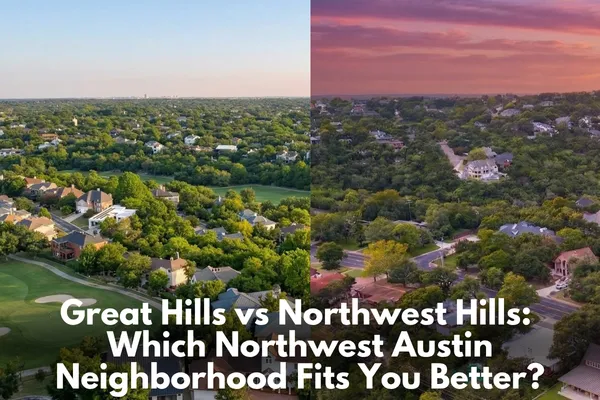
Great Hills vs Northwest Hills: Which Northwest Austin Neighborhood Fits You Better?
If you are deciding between Great Hills and Northwest Hills, you are not really choosing between a “good” neighborhood and a “bad” one.
You are choosing between two of the more established and recognizable areas in Northwest Austin that appeal to buyers for different reasons.
On paper, both can check a lot of the same boxes. Both are established. Both have strong Northwest Austin identity. Both appeal to buyers who want mature trees, larger lots than many newer neighborhoods, and better access to the northwest side of the city than a farther-out suburban search. Both also tend to attract buyers who want something that feels more rooted and residential than a newer master-planned community.
But once buyers actually start comparing them, the differences start to matter.
This is usually less about which one is “better” and more about which one fits your priorities better.
Why buyers end up comparing Great Hills and Northwest Hills
This is a very normal comparison because both neighborhoods sit in the broader Northwest Austin conversation and both tend to attract buyers who want:
established homes
stronger neighborhood identity
mature landscaping and topography
practical access to major roads
a more residential, long-term feel
A lot of buyers looking in one will eventually look at the other.
But even though they overlap in broad appeal, they do not feel the same in everyday life.
The biggest difference: Northwest Hills feels more classically central Northwest Austin, while Great Hills often feels more tied to the 183 / Arboretum / Domain side of the map
That is the first distinction I usually point out.
Northwest Hills tends to feel more like classic interior Northwest Austin. It often appeals to buyers who want a stronger old-Austin residential feel, more winding residential streets, and a neighborhood identity that feels less tied to commercial zones.
Great Hills is still very much an established Northwest Austin neighborhood, but for many buyers it feels a little more connected to the north-central side of the northwest corridor, especially when access to 183, the Arboretum, Gateway, or The Domain matters.
That does not make one better. It just changes the kind of buyer each one tends to attract.
Northwest Hills: what tends to draw buyers there
Northwest Hills usually appeals to buyers who want the neighborhood itself to be a major part of the decision.
People are often drawn there because it feels established in a very visible way. The topography, tree cover, lot patterns, and overall streetscape give it a stronger sense of place than many neighborhoods that feel more standardized.
Northwest Hills often makes sense for buyers who want:
a more classic Northwest Austin residential identity
mature trees and a stronger natural setting
a neighborhood that feels tucked into Austin rather than out on the suburban edge
homes with character, variation, and established presence
access to central and northwest parts of the city without living in a more urban setting
For a lot of buyers, Northwest Hills is not just about the house. It is about the overall feel of being in that part of Austin.
Great Hills: what tends to draw buyers there
Great Hills often appeals to buyers who want established Northwest Austin, but with a location that can feel more practical for certain daily patterns.
It tends to attract buyers who like the idea of a mature neighborhood, but who also want easier connection to areas like 183, Gateway, the Arboretum, The Domain, and the broader North Austin employment corridor.
Great Hills often makes sense for buyers who want:
an established neighborhood with strong visual appeal
mature landscaping and more topographic interest than flatter suburban areas
access that can feel more convenient for North Austin work and retail patterns
a neighborhood that still feels residential without feeling disconnected
a good middle ground between Northwest Austin character and North Austin convenience
For some buyers, Great Hills lands in a sweet spot because it gives them the established neighborhood feel they want without pulling them as far from their daily north-side routines.
Housing feel: both are established, but buyers often react differently once they drive them
This is where the in-person comparison starts to matter.
Northwest Hills often feels more distinctly residential in a classic Austin way. Buyers who value neighborhood texture, mature canopy, and a more tucked-away feeling often respond strongly to it.
Great Hills also has strong established-neighborhood appeal, but many buyers experience it as a little more “connected” to the broader north-side infrastructure. For some, that is a positive. For others, it means Northwest Hills feels more like an escape.
A lot depends on what you want your surroundings to feel like once you are home.
Commute and location logic
This is one of the biggest decision points.
If your regular routine takes you toward:
183
Gateway
the Arboretum Living Near the Arboretum in Austin - What to Expect
The Domain What’s Changing Around North Burnet and The Domain in Austin?
North Austin employers
Apple / tech corridor-adjacent areas
Great Hills often becomes very compelling.
If your routine is more tied to a broader Austin lifestyle and you care as much about the feel of the neighborhood as the efficiency of north-side access, Northwest Hills can become the stronger emotional fit.
Again, neither one is wrong. The difference is whether you prioritize:
a more interior-feeling Northwest Austin location
or a location that often feels a little more plugged into the northern corridor
Lot size, setting, and neighborhood personality
Buyers comparing these two neighborhoods are usually looking for more than square footage.
They are often looking for:
more land or a more generous lot feel
more mature surroundings
stronger curb appeal through landscaping and topography
neighborhoods that feel like they have been there a while
Both neighborhoods can satisfy that better than many newer communities.
But the personality is different.
Northwest Hills tends to feel more timeless and more purely residential.
Great Hills often feels like the buyer is still getting that established setting, but with a bit more connection to the north-side business, shopping, and convenience corridor.
That difference matters more than people think.
Which one tends to fit different kinds of buyers?
Northwest Hills may fit better if you want:
a more classic Austin residential feel
stronger neighborhood character
mature trees and topography as a major part of the appeal
a location that feels less tied to commercial convenience
a neighborhood that feels more like a destination in itself
Great Hills may fit better if you want:
established Northwest Austin living with strong access advantages
practical routes to 183, Gateway, Arboretum, or The Domain
mature neighborhood feel without giving up north-side convenience
a balance of residential appeal and day-to-day efficiency
a location that supports both lifestyle and commute logic
Resale and long-term fit
Both neighborhoods tend to remain on serious buyers’ radar because they are established, recognizable, and sit in parts of Northwest Austin that continue to attract people who do not want a generic search.
That said, resale strength is not just about the neighborhood name. It is also about:
specific lot
level of updating
floor plan
how well the home matches what buyers in that neighborhood typically want
What matters from a strategy standpoint is that both Great Hills and Northwest Hills benefit from having real identity. They are not interchangeable subdivisions that blur together online.
That matters for both buyers and sellers.
What sellers should understand about this comparison
If you are selling in either neighborhood, buyers are not just comparing your house against nearby active listings.
They are often comparing:
Great Hills versus Northwest Hills
established Northwest Austin versus farther-out suburban alternatives
character and setting versus newer finishes elsewhere
commute convenience versus neighborhood feel
That means the marketing has to do more than show photos and basic specs.
You need to position the home within the neighborhood story.
In Northwest Hills, that often means leaning into setting, character, lot feel, and classic Northwest Austin identity.
In Great Hills, that often means emphasizing both neighborhood appeal and practical proximity to the Arboretum, Gateway, 183, and North Austin convenience patterns.
The common mistake buyers make
The most common mistake is assuming these two neighborhoods are basically the same because they are both established and both in Northwest Austin.
They are not.
They attract overlapping buyers, but the reason people ultimately choose one over the other is usually tied to a more specific lifestyle preference:
what the neighborhood feels like when you drive it
what your daily route looks like
whether you want “more Austin” or “more north-side convenience”
how much the home’s setting matters to you
how central versus corridor-connected you want to feel
That is why this comparison is worth doing carefully.
My practical take
If you are drawn to neighborhood character first, I would usually make sure Northwest Hills is on your shortlist.
If you want established Northwest Austin but your daily routine leans heavily toward 183, Gateway, the Arboretum, or The Domain, Great Hills often ends up making a lot of sense.
And for a lot of buyers, the answer becomes clear only after driving both and seeing which one feels more aligned with how they actually live.
Final thought
Great Hills and Northwest Hills are both strong Northwest Austin options, but they solve for different priorities.
Northwest Hills often wins when buyers want classic Austin neighborhood character, stronger natural setting, and a more tucked-in residential feel.
Great Hills often wins when buyers want established Northwest Austin living with better connection to the north-side corridor of work, retail, and daily convenience.
The right choice is usually not about which neighborhood sounds better online.
It is about which one fits your actual life better once you are living there.
FAQ
Is Great Hills or Northwest Hills more convenient for commuting?
For many buyers, Great Hills feels more convenient if daily life revolves around 183, Gateway, the Arboretum, The Domain, or North Austin employers. Northwest Hills can still be well located, but it often appeals more for overall neighborhood feel than pure north-corridor convenience.
Which neighborhood feels more established, Great Hills or Northwest Hills?
Both are established, but Northwest Hills often feels more classically residential and more rooted in the traditional Northwest Austin identity. Great Hills also feels established, but often with a little more connection to the nearby north-side commercial and employment corridor.
Is Northwest Hills more central than Great Hills?
In practical terms, many buyers experience Northwest Hills as feeling more tucked into Austin, while Great Hills can feel more oriented toward the 183 / Arboretum / Domain side of the map. Which feels “better” depends on where you need to go most often.
Which neighborhood has more character, Great Hills or Northwest Hills?
A lot of buyers would say Northwest Hills has stronger neighborhood character if they value mature canopy, topography, and a more timeless residential feel. Great Hills also has character, but it often wins more on the balance between established setting and convenience.
Is Great Hills a good option for buyers who work near The Domain or Gateway?
Yes. Great Hills often makes a lot of sense for buyers who want an established Northwest Austin neighborhood while keeping easier access to Gateway, the Arboretum, The Domain, and related work or retail corridors.
Should sellers market homes in Great Hills and Northwest Hills differently?
Usually yes. Buyers are often drawn to Northwest Hills for neighborhood feel, setting, and classic Northwest Austin identity, while Great Hills buyers are often also weighing convenience, corridor access, and proximity to major north-side destinations. The marketing should reflect that difference.