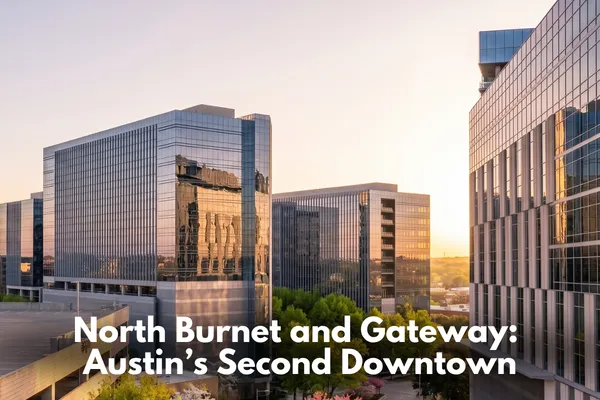
North Burnet and Gateway: Austin’s Second Downtown
If you’ve spent any time around The Domain, Q2 Stadium, Burnet Road, Braker Lane, or Gateway, you’ve probably noticed something:
👉 This part of Austin is not developing like a typical suburban commercial corridor anymore.
The short answer:
👉 North Burnet and Gateway is being built toward a denser, more urban, more mixed-use future than most of North Austin. The City of Austin’s own planning materials say the district is intended to accommodate major growth over the next 30 years through denser housing, mixed-use development, and better connectivity.
That is why people keep calling it:
👉 Austin’s second downtown.
And at this point, that label is not just hype, it is a useful way to understand what is actually happening here.
What Is North Burnet / Gateway?
North Burnet / Gateway is a large planning district in North Austin that includes and surrounds some of the city’s biggest growth nodes, including:
The Domain
Domain NORTHSIDE
areas around Q2 Stadium
Burnet Road redevelopment corridors
major commercial and industrial tracts being repositioned over time
The City of Austin says the district is roughly bounded by Walnut Creek to the north, Metric Boulevard to the east, U.S. 183 to the south and southwest, Braker Lane to the northwest, and MoPac to the west.
That matters because when people talk about growth around The Domain, they are usually talking about something bigger than just The Domain itself.
They are talking about a much larger district that has been planned for long-term urbanization.
Why People Call It Austin’s “Second Downtown”
This is not just a catchy phrase.
Community Impact has repeatedly described North Burnet / Gateway as Austin’s “second downtown,” and that tracks with what the planning framework actually aims to do: allow more height, more density, more mixed-use development, and stronger transit and mobility connections than you would expect in a typical suburban office-and-retail zone. (communityimpact.com)
This area is being shaped to function more like an urban district than a traditional North Austin commercial strip. That does not mean it is going to look exactly like downtown Austin.
But it does mean the city is intentionally steering it toward:
more residential density
more mixed-use activity
more vertical growth
more street and mobility connectivity
more people living, working, and spending time in the same district
What the City Is Actually Planning For
The City of Austin’s North Burnet/Gateway planning page is pretty direct about the goals for the district.
The city says the plan is designed to:
encourage high-quality design and connectivity
accommodate major regional growth
introduce denser housing types such as townhomes and condos
integrate housing above commercial uses
expand the street network and improve mobility within the district
That is a very different vision than:
a standard suburban shopping district
a collection of office parks
a detached-home neighborhood cluster
This is one of the clearest examples in Austin of a district being intentionally built toward a more urban future.
What’s Actually Changing on the Ground
This is where the “second downtown” label starts to make sense.
A few things stand out.
1. More mixed-use residential development is still moving forward
In February 2026, Community Impact reported that Austin City Council approved a rezoning near Q2 Stadium from warehouse mixed use to commercial mixed use, opening the door to high-density residential and retail uses.
That is not just one isolated project.
It fits a broader pattern of older industrial and warehouse sites being reconsidered for denser mixed-use redevelopment.
2. Taller buildings are still part of the story
Community Impact reported in July 2025 that taller, denser developments were being planned across the district, with Austin’s skyline in this part of town poised to get taller as the area continues to evolve.
That matters because height usually signals more than just appearance.
It usually means:
more people
more office and residential intensity
more retail support
more need for public-realm improvements
more of a true district identity
3. Burnet Road is getting real infrastructure investment
In March 2026, Community Impact reported that construction began on the $64 million Burnet Road safety and mobility project, bringing upgraded traffic signals, pedestrian and bike infrastructure, improved bus stops, and related corridor improvements. The project is expected to roll out in segments through 2027 and 2028.
This is a big deal. A lot of area-growth conversations stay abstract until the public infrastructure actually starts changing. Here, it is changing.
Why This Area Matters Beyond The Domain
The Domain is still the best-known anchor in the district.
But the bigger story is not just The Domain.
The bigger story is that the entire North Burnet / Gateway corridor is continuing to shift toward:
more mixed-use development
more residential intensity
more urban form
more public and private investment
That is why “North Burnet and Gateway” matters as a topic on its own.
It is not just a supporting character to The Domain, it's the broader stage the whole area is being built on.
What This Means for Buyers
For buyers, this is not about saying:
“You should buy here because everything is exploding.”
That is too simplistic. The more useful takeaway is:
If you want a more urban North Austin lifestyle with strong access to jobs, retail, restaurants, and continued area investment, North Burnet / Gateway is one of the clearest places in Austin to look.
That can include:
condos
townhomes
apartments
newer mixed-use housing
nearby detached-home neighborhoods that benefit from close access
It is a very different housing-and-lifestyle choice than:
classic Northwest Austin west of 183
suburban Cedar Park
detached-home North Austin east of 183
What This Means for Sellers and Owners Nearby
For sellers and owners, this area story matters because it helps explain why this part of Austin continues to draw attention.
You still have to:
price correctly
present the home well
compete against current inventory
But it helps when the bigger district around you has:
active rezonings
visible redevelopment
public-infrastructure investment
a clear long-term growth narrative
That is more powerful than simply saying a home is “near The Domain.”
A Real-World Perspective
The real story here is not:
“North Burnet and Gateway is already a second downtown.”
The real story is:
North Burnet and Gateway is being built toward that role, and the evidence is already visible.
The city’s own framework calls for denser housing, mixed-use growth, and improved connectivity. Recent reporting shows rezonings for high-density residential, taller projects in the pipeline, and major corridor work underway.
That is why this part of Austin feels different than it did years ago, and it is why it will likely feel even more different over time.
A Better Way to Think About It
Instead of asking:
“Is North Burnet / Gateway overhyped?”
Ask:
“How much more urban, connected, and built-out is this district likely to become over time?”
That is the better question.
Based on the city’s planning framework, recent rezonings, and current infrastructure work, the answer is a lot more than it is today.
That is an inference from the public planning and development pattern, not a guarantee that every proposed tower or mixed-use concept gets built exactly as imagined.
Final Thoughts
North Burnet and Gateway matters because it is one of the clearest examples in Austin of a district being intentionally transformed.
It is not just:
office parks
retail centers
one successful mixed-use project
It is a broader North Austin district that is being shaped around:
density
mixed-use growth
mobility improvements
a more urban future
👉 That is why calling it Austin’s second downtown actually makes sense.
Not because it is trying to copy downtown Austin exactly, but because it is becoming its own major urban center on the north side of the city.
What’s Changing Around North Burnet and The Domain in Austin?
What’s Changing Around Gateway and the Arboretum in Northwest Austin?
Homes Near Apple, The Domain, and North Austin Tech Corridors - What Buyers and Sellers Should Know
Frequently Asked Questions
Why is North Burnet / Gateway called Austin’s second downtown?
Because the area is being planned for taller, denser, more mixed-use development and stronger connectivity than a typical suburban commercial district. Community Impact has repeatedly used that phrase in its coverage. (communityimpact.com)
Is North Burnet / Gateway the same thing as The Domain?
No. The Domain is one anchor within the broader North Burnet / Gateway district, which the City of Austin defines as a much larger planning area. (austintexas.gov)
What kinds of changes are happening there now?
Recent examples include rezoning near Q2 Stadium for high-density residential and retail uses, planned taller developments across the district, and the start of the $64 million Burnet Road corridor improvement project. (communityimpact.com)
Does this matter for nearby real estate?
Yes, potentially. Continued redevelopment and infrastructure investment can strengthen the area’s convenience, identity, and long-term appeal, although the effect on any specific property still depends on the property itself, location, and pricing. That conclusion is an inference from the planning framework and current investment activity.
