Scofield Farms vs Milwood: Which North Austin Neighborhood Fits You?
Scofield Farms and Milwood get shopped against each other more often than either name suggests, and it makes sense once you see the map. Both sit in North Austin, both land in a similar price band, both put you close to the 183 and Parmer job corridor, and both attract the same buyer: someone who wants location and a solid house without paying master-planned prices further north. But they are not the same neighborhood, and the differences that matter most are the ones you cannot see from a listing photo. The school district is different. The vintage is different. The feel is different. This is the honest breakdown of which one fits which buyer.
The one-sentence version
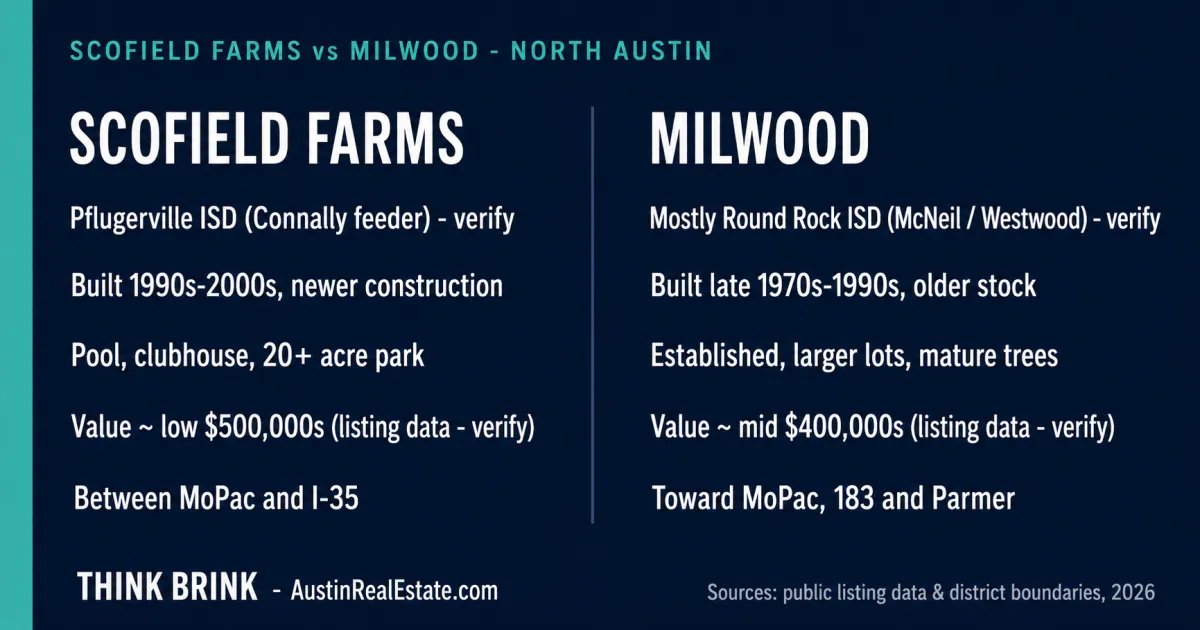
Milwood is the older, Round Rock ISD neighborhood with the stronger school-feeder story and a more central position toward Parmer and 183. Scofield Farms is the newer, Pflugerville ISD community with more amenities and generally newer construction, sitting a bit further northeast between MoPac and I-35. If schools in the Westwood or McNeil pathway are your priority, that pushes you toward Milwood. If you want a newer house with a neighborhood pool and park and you are comfortable in Pflugerville ISD, that pushes you toward Scofield Farms. Everything below is the detail behind that sentence.
Location and layout
Milwood sits in the 78727 and 78729 zip codes, west of MoPac, oriented toward the 183 and Parmer employment corridor. It is a large, established neighborhood built out in phases, and it is genuinely central to Northwest Austin's job access. Scofield Farms sits a little further northeast, in the 78727 and 78753 area, positioned between MoPac and Interstate 35. That location gives Scofield Farms easy access to both highways and a straightforward run up to the Tech Ridge and I-35 corridor, while Milwood's position leans toward the MoPac, 183, and Parmer side of the job map.
Neither location is objectively better. They optimize for slightly different commutes. If your work life centers on Apple's Parmer campus, the Domain, or the 183 corridor, Milwood's orientation is a small but real advantage. If you are heading toward I-35, Tech Ridge, or points north and east, Scofield Farms' position between the two highways is convenient. For a lot of buyers the two are close enough that it comes down to the specific house rather than a meaningful commute gap.
School districts: the biggest real difference
This is where the two neighborhoods genuinely diverge, and it is the factor I would weigh most heavily if you have or plan to have school-age kids. Milwood is served mostly by Round Rock ISD, and that is a large part of its enduring value. Depending on the section, Milwood homes can feed the Canyon Vista Middle and Westwood High School pathway, which is the most sought-after feeder in this part of Austin, or the Deerpark Middle and McNeil High School pathway, which is also strong. The far southern portion of Milwood falls into Austin ISD, so the district is not uniform across the whole neighborhood.
Scofield Farms is served by Pflugerville ISD, with students generally attending campuses such as Parmer Lane Elementary and Westview Middle, then John B. Connally High School. Pflugerville ISD is a perfectly solid district, but it does not carry the same market premium in Northwest Austin real estate that the Round Rock ISD Westwood and McNeil feeders do. That difference in perceived school desirability is a meaningful part of why buyers who are optimizing for schools tend to lean Milwood, and it shows up in resale demand.
The practical instruction is the same for both neighborhoods: verify the exact elementary, middle, and high school for the specific address with the district before you make an offer. School boundaries in this part of Austin have been redrawn before, and the section of the neighborhood you buy in determines your feeder. Do not assume from the neighborhood name.
Home age, size, and character
Milwood is the older neighborhood, and it shows in a good way and a demanding way. The first sections went up starting in the late 1970s, and most of the neighborhood was built through the 1980s and into the 1990s. Homes range widely in size, with a median in the neighborhood of roughly 1,700 square feet, on lots that tend to be larger and more tree-covered than newer construction offers. Because the housing stock is older, condition and systems updates drive value hard here. An updated Milwood home is a great house; a dated one is a project priced like a bargain until the inspection tells the real story.
Scofield Farms is the newer of the two, developed largely in the 1990s and early 2000s with several hundred homes of traditional-style construction. You are more likely to find later floor plans, newer systems, and less deferred maintenance simply because the houses are younger. That does not mean you skip the inspection, but it does mean the roof, HVAC, and plumbing on a Scofield Farms home are typically a decade or two younger than on a comparable Milwood home, which changes the near-term cost of ownership.
Amenities and neighborhood feel
Scofield Farms leans into the amenity package in a way Milwood does not. Scofield Farms offers a community pool and clubhouse and a large neighborhood park spanning over twenty acres with trails, which gives it more of a managed, master-planned feel. If you want those shared amenities as part of daily life, that is a real point in its favor.
Milwood's character is more that of an established, lived-in Austin neighborhood: mature trees, larger lots, neighborhood parks, and a settled feel that comes from forty-plus years of the same streets. It is less about a central amenity center and more about the bones of an older, central neighborhood. Which one appeals to you is genuinely a matter of preference rather than one being better.
Price and value
The two neighborhoods sit close enough in price that value comes down to what you get for the money rather than a big dollar gap. Public listing data has put Scofield Farms' median home price around the low-$500,000s with price per square foot in the mid-$200s, reflecting its newer construction and amenity package. Milwood's values have run a bit lower on average, with public data pointing to a mid-$400,000s range, reflecting its older housing stock. Treat both of these as directional anchors that blend a range of home sizes and conditions, not precise quotes for any single house, and pull current MLS figures for the specific pocket you are targeting before you set a budget.
The way to read the price relationship is this: Milwood often gets you into the more desirable Round Rock ISD feeders at a somewhat lower entry price, but you may be buying an older home that needs updating. Scofield Farms costs a little more on average and gets you a newer house with amenities, but in a district that carries less of a school premium. Which is the better value depends entirely on whether schools or house condition matters more to you.
How they fit into the broader North Austin picture
Neither neighborhood exists in a vacuum, and buyers usually look at both alongside other options in the same band. If you are weighing these two, it is worth reading the full Milwood buyer guide for the deeper detail on that neighborhood's sections and feeders, and the Wells Branch buyer guide, since Wells Branch is another North Austin neighborhood that competes for the same buyer and rounds out the comparison. For the wider context of how all of these fit together, the North Austin neighborhood guide and the guide to the best neighborhoods between MoPac, 183, and Parmer place Scofield Farms and Milwood within the whole corridor.
Property taxes to budget honestly
Both neighborhoods carry Central Texas property tax rates that relocating buyers should budget for realistically, and the exact rate differs between the Pflugerville ISD and Round Rock ISD jurisdictions and their overlapping taxing entities. Effective rates in this area generally run higher than what many out-of-state buyers expect, offset by Texas having no state income tax. If the home will be your primary residence, file for the homestead exemption, which lowers the taxable value used for school taxes and caps annual increases in your assessed value. Confirm the specific rate for the exact address, and check with a CPA or tax professional on how the exemption applies to your situation.
The fit check
Choose Milwood if Round Rock ISD school access, especially the Westwood or McNeil feeders, is near the top of your list, if you want a more central position toward the 183 and Parmer job corridor, and if you are comfortable either buying an already-updated older home or taking on updates over time to capture the value. Milwood rewards the buyer who cares about schools and location and is willing to do homework on condition.
Choose Scofield Farms if you want a newer house with fewer near-term system replacements, if a community pool, clubhouse, and large park are things you will actually use, and if you are comfortable in Pflugerville ISD with the Connally feeder. Scofield Farms rewards the buyer who values newer construction and amenities and is not specifically chasing the Round Rock ISD school premium.
The honest summary is that this is not a quality contest, it is a fit contest. Milwood and Scofield Farms are both good North Austin neighborhoods aimed at slightly different priorities. Get clear on whether schools or house-age-and-amenities matters more to you, verify the specifics for any address you like, and the right choice becomes obvious. The buyers who regret their decision are almost always the ones who picked on price alone and ignored the school district or the age of the roof.
Frequently Asked Questions
What school district is Scofield Farms in?
Scofield Farms is served by Pflugerville ISD, with students generally attending campuses such as Parmer Lane Elementary and Westview Middle, then John B. Connally High School. Pflugerville ISD is a solid district, though it does not carry the same Northwest Austin real estate premium as the Round Rock ISD feeders. Always verify the exact schools for a specific address with the district before buying.
What school district is Milwood in?
Milwood is served mostly by Round Rock ISD, with different sections feeding either the Canyon Vista Middle and Westwood High School pathway or the Deerpark Middle and McNeil High School pathway. The far southern portion of Milwood falls into Austin ISD. Because the district and feeder depend on the exact section, verify the schools for the specific address before making an offer.
Which is more affordable, Scofield Farms or Milwood?
On average, Milwood has run a bit lower, with public listing data pointing to a mid-$400,000s range, while Scofield Farms has run around the low-$500,000s reflecting its newer construction and amenities. These are directional figures that blend many home sizes and conditions, so pull current MLS numbers for the exact pocket you are targeting rather than relying on a neighborhood average.
Which neighborhood has newer homes?
Scofield Farms is the newer neighborhood, developed largely in the 1990s and early 2000s. Milwood is older, with most homes built from the late 1970s through the 1990s. That means Scofield Farms homes typically have younger roofs, HVAC systems, and plumbing, while Milwood homes more often need updating, which is reflected in their pricing.
Does Scofield Farms or Milwood have better amenities?
Scofield Farms has the stronger amenity package, including a community pool, clubhouse, and a park of over twenty acres with trails, giving it a more managed, master-planned feel. Milwood offers more of an established-neighborhood character with mature trees, larger lots, and neighborhood parks, but not a central amenity center. Which appeals to you is a matter of preference.
Which is better for commuting to Apple or the Domain?
Milwood's position toward MoPac, 183, and Parmer gives it a small edge for commutes to Apple's Parmer campus, the Domain, and the 183 corridor. Scofield Farms, sitting between MoPac and I-35 further northeast, is convenient for I-35 and Tech Ridge destinations. For many buyers the difference is minor and the specific house matters more than the commute gap.
Should I prioritize schools or home condition when choosing between them?
That is the central question, and it usually decides it. If schools, especially the Round Rock ISD Westwood or McNeil feeders, are a top priority, Milwood is the stronger choice despite its older homes. If you would rather have a newer house with fewer near-term repairs and neighborhood amenities, and you are comfortable in Pflugerville ISD, Scofield Farms fits better. Rank those two priorities honestly and the answer follows.
Are these good neighborhoods for relocating tech workers?
Both are popular with relocating tech professionals because they offer central North Austin location and job-corridor access without master-planned pricing further north. Milwood tends to attract buyers optimizing for Round Rock ISD schools and a Parmer and 183 commute, while Scofield Farms attracts buyers wanting newer homes and amenities. Verify schools and pull current pricing for your target pocket before committing.
