What Buyers Should Know About Milwood Before Making an Offer
If you have been searching Northwest Austin for more than a couple of weekends, you have run into Milwood. It shows up constantly, it is big, and the prices tend to look better than the neighborhoods just west of it. Which leads most buyers to the same question:
Is Milwood actually a good buy, or does it just look like one next to everything around it?
The short answer: Milwood is one of the most practical neighborhoods in Northwest Austin, and it is also one of the most inconsistent. Two houses a mile apart can be zoned to different schools, built a decade apart, and sit in very different condition. The neighborhood rewards buyers who do their homework at the address level and punishes buyers who shop it as one single place.
Here is what to actually look at before you write an offer.
Where Milwood Is and Why That Matters
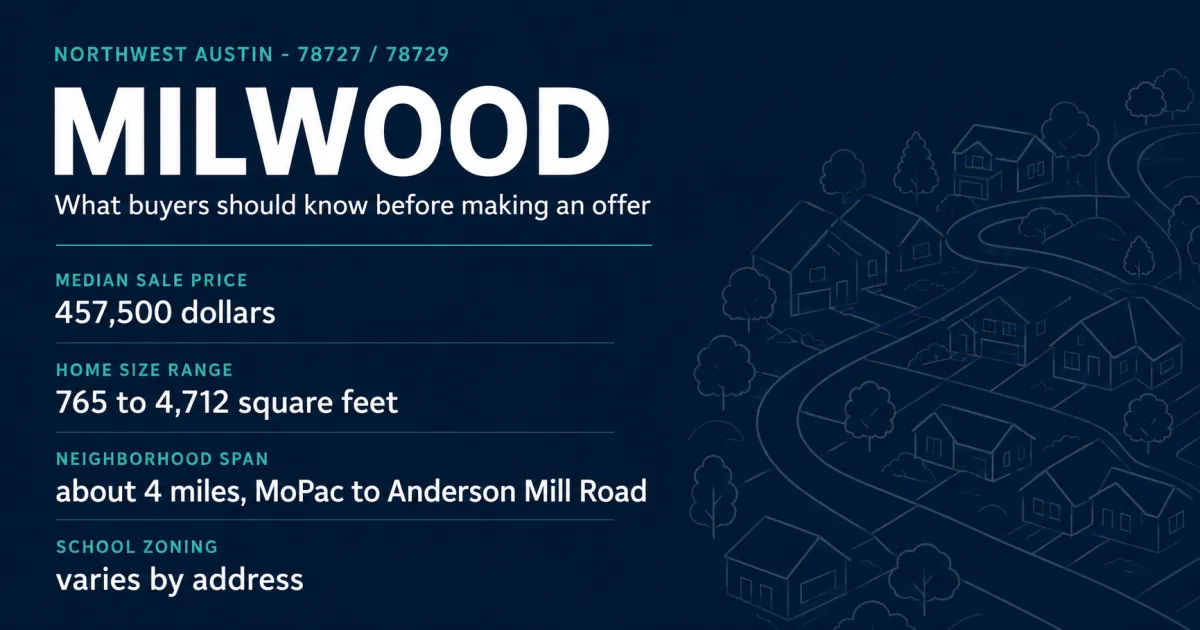
Milwood sits in Northwest Austin across the 78727 and 78729 zip codes, and it runs nearly four miles from MoPac out to Anderson Mill Road. That distance is the single most important fact about the neighborhood, and it is the one most buyers skip past.
Four miles is not a neighborhood in the way most people picture one. It is a corridor. The east end near MoPac and the west end near Anderson Mill are not interchangeable, and treating them as one market is how buyers end up surprised after closing.
Milwood is also built in numbered sections, and those sections went up over a long stretch of time. That is why you will see meaningful differences in lot size, home size, layout, and street feel as you move across it.
Why Milwood Comes Up in So Many Buyer Searches
Three things drive the traffic.
It is close to major employment
Milwood sits near two Apple campuses, which makes it a natural search for people working that corridor. The broader Parmer and 183 employment belt is right there as well. For buyers who want a short commute without paying central Austin prices, the geography does a lot of work.
It is genuinely large
Scale matters when you are shopping. A neighborhood this size means more active inventory, more turnover, and a realistic chance of finding your floor plan without waiting six months. Smaller neighborhoods with three listings a year force you to take what is available. Milwood usually does not.
The price point is more attainable than what is west of it
Over the last twelve months, the median sale price in Milwood has been around $457,500, down about five percent from the prior twelve months, according to Homes.com. Other listing sources put the figure near $460,000 in the same period.
That is a meaningful step down from the hillier Northwest Austin neighborhoods west of 183, and it is the main reason Milwood keeps landing on buyer lists. If you want a fuller picture of what current conditions mean for timing, that is covered in more depth in Is Now a Good Time to Buy in Northwest Austin?
What You Actually Get for the Money
Milwood homes run from roughly 765 square feet to about 4,712 square feet, with a median around 1,740 square feet.
Read that range again, because it explains almost everything about the neighborhood. A spread that wide inside one neighborhood name means the median price figure is close to meaningless for any specific house you are considering. You are not buying the median. You are buying a particular section, a particular size band, and a particular condition level.
In practice, buyers tend to sort into three groups here:
- Smaller homes under about 1,500 square feet, which are the most attainable entry point in the neighborhood
- Mid-size homes near the median, which is where most of the competition sits
- Larger homes well above the median, which start to overlap in price with entirely different Northwest Austin neighborhoods
That last group is where buyers most often make a mistake. Once you are shopping the top of Milwood's range, you are also in range of neighborhoods with different housing stock and different schools. At that price you owe it to yourself to look at both before committing.
The Schools Question, Answered Honestly
This is the part of Milwood that requires the most care, and it is where I see the most expensive assumptions.
Milwood does not have one school assignment. It has several, and they vary by address.
The area is served by more than one district depending on where the home sits, and the campuses buyers encounter include Jollyville Elementary, Live Oak Elementary, Pond Springs Elementary, Canyon Vista Middle, Deerpark Middle, McNeil High, and Westwood High.
Using GreatSchools ratings as of April 2026, those campuses rated as follows:
- Jollyville Elementary, 8 out of 10
- Live Oak Elementary, 8 out of 10
- Pond Springs Elementary, 8 out of 10
- Canyon Vista Middle, 10 out of 10
- Deerpark Middle, 4 out of 10
- McNeil High, 7 out of 10
- Westwood High, 9 out of 10
Look at the middle school spread. A 10 and a 4 inside the same neighborhood name is not a rounding difference, and those ratings attach to specific addresses, not to Milwood as a whole.
Two things follow from that, and both matter to your wallet:
First, verify zoning at the address before you write the offer. Not from the listing sheet, not from a neighborhood page, and not from me. Confirm it directly with the district for the exact property, and ask whether any boundary changes are under consideration. Listing remarks get school assignments wrong regularly, and the error is not the listing agent's problem after you close.
Second, understand that the market already knows. Homes zoned to the stronger campuses carry a premium, and that premium is part of why the price range in this neighborhood is so wide. If you are buying a home zoned to a lower-rated campus, you should be paying less for it, and you should expect the same dynamic when you sell.
If schools are the primary driver of your search, that is a legitimate reason to shop Milwood at the address level rather than the neighborhood level. It is also a reason not to rule the neighborhood out, because some of the assignments here are as strong as anything in Northwest Austin.
Ratings systems are one input, not a verdict on a campus. Visit the schools your address feeds into and form your own view.
The Tradeoffs Nobody Puts in the Listing
Milwood is a strong neighborhood. It is not a frictionless one.
The housing stock is established
This is a mature neighborhood, which means you are generally buying an older home. Some have been thoroughly updated, some have had one kitchen remodel and nothing else, and some are close to original. The photos will not reliably tell you which is which.
Budget for a real inspection and take the major systems seriously. Roof age, HVAC age, electrical panel, plumbing, and any signs of foundation movement are the items that turn a good buy into an expensive one. In an established Texas neighborhood, those are not exotic concerns, they are the standard checklist.
Condition varies more than price does
Two homes on the same street at the same price can be five figures apart in deferred maintenance. That is the central risk of shopping a neighborhood where the pricing is attractive. Attractive pricing draws buyers who are stretching, and buyers who are stretching sometimes waive the inspection. Do not be that buyer here.
It is not a walkable district
Milwood is a car neighborhood. If you are coming from a city where you walk to coffee, this will be an adjustment. What you get in exchange is a driveway, a yard, and quieter streets.
Proximity to employment cuts both ways
Being near major campuses and major roads is convenient, and it also means traffic. Drive your actual commute at your actual commute time before you commit. Not on a Saturday afternoon. On a Tuesday at 8am.
How Milwood Compares to the Alternatives
Most buyers looking at Milwood are also looking at two other things.
Against the hillier neighborhoods west of 183
Those neighborhoods generally offer larger lots, more topography, more views, and higher prices. Milwood is flatter, more straightforward, and more attainable. If you want the hills and the setting, Milwood will not scratch that itch and you should not force it. If what you actually want is a solid detached house with good access, the premium west of 183 buys you scenery you may not need.
For a closer look at how a more established 78759 neighborhood compares, see What Buyers Should Know About Balcones Woods Before Making an Offer.
Against the North Burnet and Domain area
That district is denser, more mixed-use, and more urban in feel, with more condo and apartment product. Milwood is the opposite trade: less walkability, more house and yard per dollar. Neither is better in the abstract. They serve different lives.
Milwood sits in the middle lane between those two, which is the whole reason this belt of North Austin exists as its own category. That larger picture is laid out in Best Neighborhoods in North Austin Between MoPac, 183, and Parmer.
Who Milwood Is Genuinely a Good Fit For
Milwood tends to work well for:
- Buyers who want a detached home with a yard in Northwest Austin without paying west-of-183 pricing
- People working the Apple, Parmer, or 183 employment corridor who want a short commute
- Buyers who want real inventory to choose from rather than waiting on a two-listing-a-year neighborhood
- People who are comfortable with an established home and will actually do the inspection homework
- Buyers who can be flexible on section and street in order to land the school assignment they want
Who Should Probably Look Somewhere Else
I would rather tell you this now than after you have spent three months on it.
- Buyers who want new construction or near-new condition without a renovation project
- Buyers who want walkability to restaurants and retail as a daily lifestyle
- Buyers who want the hill-country setting, larger lots, and views that the neighborhoods west of 183 actually deliver
- Buyers who need one guaranteed school assignment and do not want to shop street by street to get it
- Buyers with no reserve budget beyond the down payment, because an established home will eventually ask for money
What to Check Before You Write the Offer
A practical list, in order:
- Confirm school zoning with the district for that exact address, and ask about pending boundary reviews
- Identify which section of Milwood the home is in and how that section prices relative to the rest
- Drive the commute at real commute time, both directions
- Get roof, HVAC, electrical, and plumbing ages in writing before you finalize your number
- Ask directly about foundation history, including any prior repair and whether a transferable warranty exists
- Check whether the property carries any HOA or neighborhood association obligation, since this varies across the area and affects your monthly cost
- Look at what actually sold nearby in the last ninety days, not what is currently listed, because list prices tell you what sellers hope for
- Build a repair reserve into your budget, separate from your down payment and closing costs
Ongoing carrying cost is the piece buyers most often underestimate in Northwest Austin generally. That is worth reading about separately in What It Actually Costs to Own a Home in 78750 or 78759 Right Now.
A Better Way to Think About Milwood
The wrong question is whether Milwood is as desirable as the neighborhoods west of 183.
The right question is:
Does this specific house, in this specific section, with this specific school assignment and this specific condition, fit what I actually need?
Milwood is too large and too varied to have a single answer. That is not a weakness in the neighborhood, it is just how it was built. Buyers who understand that tend to do well here, because the variation creates real opportunities to find value. Buyers who shop it as one uniform place tend to either overpay for the wrong section or dismiss the whole neighborhood over one bad listing.
The Fit Check
Milwood is worth your time if you want a detached home with a yard, good access to Northwest Austin employment, and a price point that leaves room in your budget. It is a practical neighborhood that does the everyday things well.
It is not worth your time if you want new construction, walkability, hill-country setting, or a guaranteed school assignment without doing address-level work.
And if you are shopping the top of its price range, look west before you commit. At that number you have more options than the neighborhood name suggests.
Frequently Asked Questions
Is Milwood a good neighborhood in Austin?
For the right buyer, yes. It offers established detached homes with good access to Northwest Austin employment at a more attainable price point than the neighborhoods west of 183. The caveat is that it is large and varied, so the quality of any individual purchase depends heavily on the specific section, school assignment, and condition of the home.
What is the average home price in Milwood Austin?
The median sale price over the last twelve months has been around $457,500, down roughly five percent from the prior twelve months per Homes.com, with other listing sources reporting close to $460,000. Because home sizes range from under 800 square feet to over 4,700, the median is a weak guide to any particular home.
What schools does Milwood feed into?
It varies by address, which is the most important thing to know. Campuses in the area include Jollyville, Live Oak, and Pond Springs elementaries, Canyon Vista and Deerpark middle schools, and McNeil and Westwood high schools. Always confirm the assignment with the district for the exact property before making an offer.
Why are Milwood homes cheaper than other Northwest Austin neighborhoods?
Mostly geography and housing stock. Milwood is flatter and more straightforward than the hillier neighborhoods west of 183, and the homes are established rather than new. You are trading topography, views, and newer construction for a lower entry price.
Is Milwood good for Apple employees?
It is one of the more logical choices for that commute, since the neighborhood sits near two Apple campuses and the broader Parmer and 183 employment corridor. Drive your specific route at your specific commute time before deciding, because the neighborhood spans nearly four miles.
What should I watch out for when buying in Milwood?
Three things: school zoning that changes by address, condition that varies far more than price does, and deferred maintenance on established homes. Get a thorough inspection, confirm zoning with the district, and keep a repair reserve separate from your down payment.
Is Milwood or Balcones Woods the better buy?
They serve different budgets and different buyers. Balcones Woods generally sits at a higher price point with a more uniform feel, while Milwood is larger, more varied, and more attainable. If your budget stretches to both, the honest answer depends on which specific homes are available when you are shopping.
Are homes in Milwood hard to get right now?
The neighborhood's size means there is usually meaningful active inventory, which is an advantage over smaller neighborhoods where you wait for the right floor plan. Competition tends to concentrate on updated homes in the strongest school assignments.
One Last Thing
Milwood is a neighborhood where good representation earns its keep, because the variation is the whole story. Knowing which section, which school assignment, and which condition level you are actually buying is the difference between a strong purchase and an expensive lesson.
If you are considering it, I am happy to walk specific addresses with you and tell you plainly which ones are worth an offer and which ones are not.
