What It Actually Costs to Own a Home in 78750 or 78759 Right Now
Most longtime homeowners in 78750 and 78759 have a rough sense of what they pay in property taxes. Some of them have a rough sense of what they spend on maintenance in a typical year. Almost none of them have added it all up.
This post does that math. Not to tell you what to do with your home - that's your decision, not mine - but because the full annual cost of ownership is a number that deserves to be known. Especially if you're someone who has been wondering, at some level, whether the home you've owned for fifteen or twenty years is still the best use of the equity tied up in it.
The numbers in this post are based on a representative 78750 or 78759 home - a 2,400 to 2,800 square foot single-family built in the late 1980s or 1990s, currently valued somewhere between $600,000 and $750,000, with the standard homestead exemption applied. If your home is larger or smaller, or if you have the over-65 exemption, you can adjust accordingly. The methodology is the same.
Should You Sell Your 78750 or 78759 Home Before You Downsize?
The Starting Point: What Is Your Home Actually Worth Right Now?
Before you can calculate what ownership costs you, you need a current market value estimate. Not your TCAD appraised value - that can run below market, above market, or sideways depending on the year and the appeal history. Not a Zestimate. A current-market-value estimate based on what comparable homes have actually sold for in the past 90 days.
For a 2,400 to 2,800 square foot home in good condition in 78750 or 78759, that number is currently running somewhere between $580,000 and $800,000 depending on specific neighborhood, lot quality, school assignment, and condition. For this post, let's work with $650,000 as the base - a reasonable midpoint for a well-maintained but not fully renovated home in a typical section of either zip.
If your home is worth more or less than that, scale the numbers proportionally. The percentages are what matter.
Line Item One: Property Taxes
This is the largest single annual cost of owning a home in these zip codes, and it's one that many longtime owners have partially buffered through the 10% annual assessment cap on homestead properties. But the buffer only goes so far, and assessed values in 78750 and 78759 have climbed significantly over the past decade even with the cap in place.
The combined effective property tax rate in Travis County for homes in 78750 and 78759 varies depending on which taxing jurisdictions overlap your specific address. Homes in the 78750 and 78759 area that are in RRISD have been running a combined rate in the range of 2.0% to 2.3% of assessed value, which is higher than the Austin ISD combined rate due to the RRISD layer. Homes in AISD sections of these zips run somewhat lower.
With the standard homestead exemption applied - which removes $140,000 from taxable value for school district purposes as of 2026 - the effective tax on a home assessed at $650,000 looks something like this:
Taxable value after $140,000 school district exemption: $510,000. At a combined rate of approximately 2.1%, the annual tax bill comes to roughly $10,700 to $11,500 depending on the specific rate for your address.
If you are 65 or older and have the over-65 exemption, you can stack an additional $60,000 off the taxable value, reducing the bill meaningfully - and if you have the school tax freeze, your school district portion is capped at what you paid in the year you qualified, regardless of subsequent appraisal increases. If you're in that category, your actual bill is lower than the number above. If you're not, the number above is your realistic range.
Monthly equivalent: roughly $890 to $960 per month just in property taxes on a $650,000 home.
That number has gone up. If you bought this home in 2003 for $280,000 and your tax bill then was $5,000 a year, you are now paying roughly double that in absolute dollars. The 10% annual assessment cap has slowed the increase but has not stopped it. And the City of Austin's combined rate increased approximately 10% for the 2025-2026 fiscal year, adding further to bills that were already significant.
What Sellers in 78750 and 78759 Should Know About the Market Right Now
Line Item Two: Homeowner's Insurance
Texas homeowner's insurance has gotten meaningfully more expensive in recent years, and 78750 and 78759 are not exempt from that trend. The wildfire risk data for these zip codes is real - one data source indicates that 84% of properties in 78750 carry some risk of wildfire over the next 30 years - and insurance carriers have been repricing Texas risk accordingly.
A homeowner's insurance policy on a $650,000 home in these zip codes is currently running somewhere between $3,000 and $6,000 per year depending on the home's age, construction type, claims history, proximity to the Balcones Canyonlands Preserve, and the carrier. Homes that were paying $1,800 or $2,200 five years ago are frequently getting renewal quotes 40% to 60% higher. Some carriers have pulled back from the Texas market entirely, reducing competition and putting upward pressure on rates across the board.
For purposes of this calculation, a conservative estimate for a 30-year-old home in 78750 or 78759 is $3,500 to $5,000 per year. If your policy is due for renewal soon, call your agent before you assume your premium is stable.
Monthly equivalent: roughly $290 to $415 per month.
Line Item Three: Maintenance and Repairs
This is the line item that most homeowners either undercount or refuse to count honestly, because it's irregular and lumpy - you don't pay it every month, which makes it easy to treat as exceptional rather than normal.
The standard guidance for annual maintenance budgeting is 1% to 4% of home value per year, with homes over 20 years old at the higher end of that range. Research on homes built before 2010 suggests owners spend an average of closer to 2% per year when you include all maintenance and repairs - routine upkeep, system replacements, and unexpected repairs.
A home built in 1990 in 78750 or 78759 is now 35 years old. At 2% of $650,000, that's $13,000 per year in maintenance. Does every year cost $13,000? No. Some years cost $2,000. Some years cost $35,000 when the roof goes, the HVAC needs replacing, and the foundation needs a pier. The 2% average is the right number to use for planning purposes because it accounts for the lumpy nature of the costs over time.
What does maintenance actually include on a 35-year-old Northwest Austin home? HVAC service and eventual replacement - a full system replacement runs $8,000 to $15,000 and systems last 12 to 18 years. Roof replacement - $15,000 to $35,000 depending on size and material, needed every 20 to 30 years. Water heater replacement - $1,500 to $3,500 every 10 to 15 years. Foundation monitoring and occasional pier work - variable, but not zero in Central Texas clay soil. Windows - original single-pane windows on late 1980s homes are energy inefficient and increasingly hard to insure; replacement runs $10,000 to $25,000 for a full house. Landscaping and irrigation maintenance - easily $2,000 to $4,000 per year for a home with a real yard. Pool maintenance if applicable - $2,000 to $4,000 per year in chemicals, equipment, and service, plus eventual replastering at $10,000 to $20,000.
None of these numbers are surprises to longtime homeowners. The question is whether you're actually accounting for them as an ongoing cost of ownership or treating each one as a one-time exceptional event.
Monthly equivalent at 2% of $650,000: roughly $1,080 per month averaged over time.
What If Your Northwest Austin Home Needs Too Much Work to Sell?
Line Item Four: HOA Dues
Not all homes in 78750 and 78759 have HOAs. For those that do, dues typically run $400 to $1,200 per year depending on the neighborhood and what the HOA covers. Balcones Woods has community pool access and associated dues. Some sections of Great Hills have HOA governance. Various other neighborhoods in these zips have their own structures.
If your home has an HOA with annual dues of $600, that's $50 per month. Not dramatic in the context of the other numbers, but part of the complete picture.
Monthly equivalent: $35 to $100 per month for homes with typical HOA structures.
The Complete Annual Cost: What the Full Number Looks Like
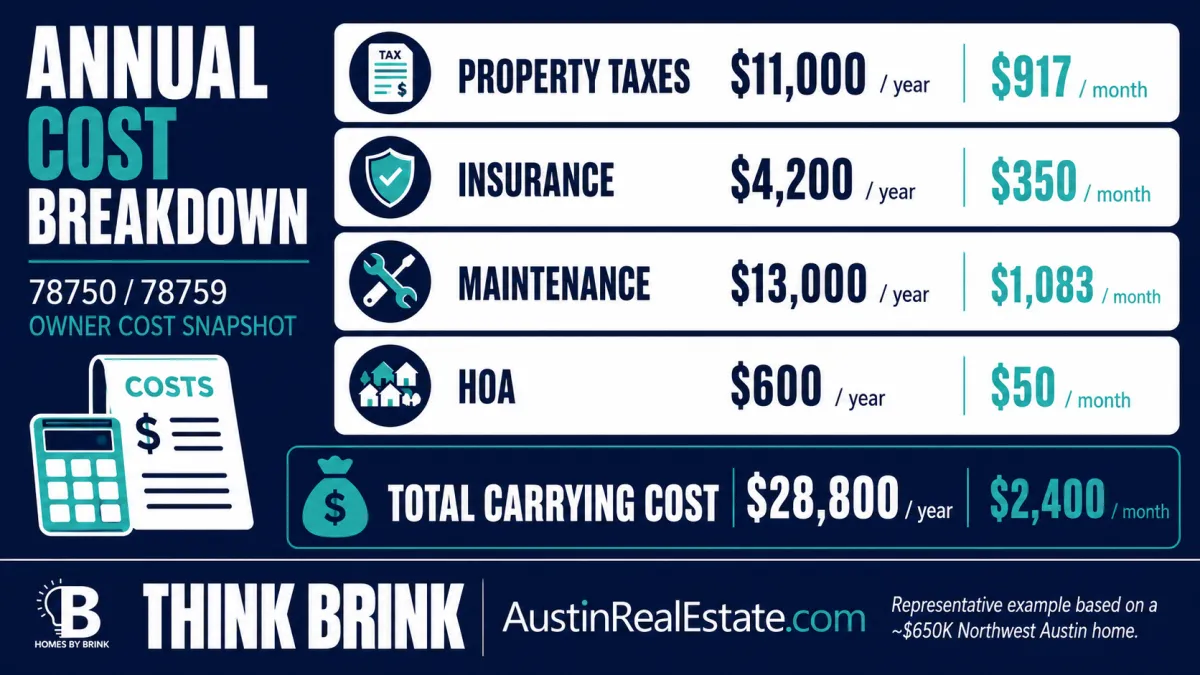
Adding it up for a representative $650,000 home in 78750 or 78759 with the standard homestead exemption and a mid-range estimate on each line:
Property taxes: $11,000 per year
Homeowner's insurance: $4,200 per year
Maintenance and repairs (2% average): $13,000 per year
HOA dues (if applicable): $600 per year
Total annual cost of ownership before mortgage: approximately $28,800 per year, or $2,400 per month.
If you have a remaining mortgage on the property - say, $150,000 at 4% from a refinance several years ago - add another $720 per month in principal and interest. If you're fully paid off, your carrying cost is the $2,400 per month above.
That is the real cost of staying in a $650,000 home in 78750 or 78759 right now. Before you pay for the utilities, the groceries, or anything else. Just the baseline carrying cost of keeping the house.
What Sellers in Northwest Austin Should Not Over-Improve Before Listing
The Opportunity Cost: What the Equity Is Doing While You Stay
This is the number most homeowners never calculate, and it's arguably the most important one.
If your home is worth $650,000 and you own it free and clear, you have $650,000 in equity sitting in a single illiquid asset. That equity is not earning a return in any conventional sense - it's appreciating when the market goes up and declining when it goes down, but it's not generating income, it's not diversified, and it's not liquid.
If that $650,000 were deployed in a different form - invested, used to purchase a smaller home outright, or some combination of both - it could be generating a return rather than sitting in the walls of a house you may or may not still need at its current size.
This is not an argument for selling. Some homeowners have excellent reasons to stay in their home regardless of the financial analysis - deep community roots, practical needs, a specific situation that makes the current home the right home. That's a legitimate choice.
But the opportunity cost is real and deserves to be acknowledged. A longtime 78750 or 78759 owner who is paying $2,400 per month in carrying costs on a home that is larger than they need, while $650,000 in equity sits illiquid and undiversified, is making a financial decision whether they realize it or not. The decision to stay is just as active as the decision to sell.
What Would Change If You Downsized?
For a longtime owner in these zip codes thinking about what the numbers look like on the other side, here's a rough picture based on moving to a smaller home, townhome, or low-maintenance option at a significantly lower price point.
A well-located one-story condo or patio home in the $350,000 to $450,000 range - whether that's in a Northwest Austin area community, a Cedar Park option, or elsewhere in the metro - looks very different on carrying costs.
Property taxes on a $400,000 home with the homestead exemption: roughly $6,000 to $7,000 per year.
Homeowner's insurance on a newer or smaller property: $1,500 to $2,500 per year.
Maintenance on a newer or smaller home or HOA-maintained exterior: $4,000 to $6,000 per year.
HOA dues if buying into a maintained community: $2,400 to $4,800 per year.
Total carrying cost: roughly $14,000 to $20,000 per year, or $1,170 to $1,665 per month.
The difference between staying and downsizing on an annual carrying cost basis is roughly $8,000 to $15,000 per year in favor of the smaller home. And if the sale of the larger home generates net proceeds of $400,000 to $600,000 after transaction costs, those proceeds can eliminate the mortgage on the next home entirely or fund a meaningful portion of the next chapter.
Over five years, that carrying cost difference is $40,000 to $75,000 - real money that is either going toward supporting a house you may have outgrown, or going toward supporting the life you actually want to be living.
Should You Sell Your Northwest Austin Home Before the Repairs Pile Up?
The Question Worth Sitting With
None of this math tells you what to do. Some longtime owners in 78750 and 78759 should absolutely stay - because the home fits, because the neighborhood is irreplaceable, because the financial situation doesn't require a change. That's a legitimate conclusion.
But the math does tell you something important: the decision to stay in your home is not a neutral or free choice. It has a real annual cost, it has an opportunity cost, and it deserves to be evaluated with actual numbers rather than assumptions about what staying does or doesn't cost.
If you've been vaguely aware that the house costs money to maintain but haven't actually put the full number together - property taxes, insurance, maintenance, and the carrying cost of the equity sitting in the walls - now you have a framework for doing that. What you do with it is up to you.
If the number you come up with prompts a conversation about what the right next step looks like, that conversation is worth having. The equity in a 78750 or 78759 home that's been owned for fifteen or twenty years is a significant financial resource. Knowing what it costs to hold it versus what it could do elsewhere is the foundation of that conversation.
Frequently Asked Questions
What are the annual property taxes on a $650,000 home in 78750?
With the standard homestead exemption applied, a home assessed at $650,000 in 78750 is currently generating a tax bill in the range of $10,700 to $11,500 per year depending on the specific taxing entities at that address. Homes in RRISD territory run at the higher end of that range. The over-65 exemption reduces this meaningfully for qualifying homeowners, and the school tax freeze caps the school district portion permanently at the qualifying year's amount.
How much does it cost to maintain a 30-year-old home in Northwest Austin?
Maintenance on homes built before 2010 averages approximately 2% of home value per year when you include routine upkeep, system replacements, and unexpected repairs averaged over time. On a $650,000 home that's approximately $13,000 per year - though actual spending varies widely by year. Some years are minimal; others involve a roof replacement, HVAC replacement, or foundation work that runs well above average.
Has homeowner's insurance gotten more expensive in 78750 and 78759?
Yes, significantly. Texas homeowner's insurance rates have increased substantially in recent years as carriers reprice wildfire, severe weather, and hail risk. Policies that were $1,800 to $2,200 per year five years ago are frequently renewing at $3,000 to $5,000 or more on older homes in these zip codes. If your policy is due for renewal, getting competitive quotes before assuming your rate is stable is advisable.
What is the real monthly cost of owning a home in 78750 or 78759?
For a representative $650,000 home with the standard homestead exemption, the combined annual cost of property taxes, insurance, maintenance, and HOA dues - before any mortgage payment - runs approximately $28,000 to $30,000 per year, or roughly $2,300 to $2,500 per month. This number surprises many longtime owners who have been thinking only about their property tax bill rather than the full carrying cost.
What happens to my carrying costs if I downsize to a $400,000 home?
Annual carrying costs on a $400,000 home - taxes, insurance, maintenance, and HOA if applicable - typically run $14,000 to $20,000 per year depending on property type and condition. That's a savings of $8,000 to $15,000 per year compared to the larger home, plus the potential to redeploy the equity from the sale rather than leaving it illiquid in the walls.
Is the equity in my 78750 or 78759 home doing anything for me while I stay?
Not in the traditional financial sense. Equity in a primary residence is illiquid and undiversified. It appreciates when the market goes up, declines when it goes down, and generates no income. Whether that equity is better deployed in the current home or elsewhere is a financial planning question worth exploring with a financial advisor, particularly for homeowners who are nearing or in retirement and for whom the equity represents a significant portion of net worth.
