What Sellers in 78750 and 78759 Should Know About the Market Right Now
If you own a home in 78750 or 78759 and you're thinking about selling - whether that's in the next few months or the next year or two - this post is worth reading before you have a single conversation with an agent. The market in these two zip codes has shifted in ways that don't always get communicated clearly, and sellers who go in without understanding the current conditions tend to make the same predictable mistakes.
This is not a doom-and-gloom post. 78750 and 78759 are still among the stronger zip codes in the Austin metro for sellers. The underlying demand drivers - Apple and the Parmer corridor, the school feeders, the established neighborhood character - haven't gone away. But the way homes sell in these zips has changed materially from what it was in 2021 and 2022, and strategy that worked then will get you into trouble now.
Here's what you need to know.
Living in 78750 and 78759: The Northwest Austin Zip Code Guide Buyers and Sellers Should Bookmark
The Numbers: What the Market Is Actually Doing
Let's start with the data because sellers deserve straight talk on this rather than optimistic framing.
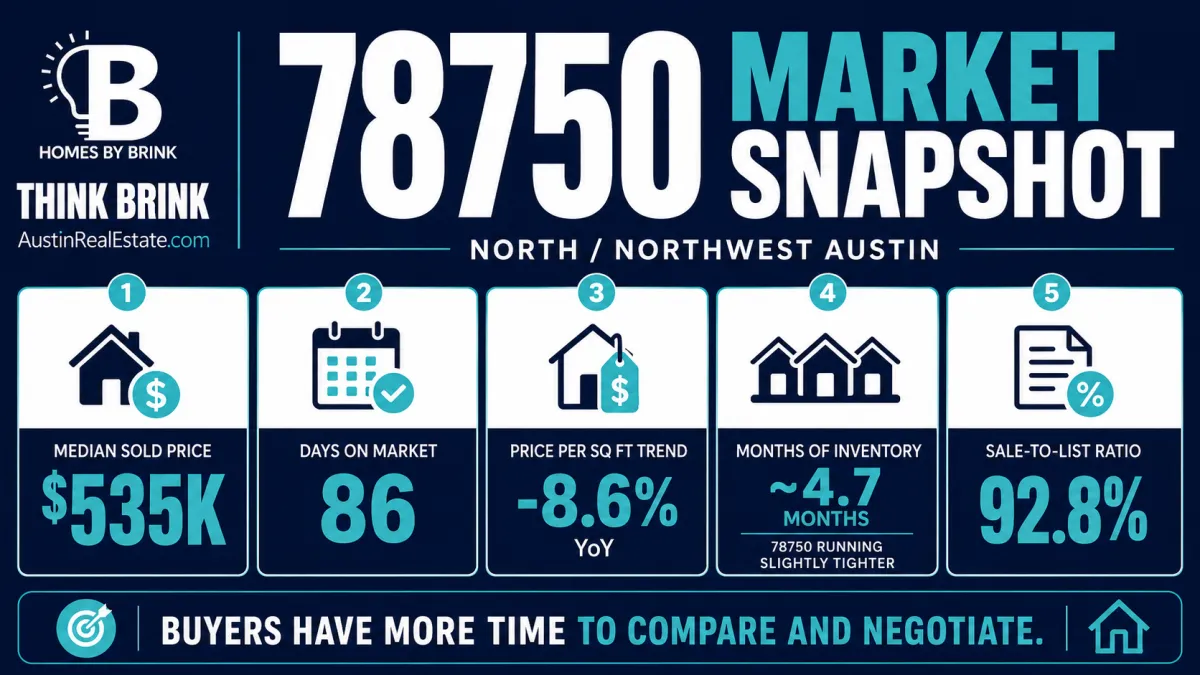
In 78750, the median sold price is currently running around $535,000, which is essentially flat compared to a year ago on a per-transaction basis but down meaningfully on a price-per-square-foot basis - roughly 8.6% lower per square foot year over year. Homes in 78750 are averaging 86 days on market right now, compared to 59 days last year. That's a significant change in pace, and it reflects a market where buyers have time to evaluate, compare, and negotiate rather than compete.
The broader Austin metro is carrying about 4.7 months of inventory as of mid-2026 - sitting at the edge of the range that separates a balanced market from a seller's market. At the zip code level, 78750 and 78759 have been running slightly tighter than the metro average on inventory, which is part of why these zips have held up better than central Austin neighborhoods that have softened more dramatically. But tighter inventory does not mean the urgency dynamic of 2021 is back. Buyers in these zips are still taking their time.
The broader context: Austin's median home price is down roughly 2.3% year over year through mid-2026, and the city is down approximately 18% from its 2022 peak. 78750 and 78759 have not fallen as far as some parts of the metro - the location and school premium is real and has cushioned the decline. But sellers who are pricing based on what a neighbor got at the 2022 peak, or even what they could have gotten in late 2023, need to update their anchoring. The market they're selling into is meaningfully different.
One more number worth knowing: nationally, about 34% of listings are taking price reductions right now. In Austin broadly, homes are closing at roughly 92.8% of list price on average. That gap between what sellers ask and what buyers pay tells you a lot about where pricing discipline matters.
What's Different About This Market Compared to Recent Years
Understanding why the market changed matters as much as knowing the data, because it affects what you need to do differently as a seller.
The rate environment changed everything. Buyers who were operating on 3% mortgage rates in 2020 and 2021 are now purchasing with rates in the 6.4% range. That shift has a direct effect on purchasing power - a buyer who could afford a $750,000 home at 3% can afford meaningfully less at 6.4%. That contraction in purchasing power doesn't reduce demand for homes in 78750 and 78759, but it does affect what buyers can pay and how carefully they evaluate every dollar.
New construction is competing with resale in ways it wasn't during the peak. Builders have been offering mortgage rate buy-downs in the 4.99% range and covering closing costs, which gives new construction a payment advantage over resale at similar price points. Resale sellers in 78750 and 78759 who are competing for buyers also considering new construction in Cedar Park or Round Rock need to understand they're up against incentive packages, not just list prices.
The buyer pool is more analytical. The tech-heavy buyer profile that dominates these zip codes - Apple employees, Parmer corridor workers, Domain-area professionals - approaches a home purchase the way they approach a work decision. They pull comparable sales from TCAD, they calculate price per square foot trends, they model what the home costs to bring to the condition they want. They are not making emotional impulse decisions in 48-hour windows the way buyers were in 2021. They have time, and they use it.
Days on market create perception risk in a way they didn't before. In 2021, a home sitting for 30 days meant something was wrong. In the current market, 86-day average means sitting for 30 days is genuinely unremarkable. But buyers still pay attention to days on market, and a home that hits 60 or 90 days starts to generate questions about why it hasn't sold. That perception problem compounds if you eventually have to reduce - buyers who see a reduction after a long time on market often assume there's something wrong with the house rather than something wrong with the original price.
Is Northwest Austin Still Worth the Premium?
The Two Things That Separate Homes That Sell From Homes That Sit
In 78750 and 78759 right now, the difference between a home that sells in 30 to 45 days and one that sits for 90-plus days usually comes down to two things: pricing and presentation. Everything else - location, schools, lot, architectural style - is largely fixed. Pricing and presentation are what you control.
On pricing: the homes that are moving in these zip codes are priced at or just below where the data points. Not at the top of the range, not at what the seller hopes, not at what the neighbor got 18 months ago. At where actual recent closed comparable sales - filtered by size, condition, and school assignment - indicate the market will support. When a home is priced correctly from day one in this market, it generates showings in the first two weeks, produces offers, and closes within a range the seller expected. When it's priced optimistically, it generates showings that don't convert to offers, sits, and eventually requires a price reduction that accomplishes less than correct initial pricing would have.
On presentation: the homes that are moving are showing impeccably. Professional photography that makes the home look its best. Staging that is clean and neutral and helps buyers mentally place themselves in the space. Exteriors that are maintained, painted if needed, landscaped to a standard that creates a positive first impression online before anyone steps foot inside. In a market where buyers have time to be selective and are browsing dozens of listings before they schedule showings, presentation is what gets you on the showing list.
The homes that are sitting are priced above what the data supports, presented with average photography and minimal staging, and listed by sellers who are waiting for the right buyer to fall in love rather than positioning to attract the broadest possible qualified buyer pool.
What the School Feeder Is Worth - And What It Isn't
The Westwood High School feeder through RRISD remains one of the most consistent value drivers in 78750 and portions of 78759. Homes with confirmed RRISD and Westwood assignment continue to command a premium over comparable homes without it, and that premium has been relatively stable even as the broader market has softened.
But here's what sellers sometimes misunderstand: the school premium is already baked into the price the market will pay for your home. It's not an add-on that allows you to price above the comparable sales in your neighborhood. The school premium shows up in what those comparable sales closed at. If you're trying to price above closed comparables because you have Westwood, you're double-counting a premium that the market already priced into the comps you're referencing.
What the school feeder actually does for sellers is narrow the buyer pool to people who specifically want it - and that's a motivated pool. A buyer who has specifically searched for Westwood-zoned addresses and found yours is already pre-qualified on school assignment. They don't need to be convinced of the value. What they're evaluating is whether the price is fair given the condition and competition. Serving that buyer well means pricing correctly, not pricing aspirationally.
One practical note: given that the RRISD/AISD boundary runs through both zip codes in non-obvious ways, sellers should confirm and prominently communicate their specific school assignment in listing materials. Don't make buyers do the homework to figure out what district you're in. A listing that clearly states the school feeder and the ISD up front converts more showings to serious buyers than one that leaves it ambiguous.
Best Neighborhoods Near Westwood High School: How Buyers Usually Narrow the Search
Best Neighborhoods Near Anderson High School: How Buyers Usually Narrow the Search
Timing: When Should You List in These Zip Codes?
The seasonal pattern in 78750 and 78759 is consistent year over year. The strongest listing windows are late February through May, when buyer activity peaks as families try to time a move before the school year ends, and September through early November, when the market picks back up after the summer slowdown.
Summer listings - June through August - face a historically slower buyer pool in these zip codes. Some buyers are specifically trying to time school enrollment, and the ones who missed the spring window are often waiting for fall. August in particular is a slow month for showings. If your goal is to capture maximum buyer competition, mid-to-late February through April is the window to target.
December and January are the slowest months for buyer activity but can actually produce effective listings for motivated sellers, because the buyers who are looking in those months are often highly motivated - corporate relocations, lease expirations, life changes - and the competition from other listings is genuinely lower.
If you're considering listing in the next six to twelve months, the spring 2027 window is worth planning for now. That means getting your preparation done - minor updates, staging decisions, photography planning - in the fall and early winter so you're ready to go live in February or March rather than scrambling to get ready in April when the window is already half over.
What Buyers in 78750 and 78759 Are Looking For Right Now
Understanding what your buyers actually want helps you make better decisions about preparation and presentation.
The buyer profile that dominates 78750 and 78759 is typically a household with children, at least one tech or professional income, and a specific school assignment requirement. They are frequently relocating from outside Texas - California, Washington, the Northeast - and they are doing extensive research before they arrive to tour. They have often been searching online for weeks or months before they set foot in a neighborhood.
These buyers want move-in-ready or close to it. They are not looking for a project. They have demanding careers, they may be managing a long-distance move, and the idea of coordinating a renovation while also managing their professional lives is not appealing. Homes that are updated, or at minimum clean and well-presented, with major systems in good condition, are what they want to buy. Homes with significant deferred maintenance or substantial renovation needs require either deep discounting or a specific buyer who is specifically seeking that opportunity.
They are comparison shoppers. Before they tour your home, they have likely looked at every active listing in your size and price range in your zip code. They know what comparable homes are priced at. They have opinions about which ones are overpriced and which represent value. Coming in at a price that reads as overpriced relative to the competition is not a negotiating position - it's a filter that keeps buyers from scheduling a showing in the first place.
They understand the school feeder. Buyers specifically targeting 78750 and 78759 have done their homework on RRISD and AISD. You don't need to explain why Westwood matters. What you need to do is make sure your listing clearly communicates the assignment and that the price is justified by what the market shows for confirmed Westwood-zoned homes in comparable condition.
How Much Are Homes Selling for in 78750?
Is 78759 a Good Place to Live?
The Seller Mistakes That Are Costing People Money Right Now
These are the patterns that come up repeatedly among sellers who end up with long days on market and eventual price reductions in 78750 and 78759.
Anchoring to 2022 peak values. The market peaked in spring 2022, and prices in the Austin metro are down significantly from that peak. Sellers who bought or refinanced at or near the peak and are hoping to recover that value from a buyer are going to have a long wait. The market doesn't care what you need to net. It pays what the current comparable sales support.
Pricing for the condition you wish the house were in rather than the condition it's in. A partially updated home priced as if it were fully renovated sits. Buyers can calculate what it costs to finish what you didn't do, and they adjust their offers accordingly - or they walk to something that's already done.
Skipping professional photography. In a market where buyers are filtering listings online before they schedule showings, listing photos are your first showing. Smartphone photos, even good ones, do not perform the same way professional real estate photography does. This is a $300 to $500 investment that directly affects how many showings your home generates.
Listing without staging. An empty house is hard for buyers to evaluate emotionally. A cluttered or heavily personalized house is hard for buyers to mentally inhabit. Staging - whether full staging or a lighter consultation that helps you edit and arrange existing furniture - produces better photography and better buyer response. In this market at these price points, it's not optional.
Waiting for the market to come back. Some sellers have been watching the market for two years waiting for conditions to return to 2021. That wait has cost some of them meaningful holding costs and opportunity cost. The market in 78750 and 78759 is functional right now - not peak, but functional. Homes are selling. The sellers who are succeeding are the ones who are pricing for the current market and presenting well, not waiting for a market that may or may not return on a timeline they can predict.
What Sellers in These Zip Codes Should Do Right Now
If you're actively planning to sell in the next three to six months:
Get a genuine market analysis from an agent who works actively in 78750 and 78759, not a Zestimate and not what you hope based on what a neighbor got last year. The analysis should show you actual closed comparable sales filtered by size, condition, and school assignment within the past 90 days. If those comps don't support what you want to net, you need to know that now rather than after you've been on the market for 60 days.
Walk your home with an objective eye - or have someone whose opinion you trust do it - and identify the specific things that are going to cause buyer resistance. Deferred maintenance, original-condition spaces in a home that's partially updated, exterior presentation, odors, clutter, dated paint colors. Make a list and decide what you're going to address before listing and what you're going to price around.
Get three to five quotes on any repairs or updates you're considering. Sellers frequently overestimate what things cost and either over-invest or skip things that would have returned their cost. Know what you're actually dealing with before you decide.
Line up your photography, staging, and any pre-listing work so you can go live when the market timing is optimal - not when you happen to be ready.
If you're in the planning stage for a future sale:
Start tracking the market now. Watch what's coming active in your price range and neighborhood, how long things are sitting, and what they're eventually closing for versus original list price. Developing a current picture of buyer behavior in your specific market is more valuable than any single conversation with an agent six months before you list.
Have a pre-listing conversation with your agent sooner than you think you need to. The decisions you make 90 to 180 days before you list - what to update, what not to update, what to price, what to fix - have more impact on your outcome than anything you do in the week before you go live.
The Honest Take on 78750 and 78759 for Sellers
These are still good zip codes to sell in. The location premium is real, the school feeder value is real, and the buyer pool for these zips is motivated and financially capable. Sellers who are realistic about current conditions and strategic about pricing and presentation are still achieving solid results.
The sellers who are struggling are not struggling because 78750 and 78759 have somehow become bad zip codes. They're struggling because they're using 2021 and 2022 playbooks in a 2026 market. Price for where the data points, present the home at its best within its actual condition, time the listing strategically, and let the location do what it does. That's still a workable formula in these zip codes.
What doesn't work anymore is optimistic pricing plus average presentation plus waiting for the right buyer to show up. That approach produces long days on market, buyer perception problems, and eventual price reductions that land you somewhere you could have started.
Frequently Asked Questions
Is now a good time to sell in 78750 or 78759?
Yes, with realistic expectations. Both zip codes have been running below six months of inventory, which technically defines a seller's market. But days on market have extended to around 86 days in 78750, and buyers are negotiating more actively than in recent years. Homes priced correctly and presented well are selling. Homes priced optimistically are sitting and reducing.
How much have home prices dropped in 78750?
The median sold price in 78750 is currently around $535,000, essentially flat year over year on a per-transaction basis but down approximately 8.6% on a price-per-square-foot basis compared to a year ago. The zip is down meaningfully from the 2022 peak but has held up better than many Austin zip codes due to the school feeder and employer proximity premium.
How long is it taking homes to sell in 78750?
As of mid-2026, homes in 78750 are averaging approximately 86 days on market - up significantly from 59 days a year ago. This extended timeline is why pricing and presentation matter more than they did in the faster market of recent years.
Should I update my home before listing in these zip codes?
Targeted pre-listing preparation - fresh paint, exterior cleanup, lighting updates, professional cleaning and staging - consistently returns more than it costs in buyer response and final sale price. Major renovation decisions require a specific analysis of your home, your neighborhood comparable sales, and what buyers are discounting for in homes similar to yours. There's no blanket answer, but the conversation is worth having before you list rather than after.
What is the Westwood feeder premium worth right now?
The RRISD/Westwood feeder continues to command a premium over comparable homes without it in these zip codes. The premium is already reflected in closed comparable sales for Westwood-zoned homes - it's not an add-on to those comps, it's what produced those comps. Sellers with confirmed Westwood assignment should communicate it clearly in listing materials and price within the range the Westwood-zoned comparable sales support.
When is the best time of year to list in 78750 or 78759?
Late February through May is historically the strongest window, driven by families trying to move before the school year ends. September through early November is the second-best window. Summer and December/January are the slowest periods for buyer activity, though December and January can work for motivated sellers willing to price aggressively in exchange for lower listing competition.
What do buyers in these zip codes want right now?
Move-in-ready or close to it, with major systems in good condition. Clean, well-presented, professionally photographed and staged. Correctly priced relative to condition and competition. Clear school assignment information in the listing. Buyers in 78750 and 78759 are analytical, comparison-shopping, and have enough time to be selective. Homes that check those boxes are getting showings and offers. Homes that don't are getting passed over.
