Is Now a Good Time to Buy in Northwest Austin? What Buyers Should Know in 2026
This is the most common question in the Northwest Austin buyer conversation right now, and it deserves a straight answer rather than a sales pitch in either direction.
Here's the honest version: The current market in 78750, 78759, and 78726 offers conditions that buyers haven't seen since before the pandemic. Not because prices are at a bottom - they may or may not be. Not because rates are low - they aren't, by recent historical standards. But because the combination of negotiating room, inspection contingencies, time to evaluate, price reductions, and actual inventory selection is something that buyers who came to market in 2021 or 2022 never experienced, and that buyers who are ready now can take genuine advantage of.
Whether this is the right time for you specifically depends on factors that have nothing to do with the market and everything to do with your situation. This post covers both.
Is Northwest Austin a Good Place to Live? What Buyers Should Actually Know
What the Market Is Actually Doing Right Now
Start with the data rather than the narrative.
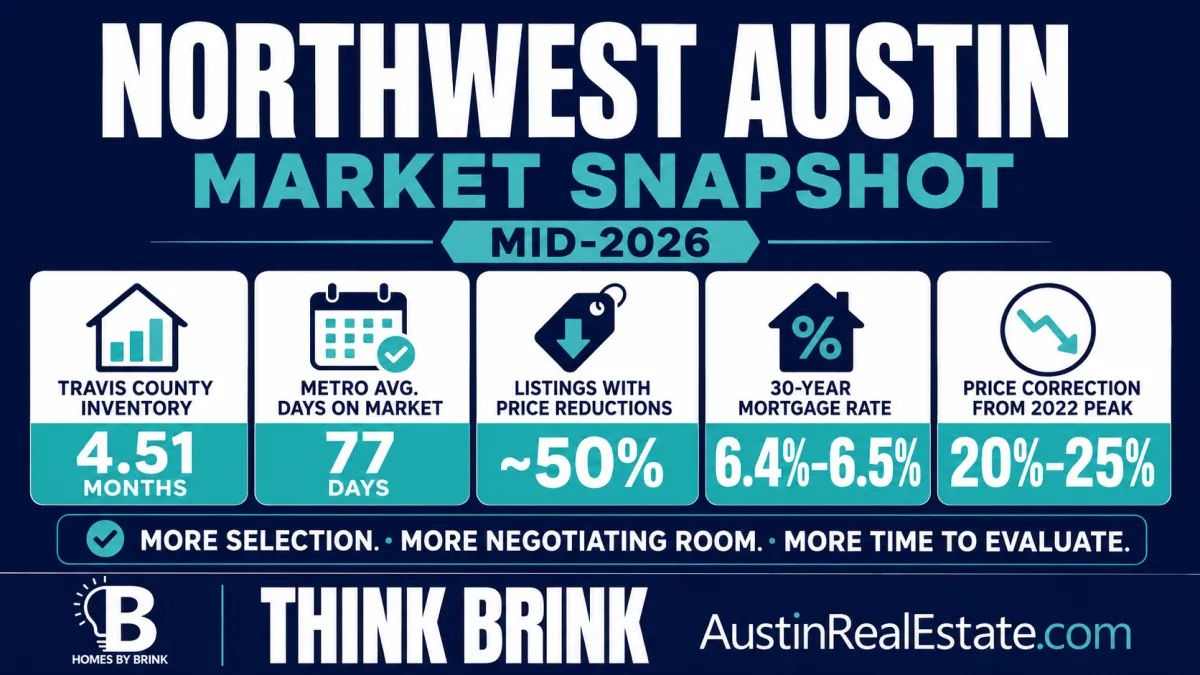
The Austin metro as of mid-2026 has approximately 16,400 active residential listings - roughly five to six times the active listing count during the 2021 to 2022 peak. The market Activity Index - a measure of buyer-to-seller ratio - sits at approximately 24%, compared to 50% in a balanced market. That means sellers significantly outnumber active buyers in the current environment. Approximately half of all active listings in the metro have taken at least one price reduction. Homes are averaging 77 days on market metro-wide, compared to 64 days a year ago.
Travis County specifically - which covers 78750, 78759, and most of the Northwest Austin geography - is running approximately 4.51 months of inventory. That's technically still a seller's market by the traditional six-month definition, but it's the loosest Travis County has been in years and a dramatically different experience from the sub-one-month inventory environment of 2021.
Mortgage rates are running approximately 6.4% to 6.5% on a 30-year fixed as of mid-2026. Fannie Mae and the Mortgage Bankers Association project rates to remain in the 6% to 6.5% range through the end of 2026 with modest declines possible in 2027 if inflation continues to cool. The rate environment that produced 3% mortgages in 2020 and 2021 is not returning on any near-term forecast horizon that mainstream economists are publishing.
Austin's metro median has corrected approximately 20% to 25% from its May 2022 peak and currently sits in the $440,000 range metro-wide. The Northwest Austin premium neighborhoods - 78750, 78759, 78726 - carry meaningfully higher medians than the metro-wide figure, reflecting the school feeder premium, the terrain character, and the employer proximity that distinguishes these zip codes from the broader market.
What the Current Conditions Mean for Northwest Austin Buyers Specifically
The market data above describes the Austin metro broadly. The specific experience in 78750, 78759, and 78726 has some important nuances.
The established Northwest Austin neighborhoods have held value better through the post-2022 correction than many other Austin submarkets. The school feeder premium, the terrain and mature canopy character, and the employer proximity that make these zip codes worth the premium over Cedar Park and Round Rock also provide a floor that speculative suburban inventory doesn't have. The correction from 2022 peak has been real - homes that traded at $800,000 in spring 2022 have not recovered to those values - but the decline has been more measured than in the newer far-north suburban corridors.
What that means for buyers: you are not buying at the 2022 peak. You are buying at a price level that represents meaningful correction from peak, with negotiating room that didn't exist two years ago. You are doing it with inspection contingencies, option periods, and the time to evaluate multiple homes without a 48-hour decision window. You are in a market where sellers in the premium zip codes are still pricing correctly when they want to move, and where homes that are priced optimistically are sitting on market long enough to present negotiating opportunities.
The specific dynamics in these neighborhoods: well-priced, well-presented homes in confirmed RRISD-Westwood addresses in good condition are still moving efficiently - often within 30 to 45 days. The homes that have been sitting are primarily original-condition homes that started too high, homes without premium school assignments that were priced as if they had them, and the upper-end inventory above $1.2 million where the buyer pool is narrower. As a buyer, knowing which category a specific home falls into tells you more about your negotiating position than the metro-wide data does.
Living in 78750 and 78759: The Northwest Austin Zip Code Guide Buyers and Sellers Should Bookmark
The Rate Reality: Why Waiting for Lower Rates Has a Cost
The most common version of "I'll wait" in the current Northwest Austin buyer conversation is "I'll wait for rates to drop." This is worth examining honestly.
The math on rates versus prices is more nuanced than the "wait for low rates" instinct suggests. A buyer who purchased a $700,000 Northwest Austin home at 6.4% in mid-2026 has a monthly principal and interest payment of approximately $3,500 on an 80% loan-to-value scenario. If rates drop to 5.5% in 2027 or 2028, that same buyer can refinance and reduce their payment by approximately $300 to $350 per month.
But here's what most rate-waiters don't fully model: if rates drop from 6.4% to 5.5% over the next 12 to 18 months, the buyer pool for Northwest Austin homes expands significantly because more buyers can qualify and afford what they previously couldn't. When that happens, competition returns and prices tend to firm. The buyer who waited for 5.5% rates may be buying the same home at $750,000 to $775,000 rather than $700,000 - and while they have a lower rate, their higher purchase price partially or fully offsets the monthly payment advantage.
The commonly cited principle: you can always refinance to a lower rate, but you can't retroactively buy at a lower price. That principle doesn't apply universally - markets don't always appreciate when rates drop and the relationship isn't guaranteed. But the directional logic matters in a market like Northwest Austin where the fundamental demand drivers are intact and the inventory that is currently available will not remain available indefinitely.
Mainstream forecasters including Fannie Mae, the Mortgage Bankers Association, and Wells Fargo are projecting rates in the 6% to 6.3% range through 2026. If rates drop below 6%, some analysts believe buyer demand would surge and absorb inventory rapidly. Waiting for that specific event may mean buying into increased competition rather than the current environment where your offer is one of a few rather than one of many.
Is Northwest Austin Still Worth the Premium?
What Makes This a Genuinely Better Buying Environment Than 2021 or 2022
Buyers who were in the market in 2021 and 2022 and lost out to multiple offers, waived inspections, or paid above asking price know exactly what that market felt like. The current environment in Northwest Austin is fundamentally different in ways that benefit buyers.
Inspection contingencies are back. In 2021 and 2022, waiving the inspection period was often a requirement to compete. Today, standard option periods and inspection contingencies are the norm in most transactions. For a home in the Northwest Austin housing stock - where 30-to-40-year-old HVAC systems, aging roofs, and foundation considerations are legitimate inspection items - the ability to do proper due diligence before removing contingencies is not a minor procedural point. It protects you from discoveries that would have been catastrophic in a waived-inspection scenario.
Price reductions and seller concessions are available. Approximately half of active listings across the Austin metro have taken at least one price reduction. Sellers in 78750, 78759, and 78726 who have been on market for 45-plus days are in a meaningfully different negotiating position than sellers in 2022. Asking for closing cost credits, rate buydowns, or repair credits is a real ask that sellers in the current environment are frequently willing to engage with.
You have time to evaluate. The 77-day metro average days on market means that in most cases, you are not making a 48-hour decision on a home. You can tour multiple homes, revisit properties you're serious about, review HOA documents, verify school assignments, and do the homework that the 2021 market simply didn't allow time for. For a purchase in the $600,000 to $1 million range in an established Northwest Austin neighborhood - with all the internal complexity around school districts, lot positions, and neighborhood sections that these zip codes involve - having adequate evaluation time is genuinely valuable.
You are not buying at the peak. Prices in 78750 and 78759 have corrected from 2022 peak values. A home that traded at $800,000 in May 2022 is worth less than that today. Buyers entering now are not in the position of those who bought at the absolute top of the most speculative market Austin has experienced. That doesn't mean prices can't soften further from here - but the risk profile of buying in mid-2026 is genuinely different from the risk profile of buying in spring 2022.
Should You Buy an Older Home in Northwest Austin or a Newer Home Farther North?
The Northwest Austin Specific Case: Why This Geography Holds Up
The broader Austin market argument for buying now applies to Northwest Austin - but with specific reasons why these zip codes specifically hold up better than other parts of the metro.
The demand drivers in 78750, 78759, and 78726 are not speculative. Apple's Parmer Lane campus is not going anywhere. The RRISD Westwood feeder and AISD Anderson feeder are not declining. The Balcones Canyonlands Preserve - the terrain and wildlife habitat that defines the western edge of these neighborhoods - is permanently protected. The mature canopy and established character that distinguish these neighborhoods from newer suburban construction take 40 to 50 years to develop and can't be replicated.
These are characteristics that produce durable buyer demand regardless of interest rate cycles. The tech employees who relocate to Austin for Apple and need to be within a reasonable commute of Parmer Lane will continue to look in 78750 and 78759. The families who have specifically researched the Westwood IB program and found homes that feed it will continue to pay a premium for confirmed RRISD assignment. These aren't speculative demand drivers that evaporate when the market softens - they're structural.
The implication for buyers: the current market conditions are more favorable than they've been in years, but the underlying demand for what these neighborhoods specifically offer has not changed. The inventory that is available now at current prices represents a genuine window - not because the market is at its absolute bottom, but because the combination of selection, negotiating room, and evaluation time that exists right now is unusual for a geography with these fundamentals.
When Buying Now Makes Sense and When It Doesn't
This is where the general market analysis gives way to the personal decision, and it's worth being direct about both.
Buying now makes sense if you are financially ready and planning to stay at least five to seven years. The break-even point on a home purchase - accounting for transaction costs on both the buy and eventual sell side - typically runs three to five years in a normal market. In a market with higher rates and modest near-term appreciation projections, planning for at least five to seven years ensures you have adequate time for the home to appreciate through the transaction cost threshold. If your timeline is shorter than that, the flexibility of renting is likely worth more than the equity you'd build.
Buying now makes sense if you have found a specific home that fits your requirements. The current inventory levels in 78750, 78759, and 78726 are higher than they were at peak - but the specific inventory that fits a particular buyer's school assignment requirement, lot position preference, and condition threshold is still limited. If you've found a home that genuinely checks your specific boxes, the argument for waiting is primarily about rate timing - which, as discussed above, is a two-sided bet rather than a guaranteed win.
Buying now makes sense if your personal situation is stable and the payment works at current rates. The ability to refinance if rates drop is real and worth planning for, but the payment you commit to at signing needs to work for your household budget at current rates without depending on future refinancing. If the payment only works if rates drop, that's a risk you're taking on rather than a plan you're executing.
Buying now is less compelling if your personal situation is uncertain. A job in transition, a relationship change that's unresolved, an upcoming major expense, or any other personal instability that might affect your ability to hold the home for five-plus years is a reason to wait regardless of what the market is doing. The best time to buy is when you're personally ready - and personal readiness has nothing to do with the Activity Index.
Buying now is less compelling if you haven't done the Northwest Austin homework. The internal complexity of these zip codes - the school district split, the lot hierarchy, the section-by-section neighborhood differences - means that a buyer who hasn't done address-level research is at risk of buying the wrong home in the right general area. Favorable market conditions don't protect you from buying into the wrong school district, the wrong section, or a lot position that doesn't support the price you paid. Do the homework first.
Best Northwest Austin Neighborhoods If You Work From Home
The Practical Steps for Buyers Who Are Ready to Move
If you've read this and concluded that the current market environment aligns with your personal situation and timeline, here are the practical steps that serve Northwest Austin buyers well right now.
Get pre-approved before you start touring seriously. In a market with 77-day average days on market, you won't lose a home to another buyer because you took 48 hours to get pre-approved. But pre-approval gives you clarity on your actual price range at current rates, positions you to move efficiently when you do find the right home, and tells sellers you're a serious buyer rather than a browser.
Define your specific requirements before you tour. School assignment, lot position, minimum square footage, one-story versus two-story, section of the neighborhood, acceptable condition range. Northwest Austin's internal complexity makes touring without specific requirements inefficient - you'll tour homes that can't possibly work for you and miss homes that might. Know your filters before you start.
Work with an agent who has real transaction history in these specific zip codes. Texas is a non-disclosure state. Closed sale data is not publicly available the way it is in California or Washington. An agent who has actual MLS transaction history in 78750, 78759, and 78726 and can pull genuine comparable closed sales is more valuable here than an agent who knows Austin broadly. The school district nuances, the lot hierarchy, and the section-level pricing differences in these zip codes reward agent knowledge that is zip-code specific.
Plan your offer strategy around current conditions rather than past market norms. Asking for a seller credit toward closing costs or a rate buydown is a legitimate negotiating tool in the current environment - particularly on homes that have been on market for 45-plus days or that have taken a prior price reduction. This kind of ask would have been laughed out of a 2021 multiple-offer situation. It's a real negotiating tool right now.
Take the inspection seriously. The ability to do a full inspection and negotiate repairs or credits based on findings is one of the most valuable features of the current market relative to 2021 and 2022. Use it. A thorough inspection on a 1985 Northwest Austin home should specifically address HVAC age and capacity, roof condition, foundation movement history, electrical panel adequacy, and window condition. These aren't minor items on a home this age.
Apple vs The Domain: Where Should North Austin Tech Buyers Actually Live?
The Honest Bottom Line
The current market in Northwest Austin is as buyer-friendly as it has been since before the pandemic. The combination of inventory levels, negotiating room, inspection contingencies, and time to evaluate that buyers have in mid-2026 is unusual for a geography with the structural demand drivers these zip codes carry.
Whether to take advantage of it depends on your personal situation - your timeline, your financial readiness, your clarity on what you're looking for - more than on any market timing calculation. The buyers who will look back on 2026 Northwest Austin purchases as good decisions are the ones who were personally ready, did the address-level homework, and bought the right home in the right section at a fair price. The market conditions supported that outcome. The personal preparation made it happen.
Frequently Asked Questions
Is 2026 a buyer's market in Northwest Austin?
Technically, Travis County is still in seller's market territory at approximately 4.51 months of inventory - a seller's market is conventionally defined as below six months. But it's the most buyer-favorable seller's market in these zip codes since before the pandemic. Approximately half of active metro listings have taken price reductions, homes are averaging 77 days on market, and contingencies are standard. Buyers have meaningfully more leverage than at any point in the 2020 to 2022 period.
How much have Northwest Austin home prices corrected from the 2022 peak?
The Austin metro broadly has corrected approximately 20% to 25% from the May 2022 peak. The established Northwest Austin neighborhoods - 78750, 78759, 78726 - have generally held up better than the broader metro due to the school premium, terrain character, and employer proximity that these zip codes carry. The correction has been real but more measured than in the newer far-north suburban corridors. Specific address-level comparable sales are the most reliable guide to current value for any specific home.
Should I wait for mortgage rates to drop before buying in Northwest Austin?
It depends on your timeline and your confidence in the rate trajectory. If rates drop from 6.4% to 5.5%, you can refinance - but a significant rate drop will also bring more buyers back to the market and likely firm prices. The buyer who waits for lower rates may find the same home at a higher price. For buyers whose timeline is five-plus years, the more important question is whether the payment works now - not whether it might be lower later.
Are homes in 78750 and 78759 still selling or is the market stuck?
Homes are selling. Pending sales across the Austin metro are actually up approximately 3.6% year over year as of mid-2026, signaling that transactions are happening even as inventory remains elevated. Well-priced, well-presented homes in confirmed RRISD-Westwood addresses in 78750 and 78759 are moving in 30 to 45 days. Original-condition homes priced at renovated-home values are sitting longer. The market rewards correct pricing and penalizes optimism.
What is the best time of year to buy in Northwest Austin?
In a normal market, fall and winter offer the best buyer negotiating environment with reduced competition. In the current market, the seasonal advantage is less pronounced because buyer competition is already muted year-round. The more important timing factor is your personal readiness - financial preparation, clarity on requirements, and agent relationship - rather than which month you happen to be shopping.
How do I know if a specific Northwest Austin home is priced correctly?
You need actual comparable closed sales filtered by size, school assignment, condition level, and lot position from the past 60 to 90 days. The school district split and lot hierarchy in these zip codes mean that neighborhood-wide medians are unreliable guides for specific property pricing. Automated valuations in 78750, 78759, and 78726 are particularly unreliable because they can't account for the RRISD vs AISD differential or the greenbelt vs interior lot premium. Work with an agent who can pull real MLS transaction data.
