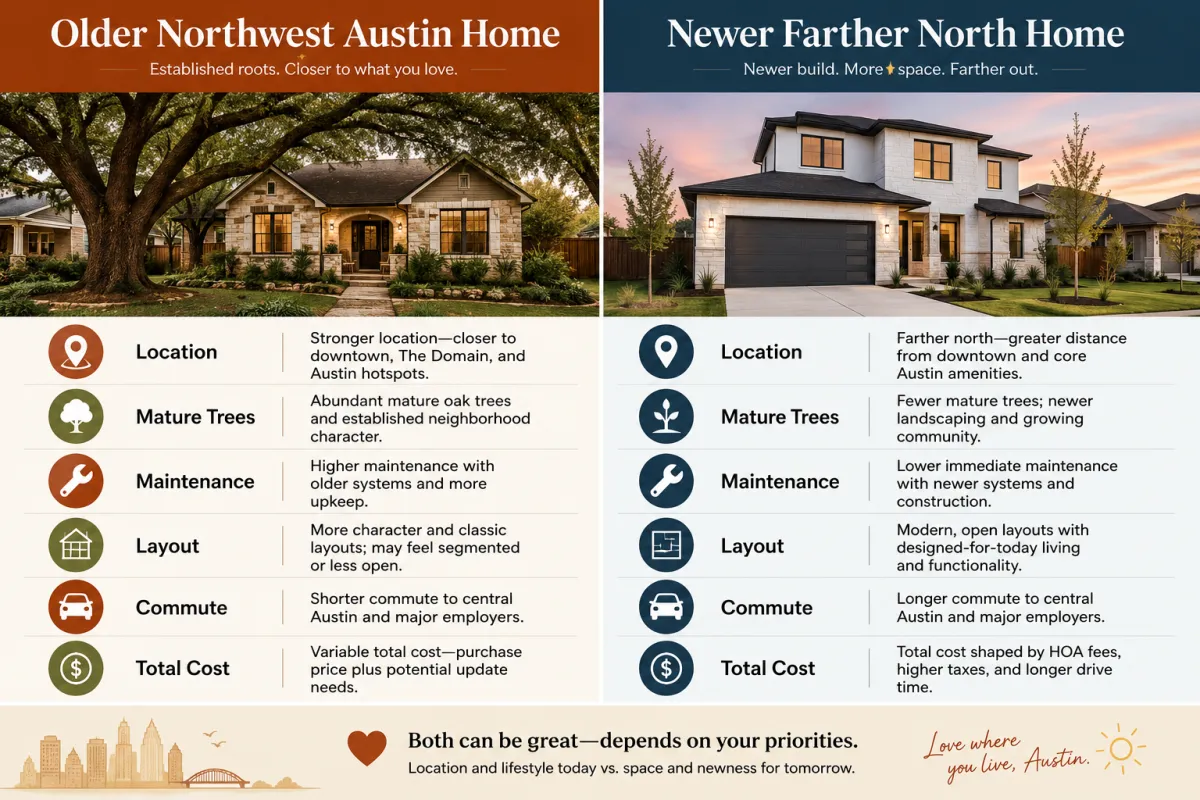
Should You Buy an Older Home in Northwest Austin or a Newer Home Farther North?
This is one of the most common Austin-area buyer tradeoffs.
Do you buy an older home in Northwest Austin because you want location, trees, character, and access?
Or do you go farther north for a newer home, more modern layout, fewer immediate updates, and potentially more space?
There is no automatic right answer.
An older Northwest Austin home may give you mature trees, established streets, shorter access to The Domain, Apple, Arboretum, Gateway, MoPac, 183, and central Austin routes.
A newer home farther north may give you modern systems, better energy efficiency, open floorplans, larger closets, newer kitchens, newer bathrooms, and less immediate repair anxiety.
Both options can make sense.
Both options can also create regret if you choose the wrong tradeoff.
The real question is not:
“Is older better or newer better?”
The better question is:
“Which home gives me the best combination of location, lifestyle, condition, maintenance, commute, and long-term fit?”
Why this decision comes up so often
Buyers start looking in Northwest Austin because they like the location.
They may want:
mature trees
established neighborhoods
shorter drives to The Domain
access to Apple and the tech corridor
proximity to Arboretum and Gateway
routes to MoPac, 183, Parmer, Burnet, and 620
a more Austin feel than some newer suburban areas
a yard
school or neighborhood reputation
access to both Austin and northwest suburbs
Then they tour a few homes and realize many are older.
That can mean:
dated finishes
older systems
less open floorplans
smaller closets
lower ceilings in some homes
older windows
bigger repair questions
less predictable maintenance
Then buyers start looking farther north.
Cedar Park, Leander, Round Rock, Georgetown, Avery Ranch, Pflugerville, Hutto, and Liberty Hill may enter the conversation depending on budget and lifestyle.
Suddenly the tradeoff gets real:
Better location and character, or newer home and easier condition?
Why Some Northwest Austin Homes Sit While Others Still Sell
The case for buying an older home in Northwest Austin
Older homes in Northwest Austin can be appealing because they often offer something newer areas struggle to recreate quickly: established location and character.
1. Mature trees and established streets
This is one of Northwest Austin’s biggest advantages.
Mature trees, shaded streets, older landscaping, and neighborhood character can make a home feel rooted.
For many buyers, that matters emotionally.
It feels less sterile.
Less new.
More settled.
A newer home may be beautiful, but a mature neighborhood can have a feel that takes decades to develop.
2. Access to major North Austin anchors
Northwest Austin can be very practical for buyers who want access to:
The Domain
Apple
Arboretum
Gateway
MoPac
183
Parmer
Burnet
620
Q2 Stadium
North Austin employers
central Austin routes
Cedar Park and Round Rock connections
For some buyers, location is the whole point.
They would rather accept an older kitchen than add 25 minutes to their daily pattern.
3. Neighborhood variety
Northwest Austin is not one uniform product.
You can find different types of neighborhoods:
classic Austin character
tree-heavy residential streets
more practical North Austin pockets
larger-lot areas
townhome or condo options
no-HOA pockets
one-story homes in some neighborhoods
homes near The Domain without condo living
That variety is useful if you care about lifestyle fit.
4. Renovation potential
Some buyers like older homes because they can update over time.
They may prefer to buy a home with good bones, good location, and a strong lot, then improve the finishes later.
That can be a smart strategy if the buyer has the budget, patience, and realistic expectations.
5. Long-term location confidence
A strong location can be hard to recreate.
You can update a kitchen.
You cannot move a house closer to The Domain, Apple, MoPac, mature trees, or a particular neighborhood feel.
That is why some buyers prioritize location first and finishes second.
What Northwest Austin Sellers Should Know About Buyers Who Want Updated but Not Overpriced
The case against buying an older home in Northwest Austin
Older homes can be excellent purchases, but buyers should not romanticize them.
1. Maintenance can be real
Older homes may need attention to:
roof
HVAC
water heater
plumbing
electrical
windows
insulation
drainage
foundation
exterior wood rot
fencing
tree maintenance
flooring
bathrooms
kitchen
appliances
A dated home is not necessarily a problem.
A deferred home can be.
Buyers need to know the difference.
2. Remodel costs can surprise people
Many buyers say:
“We can update it over time.”
That can work.
But updates may cost more than expected, especially when cosmetic work uncovers system issues.
A kitchen update may lead to electrical work.
A bathroom update may reveal plumbing issues.
New flooring may expose subfloor problems.
A simple exterior refresh may reveal wood rot.
Older homes can be worth it, but buyers need a realistic renovation cushion.
3. Layouts may not match modern preferences
Older homes may have:
smaller kitchens
more formal rooms
fewer open-concept layouts
smaller closets
lower ceilings
split-level designs
stairs
less natural light
smaller bathrooms
less separation for home offices
Some buyers love the character.
Others eventually wish they had bought a newer layout.
4. Energy efficiency may vary
Older homes may have older windows, insulation, HVAC design, or building standards.
That can affect comfort and utility costs.
Some older homes have been improved well.
Others have not.
Buyers should evaluate actual performance, not assume.
5. Mature trees require care
Trees are beautiful, but they are not free.
They may require trimming, cleanup, root evaluation, roof and gutter care, and attention after storms.
A mature tree canopy is an asset when maintained.
It can become a burden if ignored.
Best Northwest Austin Neighborhoods If You Work From Home
The case for buying a newer home farther north
Newer homes farther north can make a lot of sense, especially for buyers who want a cleaner, simpler ownership experience.
1. Newer systems and fewer immediate repairs
This is the obvious advantage.
A newer home may have:
newer roof
newer HVAC
newer plumbing
newer electrical
newer windows
newer appliances
newer water heater
newer insulation
newer finishes
That does not mean zero maintenance.
But it can reduce the anxiety of major immediate expenses.
For buyers who are stretching financially, that predictability can matter.
2. Modern floorplans
Newer homes often offer:
open kitchens
larger closets
bigger pantries
dedicated offices
flex rooms
higher ceilings
larger primary suites
more functional laundry rooms
better storage
more modern bathroom layouts
easier furniture placement
For many buyers, this is a huge quality-of-life factor.
You may not need to remodel anything to make the home fit modern life.
3. More house for the money in some searches
Depending on budget and location, moving farther north may offer more square footage, newer condition, or more modern features than a similarly priced Northwest Austin home.
This is not always true, and the market changes.
But the pattern often shows up.
A buyer may compare an older Northwest Austin home needing work with a newer Cedar Park, Leander, Round Rock, Georgetown, or Hutto-area home that feels move-in ready.
That is a real tradeoff.
4. Community structure and amenities
Newer suburban areas may offer:
sidewalks
community pools
parks
trails
neighborhood amenities
newer schools in some areas
HOA-managed common areas
more consistent streetscapes
planned-community feel
For some buyers, that structure is appealing.
For others, it feels too uniform.
It depends on the buyer.
5. Less emotional friction
Some buyers do not want a project.
They want to move in, set up furniture, and live.
A newer home can reduce decision fatigue.
No immediate kitchen remodel.
No wondering whether the HVAC is on borrowed time.
No surprise list of deferred maintenance.
For busy families, remote workers, and relocation buyers, that can be a big deal.
Apple vs The Domain: Where Should North Austin Tech Buyers Actually Live?
The case against buying newer farther north
Newer is not automatically better.
1. The commute may cost you more than you think
A newer home farther north may look great until you test the drive.
Commute patterns can affect:
workdays
school drop-off
evening activities
dinners in Austin
visits to friends
airport access
doctors
weekend plans
family routines
A beautiful newer home can start to feel less beautiful if every errand or commute feels like a production.
Do not compare homes only inside the house.
Compare the life around the house.
2. The neighborhood may not feel as established
Newer neighborhoods can be clean and attractive, but they may not have the same mature tree canopy or rooted feel as older Northwest Austin neighborhoods.
That may matter if you value:
shade
character
older trees
varied architecture
established streets
less uniformity
a more Austin-specific feel
Some buyers do not care.
Some care a lot.
Know which one you are.
3. HOA rules may be more involved
Many newer communities have HOAs.
That can be good if you want consistency, amenities, and rules.
But it may be frustrating if you want flexibility.
HOAs may affect:
exterior changes
paint colors
fences
landscaping
parking
rentals
visible storage
architectural changes
fees and assessments
No HOA is not automatically better, and HOA is not automatically bad.
But the rules need to fit your lifestyle.
4. Property taxes and total monthly cost matter
A newer home farther north may have a different tax profile, HOA dues, special district costs, insurance costs, and commuting costs.
Do not compare purchase price alone.
Compare total monthly and annual cost.
A home with a lower price but higher taxes, longer commute, and HOA dues may not be as affordable as it first appears.
5. Resale depends on supply
Newer areas may have more competition from new construction or similar resale homes.
If a buyer can buy a brand-new home nearby, your newer resale home needs to compete on price, upgrades, lot, location, condition, and timing.
In older Northwest Austin areas, supply may be more limited because the location and mature neighborhood are harder to duplicate.
That does not make one better.
It just changes the resale equation.
What Nobody Tells You About Buying Near Apple in Northwest Austin
The biggest comparison: location versus condition
Most buyers are really choosing between location and condition.
Older Northwest Austin home
You may get:
stronger Austin location
mature trees
established neighborhood
shorter access to key hubs
more character
renovation potential
But you may give up:
newer systems
modern layout
move-in-ready finishes
lower maintenance anxiety
larger closets or storage
predictable condition
Newer farther-north home
You may get:
newer systems
modern floorplan
less immediate maintenance
more square footage in some searches
community amenities
suburban structure
But you may give up:
shorter access to Austin
mature trees
established neighborhood character
certain commute advantages
proximity to The Domain, Arboretum, Gateway, or central Austin
uniqueness
Neither side wins automatically.
The winner depends on what matters most.
Buyer type: who may prefer older Northwest Austin?
An older Northwest Austin home may be better if you:
value location over finishes
want mature trees and established streets
like character
work near The Domain, Apple, Arboretum, Gateway, or central Austin
want shorter access to Austin amenities
are comfortable with renovation over time
have cash reserves for maintenance
prefer no-HOA or less uniform neighborhoods in some pockets
care about long-term location strength
This buyer often says:
“I can change the house, but I cannot change the location.”
Buyer type: who may prefer newer farther north?
A newer home farther north may be better if you:
want move-in-ready condition
do not want immediate repairs
need a modern layout
want more space in your budget
prefer planned communities
want community amenities
work remotely or hybrid
have family or routines farther north
are comfortable with a longer drive into Austin
want fewer renovation decisions
This buyer often says:
“I want the home to work on day one.”
What Locals Wish They Knew Before Buying in Northwest Austin
What about families?
Families may lean either way.
An older Northwest Austin home may work if:
school assignment fits
commute is important
the yard is usable
layout works for kids
the buyer wants established surroundings
A newer farther-north home may work if:
schools and amenities fit
the floorplan is more family-friendly
the home has more bedrooms or flex space
the buyer wants newer systems
suburban community structure matters
Families should compare not just the house, but weekday routines.
School, commute, activities, grocery, friends, and support network all matter.
What about downsizers?
Downsizers should be careful with both choices.
An older Northwest Austin home may offer familiarity and mature trees, but it may still bring maintenance, stairs, yard work, and repair obligations.
A newer farther-north home may offer easier condition, but it may also move you farther from doctors, family, friends, restaurants, and familiar routines.
For downsizers, the question should be:
Which home actually makes daily life easier?
Not which home is smaller.
Not which home is newer.
Not which home is closer to the old neighborhood.
The home must reduce the right burdens.
What about remote workers?
Remote workers should focus on daily environment.
An older Northwest Austin home may offer trees, character, and access to coffee/restaurants, but it may also have road noise, poor office layout, or older HVAC comfort issues.
A newer farther-north home may offer a better office, better layout, and more space, but may feel farther from the restaurants, errands, and social life you want during the week.
Remote workers should prioritize:
office space
natural light
quiet
internet
nearby errands
outdoor reset
long-term resale
What about relocation buyers?
Relocation buyers often struggle with this decision because they may not fully understand the Austin-area map yet.
They may see a newer home farther north and think:
“This seems like a much better deal.”
Sometimes it is.
But they should also test:
commute into Austin
weekend patterns
distance to friends or family
airport routes
restaurant and entertainment preferences
weather and traffic reality
school or activity routes
resale competition nearby
The home can be great, but the location needs to fit the life they actually want.
Should You Sell Your Northwest Austin Home Before the Repairs Pile Up?
The financial comparison buyers should make
Do not compare only price.
Compare total cost.
For the older Northwest Austin home, estimate:
purchase price
expected repairs
roof/HVAC age
renovation budget
tree maintenance
insurance
taxes
utility efficiency
future updates
commute savings
location premium
For the newer farther-north home, estimate:
purchase price
taxes
HOA dues
special district costs if applicable
commute cost
tolls
fuel
time
new construction competition
landscaping maturity
future resale competition
longer drive to Austin amenities
The better financial choice is not always the cheaper house.
It is the house with the better total ownership fit.
The emotional comparison buyers should make
Ask yourself:
Do I want established character or newer comfort?
Do I want shorter access or more house?
Do I want mature trees or lower maintenance?
Do I want renovation potential or move-in-ready ease?
Do I want Austin feel or suburban structure?
Do I want unique or predictable?
Do I want flexibility or HOA consistency?
These are not purely financial choices.
They affect how you feel every day.
The inspection difference
Older Northwest Austin homes usually require more careful inspection attention.
That may include:
roof
HVAC
plumbing
electrical
drainage
foundation
windows
exterior condition
tree impact
prior remodel quality
Newer homes still need inspections too.
Do not skip inspection just because the home is newer.
Newer homes can still have:
construction defects
drainage problems
poor grading
HVAC issues
roof installation concerns
warranty questions
incomplete punch-list items
settlement cracks
appliance or system issues
Different age.
Different risk profile.
Still inspect.
Avoid These Northwest Austin Areas If You Hate Traffic
Resale considerations
Older Northwest Austin resale strengths may include:
limited supply
mature neighborhoods
strong location
established buyer demand
proximity to major Austin anchors
renovation upside
one-story or tree-heavy appeal
Older Northwest Austin resale risks may include:
continued aging
deferred maintenance
dated layout
expensive future systems
buyer concerns over condition
Newer farther-north resale strengths may include:
modern layout
newer systems
family-friendly design
community amenities
lower immediate maintenance
Newer farther-north resale risks may include:
competition from similar homes
new construction competition
longer commute objections
higher tax or HOA concerns
less unique neighborhood character
Neither resale story is guaranteed.
The specific home matters.
A simple decision framework
Use this before choosing older Northwest Austin or newer farther north.
Choose older Northwest Austin if:
location is your top priority
you value mature trees and established neighborhoods
you can budget for updates and repairs
you want better access to Austin amenities
you are comfortable improving the home over time
the street, lot, and layout are strong
you are buying for long-term location strength
Choose newer farther north if:
you want move-in-ready condition
you value modern layout and systems
you want more space or newer finishes
you work remotely or have a flexible commute
your family or routines point farther north
you are comfortable with suburban structure
you want fewer immediate renovation decisions
Keep both options open if:
you are not sure whether location or condition matters more
your budget can work in both areas
commute is flexible
you need to compare real homes, not theories
The common mistake buyers make
The biggest mistake is comparing the prettiest newer home against the worst older home.
That makes the decision look obvious.
A fair comparison is:
good older home in Northwest Austin
good newer home farther north
total cost
commute
lifestyle
repairs
resale
daily fit
Do not compare one home’s strengths to another home’s weaknesses.
Compare the full tradeoff.
My practical take
If your life is deeply tied to Austin, The Domain, Apple, Arboretum, Gateway, MoPac, 183, or established Northwest Austin routines, an older Northwest Austin home may be worth the maintenance tradeoff.
If your priority is a newer layout, fewer immediate repairs, more space, or suburban structure, a newer home farther north may be the better quality-of-life choice.
The right answer is not about old versus new.
It is about whether the home supports the life you actually live.
Final thought
Buying an older home in Northwest Austin or a newer home farther north is one of the biggest tradeoff decisions in the Austin area.
Older Northwest Austin may give you location, trees, character, and access.
Newer farther north may give you modern layout, newer systems, more space, and less immediate maintenance stress.
Both can be smart.
Both can be wrong.
The best choice is the one where the tradeoffs still feel acceptable after the excitement of the showing wears off.
Buy the home that fits your life, not just the one that wins on paper.
FAQ
Is it better to buy an older home in Northwest Austin or a newer home farther north?
It depends on your priorities. Older Northwest Austin homes may offer stronger location, mature trees, and character. Newer homes farther north may offer modern layouts, newer systems, and less immediate maintenance.
Are older Northwest Austin homes worth it?
They can be if the location, lot, layout, and condition make sense. Buyers should budget realistically for roof, HVAC, plumbing, electrical, drainage, windows, and updates.
Why do buyers choose newer homes farther north?
Buyers often choose newer homes farther north for modern floorplans, newer systems, more space, community amenities, and fewer immediate renovation concerns.
What are the downsides of buying farther north?
Potential downsides include longer commutes, more driving into Austin, less mature tree canopy, HOA rules, property tax differences, and competition from similar newer homes.
Should I prioritize location or home condition?
That depends on your budget, lifestyle, and tolerance for repairs. If you can handle updates, location may be worth prioritizing. If you want a home that works immediately, condition may matter more.
What should I compare before deciding?
Compare total cost, commute, property taxes, HOA dues, maintenance, renovation needs, layout, schools, road noise, neighborhood feel, and long-term resale.
