Avoid These Northwest Austin Areas If You Hate Traffic
Northwest Austin is one of the most practical and popular parts of Austin for a reason.
You have access to major roads, employers, restaurants, shopping, schools, The Domain, Apple, Arboretum, Gateway, Lake Travis routes, Cedar Park, Round Rock, and a long list of established neighborhoods with real character.
But here is the part buyers sometimes underestimate:
Convenient does not always mean traffic-free.
In fact, some Northwest Austin areas are popular precisely because they sit near major roads and major destinations. That access is valuable, but it can also mean congestion, cut-through traffic, road noise, event traffic, school traffic, and commute patterns that feel very different depending on the time of day.
So this is not a “bad neighborhood” list.
It is not about trashing any area.
It is about fit.
If you hate traffic, certain locations may frustrate you more than others. And if you understand that before you buy, you can make a much better decision.
No-HOA Neighborhoods in Northwest Austin: What Buyers Should Know
First, “avoid” does not mean “bad”
This needs to be clear.
Some of the most traffic-affected parts of Northwest Austin are also some of the most convenient.
That is the tradeoff.
You may be near:
The Domain
Q2 Stadium
Apple
Arboretum
Gateway
MoPac
183
620
Parmer
Burnet
Anderson Mill
Lakeline
Cedar Park
Round Rock
major restaurants, offices, and shopping
That kind of access creates demand.
It also creates movement.
So when I say “avoid these areas if you hate traffic,” I really mean:
Think carefully before buying in these areas if peace, quiet, and easy driving matter more to you than convenience and access.
Why Northwest Austin traffic can surprise buyers
A lot of buyers assume Northwest Austin will feel easier than central Austin.
Sometimes it does.
But Northwest Austin traffic has its own personality.
It can be shaped by:
work commutes
tech-corridor traffic
school drop-offs
Q2 Stadium events
weekend shopping
MoPac and 183 slowdowns
620 bottlenecks
Parmer corridor employment traffic
construction
limited route options in certain pockets
people cutting through neighborhoods to avoid major roads
A home can be five minutes from everything on a map and still feel frustrating at the wrong time of day.
That is why buyers need to test routes, not just trust map distance.
What Sellers in Northwest Austin Should Not Over-Improve Before Listing
Area 1: The Domain and North Burnet/Gateway if you want quiet more than convenience
The Domain and North Burnet/Gateway area is one of North Austin’s biggest lifestyle and employment centers.
That is the appeal.
It gives you access to:
restaurants
shopping
nightlife
offices
hotels
Q2 Stadium nearby
Burnet Road
Braker Lane
MoPac
183
major employers
But if you hate traffic, this is one of the first areas to evaluate carefully.
The traffic here is not just workday traffic. It can include:
lunch traffic
dinner traffic
weekend shopping
office traffic
apartment density
event traffic
rideshare activity
ongoing redevelopment patterns
Living near The Domain can be fantastic if you want energy and convenience.
But if your dream is quiet streets, easy turns, and minimal congestion, you may prefer being a little farther out in an established neighborhood rather than directly next to the activity.
Better fit if:
You want restaurants, convenience, nightlife, and short drives to employers.
Possible frustration if:
You want calm, quiet, and low-traffic daily life.
What Nobody Tells You About Living Near The Domain in Austin
Area 2: Burnet Road corridor if construction and change bother you
Burnet Road is one of the most important north-south corridors in North Austin.
It connects a lot of neighborhoods, businesses, redevelopment areas, and daily routes.
But corridors like Burnet can also come with:
congestion
construction
lane changes
turning delays
driveway conflicts
pedestrian and bike improvements
commercial traffic
redevelopment disruption
more stop-and-go driving than buyers expect
If you love being near restaurants, shops, and the changing North Austin energy, Burnet can be a great lifestyle anchor.
If you hate traffic and road work, you need to be careful about buying too close to it or depending on it for every daily trip.
Better fit if:
You want quick access to restaurants, shops, The Domain, and central North Austin routes.
Possible frustration if:
You want quiet, predictable, low-stress driving.
Area 3: 620 corridor if you dislike bottlenecks
The 620 corridor can be beautiful and practical, but it can also test your patience.
This matters for buyers looking around:
Four Points
Lake Travis side access
Anderson Mill Road connections
River Place
Canyon Creek
Steiner Ranch routes
parts of 78726 and 78730
west/northwest commute patterns
The challenge is that 620 can feel like a necessary funnel for many trips.
Depending on where you live, your route options may be limited. That means when traffic stacks up, you may not have many easy alternatives.
This is especially important if you commute daily, have school drop-offs, or need to get back toward central Austin, The Domain, or MoPac regularly.
Better fit if:
You love the west/northwest setting and are willing to trade some drive-time predictability for lifestyle.
Possible frustration if:
You hate bottlenecks and want multiple easy route options.
Estates of Brentwood vs Canyon Creek: Which 78726 Neighborhood Fits You Better?
Area 4: MoPac access points if you assume “close to MoPac” means easy commute
Being close to MoPac can be a major advantage.
But it can also be misleading.
A home may be close to a MoPac entrance, but that does not mean your commute will be easy.
You still need to think about:
which entrance you use
what direction you are going
time of day
school traffic near the route
backups near 183, 2222, Far West, or The Domain
whether your neighborhood has easy access or only one frustrating way out
For buyers considering areas like Northwest Hills, Great Hills, Balcones Woods, Arboretum/Gateway-adjacent neighborhoods, and nearby pockets, MoPac proximity can be both a gift and a trap.
Better fit if:
Your commute aligns well with MoPac and you test the route at real times.
Possible frustration if:
You assume map proximity equals smooth traffic.
Great Hills vs Northwest Hills: Which Northwest Austin Neighborhood Fits You Better?
Area 5: 183 and Research Boulevard if road noise and access friction bother you
183 is incredibly useful.
It connects major parts of Northwest Austin and North Austin and gives access to many neighborhoods, employers, and commercial areas.
But homes near 183 can bring tradeoffs:
road noise
access road complexity
turning delays
backups
construction effects
commercial traffic
less peaceful outdoor space depending on location
This is not a reason to avoid every neighborhood near 183.
Many are very practical.
But if road noise bothers you, or if you want a calm backyard experience, pay close attention to how close the home is, how it sits, and whether sound carries.
Better fit if:
You prioritize access and convenience.
Possible frustration if:
You are sensitive to road noise or want quiet outdoor living.
Balcones Woods vs Milwood - Which North Austin Neighborhood Fits You Better?
Area 6: Parmer corridor if you work from home but live around commute traffic
Parmer is one of the big employment corridors in North Austin.
It matters for buyers connected to:
Apple
tech employers
Milwood
Scofield Farms
Avery Ranch
Wells Branch
North Austin
Cedar Park connections
Parmer can be very convenient.
But because it is tied to major employment centers, it can also feel busy during commute windows.
If you work from home and rarely need to drive during peak hours, this may not bother you much.
If you expect easy movement during rush hour, test it.
Better fit if:
You want access to Apple, tech employers, and North Austin/Cedar Park routes.
Possible frustration if:
You hate employment-corridor traffic and peak-hour congestion.
Area 7: Anderson Mill Road if you need easy east-west movement
Anderson Mill can be very useful, but parts of it can feel slow or congested depending on time of day and exact route.
This matters for buyers looking around:
Anderson Mill
Jollyville
78750 pockets
620 connections
183 access
Cedar Park routes
The issue is not that Anderson Mill is bad. It is that a lot of people use it to move across Northwest Austin.
If your daily life depends heavily on Anderson Mill at busy times, you need to test it before buying.
Better fit if:
You like established Northwest Austin and are comfortable with local traffic patterns.
Possible frustration if:
You need fast, predictable east-west movement every day.
Area 8: Neighborhoods near schools if morning and afternoon traffic bother you
This one is easy to overlook.
A house near a school can be convenient for families.
But if you are not using that school, or if you work from home and value quiet streets, school traffic may become annoying.
Watch for:
morning drop-off traffic
afternoon pickup lines
parked cars
buses
sports and event traffic
pedestrian congestion
cut-through patterns during school hours
This applies throughout Northwest Austin, not just one neighborhood.
A street that feels quiet during a weekend showing may feel very different at 7:30 a.m. on a school day.
Better fit if:
You have children at the school or value school proximity.
Possible frustration if:
You do not want school traffic affecting your street rhythm.
Area 9: Q2 Stadium impact zones if event traffic annoys you
Q2 Stadium has added another layer to the North Austin traffic conversation.
For many people, it is a great amenity.
For others, event traffic is something to plan around.
If you live near The Domain, North Burnet, Braker, Burnet, Metric, Kramer, or surrounding areas, you may feel some impact depending on exact location and event timing.
This does not make the area bad.
But buyers should understand that event traffic is different from normal commute traffic.
It can affect:
dinner plans
rideshare movement
parking
road closures or slowdowns
neighborhood cut-through patterns
evening and weekend driving
Better fit if:
You love being near sports, entertainment, and urban energy.
Possible frustration if:
You want calm evenings and easy movement on event days.
Area 10: Any neighborhood with only one or two realistic ways in and out
This is less about one named area and more about layout.
Some neighborhoods are lovely once you are inside them, but they depend on a small number of main exits.
That can matter if:
traffic backs up at the entrance
school traffic affects the exit
construction blocks a route
the main road is congested
emergency access or daily convenience matters to you
A home may feel peaceful because it is tucked away.
But tucked away can also mean less flexibility.
If you hate traffic, do not just evaluate the street.
Evaluate the exit strategy.
Better fit if:
You value quiet once you are home and do not mind fewer route options.
Possible frustration if:
You want multiple easy ways to get out during busy times.
What buyers should do before buying in Northwest Austin
Drive your actual commute
Not once.
Several times.
Test:
morning commute
evening commute
school-hour traffic
weekend errands
route to The Domain
route to Apple or work
route to family
route to the airport if that matters
route to doctors or activities
Your daily drive matters more than the listing map.
Visit the house at different times
Do not judge traffic from one showing.
Visit:
weekday morning
weekday evening
Saturday afternoon
event night if near Q2 or The Domain
after dark
You will learn more from three visits than from thirty listing photos.
Stand outside and listen
Road noise can be subtle at first.
Stand in:
front yard
backyard
primary bedroom
patio
driveway
upstairs rooms if applicable
Open windows if possible.
Traffic noise tolerance is personal. Know yours.
Check whether “close” means convenient or congested
A home can be close to major roads but awkward to access.
Look at:
left turns
traffic lights
medians
access roads
school zones
event areas
backup points
alternate routes
Close is not always easy.
Think about your traffic personality
Some people handle traffic well.
Others hate it.
Be honest.
If traffic ruins your mood every day, do not talk yourself into a house where congestion is baked into the routine.
A great house in a frustrating location may not feel great for long.
How sellers should handle traffic-related tradeoffs
If you are selling a Northwest Austin home near a busy road, school, employment corridor, or high-activity area, do not pretend the tradeoff does not exist.
Instead, position the value clearly.
A buyer may accept traffic if the home offers:
strong location
shorter commute
access to employers
proximity to The Domain
mature trees
larger yard
better price
updated condition
desirable school access
lifestyle convenience
The key is alignment.
The buyer who wants quiet above all else may not be your buyer.
The buyer who wants access may see the location as a major benefit.
Good marketing knows the difference.
Best fits if you want less traffic stress
If you hate traffic, you may want to prioritize:
interior neighborhood streets
homes farther from major roads
multiple route options
streets that are not school cut-throughs
locations where your commute avoids the worst choke points
neighborhoods where your daily errands are close but not congested
homes that are near convenience without being directly on top of activity
You may still choose Northwest Austin.
You just need to choose carefully.
When convenience is worth the traffic
For some buyers, traffic is an acceptable tradeoff.
You may be willing to deal with congestion because you get:
a shorter commute overall
close access to The Domain
proximity to Apple or tech employers
restaurants nearby
easy shopping
faster access to major roads
less time driving across the metro
stronger resale demand
That is a legitimate choice.
The goal is not to avoid every busy area.
The goal is to choose the tradeoff intentionally.
The common mistake buyers make
The biggest mistake is assuming they will “get used to it.”
Maybe you will.
Maybe you will not.
If you already know traffic bothers you, believe yourself.
Do not let a pretty kitchen, big yard, school zone, or lower price convince you that daily frustration will not matter.
It will.
Traffic is not just a map issue.
It is a quality-of-life issue.
My practical take
Northwest Austin can be a great place to live, but buyers need to understand the traffic personality of each area.
If you want energy, convenience, restaurants, employers, and access, some traffic is part of the deal.
If you want quiet, easy driving, and low-stress routines, you need to be more selective about streets, routes, and proximity to major corridors.
The best choice is not the area with the least traffic in theory.
It is the home where the traffic tradeoff fits your actual life.
Final thought
Avoiding traffic in Northwest Austin is not about avoiding Northwest Austin.
It is about knowing where traffic shows up and whether that matters to you.
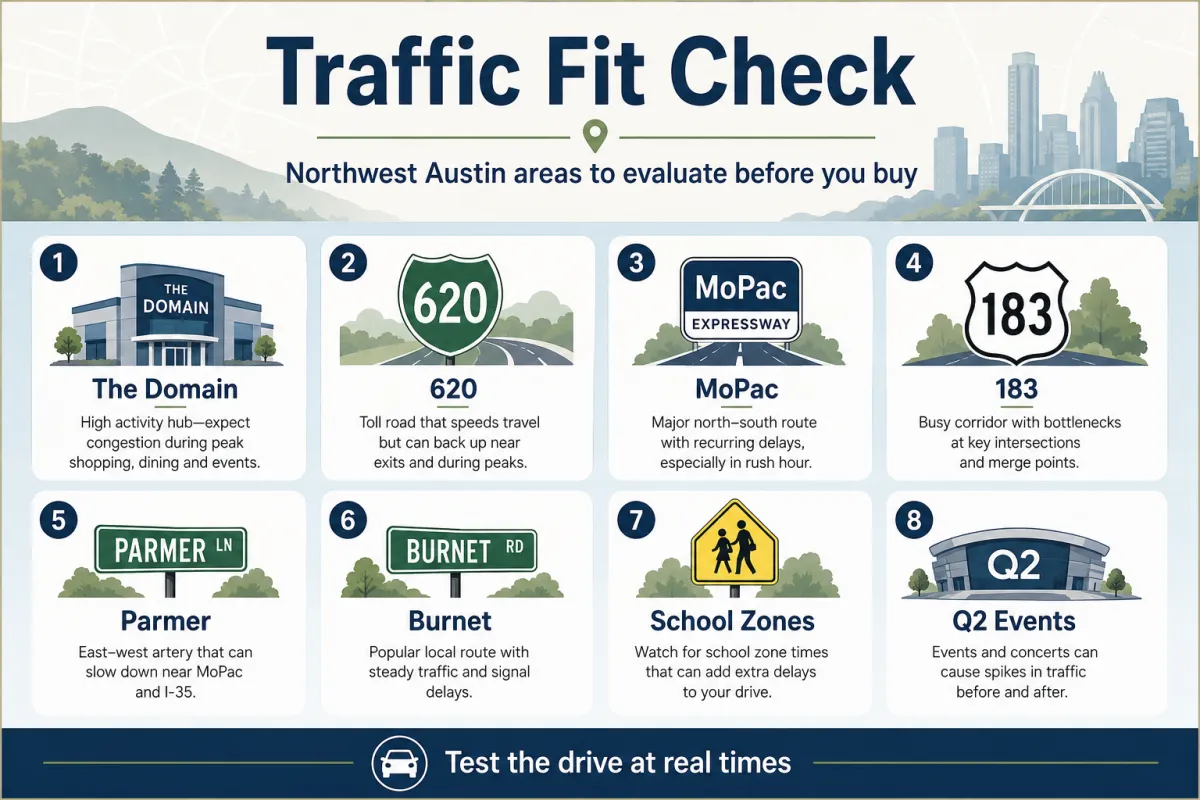
The Domain, Burnet, 620, MoPac, 183, Parmer, Anderson Mill, school zones, Q2 Stadium, and limited-exit neighborhoods can all create different kinds of traffic tradeoffs.
Some buyers will gladly accept those tradeoffs for convenience.
Others will regret them quickly.
So before you buy, do the boring thing that saves you from buyer remorse:
Drive the routes. Visit at different times. Listen outside. Test your real life.
That is how you find a Northwest Austin home you actually enjoy living in, not just one that looked good on the map.
FAQ
What areas of Northwest Austin should buyers avoid if they hate traffic?
Buyers who strongly dislike traffic should be cautious around The Domain/North Burnet, Burnet Road, 620, major MoPac and 183 access points, Parmer, Anderson Mill, school traffic zones, Q2 Stadium impact areas, and neighborhoods with limited ways in and out.
Does “avoid” mean these are bad places to live?
No. Many of these areas are popular because they are convenient. The point is that convenience can come with traffic, road noise, event activity, or congestion. They may be great fits for some buyers and frustrating for others.
Is living near The Domain bad for traffic?
It can be busy because of restaurants, shopping, offices, apartments, nightlife, and Q2 Stadium nearby. It can still be a great location if you value convenience and energy.
Is 620 traffic a problem?
For some buyers, yes. Parts of 620 can feel like a bottleneck, especially when route options are limited. Buyers considering Four Points, River Place, Canyon Creek, or nearby areas should test real drive times.
How can I check traffic before buying a home?
Drive your actual commute at real commute times, visit the home on weekdays and weekends, check school-hour traffic, test routes to errands and family, and visit during event times if near The Domain or Q2 Stadium.
Should I buy near a busy road if the home is otherwise great?
Maybe. It depends on price, lifestyle, noise tolerance, commute needs, and resale considerations. A busy location can be worth it if the convenience matters more to you than quiet.
