The Section 121 Capital Gains Exclusion: What Sellers of Long-Held Northwest Austin Homes Should Know
The tax question long-held Northwest Austin owners forget to ask
Most of the property tax attention in Northwest Austin goes to the annual bill, the homestead exemption, and the over-65 protections like the school-tax ceiling and the over-65 deferral. Those matter. But there is a separate, larger, one-time tax event that catches long-held owners in 78750, 78759, and 78726 off guard: the federal capital gains tax when they finally sell.
The reason it catches people is simple math. If you bought a home in Spicewood Estates, Balcones Woods, Great Hills, or Canyon Creek in the 1980s or 1990s, you likely paid somewhere between $120,000 and $300,000 for it. That same home may be worth $700,000 to well over $1,000,000 today. On paper, that is a gain of several hundred thousand dollars, and the IRS treats the sale of a home the same way it treats any capital asset unless a specific rule shields the gain.
That rule is Section 121 of the Internal Revenue Code, the home-sale exclusion. It is the single most valuable tax break most homeowners will ever use, and for a lot of long-held Northwest Austin sellers it covers the entire gain. But for a meaningful slice of owners here, especially single filers and surviving spouses, the gain has grown large enough to run past the exclusion. Knowing where that line falls before you list is the difference between a clean sale and a surprise five-figure tax bill.
This is general information, not tax advice. Every situation turns on your own basis, filing status, and history with the property, so confirm the specifics with your CPA or tax attorney before you make decisions based on any of this.
What the Section 121 exclusion actually does
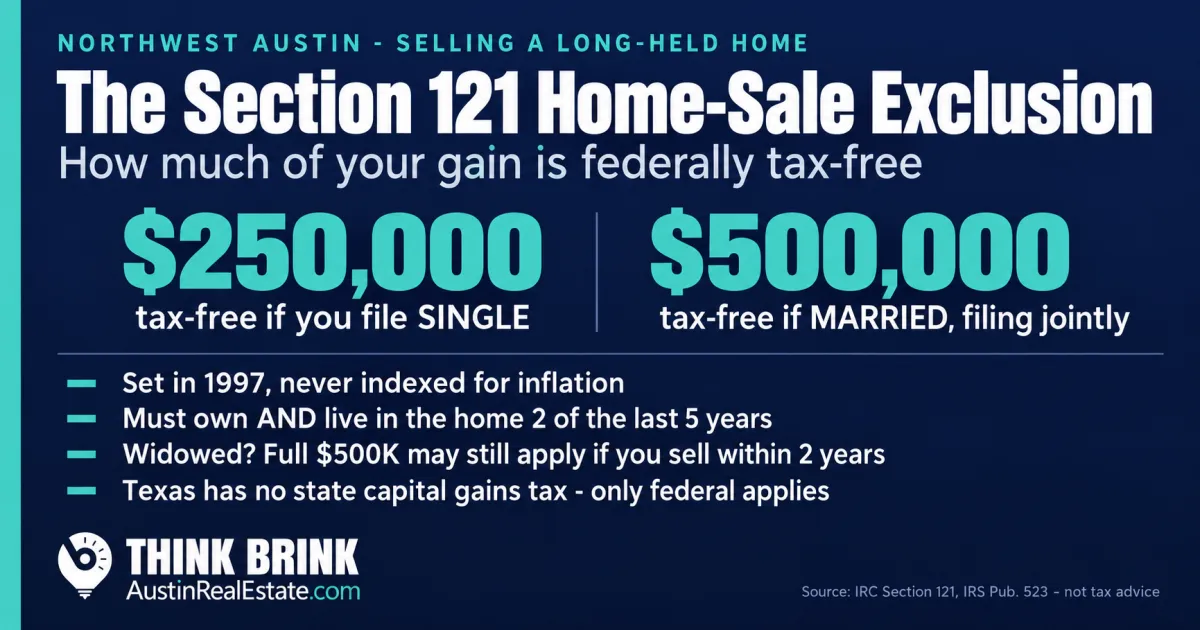
Section 121 lets you exclude a large chunk of the gain on the sale of your main home from federal income tax. The amount you can exclude depends on how you file:
Up to $250,000 of gain if you are single or married filing separately.
Up to $500,000 of gain if you are married filing jointly.
These figures are not typos and they are not out of date. Congress set them in 1997 and never indexed them to inflation, so they are the same today as they were nearly three decades ago, even though Austin home prices have multiplied several times over in that window. That mismatch is the whole story for long-held owners, and I will come back to it.
To claim the full exclusion, you have to pass two tests, both measured against the five years ending on the sale date:
Ownership test: you owned the home for at least two of those five years (24 months total).
Use test: you lived in it as your principal residence for at least two of those five years (24 months total).
The two periods do not have to be the same 24 months, and they do not have to be continuous. For a married couple filing jointly to get the full $500,000, both spouses have to meet the use test and at least one has to meet the ownership test. There is also a frequency limit: you cannot use the exclusion if you already used it on another home sale within the two years before this one. For someone who has lived in the same Northwest Austin home for twenty or thirty years, passing all of these is usually automatic. The tests are designed to stop people from flipping their way to serial tax-free gains, not to trip up genuine long-term residents.
One more point that surprises people: there is no reinvestment requirement. The old rule where you had to roll your gain into a more expensive house is gone. You can sell, take your excluded gain, and rent or downsize into something cheaper, and the exclusion still applies. That is exactly why Section 121 is so central to the downsizing decision.
Why long-held Northwest Austin homes are the ones that run past the limit
Here is where local reality collides with a 1997 dollar figure. The $250,000 and $500,000 caps were generous in 1997, when the median Austin home cost a fraction of what it does now. They have not moved. Northwest Austin prices have.
Run the arithmetic on a realistic long-held home. Say a couple bought in Balcones Woods or Great Hills in 1990 for $180,000 and the home is worth $850,000 today. Their raw gain is roughly $670,000 before any adjustments. A married couple filing jointly excludes $500,000 of that, leaving about $170,000 potentially exposed to federal capital gains tax, before you account for improvements and selling costs that reduce the taxable number. That is not a disaster, and good basis records often shrink it further, but it is real money that a lot of sellers assume is fully covered and it is not.
Now change one variable. Suppose one spouse has passed away and the survivor is now selling as a single filer. The exclusion drops from $500,000 to $250,000. On that same $670,000 gain, the exposed amount jumps from around $170,000 to around $420,000. Same house, same price, radically different tax outcome, purely because of filing status. This is the single most important thing I want long-held owners in these zip codes to understand, and it is the reason the surviving-spouse timing rule below matters so much.
The takeaway is not to panic. It is that the assumption "my home sale is tax-free" is no longer automatically true for a home that has appreciated the way Northwest Austin homes have. You need to know your actual number before you list, not after you close.
How to figure your real gain: basis is everything
Your taxable gain is not sale price minus purchase price. It is amount realized minus adjusted basis, and both of those are more favorable to you than the raw numbers suggest if you have kept records.
Adjusted basis starts with what you paid for the home, including many of the closing costs from your original purchase, and then goes up by the cost of capital improvements you made over the years. Capital improvements are the substantial, value-adding, life-extending projects: a room addition, a new roof, a kitchen or bath remodel, a replaced HVAC system, a pool, a foundation repair, new windows, a re-piped house, a driveway. Over twenty or thirty years in the same home, these add up to a lot, and every dollar of legitimate improvement is a dollar that reduces your taxable gain.
What does not count are ordinary repairs and maintenance: repainting, fixing a leak, servicing the AC, replacing a broken fixture. The IRS line is roughly whether the work added value or meaningfully extended the home's life, versus simply keeping it in working order. Given how many aging Northwest Austin homes have had major systems replaced, big remodels, and foundation and drainage work on these clay soils, the improvement side of the ledger is often substantial for long-held owners, and it is exactly the number people fail to document.
Amount realized is your sale price minus selling costs: the real estate commission, title and escrow fees you pay, and similar transaction expenses. Those come off the top before the gain is calculated.
The practical instruction is blunt: find your records now, not at closing. Pull together the original settlement statement and every receipt and contract for improvements you can locate. If you have owned the home for decades and the paperwork is thin, your CPA can help reconstruct a defensible basis, but the more documentation you have, the lower your taxable gain and the smaller the chance of a dispute. This one habit is worth more to a long-held Northwest Austin seller than almost any staging or pricing tactic, because it works directly against the part of the gain the exclusion does not cover.
The surviving-spouse rule and the two-year window
Because so many of my downsizing clients are selling after the loss of a spouse, this rule deserves its own section. Normally, when one spouse dies, the survivor becomes a single filer and is limited to the $250,000 exclusion on a later sale. But there is a specific exception: a surviving spouse who has not remarried can still claim the full $500,000 exclusion if the home is sold within two years of the date of the spouse's death, provided the couple met the tests before the death.
Two years is not a long window when you are grieving and trying to make a major housing decision. I have seen families let it lapse simply because nobody told them the clock existed. If you are a recently widowed Northwest Austin homeowner sitting on a large gain, the timing of your sale can be worth tens of thousands of dollars in tax. That does not mean you should rush a decision you are not ready for, but it does mean the two-year mark should be a known date on your calendar and a conversation with your CPA, not an afterthought.
There is a second, related concept that can help heirs even more, and it points the other direction on timing.
Inheriting a home is different: the step-up in basis
Section 121 is about selling a home you have lived in. When someone inherits a home instead, a different and often more powerful rule applies: the step-up in basis. Generally, when you inherit property, your basis is reset to the fair market value as of the date of the previous owner's death, rather than what that person originally paid.
Consider the same long-held Balcones Woods home worth $850,000. If the children inherit it after the parents pass, their basis generally steps up to roughly that $850,000 date-of-death value. If they then sell it fairly promptly for around $850,000, the taxable gain can be close to zero, because the decades of appreciation that built up during the parents' lifetime are effectively wiped off the taxable ledger. That is a very different outcome from a parent selling during their lifetime and running past the Section 121 cap.
This is not a reason to make an emotional decision about whether to sell now or hold and pass a home to heirs, and it is heavily fact-dependent, but it is exactly the kind of tradeoff a good CPA and estate attorney should walk a long-held owner through before a sale. The tax treatment of selling in your lifetime and the tax treatment of passing the home through your estate can be meaningfully different, and the right answer depends on your whole financial and family picture, not just the house.
If you ever rented the home or claimed a home office
The exclusion covers your years of personal use, but it does not erase depreciation. Any depreciation you claimed, or could have claimed, for periods after May 6, 1997, when part of the home was rented out or used for a business or home office, is not eligible to be excluded. That portion of the gain gets recaptured and taxed, generally at a higher rate than ordinary long-term capital gains.
There is also the concept of nonqualified use: time after January 1, 2009, when the home was not your principal residence, such as a stretch when you rented it out or used it as a second home, can reduce the fraction of gain you are allowed to exclude. For the typical Northwest Austin owner who bought a home, lived in it continuously, and is now selling, none of this applies. But if you converted the house to a rental for a few years, ran a business out of a dedicated space and depreciated it, or moved out and leased it before selling, the calculation gets more complicated and you should not assume the full exclusion. This is squarely CPA territory.
What if you have not lived there a full two years?
Most long-held owners easily clear the two-year tests, so this is more relevant to newer buyers, but it matters for anyone forced to sell early. If you fail the ownership or use test, you may still qualify for a partial exclusion if the sale is triggered by one of three categories: a change in place of employment, a health condition, or certain unforeseen circumstances such as a divorce, a death, or a natural disaster.
For the job-related reason, there is a safe harbor: if your new workplace is at least 50 miles farther from the home than your old workplace was, the move is treated as qualifying. When you qualify for a partial exclusion, you do not get the full $250,000 or $500,000. Instead you get a reduced maximum, calculated by taking the months you actually met the tests, divided by 24, and multiplying that fraction by the full exclusion. So an owner who lived in the home 12 of the required 24 months and qualifies under one of the categories can shelter up to half of the normal cap. That is still a substantial break, and it is worth checking with a professional before assuming an early sale is fully taxable.
The Texas angle, and the federal rate that still applies
Here is the good news for Texas sellers: Texas has no state income tax and therefore no state capital gains tax. In a state like California, a home-sale gain above the federal exclusion gets hit at both the federal level and a high state rate. In Texas, only the federal tax applies. For a relocating seller comparing markets, that is a genuine and permanent advantage.
The federal tax that does apply, on gain above your exclusion, is the long-term capital gains tax, assuming you owned the home more than a year, which every long-held owner has. Long-term capital gains are taxed in tiers, and the rate that applies to you depends on your total taxable income for the year. Higher-income sellers can also owe an additional net investment income tax on top of the capital gains rate. Because the income thresholds that set those tiers change from year to year, I am not going to quote specific bracket numbers here that could be stale by the time you read this. The point to carry is that the tax on the exposed portion of your gain is not a flat number you can guess, it depends on your income in the year of sale, and it is precisely the figure your CPA can pin down before you list so there are no surprises.
What is being debated in Congress, and why not to plan around it
You may have seen headlines suggesting capital gains tax on home sales could be eliminated. It is worth understanding what is real and what is not. As of this writing, a bill called the No Tax on Home Sales Act, introduced in mid-2025, would remove the caps entirely for a primary residence, and a separate bipartisan proposal, the More Homes on the Market Act, would double the exclusion amounts and index them to inflation going forward. Both remain in committee. Neither has passed, and it is unclear whether either will.
My honest advice is to plan around the law as it exists today, the $250,000 and $500,000 caps set in 1997. Timing a major home sale around a bill that has not moved out of committee is a bet, not a plan. Know your number under current law, and treat any change as a bonus. If your bigger concern is the annual bill after you move, the homestead exemption and property-tax rules are a separate topic worth reading alongside this one.
What this means for you
If you have owned your Northwest Austin home for a long time, do three things before you list. First, get your basis records together, the original purchase and every capital improvement, because that number directly shrinks your taxable gain and it is the one thing entirely within your control. Second, know your filing status and, if you are a surviving spouse, know your two-year window, because the difference between the $250,000 and $500,000 exclusion is the single biggest swing in the whole calculation. Third, have your CPA run your actual numbers before you sign a listing agreement, not after you are under contract, so any tax on the exposed portion of the gain is a known cost you have planned for rather than a shock at tax time.
For most long-held owners here, the exclusion still covers the whole gain and this is a non-issue. For a meaningful minority, especially single and widowed sellers of homes that have appreciated the most, part of the gain is exposed, and the right combination of documented basis and timing can save real money. Either way, the answer is the same: find out where you stand before the market forces the question. That is the kind of thing I help downsizing sellers think through, well before we ever talk about price.
Frequently asked questions
Do I have to pay capital gains tax when I sell my house in Texas?
Texas has no state income tax, so there is no state capital gains tax on a home sale. Federal capital gains tax can still apply, but only on the portion of your gain that exceeds the Section 121 exclusion of $250,000 if you are single or $500,000 if you are married filing jointly. For many long-held owners, the exclusion covers the entire gain and no tax is owed. Confirm your own situation with a CPA.
How much gain can I exclude when I sell my primary residence?
Up to $250,000 of gain if you file single, and up to $500,000 if you are married filing jointly, provided you meet the ownership and use tests. These amounts were set in 1997 and have not been adjusted for inflation, which is why long-held, highly appreciated homes can produce a gain larger than the cap.
What are the ownership and use tests for the home-sale exclusion?
You must have owned the home for at least two of the five years before the sale, and lived in it as your principal residence for at least two of those five years. The two periods do not have to overlap or be continuous. You also cannot have used the exclusion on another home sale in the two years before this one.
I am widowed. Can I still get the $500,000 exclusion?
Possibly. A surviving spouse who has not remarried can claim the full $500,000 exclusion if the home is sold within two years of the spouse's death, assuming the couple met the tests before the death. After that window, the survivor is generally limited to the $250,000 single-filer amount, which is why the timing of the sale can be worth a great deal in tax. Talk to your CPA about your specific date and situation.
What counts toward my home's basis to reduce the taxable gain?
Your basis is what you paid for the home plus the cost of capital improvements over the years, such as additions, a new roof, remodels, replaced HVAC, a pool, foundation work, or new windows. Ordinary repairs and maintenance do not count. Selling costs like the real estate commission and title fees also reduce your gain. Keeping and finding these records is the most effective way to lower the taxable portion.
What happens to capital gains tax if my kids inherit the house instead?
Inherited property generally receives a step-up in basis to the fair market value at the date of death. If the heirs sell fairly soon after for about that value, the taxable gain can be close to zero, because the appreciation that built up during the owner's lifetime is effectively reset. This is different from selling during your lifetime and can be a significant planning consideration, so involve a CPA and estate attorney.
Does renting out my home affect the exclusion?
Yes. Depreciation you claimed or could have claimed for rental or business use after May 6, 1997, cannot be excluded and is recaptured and taxed. Periods after January 1, 2009, when the home was not your principal residence can also reduce the fraction of gain you are allowed to exclude. If you ever rented the home or used part of it for a depreciated business use, the calculation is more complex and needs professional review.
Is the capital gains tax on home sales going away?
Not currently. Proposals to eliminate or raise the exclusion have been introduced in Congress but remain in committee and have not become law. Plan around the current $250,000 and $500,000 caps, and treat any future change as an upside rather than something to time your sale around.
A note on advice
I am a real estate broker, not a CPA or tax attorney. Everything above is general information, not personalized tax advice. Your basis, filing status, prior use of the home, and income in the year of sale all change the answer, so run your specific numbers with a qualified tax professional before you decide when and how to sell.
