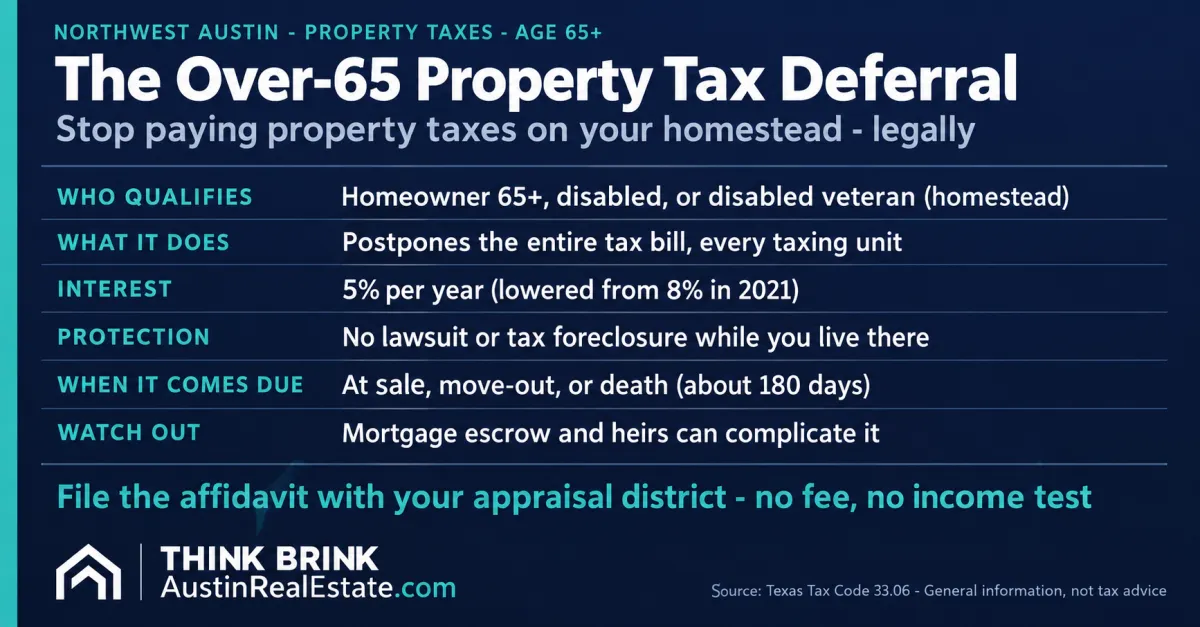
How the Texas Over-65 Property Tax Deferral Works for Northwest Austin Homeowners
The over-65 tool almost nobody uses on purpose
Most Northwest Austin homeowners past 65 know about the school tax ceiling, the extra homestead exemptions, and the appraisal protest. Those are the tools people talk about at the neighborhood coffee. The Texas property tax deferral for homeowners 65 and older is different. It is the most powerful cash-flow tool available to a senior homeowner in this state, and it is also the one most people either have never heard of or have been quietly warned away from. Both reactions miss the point.
A deferral does not lower your tax bill. It lets you stop paying it, legally, for as long as you own and live in your home. That is a very specific thing, useful in some situations and a mistake in others. This is the honest broker's read on how the over-65 deferral actually works in 78750, 78759, and 78726, when it makes sense for a homeowner here, and the parts of it that catch people off guard. If you have already read our piece on how the over-65 school tax ceiling transfers when you downsize, treat this as the companion. The ceiling caps what you owe. The deferral changes when you owe it.
One caveat up front, because it matters on every line below: this is general information, not tax or legal advice. Property tax deferral has real long-term consequences for your equity and your heirs, and the right call depends on your specific finances. Talk to a CPA or an attorney before you file anything.
What the over-65 deferral actually is
Under Texas Tax Code Section 33.06, a homeowner who is 65 or older, disabled as defined by the tax code, or a qualifying disabled veteran or surviving spouse, can defer or stop the collection of property taxes on their residence homestead. You qualify by age or disability, you own and occupy the home as your homestead, and you file a one-page affidavit with the chief appraiser at the appraisal district where the property sits. In Northwest Austin that is the Travis Central Appraisal District for most of 78750, 78759, and 78726, and the Williamson Central Appraisal District if your home falls on the Williamson County side of the line. If you are unsure which county you are in, that boundary matters for more than the deferral, and it is worth reading our breakdown of Travis County versus Williamson County property taxes in Northwest Austin.
Here is the part people misunderstand. A deferral is not an exemption and it is not forgiveness. The taxes are still assessed every year, they still accrue, and a lien stays on your property the entire time. What changes is that no taxing unit can force you to pay while you own and live there, and no one can foreclose on the home over those taxes during the deferral. You are not erasing the bill. You are postponing it and letting it grow, on your terms, until you sell, move out, or pass away.
How you actually file, and what happens next
The mechanics are simpler than the stakes suggest. You complete the Tax Deferral Affidavit for Over-65 or Disabled Homeowner and submit it to your appraisal district. There is no application fee and no income test. You do not have to be behind on your taxes to file, and you can file even if you are already delinquent, which is one of the reasons the tool exists. Once the affidavit is on record, the collector for each taxing unit is on notice that your home is in deferral status.
From that point, you can stop writing the property tax check. You do not lose your homestead exemption, your over-65 exemption, or your school tax ceiling by deferring. Those stack with the deferral rather than competing with it. The deferral simply sits on top and pauses collection of whatever is owed after those exemptions and the ceiling have already done their work. In practice, a longtime Northwest Austin homeowner with the over-65 exemptions and a frozen school bill is deferring a smaller annual number than a younger owner down the street would be, because the exemptions shrank the base first.
The five percent interest, and why the number used to scare people
Deferred taxes do not sit still. They accrue interest at five percent per year during the deferral period. That five percent is worth pausing on, because a lot of the old advice warning seniors away from deferral was written when the rate was eight percent. Texas lowered it to five percent through House Bill 988 in 2021, and that change quietly turned the deferral from an expensive last resort into a genuinely reasonable financing tool for the right homeowner.
Think about what five percent simple interest on a deferred property tax balance actually competes with. For a homeowner on a fixed income who would otherwise pull the tax money out of a brokerage account, sell an appreciated asset and trigger capital gains, or worse, put the tax bill on a credit card, five percent is often the cheapest money in the room. For a homeowner who has plenty of liquidity and is earning more than five percent on their savings, it is a wash or a slight loss and probably not worth the complications below. The interest rate is the hinge the whole decision turns on, and it is low enough now that the deferral deserves a real look rather than a reflexive no.
It covers every taxing unit, not just the schools
This is where the deferral and the school tax ceiling do different jobs, and where people conflate them. The over-65 school tax ceiling only freezes the school district portion of your bill. In Northwest Austin the school district is usually the single largest line on the tax statement, so the ceiling is powerful, but it leaves the county, the city, the community college, the road district, and any municipal utility district untouched. Those keep rising with your appraised value and the rates set each year.
The deferral is broader. It stops collection of the entire property tax bill, every taxing unit on the statement, not just the schools. For a homeowner in a neighborhood with a MUD or a county road district on top of the usual lines, the deferral reaches parts of the bill the ceiling never will. If you want the full picture of which units show up on a Northwest Austin statement and how the exemptions apply to each, our guide to what buyers should know about property taxes and exemptions before making an offer lays out the whole stack.
The protection that makes it more than a payment plan
The deferral has teeth that a casual payment arrangement does not. Once your affidavit is filed, a taxing unit cannot file suit to collect the delinquent taxes, and it cannot sell your home at a tax foreclosure sale, for as long as you own and occupy the property. If a taxing unit has already sued, filing the deferral affidavit forces the court to abate that suit. This is the provision that makes the deferral a real safety net for a senior homeowner who has fallen behind and is genuinely afraid of losing the house. It converts an emergency into a manageable, if growing, balance.
That protection follows a defined timeline once the deferral ends. When you no longer own and occupy the home as your homestead, the collector delivers a notice of delinquency, and collection actions, including foreclosure, cannot proceed until the 181st day after that notice. In plain terms, whoever inherits or buys the home gets roughly six months of breathing room to settle the deferred balance before the taxing units can move. That window is deliberate, and it is one of the more humane corners of the Texas property tax code.
What happens when the deferral ends
Every deferral ends eventually, because the qualifying condition is that you own and live in the home. The three ways it ends are selling the home, moving out of it as your primary residence, or passing away. When any of those happens, the full deferred balance, all the postponed taxes plus the accrued five percent interest, becomes due. After the notice of delinquency, there is a payoff window of roughly six months before the ordinary delinquency penalties and higher interest kick back in.
For most Northwest Austin homeowners, the practical answer is that the deferred balance gets paid out of the home sale. Homes in 78750, 78759, and 78726 carry substantial equity, and a few years of deferred taxes plus five percent interest is a modest fraction of what one of these houses sells for. The deferral, in that case, is essentially a way to borrow against your own equity at five percent and settle up at closing. If you are weighing a sale anyway, especially a downsizing move, it is worth understanding how the timing interacts with your equity, which is the subject we cover in the school tax ceiling and downsizing piece.
The harder version of this conversation is about heirs. If the plan is to pass the home to children rather than sell it, the deferred balance becomes their problem, and it becomes due when you pass away. Your heirs will have the roughly six-month window to pay it, but pay it they must, or refinance or sell to cover it. This is not a reason to avoid the deferral. It is a reason to make sure your family knows the balance exists and has a plan for it, rather than discovering a five-figure tax lien in the middle of grief.
The mortgage complication nobody mentions first
Here is the practical wrinkle that decides the question for a lot of homeowners before the finances even come up. If you still have a mortgage with an escrow account, your lender is almost certainly paying your property taxes out of that escrow every year, on your behalf, whether or not you have a deferral on file. Deferring taxes you are not personally writing a check for accomplishes very little, and many loan agreements treat unpaid property taxes as a default even when a deferral would otherwise protect you from the taxing units. The deferral protects you from the county. It does not rewrite your deal with your lender.
That is why, in real life, the over-65 deferral is cleanest and most useful for homeowners who own their home free and clear, or who are prepared to have a direct conversation with their loan servicer first. A large share of longtime Northwest Austin owners who bought in the 1980s and 1990s are in exactly that free-and-clear position, which is part of why this tool is more relevant here than the low awareness of it would suggest. If you carry a mortgage, do not file anything until you have talked to both your servicer and a CPA about how it interacts with your loan.
The other deferral, for homeowners who are not yet 65
There is a second, less-known deferral in the same part of the code, Section 33.065, and it is worth a sentence because people confuse the two. That one is not about age. It lets any homestead owner defer the taxes on the portion of their appraised value that exceeds 105 percent of the prior year's value, plus the value of any new improvements. In other words, it targets the runaway appreciation, not the whole bill. It exists so that an owner whose home value spiked can postpone the taxes on the spike specifically.
For most established Northwest Austin homeowners, the 105 percent deferral matters less than it would in a rapidly appreciating new area, because the homestead cap already limits how fast the taxable value of a long-held home can climb. But it is a distinct tool, available regardless of age, and if you are under 65 and got hit with a large jump in taxable value, it is worth asking your appraisal district about. The over-65 deferral under 33.06 is the bigger lever; 33.065 is the narrower one.
Who this is actually right for in Northwest Austin
The honest answer is that the deferral is right for a minority of homeowners and wrong for many, and the split is not about how much money you have. It is about liquidity and intent.
It fits the homeowner who is house-rich and cash-tight. Someone who bought a Spicewood Estates or Balcones Woods or Canyon Creek home decades ago, owns it free and clear, is living on a fixed income, and is watching the non-school portion of the tax bill climb faster than their income. For that person, five percent money secured by a home worth many times the deferred balance is a rational way to stay in a paid-off house without draining savings or being forced to sell before they are ready.
It also fits the homeowner in genuine trouble, the one who has fallen behind and is afraid of foreclosure. The deferral stops the clock on collection and buys real time, and at five percent it does so without the punitive interest that delinquent taxes normally carry.
It fits poorly the homeowner with ample liquidity earning more than five percent, the one who intends to leave the home to heirs without a clear plan for the balance, and the one with a mortgage and escrow who would be deferring taxes the lender is already paying. For those owners the deferral adds a growing lien and a future complication in exchange for very little. There is no penalty for skipping it, and for many well-situated Northwest Austin retirees, skipping it is the right move.
Frequently asked questions
Does the over-65 deferral lower my property taxes?
No. It does not reduce what you owe. It postpones collection of the taxes you already owe and lets the balance accrue at five percent interest until you sell, move out, or pass away. The tools that actually lower your bill are the homestead and over-65 exemptions and the school tax ceiling, which you keep in addition to the deferral.
Do I have to pay the money back?
Yes, eventually. The deferral is a postponement, not forgiveness. The full deferred balance plus accrued interest comes due when you no longer own and occupy the home, which usually means at sale or after your death. In most Northwest Austin cases the balance is paid from the home sale, since the equity here dwarfs a few years of deferred taxes.
Can the county foreclose on my home while I am deferring?
No. Once your affidavit is filed, no taxing unit can sue to collect or sell your home at a tax foreclosure while you own and live there. If a suit was already filed, the deferral forces the court to abate it. After the deferral ends, there is roughly a six-month window before collection can resume.
What interest rate applies to deferred taxes?
Five percent per year during the deferral period, set by Texas Tax Code Section 33.06. It was eight percent until House Bill 988 lowered it in 2021, which is why older advice about deferral being expensive is out of date.
Will deferring hurt my heirs?
It creates a balance they will need to settle, with interest, when you pass away, and they will have roughly six months after the notice of delinquency to pay it, refinance, or sell to cover it. It is not a reason to avoid the deferral, but it is a reason to make sure your family knows the balance exists and has a plan for it in advance.
Can I defer my taxes if I still have a mortgage?
Be careful here. If your lender pays your taxes from an escrow account, deferring accomplishes little, and many loan agreements treat unpaid taxes as a default even during a deferral. The deferral protects you from the taxing units, not from your lender. Talk to your loan servicer and a CPA before filing if you carry a mortgage.
Is the deferral the same thing as the school tax ceiling?
No. The ceiling freezes only the school district portion of your bill. The deferral postpones collection of the entire bill, every taxing unit, but the amount comes back due later with interest. Many Northwest Austin homeowners use the ceiling permanently and never need the deferral at all.
How do I file for the deferral in Northwest Austin?
File the Over-65 or Disabled Homeowner tax deferral affidavit with your appraisal district, Travis Central Appraisal District or Williamson Central Appraisal District depending on which side of the county line your home sits. There is no fee and no income test. Confirm the current form and any local details directly with your appraisal district.
What this means for you
The over-65 property tax deferral is a scalpel, not a hammer. Used on the right homeowner, a house-rich, cash-tight owner in a paid-off Northwest Austin home, or someone genuinely at risk of losing the house over back taxes, it is the cheapest and most protective tool in the code, especially now that the interest rate is five percent. Used on the wrong homeowner, someone with a mortgage and escrow, plenty of liquidity, or heirs and no plan, it quietly stacks a growing lien onto the home for very little benefit.
The reason it deserves a look rather than a reflexive no is that most of the fear around it dates to the eight percent era and to a general discomfort with the idea of not paying your taxes. The mechanics are sound, the protections are real, and for the right person in these zip codes it is the difference between staying in a beloved home and being pushed to sell before they are ready. The reason it deserves care rather than a reflexive yes is that it touches your equity and your family, and the details of your mortgage and your estate change the answer.
Run your specific numbers with a CPA, and if you have a mortgage, talk to your loan servicer before you file. This is general information about how the Texas over-65 deferral works, not personalized tax, legal, or financial advice. If you want help thinking through how a deferral, the school tax ceiling, and a potential downsizing move fit together for your particular home in Northwest Austin, that is a conversation worth having before you make any of these decisions permanent.
