What Northwest Austin Buyers Should Know About Property Taxes and Exemptions Before Making an Offer
Most buyers moving into Northwest Austin budget carefully for the mortgage and then get surprised by the second number that shows up on the closing statement: property taxes. In 78750, 78759, and 78726, the tax line is not a rounding error. On a home in the mid-to-upper price ranges these neighborhoods command, property taxes can add somewhere between $900 and $1,600 a month to what you actually pay to live there, on top of principal and interest. If you are relocating from a state that funds schools and local government differently, that number can be the single biggest shock of the whole move.
This guide walks through how property taxes and exemptions actually work in Northwest Austin, what changed in 2025, and how to figure out your real monthly cost before you write an offer instead of after. Texas has no state income tax, and property taxes are how local government and schools get funded here. That trade is often a net win for high earners relocating from California, Washington, or the Northeast, but only if you understand what you are signing up for.
One note before we start: I am a real estate broker, not a CPA or a tax attorney. The numbers and rules below are accurate as of this writing and drawn from public sources, but exemption eligibility, deadlines, and the tax consequences of your specific situation should be confirmed with a qualified tax professional and your county appraisal district before you rely on them.
Why property taxes matter more here than the sticker price suggests
When you look at a listing in Spicewood Estates or Canyon Creek, the price is the headline. But the number that determines whether you can comfortably afford the home is the total monthly payment, and in Texas the tax portion of that payment is unusually large. There is no state income tax in Texas, so the funding that other states pull from paychecks gets collected instead through property taxes on your home.
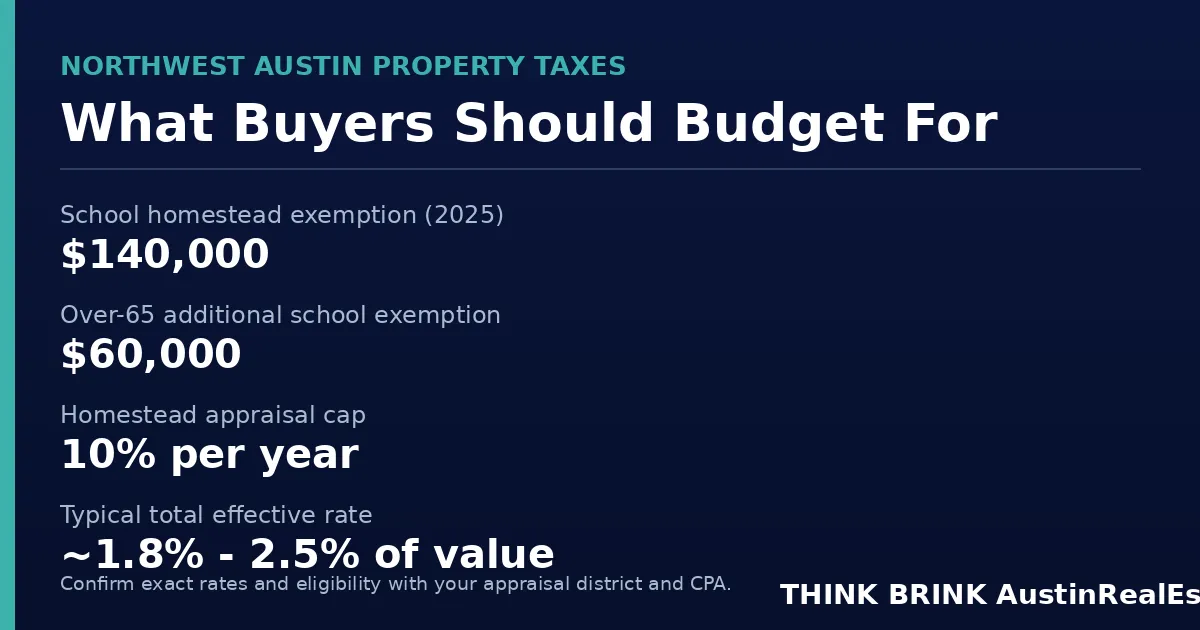
Your total property tax bill is the sum of several separate taxing entities that happen to overlap at your address. For a Northwest Austin home that typically means the school district, Travis County, the City of Austin, a community college district, and sometimes a special district like a MUD. Each one sets its own rate, and your bill is all of them added together. In practice, the total effective rate across Travis County runs roughly 1.8 percent to 2.5 percent of assessed value depending on which jurisdictions stack up at a given address. The single largest piece is almost always the school district.
Here is what that means in dollars. On a home assessed at $650,000 with no exemptions, a total rate near 2.0 percent produces a tax bill around $13,000 a year, or about $1,083 a month rolled into your escrow. That is why two homes at the same list price can carry meaningfully different monthly payments: the tax rate at the address, the current assessed value, and whether the seller had exemptions in place all move the number. I go deeper on how the full carrying cost adds up in what it actually costs to own a home in 78750 or 78759 right now.
How your tax bill is actually calculated
There are three moving parts to any Texas property tax bill, and understanding each one is what lets you predict your cost instead of guessing.
1. The appraised value
Every property in Travis County is assigned a market value each year by the Travis Central Appraisal District. This is their estimate of what your home would sell for, and it is not the same as your purchase price, though a recent sale price is strong evidence of value. The appraisal district updates values annually, and you have the right to protest an assessment you believe is too high.
2. The exemptions
Exemptions reduce the portion of your value that gets taxed. The most important one for a primary residence is the homestead exemption, covered in detail below. Exemptions are subtracted from the appraised value before the rate is applied, so they lower your bill directly.
3. The tax rate
Each taxing entity sets an annual rate expressed as dollars per $100 of taxable value. Add all the overlapping entities together and you get your total rate. For reference, Travis County adopted a county rate of roughly $0.372 per $100 for its 2025-2026 fiscal year, and the school district portion, which is the biggest single line, has run in the neighborhood of $0.90 to $0.95 per $100 in recent years. Because rates are reset every year and vary by exact jurisdiction, confirm the current combined rate for a specific address rather than assuming.
The formula is straightforward once you have all three: take the appraised value, subtract your exemptions to get the taxable value, then multiply by the combined rate. The complexity is not in the math. It is in knowing which exemptions apply to you and how the value is likely to move after you buy.
The homestead exemption: the single biggest lever you control
If you buy a home in Northwest Austin and make it your primary residence, the homestead exemption is the most valuable tax benefit available to you, and it is the one buyers most often leave on the table by forgetting to file.
Texas made a major change here in 2025. Voters approved Proposition 13 in November 2025, which raised the school district homestead exemption from $100,000 to $140,000. The change was made effective for the 2025 tax year through Senate Bill 4. In plain terms, that means the first $140,000 of your home's value is exempt from school district taxes, which is the largest slice of your bill. Because the school rate is the biggest component, that $140,000 exemption is worth real money every year, generally over a thousand dollars annually for a typical homesteaded property.
The homestead exemption only applies to your principal residence. You cannot claim it on an investment property, a second home, or a rental. You have to own the home and occupy it as your main home to qualify. For most buyers, the practical steps are: close on the home, make it your primary residence, and file the homestead application with the Travis Central Appraisal District. There is no fee to file, and you do not need a service to do it for you despite the mailers you will receive suggesting otherwise.
Historically, the rule was that you had to own and occupy the home as of January 1 to claim the exemption for that tax year. Texas law has since changed to allow homestead exemptions in the year of purchase in many circumstances, so if you buy mid-year it is worth filing promptly rather than waiting for the next January. Confirm the current filing window and eligibility for your closing date with the appraisal district, because the details matter and they do change.
The 10 percent appraisal cap: protection that takes a year to kick in
The second big benefit of the homestead exemption is the appraisal cap. Once your homestead exemption is in place, the taxable value of your home cannot increase more than 10 percent per year, regardless of how much the market value rises. In a market like Northwest Austin, where appreciation has at times run well above 10 percent in a single year, this cap is meaningful protection against a runaway tax bill.
There is an important catch that trips up new buyers. The 10 percent cap applies beginning in the second year you have the homestead exemption. In your first full year, the assessed value can reset to current market value, which for a home you just bought often means it jumps to something close to your purchase price. This is the reason so many buyers see a tax increase in year two of ownership even though nothing about the house changed: the property may have been carrying a seller's long-held capped value, and after your purchase it resets, then the cap begins protecting you going forward.
This is also why you should never assume the seller's current tax bill will be your tax bill. If the seller owned the home for fifteen years with a homestead exemption, their assessed value may be far below current market value, and their tax bill will not survive the sale. Budget based on a reset to roughly your purchase price, apply the homestead exemption, and then let the cap protect you in the years that follow. I walk through how to think about a home's true value versus its assessed value in what is your 78750 or 78759 home worth right now.
Exemptions for buyers 65 and older
Northwest Austin has a large population of long-term owners and relocating retirees, and the over-65 exemptions are among the most generous in the tax code. If you or your spouse is 65 or older, you qualify for benefits well beyond the standard homestead exemption.
First, there is an additional school district exemption for homeowners 65 and older. In 2025 that additional amount was raised from $10,000 to $60,000 through the same round of legislation. Stacked on top of the general $140,000 school exemption, that brings the combined school district exemption for a qualifying senior to roughly $200,000 of value exempted from school taxes. For a household on a fixed income, that is a substantial annual reduction.
Second, and often more valuable over time, is the over-65 school tax ceiling, sometimes called the tax freeze. Once you turn 65 and have the exemption in place, the amount you pay in school district taxes is frozen at that year's level. Even if your home's value climbs in the years that follow, your school tax portion cannot go above the ceiling amount. It can go down in a year when rates fall, but it will not rise above where it was set. Over a decade of appreciation, that ceiling can save a senior homeowner tens of thousands of dollars.
There are also provisions that let qualifying seniors transfer a percentage of their tax ceiling to a new homestead within Texas, which matters for downsizers moving within the state. The rules around transferring ceilings and exemptions between homes are specific and depend on timing, so this is exactly the kind of thing to run past a tax professional and your appraisal district before you make a move. Disabled homeowners and disabled veterans have their own set of exemptions as well, some of which can eliminate the tax bill entirely for a 100 percent disabled veteran.
What this looks like in Northwest Austin specifically
The mechanics above are statewide, but the dollars land differently depending on where in Northwest Austin you buy, because the taxing jurisdictions change by address.
The 78750, 78759, and 78726 zip codes are split across school districts. Much of the established 78750 and 78759 area, and Canyon Creek in 78726, sits in Round Rock ISD, while parts of the area feed Austin ISD, and pockets of the broader northwest fall into Leander ISD. Because the school district is the biggest single component of your bill, the specific district at your address is the largest driver of what you will pay. Two homes a few streets apart at the same price can carry different tax bills purely because they sit in different districts. This is the same address-level effect that determines your school assignment, which I cover in how school zoning by address changes what you pay in Northwest Austin and in more detail in Round Rock ISD vs Austin ISD in Northwest Austin.
City of Austin taxes apply to most of these neighborhoods because they are inside city limits, and Travis County and Austin Community College rates apply across the board. Some newer developments along the Parmer and 183 corridors sit inside a Municipal Utility District, which adds a MUD assessment on top of the standard entities. MUD rates can be significant in the early years of a development and typically decline as the district's infrastructure debt is paid down. If you are looking at newer construction north and east of the established core, always ask specifically whether the property is in a MUD and what the current MUD rate is, because it can be the difference of several hundred dollars a month.
The practical takeaway for a Northwest Austin buyer is this: never budget off a listing's advertised tax figure or the seller's current bill. Pull the actual taxing entities for the specific address, assume the assessed value resets toward your purchase price, apply the homestead exemption you will file, and account for any MUD. That gives you a real number instead of a hopeful one.
How to estimate your true monthly payment before you offer
Here is the process I walk buyers through so the tax line does not blindside them at closing.
Start with the purchase price as your working assessed value, because after your first year the value will likely reset toward what you paid. Subtract the $140,000 school homestead exemption to get your taxable value for the school portion, and remember other entities have their own smaller exemption treatment. Apply the combined tax rate for the specific address, which you can get from the appraisal district or your agent, using a working figure around 1.8 percent to 2.2 percent of value for most established Northwest Austin homes with a homestead exemption in place. Divide by twelve to get the monthly escrow amount.
On a $650,000 purchase with a homestead exemption and a combined effective rate near 2.0 percent, you are looking at roughly $12,000 to $13,000 a year, or about $1,000 to $1,083 a month in taxes alone, folded into your payment alongside principal, interest, and insurance. If the home is in a MUD, add that separately. If you qualify for over-65 exemptions, the number drops meaningfully and then freezes on the school portion.
Doing this math before you offer changes how you shop. A buyer who realizes the tax line adds a thousand dollars a month often reconsiders the top of their price range, and that is a far better realization to have during the search than after the first escrow analysis arrives. It also lets you compare two homes honestly, because the one with the lower list price is not always the cheaper one to own once you account for the district and any special assessments.
Common mistakes Northwest Austin buyers make with property taxes
Assuming the seller's tax bill is yours. A long-term owner's capped, exemption-protected bill disappears when you buy. Your first full year resets toward market value. This is the most expensive assumption a buyer can make.
Forgetting to file the homestead exemption. It is free, it is the biggest single tax break you control, and it is easy to overlook in the chaos after closing. File it. Ignore the official-looking mailers offering to file it for you for a fee.
Not asking whether a home is in a MUD. Two similar homes can carry very different total rates if one sits in a Municipal Utility District. On newer construction especially, ask the question directly.
Overlooking the year-two increase. Even with the 10 percent cap, your bill can jump in the second year as the value resets and the cap only starts protecting you afterward. Budget for it so it is not a surprise.
Not protesting an inflated assessment. If the appraisal district's value comes in above what you paid or above comparable sales, you have the right to protest. Many owners never do, and leave money on the table every year.
Frequently Asked Questions
How much are property taxes in Northwest Austin?
The total effective property tax rate across Travis County generally runs about 1.8 percent to 2.5 percent of assessed value, depending on which taxing entities overlap at your address. On a $650,000 home with a homestead exemption, that typically works out to roughly $1,000 to $1,200 a month rolled into your payment. The exact figure depends on your school district, whether you are inside Austin city limits, and whether the property sits in a MUD, so confirm the combined rate for the specific address.
What is the homestead exemption in Texas and how much is it worth?
The homestead exemption reduces the taxable value of your primary residence. As of the 2025 tax year, the school district homestead exemption is $140,000, raised from $100,000 by Proposition 13. Because the school district is the largest part of your bill, that exemption typically saves a homeowner over a thousand dollars a year. It only applies to your primary residence, not to rentals or second homes, and you have to file for it with the county appraisal district.
Do I have to wait until January 1 to file for a homestead exemption?
The traditional rule required you to own and occupy the home as your primary residence on January 1. Texas law now allows homestead exemptions in the year of purchase in many situations, so if you buy mid-year it is worth filing promptly rather than waiting. Confirm the current filing window and your eligibility with the Travis Central Appraisal District for your specific closing date.
Why did my property taxes go up so much in the second year after I bought?
The 10 percent appraisal cap only begins protecting you in the second year you hold the homestead exemption. In your first full year, the assessed value can reset to current market value, which for a recent purchase often means it climbs toward your purchase price. If the previous owner had a long-held, capped value, the reset can produce a noticeable jump before the cap starts limiting increases going forward.
What tax breaks do homeowners over 65 get in Texas?
Homeowners 65 and older qualify for an additional school district exemption, raised to $60,000 in 2025, which stacks on top of the general $140,000 exemption for a combined school exemption around $200,000. They also get a school tax ceiling that freezes the school portion of the bill at the level set the year they turned 65, so it cannot rise above that amount even as values climb. Qualifying seniors can often transfer a percentage of that ceiling to a new home within Texas, which matters for downsizers.
Are property taxes higher in Round Rock ISD or Austin ISD parts of Northwest Austin?
The school district is the biggest single component of your bill, so the district at your address is the largest driver of what you pay. The 78750, 78759, and 78726 zips are split across Round Rock ISD, Austin ISD, and in places Leander ISD, and rates differ between them and change every year. Because two homes a few streets apart can sit in different districts, always confirm the specific district and current rate for the exact address rather than assuming based on the zip code.
What is a MUD and how does it affect my tax bill?
A Municipal Utility District is a special taxing entity that funds water, sewer, and infrastructure in some newer developments, often along the Parmer and 183 corridors. If your home is in a MUD, its assessment is added on top of the standard school, county, and city taxes, and can add several hundred dollars a month in the early years. MUD rates usually decline over time as the district pays down its infrastructure debt. Always ask whether a property is in a MUD before you offer.
Can I lower my property taxes if I think my home is over-assessed?
Yes. You have the right to protest your assessed value with the appraisal district each year. If their value comes in above your purchase price or above comparable recent sales, a protest supported by good evidence can lower your taxable value and your bill. Many owners never protest and overpay year after year. A tax professional or a protest service can handle it, or you can file yourself.
The honest summary
Property taxes are the part of Northwest Austin homeownership that relocating buyers underestimate most, and they are also the part where a little knowledge saves the most money. The trade Texas offers is real: no state income tax in exchange for higher property taxes, which favors high earners but hits everyone at the closing table. The levers that matter are the ones you control. File your homestead exemption, understand that your first year resets toward your purchase price before the 10 percent cap kicks in, ask whether the home is in a MUD, and if you are over 65, make sure you claim the additional exemption and the tax ceiling that go with it.
Budget off a realistic reset value and the specific district at the address, not the seller's old bill or the listing's advertised figure. Do that math before you write an offer, and the tax line becomes a number you planned for instead of one that surprises you. If you want help pulling the actual taxing entities and estimating the true monthly cost for a specific Northwest Austin home before you offer, that is exactly the kind of thing I do with buyers, and it is worth doing before you fall in love with a house at the top of your range.
This article is general information from a licensed real estate broker and is not tax or legal advice. Exemption eligibility, deadlines, and the tax treatment of your specific situation should be confirmed with a qualified CPA or tax attorney and the Travis Central Appraisal District before you rely on them.
