How School Zoning by Address Changes What You Pay in Northwest Austin
Here is the single most expensive assumption buyers make in Northwest Austin: that the neighborhood name tells you the schools. It does not. In this part of Austin, two houses on the same street, sometimes two houses next door to each other, can be assigned to different elementary schools, different middle schools, and in some cases different school districts entirely. And because a large share of what buyers pay for a home here is really payment for the school assignment attached to that address, getting the zoning wrong, or assuming it, is one of the costliest mistakes you can make.
This post explains how school zoning by address actually works in the 78750, 78759, and 78726 zip codes, why it moves prices as much as it does, where the boundary surprises hide, and exactly how to verify an assignment before you write an offer instead of after you have moved in. If you take one thing from it, take this: in Northwest Austin, you are not buying a neighborhood's schools, you are buying a specific address's schools, and the difference between those two ideas can be six figures.
Why school zoning drives price so hard here
Northwest Austin's buyer pool is heavily weighted toward tech professionals, dual-income households, and relocating families, many from California and the Pacific Northwest, who are choosing this area in large part for the public schools. When a big share of the demand for a neighborhood is school-driven, the school assignment stops being a nice-to-have and becomes a priced-in feature of the property, the same way square footage or a pool is.
The clearest example in this area is Westwood High School. Westwood is a Round Rock ISD International Baccalaureate World School with a 9 out of 10 GreatSchools rating, an "A" accountability rating from the Texas Education Agency for the 2024-2025 school year, and a graduation rate around 99 percent. It is one of the most sought-after public high school feeders in the Austin metro. Homes that are confirmed to feed Westwood carry a demand premium precisely because so many buyers are filtering their entire search around landing at that school. When demand concentrates on a specific assignment, the homes that carry it cost more. That is not a Northwest Austin quirk; it is how school-driven housing markets work everywhere. It is just unusually visible here because the feeders are strong and the buyer pool cares.
The problem is that the boundaries that decide who feeds Westwood, or Canyon Vista, or Anderson, do not follow neighborhood names or marketing maps. They follow attendance-zone lines drawn by the districts, and those lines cut through neighborhoods in ways that surprise people constantly.
How assignment actually works: address first, everything else second
School assignment in Texas is set at the address level by the school district's attendance boundaries. Your home is assigned to an elementary, a middle school, and a high school based on where the property physically sits relative to those boundary lines, not based on the subdivision name, not based on the zip code, and not based on what the listing agent wrote in the description.
Three things follow from that, and all three catch buyers off guard.
First, a single neighborhood can straddle a boundary. The northern half of a subdivision might feed one elementary and the southern half another. This is common in older Northwest Austin neighborhoods that were platted before or across current boundary lines.
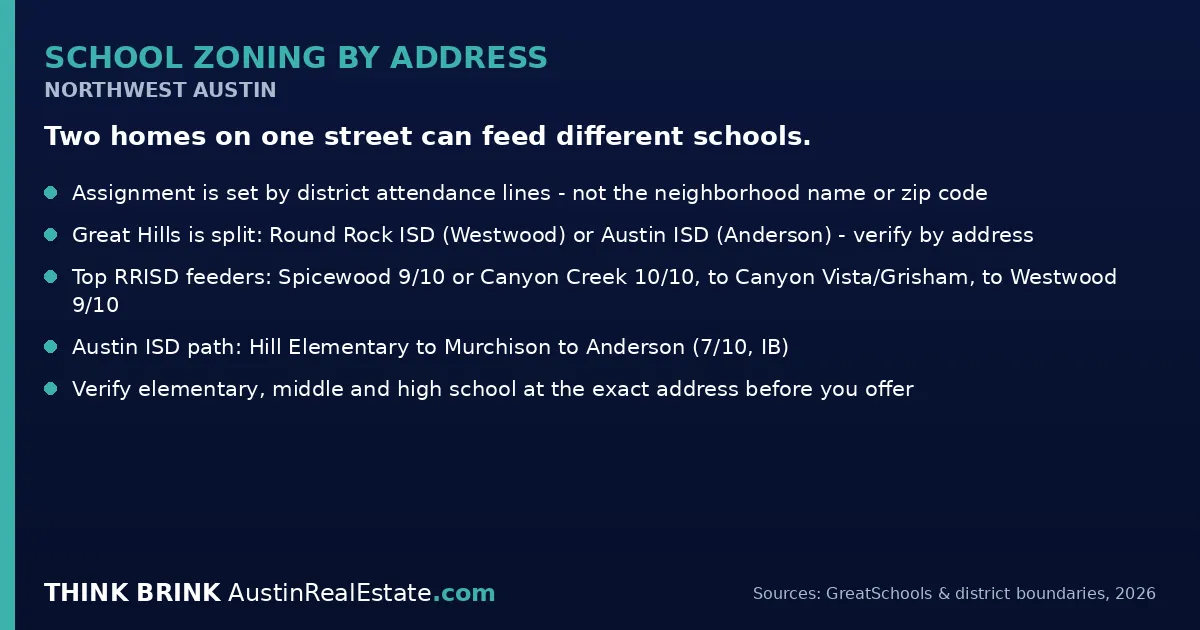
Second, a single neighborhood can straddle two districts. The clearest local case is Great Hills, which is split between Round Rock ISD and Austin ISD depending on the exact home. Part of Great Hills feeds the Round Rock ISD path toward Westwood; part feeds the Austin ISD path toward Anderson High. Both are strong, but they are entirely different pathways, and you cannot tell which one a house has from the neighborhood name alone. I walk through this in more detail in the Great Hills buyer guide, because it is the neighborhood where this trips up the most buyers.
Third, boundaries change. Districts redraw attendance zones when they open schools, close schools, or rebalance enrollment. An assignment that was true five years ago, or that a neighbor quotes you from memory, may not be current. The only assignment that matters is the one the district publishes for that address today.
The district line is the biggest price lever, and the least visible
Within Northwest Austin you are dealing primarily with two districts, Round Rock ISD and Austin ISD, and they differ in ways that go beyond individual school ratings.
Round Rock ISD carries the feeders most Northwest Austin buyers are chasing. The premier path in my geography runs through Spicewood Elementary, currently 9 out of 10, and Canyon Vista Middle, currently 9 out of 10, into Westwood High at 9 out of 10. A second strong Round Rock path runs through Canyon Creek Elementary, a 10 out of 10 school ranked in the top 1 percent of Texas elementaries, and Grisham Middle at 8 out of 10, also into Westwood. When buyers talk about "the Westwood feeder," they usually mean one of these two Round Rock ISD pathways.
Austin ISD in this area runs a different, also-strong path: Hill Elementary and Murchison Middle into Anderson High School, an International Baccalaureate school with a 7 out of 10 GreatSchools rating and a graduation rate around 98 percent. Anderson is a genuinely good high school. But it is not Westwood, and the buyer pool prices it differently. So when a Great Hills home turns out to be on the Austin ISD side, it is not that the buyer got bad schools, it is that they got a different assignment than the one that carries the Westwood premium they may have been paying for.
The reason this matters so much for price is that the district line is invisible from the curb. You can stand in front of two comparable homes and have no way of knowing that one feeds Westwood and one feeds Anderson unless you check the address against the district boundaries. And because the market prices the Westwood assignment higher, that invisible line can be worth a meaningful amount of money. That is exactly why you verify before you offer.
What "the assignment" is really worth
I am deliberately not going to attach a precise dollar figure or percentage premium to a specific school assignment, because those numbers move with the market and I will not publish a market statistic I cannot stand behind under my license. What I can tell you is directional and reliable: in a buyer pool this school-focused, the confirmed strong-feeder assignment is a real and priced-in component of value, and homes carrying the most sought-after feeders tend to sell faster and hold value better than otherwise-comparable homes that do not.
The practical implications cut both ways, and both are worth understanding.
If you are buying, the assignment premium means two things. One, do not pay a Westwood-feeder price for a home that does not feed Westwood, verify first. Two, if schools are not your priority, for example if your kids are grown, you homeschool, or you are child-free, you may be able to buy more house or a better lot by deliberately choosing an address just outside the most-demanded feeder, where you are not competing with the school-driven buyers. That is a legitimate strategy, and I have helped buyers use it to get more home for their money.
If you are selling, the assignment is one of the most important things to get right in your marketing, and one of the most damaging to get wrong. Advertising a Westwood feeder that the address does not actually have is not just misleading, it creates real problems in the transaction. Confirm your home's current assignment before you list, and market the one you actually have.
Where the surprises hide in Northwest Austin
A few patterns account for most of the zoning surprises I see in this area.
Neighborhoods that straddle a district line
Great Hills is the headline example, split between Round Rock ISD and Austin ISD. But the broader lesson applies anywhere near a district boundary: if a neighborhood sits close to where Round Rock ISD and Austin ISD meet, do not assume the district from the neighborhood name. Check the specific home.
Older neighborhoods platted across elementary boundaries
In established neighborhoods across 78750 and 78759, elementary attendance lines sometimes run through the middle of a subdivision, so the same neighborhood can send kids to two different elementaries even when the middle and high school are the same. If the elementary matters to you, and for a lot of families it matters most, verify at the address, not the subdivision.
Corridor neighborhoods with mixed assignments
Along the Jollyville and broader 183 corridors, you get pockets that feed different Round Rock ISD schools, and occasionally Austin ISD, depending on exactly where the home sits. The neighborhood-level guides help, but the corridor is exactly the kind of place where address-level verification pays off. The Living in 78750 and 78759 guide lays out how the schools map across the core cluster, and the 78726 neighborhood guide does the same for Canyon Creek and Grandview Hills, which are cleaner because 78726 is more uniformly Round Rock ISD.
How to verify an assignment before you offer
This is the part that actually protects you, so here is the process I use with buyers.
Start with the school district's own attendance-boundary lookup tool, entering the exact property address. Round Rock ISD and Austin ISD each publish a boundary or "find my school" tool, and the district's own tool is the authoritative source. Do not rely on the assignment shown on a listing portal, because those are frequently outdated or approximate, and do not rely on the listing description, which is marketing, not a district record.
Confirm all three levels: elementary, middle, and high school. It is common for the high school to be the one everyone talks about while the elementary, which your youngest child will actually attend first, quietly feeds somewhere less expected. Verify each one.
Check the effective date and any planned boundary changes. Districts sometimes approve future boundary adjustments that will take effect in a coming school year. If a rezoning is on the calendar, the assignment you verify today may not be the one in place when your child starts. Ask the district directly if you have any doubt.
Get it in the record, not just in conversation. If the assignment is central to your decision and your price, make sure your verification is documented and that your agent has confirmed it independently rather than repeating what the listing said. This is exactly the kind of detail a good buyer's agent is supposed to nail down for you before you are emotionally committed to a house.
When in doubt, call the district. The online tools are usually right, but a five-minute phone call to the district's enrollment or boundary office removes the last bit of uncertainty, and it is a lot cheaper than discovering the problem after closing.
How to use zoning strategically instead of just defensively
Most buyers treat school zoning as a landmine to avoid. It is smarter to treat it as a lever you can pull in either direction.
If schools are your top priority, let the assignment lead the search. Identify the specific feeder you want, whether that is the Spicewood-Canyon Vista-Westwood path, the Canyon Creek-Grisham-Westwood path, or the Hill-Murchison-Anderson path, and then look only at addresses that verifiably carry it. This keeps you from falling in love with a house that turns out to feed the wrong school, and it focuses your competition on the homes that actually deliver what you are paying for.
If schools are not your priority, use the premium against itself. The homes just outside the most-demanded feeders face less school-driven competition, which can mean more house, a better lot, or a better price for the same money. Buyers without school-age kids, downsizers, and investors can all benefit from deliberately shopping the addresses that the school-focused crowd skips. I have written about the surrounding pricing dynamics in the Canyon Creek buyer guide and elsewhere, and this is one of the clearest ways to find value in a market where so much demand is concentrated on a handful of feeders.
Either way, the move is the same: know the assignment before you decide, and let that knowledge shape the search instead of surprising you at the end of it.
Frequently asked questions
Do all homes in the same neighborhood go to the same schools in Northwest Austin?
No, and assuming they do is one of the most expensive mistakes buyers make here. School assignment is set at the address level by district attendance boundaries, and those boundaries can cut through a single neighborhood. Homes in the same subdivision can feed different elementaries, and in some cases, like Great Hills, different school districts entirely. Always verify the assignment for the specific address rather than trusting the neighborhood name.
Which Northwest Austin neighborhoods are split between school districts?
Great Hills is the clearest example, split between Round Rock ISD, which feeds toward Westwood High, and Austin ISD, which feeds toward Anderson High, depending on the exact home. More broadly, any neighborhood sitting near the boundary between Round Rock ISD and Austin ISD can have mixed assignments. The safe rule is to verify the district at the address level anywhere near a district line rather than assuming from the neighborhood.
How much does school zoning affect home prices in Northwest Austin?
Enough that it is one of the biggest invisible price factors in the area. Because so many buyers here are choosing homes specifically for the public schools, a confirmed strong-feeder assignment, especially one that leads to Westwood, is a real and priced-in component of value. I will not attach a precise premium figure, because those numbers move with the market, but directionally the most sought-after feeders sell faster and hold value better. For an exact read on how much an assignment is affecting a specific home's price, ask for a comparative market analysis.
How do I find out what schools a specific address is zoned to?
Use the school district's own attendance-boundary or "find my school" lookup tool and enter the exact property address. Round Rock ISD and Austin ISD each publish one, and the district's tool is the authoritative source. Verify all three levels, elementary, middle, and high school, check for any planned boundary changes, and when the assignment is central to your decision, call the district directly to confirm. Do not rely on listing portals or the listing description, which are frequently outdated or approximate.
Is Westwood High School worth paying more for?
That depends on your family and your priorities, and it is your decision to make. Westwood is a Round Rock ISD IB World School with a 9 out of 10 GreatSchools rating, an "A" state accountability rating for 2024-2025, and a graduation rate around 99 percent, which is why so many buyers target it and why homes that feed it carry a demand premium. If a top public high school is central to why you are moving to this area, many families conclude the assignment is worth prioritizing. If schools are not your focus, you may be better off buying just outside the most-demanded feeder where you face less competition.
Can school boundaries change after I buy a home?
Yes. Districts redraw attendance boundaries when they open or close schools or rebalance enrollment, so an assignment is current-as-of-today, not permanent. This is why you should check the effective date and ask the district about any planned changes before you rely on an assignment, especially if your child will not start for a year or two. Verify the current assignment and any pending rezoning directly with the district rather than assuming today's boundaries are fixed.
Should I buy outside a top feeder to save money if I do not have kids?
It can be a smart strategy. Homes just outside the most-demanded feeders face less school-driven competition, which can translate into more house, a better lot, or a better price for the same budget. Downsizers, child-free buyers, and investors can all use the school premium against itself by deliberately shopping addresses the school-focused crowd skips. Just confirm you are actually outside the premium feeder and understand you may face a slightly different resale buyer pool later.
Does the zip code tell me the school district in Northwest Austin?
No. Zip codes and school district boundaries are drawn by different authorities and do not line up. A single zip code in Northwest Austin can contain more than one school district and multiple feeder patterns. The 78726 zip is more uniformly Round Rock ISD, but even where a zip leans heavily toward one district, you should still verify the specific address, because the exceptions are exactly where buyers get surprised.
The bottom line
In Northwest Austin, the school assignment attached to an address is one of the largest and least visible factors in what a home costs and how it holds value, and it is set by district attendance lines that do not follow neighborhood names, zip codes, or listing descriptions. The buyers who do well here treat zoning as something to verify and use, not something to assume. Before you write an offer, confirm the elementary, middle, and high school for the exact address through the district's own tool, check for pending boundary changes, and make sure your agent has independently verified the assignment you are paying for.
This post covers property taxes and school-driven value in general terms only, and boundary rules, tax rates, and exemption amounts change and vary by address, so confirm specifics with the school district and the county appraisal district, and consult a CPA or attorney for tax and legal questions about a particular property. If you want help identifying which addresses actually carry the feeder you are after, or which ones sit just outside it where the value is, that is exactly the kind of verification I do with buyers before they offer. Send me the address or the neighborhood you are considering and I will confirm the assignment for you before you fall in love with the house.
