What Buyers Should Know About Canyon Creek Before Making an Offer (78726)
Why Canyon Creek is the name buyers keep circling back to in 78726
Canyon Creek is the neighborhood in 78726 that people start with when schools are the reason they are moving. It sits in far Northwest Austin, tucked against the greenbelt and canyon land west of US 183 near the 620 corridor, and it is built around one of the strongest school feeders in the Round Rock ISD footprint. If you have been researching Northwest Austin from out of state and Canyon Creek keeps showing up, this is why: it packages a top-rated elementary, a well-regarded pathway to Westwood High School, an established master-planned layout, and lots that back to real greenbelt, all in a single neighborhood.
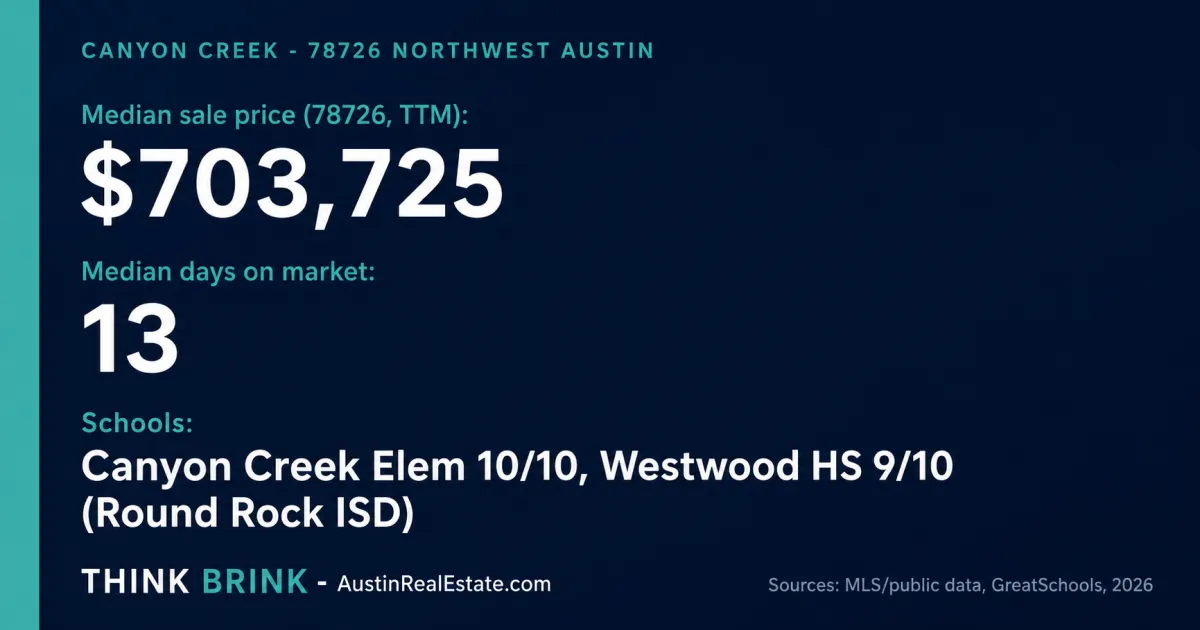
That combination also makes it competitive. Recent market data shows a median time on market for Canyon Creek homes of around 13 days, which tells you what you need to know about how the neighborhood behaves: buyers who understand it act quickly, and hesitation costs you the house. This guide covers what Canyon Creek actually is, what you are paying for, where the internal price differences come from, and the specific things to check before you write an offer. It is written to answer the question completely, so you can decide whether Canyon Creek fits before you spend three weekends touring it.
Where Canyon Creek sits and how it is built
Canyon Creek is a master-planned community in the 78726 zip code, on the western side of Northwest Austin where the developed grid gives way to canyon and greenbelt terrain. The location is defined by the 620 and 183 corridors: you are out past the densest part of the metro, closer to the Hill Country edge, which is exactly the appeal for buyers who want space and trees over urban proximity. The neighborhood is anchored by a community center, pool, tennis and sport courts, and an extensive trail network that connects to the surrounding greenbelt, and by the Canyon Creek golf area that gives a set of lots their premium.
The housing stock is predominantly late 1990s and 2000s construction, which matters for how you shop it. These are not 1970s ranch houses that need everything; they are newer, larger family homes, many with two stories, that generally offer more square footage and more contemporary floor plans than the older established neighborhoods closer in. The tradeoff is that "newer" here still means twenty to twenty-five years old, so roofs, HVAC systems, and original finishes are all reaching the age where they become negotiation items. You are not buying new construction; you are buying a mature home in a mature neighborhood, and you should shop it that way.
What Canyon Creek costs right now
Canyon Creek prices with the top of the 78726 market. The trailing twelve-month median sale price for the 78726 zip code was about $703,725 as of mid-2026, with a median close price around $710,500 across roughly 48 recorded sales in the prior year. Canyon Creek generally lives in the upper half of that range because of the school feeder and the newer, larger housing stock. In practical terms, most buyers should come in expecting the core of the neighborhood to trade in the high $600,000s to comfortably into the $800,000s, with greenbelt, golf, and view lots or heavily updated homes reaching higher.
The 13-day median time on market is the number to internalize. That is fast for any established neighborhood, and it means the well-priced, well-presented homes are gone before a casual buyer has finished thinking about them. The neighborhood is liquid and holds its value, which is reassuring on the resale side, but it also means you need your financing, your agent, and your decision criteria lined up before you tour, not after. In a 13-day market, the buyer who has done the homework wins the house.
The schools: this is what you are actually buying
Be honest with yourself about Canyon Creek and you will admit the schools are doing most of the work. The neighborhood feeds Canyon Creek Elementary, a Round Rock ISD school that carries a 10 out of 10 GreatSchools rating and ranks in the top 1 percent of Texas public schools, with reported math proficiency in the 90 to 94 percent range and strong reading numbers to match. The pathway continues to Grisham Middle School and then to Westwood High School, an IB World School with a 9 out of 10 GreatSchools rating, roughly a 97 percent graduation rate, and a decade-plus record of top-tier state rankings among a student body of around 2,600.
That Westwood pathway is one of the most sought-after in the entire metro, and it is the single biggest reason Canyon Creek commands what it does. Here is the important nuance: the school assignment is set at the address level, and it does not scale with how much you spend inside the neighborhood. A more modest home in the Canyon Creek feeder feeds the same Canyon Creek Elementary to Grisham to Westwood pathway as the largest house on the golf course. If the schools are why you are here, that is genuinely good news, because it means you can capture the feeder without buying at the very top of the neighborhood. But you must still confirm the assignment for the specific address with the district, because boundaries near the edges of any feeder can surprise you.
Lot hierarchy: where the price differences actually come from
Within Canyon Creek, two homes with similar square footage can carry very different prices, and the difference is usually the lot. This is the part of the neighborhood buyers underestimate. The premium tiers, roughly from most to least sought-after, are greenbelt and canyon-backing lots that give you privacy and a natural view with nothing built behind you, golf-adjacent lots along the course, and then the cul-de-sac and interior lots on the standard grid. A greenbelt or golf lot can add a meaningful premium over an otherwise comparable interior home.
My standing advice for Canyon Creek buyers is to decide early how much the lot matters to you, because it changes your whole search. If a private greenbelt backdrop is the dream, you are competing for a small subset of the inventory and you should expect to pay for it and move fast when one appears. If the lot is secondary to the house and the schools, you have far more options and more negotiating room on the interior lots, and you are getting the same feeder either way. There is no wrong answer, but knowing which buyer you are before you tour keeps you from falling for the one greenbelt home that comes up and then overpaying in a bidding situation you did not plan for.
Commute: the tradeoff for the space and the greenbelt
Canyon Creek's location is its best feature and its honest cost. Being out on the western edge near 620 and 183 gives you the trees, the greenbelt, and the space. It also puts you farther from the Parmer and Domain job centers than the neighborhoods deeper inside the corridor. The commute to the Apple campus on Parmer typically runs in the 25 to 35 minute range in morning traffic, longer than what buyers in the more central Northwest Austin neighborhoods deal with, and the drive toward downtown or the Domain is a real commitment during peak hours.
For a household with one or two hybrid or remote workers, that tradeoff is easy: you are in the office a few days a week, and the greenbelt and schools are worth the drive. For a household with a daily in-person commute to Parmer or central Austin, you should drive the actual route at the actual time before you commit, because the difference between Canyon Creek and a more central neighborhood can be twenty minutes each way, every day. That is not a reason to rule it out; it is a reason to price the commute honestly against the space and schools you are getting in return.
Taxes and the real monthly cost
Because 78726 sits near the Travis and Williamson county line, the exact property tax rate depends on your address, but Canyon Creek buyers should budget in the general Austin-area range of roughly 1.8 to 2.2 percent of taxable value, with the effective Austin-area rate reported around 1.97 percent in 2026. Texas has no state income tax, so property tax carries more of the load than relocating buyers from income-tax states are used to. On a home in the $700,000s, the annual tax bill is a serious line item, and it should be in your monthly math from the start, not a surprise at closing.
The offset for owner-occupants is the Texas homestead exemption, which in 2026 removes $140,000 from your school district taxable value, with additional smaller local exemptions stacking on top. Run the specific numbers on any home you are serious about, because the tax and insurance load on a Canyon Creek house materially changes the monthly payment relative to a lower-priced neighborhood, even at the same interest rate. For tax specifics, confirm with a CPA; this is general information, not tax advice.
What to check before you make an offer
Canyon Creek homes are mostly twenty to twenty-five years old, so the inspection matters. The predictable big-ticket items at this age are roofs, HVAC systems, water heaters, and original windows, plus any foundation movement, which Central Texas clay soils make worth watching everywhere. On greenbelt lots specifically, look at drainage and any slope behind the home, because a lot that backs to a canyon is beautiful and also needs to shed water correctly. Get a real inspection and read it closely; in a 13-day market it is tempting to waive contingencies to win, but the deferred maintenance on a home this age is exactly what you want to know before you are the owner of it.
Also confirm the HOA details and any current dues and rules, verify the school assignment for the exact address rather than trusting a listing's claim, and understand what the specific lot gives you and gives up. If you are weighing Canyon Creek against its 78726 neighbors, the companion guides on Grandview Hills and Estates of Brentwood are worth reading, and the 78726 neighborhood guide ties the whole zip code together.
Frequently Asked Questions
Is Canyon Creek in Round Rock ISD?
Yes. Canyon Creek feeds Round Rock ISD, specifically Canyon Creek Elementary, then Grisham Middle School, then Westwood High School. That feeder is a major reason for the neighborhood's demand and pricing. Always confirm the assignment for the specific address, since feeder boundaries can shift near the edges.
How good are the Canyon Creek schools?
Very good. Canyon Creek Elementary holds a 10 out of 10 GreatSchools rating and ranks in the top 1 percent of Texas public schools. The pathway leads to Westwood High School, an IB World School with a 9 out of 10 rating, about a 97 percent graduation rate, and consistent top state rankings.
How much do homes in Canyon Creek cost?
The 78726 zip code had a trailing twelve-month median sale price around $703,725 in mid-2026, and Canyon Creek generally lives in the upper half of that range. Expect the core of the neighborhood in the high $600,000s to the $800,000s, with greenbelt, golf, and heavily updated homes reaching higher.
How fast do Canyon Creek homes sell?
Fast. Recent data shows a median time on market around 13 days. Well-priced, well-presented homes go quickly, so buyers need financing and decision criteria ready before they tour rather than after.
What is the commute from Canyon Creek to the Apple campus?
Typically about 25 to 35 minutes in morning traffic, since Canyon Creek sits on the western edge near 620 and 183, farther from Parmer than more central Northwest Austin neighborhoods. Drive the actual route at your actual commute time before committing.
Are the greenbelt and golf lots worth the premium in Canyon Creek?
It depends on your priorities. Greenbelt-backing and golf-adjacent lots carry a real premium for the privacy and views, and they are a small share of inventory that moves fast. If the lot is the dream, expect to pay and act quickly. If schools and the house matter more, interior lots give you the same feeder with more options and room to negotiate.
What should I inspect in a Canyon Creek home?
Because most homes are twenty to twenty-five years old, focus on roof, HVAC, water heater, and original windows, plus foundation given Central Texas soils. On greenbelt lots, check drainage and slope behind the home. Do not skip the inspection just to win in a fast market.
Is Canyon Creek a good place to buy in 2026?
For buyers who want top Round Rock ISD schools, newer and larger homes, and greenbelt space, and who can accept a longer commute to central job centers, it is one of the strongest options in 78726. The market is competitive but liquid, which supports resale value.
The fit check
Canyon Creek fits the buyer who is here for the schools and the space, works a hybrid or remote schedule or is comfortable with a 25-to-35-minute commute, and wants a newer, larger family home on the western edge of Northwest Austin with real greenbelt nearby. It does not fit the buyer who needs a short daily drive to Parmer or downtown, or who wants a walkable, urban, closer-in feel. If you are the first buyer, the top-rated Westwood feeder and the greenbelt lots are hard to beat, and the 13-day market means you should get your homework done before you tour so you are ready to move when the right home comes up. If you want help deciding whether Canyon Creek or a more central Northwest Austin neighborhood is the better trade for your job and school needs, that is the conversation I have with buyers every week.
