What Buyers Should Know About Grandview Hills Before Making an Offer
Grandview Hills sits at the far western edge of 78726, where the developed Northwest Austin corridor gives way to the Balcones Canyonlands Preserve and the lakes corridor beyond. It is the highest-price-point neighborhood in the zip code, the one with the most dramatic terrain, and the one that draws a specific type of buyer - someone who has largely given up on finding Hill Country character this close to Austin and then discovers that it actually exists here.
If that's you, this guide is worth reading carefully before you make an offer. Grandview Hills has real internal variation that doesn't show up when you search the neighborhood name. The three sub-sections feel meaningfully different from each other. The days on market here run nearly double the national average, which tells you something about the buyer pool and the pricing dynamics. And the school situation - entirely Leander ISD throughout - is both the neighborhood's clearest distinction from Canyon Creek and the thing that defines which buyers end up here.
Living in 78726: The Northwest Austin Zip Code Guide Buyers Should Read Before They Start Searching
Where Grandview Hills Is and What Surrounds It
Grandview Hills is located off FM 620 in far northwest Austin, accessible primarily via Wilson Parke Avenue west of 620. It sits at approximately 17 miles northwest of downtown Austin via 183, with the Balcones Canyonlands Preserve forming its western boundary and Lake Travis roughly 10 minutes to the west.
That positioning matters more than most buyers initially appreciate. Grandview Hills is not near the Domain. It is not a short drive to Apple. It is not convenient to 183 the way that the 78750 and 78759 neighborhoods are. What it offers instead is something those neighborhoods don't have: estate-scale lots backing permanently protected land, Hill Country views that in some sections include Lake Travis, and a remove from the commercial energy of the tech corridor that buyers who specifically want that separation are willing to pay for.
The 620 corridor serves as the primary commercial spine for daily life - the H-E-B Plus, the Four Points Centre with retail and restaurants, the Cinemark at Four Points, Summer Moon Coffee, and the broader dining and service options that have built up along 620 over the past decade. This is a car-dependent neighborhood by any measure, but the commercial infrastructure on 620 means daily errands don't require a trip toward the city.
The Three Sub-Sections: What Buyers Need to Understand
Most of the confusion about Grandview Hills pricing and character comes from treating it as a single uniform neighborhood. It isn't. There are three distinct sub-sections with different lot profiles, different home eras, different price points, and different internal characters.
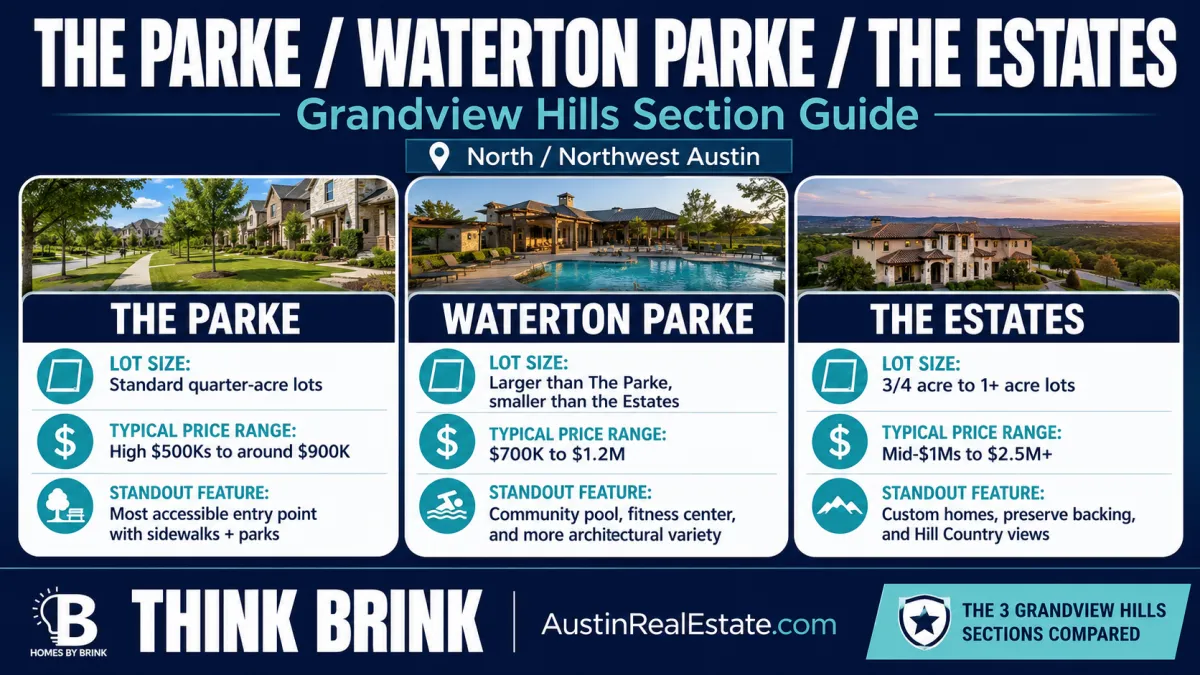
The Parke is the oldest section, with construction beginning in the late 1980s and running through the 1990s. It has a suburban atmosphere - brick and stone traditional homes connected by sidewalks, two community parks (Waterton Parke and Muir Parke) with open green space and playgrounds, and a more conventional subdivision feel compared to the other sections. Lots here are generally in the standard quarter-acre range. The Parke is the most accessible price entry point in Grandview Hills and tends to attract buyers who want the neighborhood's location and school access without the estate lot premium. Homes typically run from the high $500,000s to around $900,000 depending on size and condition.
Waterton Parke and the mid-tier sections sit between the Parke and the estate sections in both price and character. These are the sections that have the community pool and the fitness center. Homes here range from roughly 2,300 to over 4,000 square feet on lots that are larger than the Parke but smaller than the estate sections, with architectural variety that includes Spanish-inspired designs, classic brick, and contemporary builds. This is where the bulk of the turnover activity in Grandview Hills tends to concentrate.
The Estates at Grandview Hills is the premium section - custom and semi-custom homes on lots ranging from three-quarters of an acre to a full acre or more, many of which back directly to the Balcones Canyonlands Preserve. These are the lots that deliver the dramatic Hill Country views and the permanent open space backdrop that defines Grandview Hills at its best. Homes here include genuinely custom builds with architectural detail - barrel tile roofs, circular brick drives, stone and stucco exteriors, soaring ceiling heights - that is not found in the production-builder sections. Pricing in the Estates runs from the mid-$1 millions up through $2.5 million and above for the largest and best-positioned lots.
The practical implication: when a buyer says they're "looking in Grandview Hills," the follow-up question is always which section, because the Parke and the Estates are not remotely comparable purchases.
Estates of Brentwood vs Canyon Creek: Which 78726 Neighborhood Fits You Better?
Schools: Leander ISD All the Way Through
Unlike Canyon Creek, which has an internal district split between RRISD and Leander ISD, Grandview Hills is entirely in Leander ISD throughout the neighborhood. The feeder runs Grandview Hills Elementary - Four Points Middle School - Vandegrift High School.
This is the school situation that consistently differentiates Grandview Hills from Canyon Creek in buyer conversations, and it's worth understanding clearly before you choose between the two neighborhoods.
Vandegrift High School has had a significant resurgence in reputation. It moved from a ranking of 16th to 3rd among Austin area public high schools in 2025-2026, earning an A+ from Niche. Its academics, athletics, and overall program profile have strengthened meaningfully, and it is no longer in the shadow of Westwood the way it once was. Buyers who were previously anchored to RRISD specifically for the Westwood pathway should do fresh research on Vandegrift before assuming the gap still exists at the same magnitude it once did.
Four Points Middle School has a strong reputation within Leander ISD and consistently earns high marks.
Grandview Hills Elementary is the on-site campus with direct neighborhood access. Its GreatSchools ratings have been lower than some buyers expect for a neighborhood at this price point - a fact worth acknowledging honestly. The school benefits from an active parent community and has distinctive programs including a ukulele club and a sewing class, reflecting a school culture that emphasizes arts integration. But buyers who are making a seven-figure decision based heavily on elementary school should research current TEA accountability ratings and not rely solely on general reputation.
One practical advantage of the Leander ISD positioning: the district is known for strong intradistrict and out-of-district transfer flexibility based on campus capacity and eligibility, which gives families more options than RRISD's structure in some cases.
The Preserve and Lake Travis: What Makes This Location Distinctive
This is the aspect of Grandview Hills that has no equivalent in the established Northwest Austin neighborhoods closer to MoPac. The Balcones Canyonlands Preserve, covering over 33,000 acres of protected Hill Country habitat, forms the western boundary of Grandview Hills and provides the backdrop for the estate lots that define the neighborhood at its best.
For buyers on preserve-adjacent lots in the Estates section, what this means practically is permanent open space that will never be developed, Hill Country views that are protected rather than contingent, wildlife that includes the endangered Golden-cheeked Warbler and Black-capped Vireo, and a daily living experience that feels meaningfully removed from suburban Austin. The views from some of these lots - particularly those with elevation and westward exposure - extend to Lake Travis.
Lake Travis itself is approximately 10 minutes from most of Grandview Hills. Cypress Creek Park, Bob Wentz Park, and several other access points are within a short drive. For buyers who use the lake regularly - boating, kayaking, paddleboarding, fishing - this proximity is a genuine quality-of-life factor that compares favorably to essentially every other established neighborhood in Northwest Austin. If lake access is part of how you want to live, Grandview Hills offers it at a scale that 78750 and 78759 neighborhoods simply can't match.
The outdoor lifestyle connection extends through St. Edwards Park on Bull Creek, which is accessible from the preserve trail system and provides additional hiking and swimming access within minutes of the neighborhood.
78726 vs 78750: Which Northwest Austin Zip Code Fits You Better?
The Days on Market Reality
This is data that buyers and sellers both need to understand: homes in Grandview Hills sell in an average of 94 days, compared to a national average of 58 days. That's a meaningful gap, and it reflects several things happening simultaneously in this specific market.
The buyer pool for a $700,000 to $2.5 million home in far northwest Austin with Leander ISD schools is narrower than the buyer pool for a $600,000 Canyon Creek home with RRISD and Westwood. The location further west of the employment centers limits the pool of buyers for whom the commute math works. And the price range requires a buyer who has either made the decision that Grandview Hills' specific character is worth the premium, or who is specifically targeting the lake lifestyle and the estate lot profile.
None of this makes Grandview Hills a bad market. It makes it a specific market. Sellers who price accurately and present their homes well are still finding buyers. Sellers who anchor to peak 2022 valuations or who don't prepare properly for the longer marketing window are experiencing frustration.
For buyers, the extended days on market is actually useful information. It means there is time to evaluate, negotiate, and do proper due diligence without the pressure of a 48-hour decision window. In a neighborhood where lot character, preserve adjacency, and specific section positioning vary as dramatically as they do in Grandview Hills, having time to evaluate carefully is genuinely valuable.
Commute Reality from Grandview Hills
Grandview Hills is the right neighborhood for a specific type of buyer, and commute is one of the clearest filters for who that is.
Apple Campus on Parmer Lane is typically 25 to 35 minutes from most of Grandview Hills. The routing generally goes 620 to 183 to MoPac or 183A toll. This is manageable for buyers who work at Apple but is a daily commitment that compounds over time. Buyers who are specifically commuting to Apple five days a week should drive the route at 7:30am before they commit.
The Domain is 20 to 30 minutes from Grandview Hills in typical conditions. Usable on a regular basis, not daily-convenient in the way it is from neighborhoods closer to MoPac.
Downtown Austin is 30 to 45 minutes in peak traffic. The 620 to 183 to MoPac routing is the standard approach, with the MoPac express lanes helping during congested periods.
Dell in Round Rock is a longer drive - 40 to 50 minutes in morning traffic via 183 or 183A north. This is one of Grandview Hills' weaker commute directions and tends to filter out buyers who are commuting to the Round Rock campus regularly.
Work from home is a genuine match for Grandview Hills. Data shows that approximately 35% of Grandview Hills residents work from home - among the highest percentages in any Austin metro neighborhood, and significantly higher than national averages. The neighborhood's remove from commercial energy, its trail and preserve access, and its lifestyle orientation make it well-suited to buyers who want a home environment that supports working from home rather than one that's primarily a commute launchpad.
What Homes Look Like and What to Expect
Grandview Hills homes were built primarily from the early 1990s through the mid-2000s, with some earlier Parke construction going back to the late 1980s. The architectural variety across sections is genuine - Spanish-inspired with barrel tile roofs and stucco, classic brick New Traditional, contemporary builds, and fully custom estate homes are all represented.
Square footage runs from approximately 2,300 square feet at the accessible end up to 11,500 square feet in the largest custom estate homes, with the typical single-family home in the 3,000 to 4,500 square foot range. Most homes have four to five bedrooms and three to four bathrooms. Many homes in the neighborhood have in-ground pools, which reflects both the buyer profile and the outdoor lifestyle orientation of the area.
The lot variation is what buyers need to spend real time evaluating. Standard lots in the Parke section run about a quarter acre - reasonable for the neighborhood character but not distinctive. Estate lots in the Estates at Grandview Hills section run from three-quarters of an acre to over an acre with preserve views, and the experience of those lots is fundamentally different from what a quarter-acre Parke lot delivers. They are not comparable purchases even when the house itself might be similar in square footage, and they should not be compared using the same price benchmarks.
The updates question applies here as it does across all 78726 inventory. Homes from the early to mid-1990s are now 30-plus years old. Well-maintained and updated homes show well. Original-condition homes need honest pricing to move in the current market. The gap in buyer response between a renovated Grandview Hills home and an original-condition one - at this price point and with the extended days on market already built into the market dynamic - is significant.
Best Neighborhoods in 78726: How Buyers Usually Narrow the Search
What Homes Are Trading For
The price range in Grandview Hills is wide enough that a single number is genuinely misleading. Current pricing across the neighborhood spans from around $600,000 on the accessible end of the Parke section up through $1.8 million for typical estate-section homes and above $2.5 million for the largest custom properties on premium preserve-view lots. The reported median for the broader Grandview Hills area has been running in the $667,000 to $825,000 range depending on which section and time period is captured, with the estate sections pulling averages significantly higher.
Homes are down approximately 7% year over year in Grandview Hills based on recent market data - a decline that reflects both the broader Austin market softening and the specific dynamics of a high-price-point, longer-days-on-market neighborhood. Buyers have meaningful negotiating leverage in the current environment, particularly on homes that have been sitting. Sellers who are realistic about where the market is right now are still transacting.
The property tax rate in Grandview Hills is 2.2082% as of the 2025 tax year, which is on the higher end of the Northwest Austin range and a meaningful number at the price points this neighborhood trades at. A $1.2 million home carries approximately $26,500 in annual property taxes at that rate. Buyers should account for this in their carrying cost analysis.
What to Check Before You Make an Offer
Run through this before you go under contract on any Grandview Hills home:
Which section is this - The Parke, Waterton Parke, or the Estates at Grandview Hills? The section determines the lot profile, the comparable set, and what you should be paying.
What is the specific lot position relative to the preserve? Back to preserve with views, back to interior lots, or on a standard suburban street are three very different purchases. Visit the lot at different times of day, including at sunrise or sunset if views are part of why you're buying.
What is the school situation for this specific address? Grandview Hills is Leander ISD throughout, but verify the specific campus assignments with Leander ISD directly, as feeder patterns can shift.
What does the property tax rate mean for your carrying cost at this specific price point? Run the actual annual tax number before you negotiate on purchase price.
What is the condition of the major systems? Homes from the early 1990s to mid-2000s are now 20 to 35 years old. HVAC, roof, water heater, and in some cases original windows deserve specific attention in any inspection.
If there is a pool, what is its condition and age? A significant share of Grandview Hills homes have in-ground pools, and pool condition and equipment age should be part of any inspection for homes where a pool is present.
Does the HOA cover the specific section you're buying in, and what are the dues and restrictions? Grandview Hills has HOA governance across most sections with dues running in the $45 to $55 per month range. Confirm the specific section's dues, rules, and architectural review process before going under contract.
What is the commute you'll actually be doing, and have you driven it at the time you'll be doing it? Grandview Hills is beautiful but it is far west. Drive the route to your employer at your actual departure time before you decide.
What’s It Like to Live in River Place?
What Buyers Should Know About Canyon Creek Before Making an Offer
The Buyer Fit Check
Grandview Hills tends to work well for buyers who:
Specifically want Hill Country terrain, preserve adjacency, and views that can't be found in more centrally positioned Northwest Austin neighborhoods
Work from home full-time or primarily, or have flexible work arrangements that reduce the commute burden
Want Leander ISD and are comfortable with the Grandview Hills - Four Points - Vandegrift feeder
Use Lake Travis regularly and value having it 10 minutes from home
Are looking at estate-scale lots in the half-acre to two-acre range with permanent open space backing
Are comfortable at the $700,000 to $2.5 million price range and understand the longer marketing window that comes with this price tier
Value a neighborhood that has meaningfully higher proportions of professionals and executives who work from home and treat the neighborhood as a genuine retreat
Grandview Hills tends to be a harder fit for buyers who:
Commute daily to Apple, the Domain, or downtown and want to minimize drive time
Are specifically seeking RRISD and the Westwood High School pathway
Need to be below $600,000 and want meaningful lot character - the Parke entry point exists but is limited
Are expecting Canyon Creek's master-planned community amenity infrastructure - Grandview Hills has a pool and parks, but not the same level of organized community programming
Want the highest-volume, most-liquid market in 78726 - Canyon Creek trades far more actively and has more comparable sales to validate pricing
The Honest Summary
Grandview Hills is genuinely distinctive, and the buyers who belong there know it when they see it. The preserve views, the estate lots, the Hill Country terrain, and the proximity to Lake Travis combine to offer something that simply doesn't exist elsewhere in the established Northwest Austin market at this distance from downtown. The school situation has gotten stronger with Vandegrift's significant ranking improvement. The 94-day average days on market is not a neighborhood problem - it's a function of a specific buyer pool and a price range that self-selects for people who have made a deliberate choice.
The buyers who regret Grandview Hills purchases are typically the ones who fell in love with a specific house without doing the commute math honestly, who didn't understand the section-by-section variation and paid estate pricing for a Parke lot, or who didn't account for the property tax burden at this price point. All of those are avoidable with proper preparation.
Go in knowing which section, knowing the lot position, knowing the commute reality, and knowing what the current market will actually bear. If those things align with what you're looking for, Grandview Hills has a case that's hard to match anywhere else in Northwest Austin.
Frequently Asked Questions
What school district is Grandview Hills in?
Grandview Hills is entirely in Leander ISD throughout the neighborhood. The feeder runs Grandview Hills Elementary - Four Points Middle School - Vandegrift High School. Unlike Canyon Creek, there is no internal RRISD/Leander ISD split in Grandview Hills. Verify current campus assignments with Leander ISD for the specific address.
How is Vandegrift High School ranked?
Vandegrift moved to third among Austin area public high schools in the 2025-2026 rankings, up from 16th the prior year, earning an A+ from Niche. Its academic programs, athletics, and overall profile have strengthened significantly in recent years, and it is now competitive with Westwood in overall standing.
What are the three sections of Grandview Hills?
The Parke is the oldest section with quarter-acre lots and a more conventional suburban feel, generally the most accessible price point. Waterton Parke and the mid-tier sections have larger lots and the neighborhood's community pool and fitness center. The Estates at Grandview Hills has estate-scale lots from three-quarters to over an acre, many backing to the Balcones Canyonlands Preserve with Hill Country views, and is the highest-price-point section.
How far is Grandview Hills from Lake Travis?
Approximately 10 minutes from most of the neighborhood. Cypress Creek Park, Bob Wentz Park, and several other Lake Travis access points are a short drive west on 620. This lake proximity is one of Grandview Hills' most distinctive advantages compared to other established Northwest Austin neighborhoods.
What are typical home prices in Grandview Hills?
The range is wide. The Parke section starts in the high $500,000s to $900,000 for typical inventory. Mid-section homes run from $700,000 to $1.2 million. The Estates section ranges from the mid-$1 millions up through $2.5 million and above for large custom homes on premium preserve-view lots. The neighborhood is down approximately 7% year over year in recent data, giving buyers meaningful negotiating leverage in the current market.
How long does it take to sell a home in Grandview Hills?
The average is approximately 94 days, compared to a national average of 58. This reflects the narrower buyer pool for a high-price-point, far-west location with Leander ISD schools. Well-priced and well-presented homes do sell - the extended average is driven partly by overpriced inventory that eventually corrects. Sellers should plan for a longer marketing window than in more actively traded Northwest Austin neighborhoods.
Does Grandview Hills have a community pool?
Yes. The neighborhood has a community pool and fitness center, as well as two parks - Waterton Parke and Muir Parke - with open green space and playgrounds. The community amenities are more modest than Canyon Creek's master-planned infrastructure but functional for the neighborhood's scale.
What is the biggest mistake buyers make in Grandview Hills?
Not understanding the section-by-section variation before they start making offers. A quarter-acre Parke lot and a one-acre preserve-view Estates lot carry the Grandview Hills name but are fundamentally different purchases with different comparable sets and different value drivers. The second most common mistake is not running the commute math honestly for their specific employer location before committing to a neighborhood that is genuinely far west of most Austin employment centers.
