Living in 78750 and 78759: A Northwest Austin Neighborhood Guide for Buyers
If you are researching Northwest Austin, you have almost certainly run into the two zip codes that define it: 78750 and 78759. They sit side by side on the map, they share the same freeway spine, and they feed a lot of the same schools. Buyers relocating from California, Seattle, or the coasts often treat them as interchangeable. They are not. The differences between these two zip codes - in price, in housing stock, in commute, and in the kind of buyer each one tends to attract - are real and worth understanding before you spend a weekend touring homes.
I am James Brinkman. I have been a broker in this part of Austin for years and I live in the Spicewood Estates area of 78750. This is the pillar guide to living in 78750 and 78759: what these zip codes actually are, how the neighborhoods inside them differ, what you get for your money, and the tradeoffs nobody puts in the listing description. It is long because the subject deserves it. If you want a specific neighborhood, this guide links out to the deeper buyer guides underneath it.
Where 78750 and 78759 Are, and Why They Get Grouped Together
Both zip codes sit in the wedge of Northwest Austin bounded roughly by MoPac (Loop 1) on the east, US 183 to the south, and the Williamson County line to the north. This is the established, tree-covered part of Austin that was largely built out between the late 1970s and the mid-1990s, before the master-planned suburbs pushed further into Cedar Park and Leander. What ties the two zips together is proximity to the same three things buyers here are chasing: the Round Rock ISD Westwood High School feeder pattern, the Apple campuses on West Parmer Lane, and MoPac as the fast route into central Austin and the Domain.
78759 is generally the more central of the two. It hugs the 183 and MoPac corridor, wraps around the Arboretum and the Great Hills commercial district, and includes some of the most convenient established neighborhoods in North Austin. 78750 sits just to the north and west, running up toward the wildland edge where Austin turns into hill country. That geographic difference - central-and-flat versus northern-and-hilly - drives most of the differences in price and feel that follow.
The Money: What Each Zip Code Actually Costs in 2026
Here is where the "they are basically the same" assumption breaks down. As of early 2026, the two zip codes were not selling at the same price, and the direction they were moving was different too.
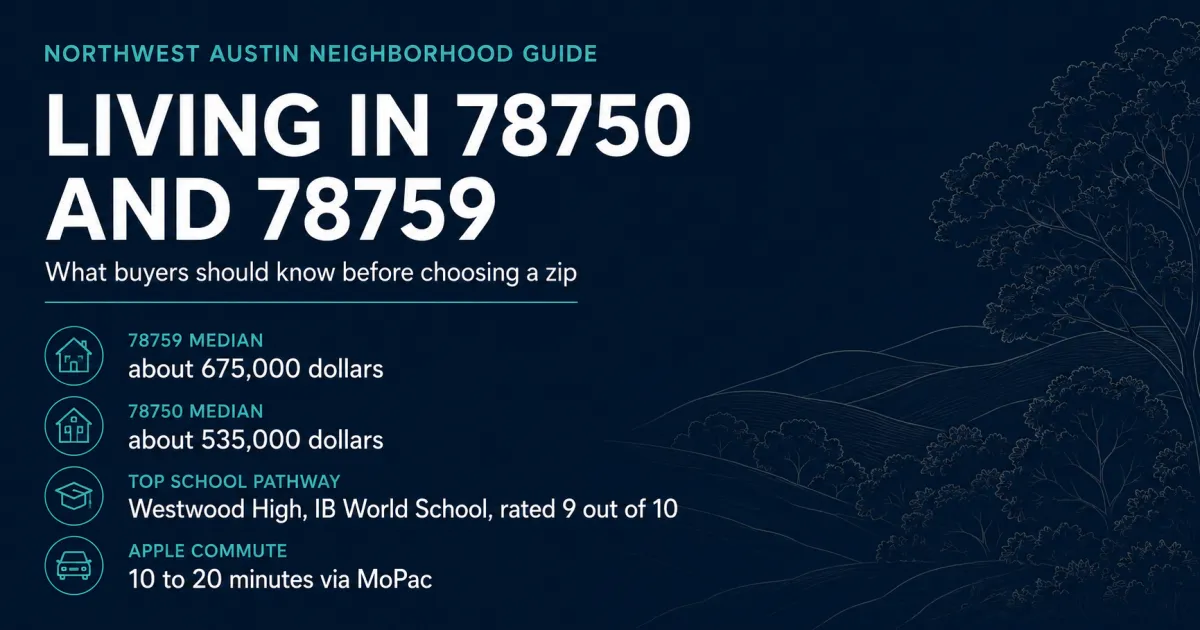
In 78759, the median sale price was in the neighborhood of $675,000 in the first quarter of 2026, and that figure was up meaningfully year over year, on the order of 7 percent, according to Redfin's zip-level data. Homes were taking around 68 days to sell, compared to roughly 49 days a year earlier, and were drawing about two offers on average. That is a market that has appreciated but also slowed down - buyers have more time to think than they did during the frenzy, but the underlying demand is still there.
In 78750, the picture was softer at the median. Redfin's data put the 78750 median sale price around $535,000 in early 2026, essentially flat year over year, with median price per square foot near $271 and median days on market around 86 days, up from roughly 59 the year before. On average, homes were pulling a single offer.
Now, a word of caution about those medians, because this is exactly where buyers get misled. A zip code median blends everything inside it. 78750 contains both modest 1980s starter homes near Jollyville and established, larger-lot neighborhoods like Spicewood Estates, where the typical sale runs closer to $900,000. So the 78750 "median" of roughly $535,000 does not mean you can buy in the best part of the zip for that number. It means the zip as a whole spans a very wide range, and where you land depends entirely on which neighborhood you target. Do not shop by zip-code median. Shop by neighborhood.
The practical takeaway: 78759 tends to command a premium for its central location and its more move-in-ready housing stock, while 78750 offers a wider spread - genuine value at the entry end and true premium properties at the top, with more variance in between. If you want to understand what your monthly cost of ownership actually looks like once taxes and insurance are added in, I wrote a full breakdown in what it actually costs to own a home in 78750 or 78759 right now.
Schools: The Westwood Feeder Is the Reason Half of These Buyers Are Here
If there is one single force driving demand across both zip codes, it is the Round Rock ISD Westwood High School feeder pattern. Westwood is an IB World School - it runs a district-level International Baccalaureate Diploma Programme magnet alongside a deep AP catalog. As of the 2025-2026 school year it carried a 9 out of 10 GreatSchools rating, a 97 percent graduation rate, and a national ranking around 63rd in Texas by U.S. News. In 2025 it earned Platinum recognition on the College Board's AP School Honor Roll. For a lot of dual-income tech families relocating here, the Westwood pathway is the whole reason they drew a box on the map around these two zips.
The elementary and middle feeders underneath it are strong too. Canyon Vista Middle School carried a 9 out of 10 GreatSchools rating and was the only local middle school to place among the top 25 middle schools statewide in the 2026 U.S. News rankings. Spicewood Elementary, Canyon Vista, and Westwood form the most sought-after single pathway in my geography.
Here is the honest part. Not every address in 78750 and 78759 feeds Westwood, and not every home is even in Round Rock ISD. School attendance is assigned at the address level, not the zip level, and the boundaries do not follow the zip lines. Some pockets feed Austin ISD schools, including the Hill Elementary, Murchison, and Anderson High pathway, which is a strong AISD option in its own right. A few edges sit in other feeders entirely. If schools are driving your search, verify the specific home's attendance zone with the district before you fall in love with it - I check this for every client at the address level, because being one street off can change the assignment. I go deeper on how zoning by address changes what you pay in a dedicated post, but the one-line version is: confirm the school before you confirm the offer.
The Apple Commute, and Why It Anchors This Whole Market
Apple operates two campuses on West Parmer Lane in far Northwest Austin - the original complex at 5501 West Parmer and the newer campus at 6900 West Parmer. Together they employ a large and growing share of the buyers competing for homes in these zips. The campuses sit off MoPac and US 183, not I-35, which matters: it means the neighborhoods that hug MoPac north have a genuinely short, predictable drive to work.
From the established 78750 and 78759 neighborhoods, the Apple Parmer campuses are typically a 10 to 20 minute drive in normal traffic. The neighborhoods closest to the campus - Milwood, Balcones Woods, Great Hills, and Canyon Creek among them - are often 5 to 10 minutes door to door. That is meaningfully better than what Cedar Park and Leander buyers deal with, where the same commute stretches longer and less predictably during the morning push. The 183 North Mobility Project, which opened new northbound express lanes in January 2026, took out one of the worst bottlenecks on that corridor, which helped.
If your household has one or two people commuting to the Parmer corridor, this is the single biggest reason to weigh 78750 and 78759 over the outer suburbs. You are paying more per square foot than you would in Leander, but you are buying back time every single workday. Whether that trade is worth it depends on your situation, which is exactly the question I work through in Northwest Austin vs Cedar Park: which one actually fits your situation.
The Neighborhoods Inside 78750
78750 is the more varied of the two zips, running from convenient and mid-priced near Jollyville up to established and premium near the hill country edge.
Spicewood Estates and Balcones Village
This is where I live, so I will be direct about it. Spicewood Estates is one of the premium established neighborhoods in the zip - larger lots, homes mostly built around the early 1990s, hill country character, and a Firewise wildfire-aware community designation that reflects its position near the wildland edge. It carries the full Spicewood Elementary, Canyon Vista, Westwood pathway with all three schools rated at the top of the scale. The tradeoff is price and the wildfire-aware setting that comes with living near the greenbelt. I cover it in detail in the Spicewood Estates buyer guide.
The Jollyville corridor and mid-priced 78750
Toward the south and east of the zip, closer to Jollyville Road and 183, you find the more attainable end of 78750 - smaller 1980s homes, tighter lots, and prices that pull the zip median down. This is where a buyer who wants the address and the school access without the premium neighborhood price tag should be looking. The homes are older and often need updating, but the location fundamentals are the same.
The Neighborhoods Inside 78759
78759 is more uniformly central and, on the whole, commands the higher median. Its neighborhoods trade on convenience - you are close to the Arboretum, the Domain is a short hop, and MoPac access is excellent.
Great Hills
Great Hills is the marquee name in 78759 - established, wooded, hilly, and anchored to the 183 and 360 intersection with Arboretum adjacency. It spans a wide price range because the hillside-view lots command a real premium over the flatter interior streets, but the school assignment does not change with the price. A home in the Round Rock ISD section of Great Hills feeds the same Canyon Vista and Westwood pathway whether it is an entry-tier house or a hillside property six streets away. I break down how to buy into the neighborhood without overpaying in the Great Hills buyer guide.
Balcones Woods
Balcones Woods does not have the name recognition of Great Hills, but it is one of the fastest-moving established neighborhoods in the zip, with a genuinely central location, an active HOA with real community identity, and a price point that consistently undercuts comparable neighborhoods for similar proximity. Buyers who know it act quickly when something comes available. The full picture is in the Balcones Woods buyer guide.
Property Taxes: Budget for the Real Number
Texas has no state income tax, and buyers moving from California and the Pacific Northwest often celebrate that until they see the property tax bill. In Travis County, the effective combined property tax rate for 2026 runs roughly in the 1.8 to 2.3 percent range of taxable value, depending on the specific taxing jurisdictions your home falls under - city, county, school district, community college, and any special districts. For Austin proper, the combined effective rate lands close to 2 percent. On a $675,000 home, that is real money - budget it into your monthly cost, not just your down payment. Homestead and over-65 exemptions can reduce the taxable base meaningfully if you qualify, so factor those in. For anything tax-specific to your situation, talk to a CPA - I can walk you through the ranges but I am a broker, not a tax advisor.
Who Each Zip Code Actually Fits
After enough transactions in both, the pattern is fairly consistent. 78759 tends to fit the buyer who prioritizes central convenience and a more move-in-ready home, who values being minutes from the Arboretum and the Domain, and who is willing to pay the premium the location commands. 78750 fits a wider range - the value-focused buyer who wants school access at an attainable price near Jollyville, and separately the premium buyer who wants a larger lot and hill country character in a neighborhood like Spicewood Estates. Both zips serve the Apple and tech-corridor commuter well. Neither is the obviously "better" choice - they are different, and the right one depends on your budget, your commute, and how much house versus how much location you are optimizing for.
If you are still deciding whether now is even the moment to buy in this part of town, I laid out the case in is now a good time to buy in Northwest Austin.
Frequently Asked Questions
Is 78750 or 78759 more expensive?
In early 2026, 78759 carried the higher median sale price, around $675,000 versus roughly $535,000 in 78750, according to Redfin zip-level data. But the 78750 median is misleading because that zip spans everything from attainable 1980s homes near Jollyville to premium neighborhoods like Spicewood Estates where sales run closer to $900,000. Compare specific neighborhoods, not zip medians.
Do 78750 and 78759 feed Westwood High School?
Many neighborhoods in both zips feed the Round Rock ISD Westwood High School pathway, which is an IB World School rated 9 out of 10 by GreatSchools. But attendance is assigned at the address level, not the zip level, and some pockets feed Austin ISD schools like Anderson High instead. Always verify the specific home's attendance zone with the district before making an offer.
How far is Apple from 78750 and 78759?
Apple's campuses on West Parmer Lane are typically a 10 to 20 minute drive from the established neighborhoods in both zips, and 5 to 10 minutes from the closest ones like Milwood, Balcones Woods, Great Hills, and Canyon Creek. The campuses sit off MoPac and US 183, so the neighborhoods that hug MoPac north have a short, predictable commute.
What are property taxes like in Northwest Austin?
Travis County effective property tax rates for 2026 run roughly 1.8 to 2.3 percent of taxable value depending on the exact taxing jurisdictions, landing close to 2 percent in the City of Austin. There is no state income tax in Texas, but you should budget the property tax into your monthly cost. Homestead and over-65 exemptions can lower the taxable base if you qualify. Confirm your specific situation with a CPA.
Which is better for families, 78750 or 78759?
Both serve strong school pathways, so it comes down to what your family is optimizing for. 78759 leans toward central convenience and more move-in-ready homes at a higher price. 78750 offers a wider range, from attainable homes near Jollyville to larger-lot premium neighborhoods with hill country character. The best fit depends on your budget and how far you want to be from the Arboretum and Domain versus the greenbelt.
Are homes in 78750 and 78759 selling quickly in 2026?
Not as fast as during the peak. In early 2026, homes in 78759 were taking around 68 days to sell and 78750 around 86 days, both longer than a year earlier. That means buyers have more time to make decisions than they did during the frenzy, though well-priced homes in the strongest neighborhoods still move quickly.
Should I move to Northwest Austin from California or Seattle?
Many buyers in these zips are relocators from the coasts drawn by the tech corridor, the schools, and the absence of a state income tax. The tradeoffs to understand are the property tax bill, the summer heat, and the fact that you are paying a location premium over the outer suburbs. Whether it fits depends on your commute and priorities. I wrote a dedicated guide for California and Pacific Northwest buyers moving to Northwest Austin.
The Honest Summary
78750 and 78759 get grouped together for good reasons - shared schools, shared freeway, shared employer access - but they are not the same buy. 78759 is the more central, more consistently priced, more move-in-ready of the two. 78750 is the wider spread, with real value at the entry end and genuine premium at the top. Both put you close to the Westwood feeder and the Apple corridor, which is why demand holds up even in a slower market. The mistake to avoid is shopping by zip-code median. Pick the neighborhood, verify the school at the address, budget the real tax number, and the rest of the decision gets a lot clearer. When you are ready to compare specific neighborhoods head to head, that is the conversation I am here for.
