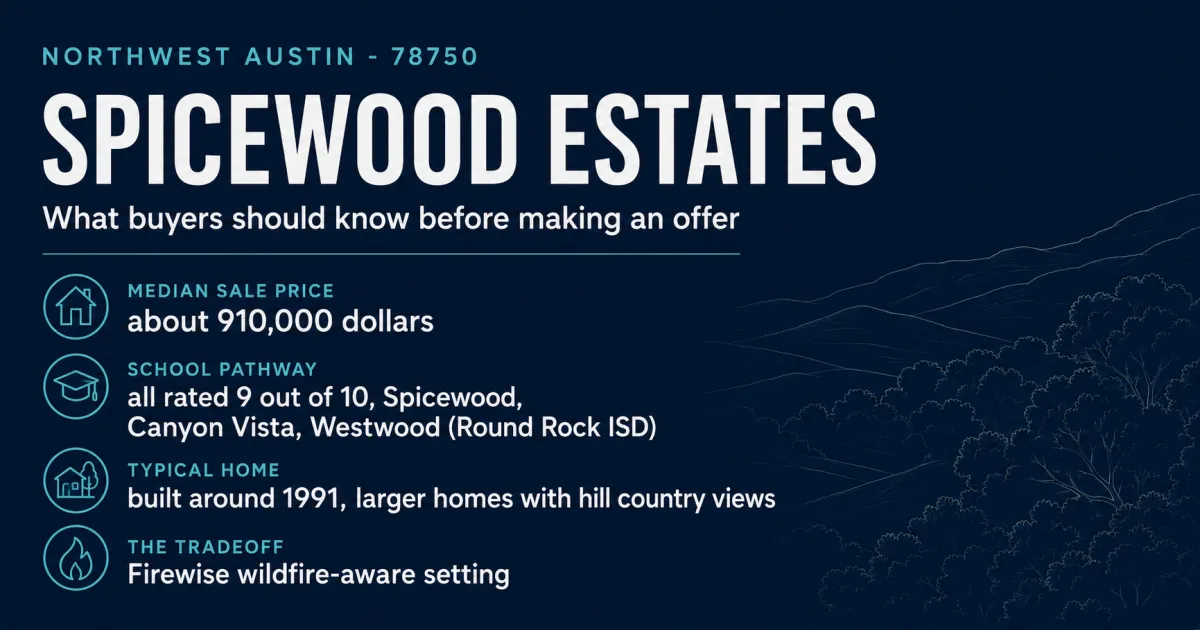
What Buyers Should Know About Spicewood Estates Before Making an Offer
Most buyers find Spicewood Estates because they are chasing one thing: the schools. Spicewood Elementary, Canyon Vista Middle, and Westwood High are among the strongest Round Rock ISD pathways in all of Austin, and this neighborhood sits inside all three. That is the draw, and it is a real one.
But the schools are also why this is one of the more expensive established neighborhoods in the 78750 area, and price is the first thing you need to be honest with yourself about before you fall for the hill country views.
Over the last twelve months, roughly eleven homes sold in Spicewood Estates at a median sale price around $910,000, with current listings pricing higher and price per square foot averaging in the low $300s. This is not the $450,000 to $700,000 range that Milwood or Balcones Woods buyers work in. Spicewood Estates is a step up in price, in home size, and in setting, and it asks you to pay for all three.
This guide covers what you actually get for that money, where the tradeoffs are, and who this neighborhood genuinely fits.
What Spicewood Estates Actually Is
Spicewood Estates is a small, established neighborhood in Northwest Austin's 78750 zip code, developed off Spicewood Parkway north of Spicewood Springs Road. It sits up in the hills on the western edge of the established Northwest Austin neighborhoods, which is the source of both its appeal and its main tradeoff.
The average home here was built around 1991, which places it a generation newer than the 1970s ranch neighborhoods closer to MoPac and 183. That matters. A 1991 home is a different animal from a 1978 home in terms of layout, ceiling heights, primary suites, and the kind of floor plan buyers expect today. It also means the homes are now over thirty years old, so the condition questions are real, just different from what you face in older stock.
This is a neighborhood of larger homes on tree-lined lots, many with genuine hill country views. The housing is far from cookie cutter, which is part of why buyers who want character rather than a production-builder subdivision gravitate here. Turnover is low. Eleven sales in a year tells you this is a neighborhood people buy into and stay in, which is usually a good sign about how a place lives, but it also means you may wait for the right home rather than choosing from a dozen at once.
The Schools: The Real Reason to Be Here
This is the heart of the Spicewood Estates value proposition, so it is worth being specific rather than waving at "good schools."
The neighborhood feeds Round Rock ISD's Spicewood Elementary, Canyon Vista Middle School, and Westwood High School. All three are top-tier, and the ratings back it up rather than just local reputation.
Spicewood Elementary carries a 9 out of 10 GreatSchools rating and an A on Niche, and has been ranked in roughly the 99th percentile of Texas elementary schools, placing among the top 60 or so out of more than 4,600 statewide. Canyon Vista Middle carries a 9 out of 10 and an A-plus on Niche, ranks in the top 2 percent of Texas middle schools, and has been cited as the top-ranked middle school in Round Rock ISD and one of the strongest in the state. Westwood High carries a 9 out of 10 and an A-plus on Niche, with a graduation rate around 97 percent, well above the Texas average.
Three consecutive 9-out-of-10 campuses from elementary through high school is genuinely rare, and it is the single strongest reason this neighborhood commands the prices it does. If you are a family specifically targeting the Westwood pathway, Spicewood Estates puts you inside it without the gamble of a boundary that could shift you into a different feeder.
One caution that applies everywhere in this part of Austin: verify the school assignment at the specific address with Round Rock ISD directly before you make a school-based decision. Feeder maps have edge cases, boundaries get reviewed, and the online aggregators are not authoritative. Confirm the exact property.
Ratings are one input, not the whole story. If the schools are your reason for buying here, go visit them and talk to families whose kids attend, rather than buying on the numbers alone.
The Homes: What to Expect
Spicewood Estates homes are generally larger, 1990s-era houses on wooded lots. Compared with the older established neighborhoods to the east, you get more square footage, more contemporary floor plans, and in many cases real elevation and views that flatter neighborhoods simply cannot offer.
Because the homes were built around the early 1990s, the condition spectrum is wide. Some have been beautifully updated and show like much newer homes. Others still carry 1990s kitchens, bathrooms, and finishes and are priced accordingly. A home in this neighborhood that has never been renovated is now working with thirty-year-old systems and finishes, and the cost to bring it current can be substantial given the size of these houses. Updating a 3,500-square-foot home is not the same budget as updating a 1,900-square-foot ranch.
Pay close attention to the major systems. At thirty-plus years, roofs, HVAC units, water heaters, windows, and any original plumbing or electrical are all at or past the point where replacement history matters. On homes of this size, those replacements are five-figure line items, so get an inspection that treats them as primary rather than an afterthought to cosmetics.
The lots and the trees are a genuine asset here. Mature tree canopy and larger, contoured lots are part of what you are paying for, and they are not something a newer subdivision can manufacture. That same terrain, though, connects to the neighborhood's one honest environmental tradeoff, which is worth its own section.
The Setting: Hill Country Views, and the Tradeoff Behind Them
Spicewood Estates is tucked into the hills rather than sitting flat next to a highway. For a lot of buyers that is exactly the appeal. The streets are quiet, the views are real, and the neighborhood feels removed in a way that the neighborhoods hugging MoPac and 183 do not.
That removal is also the tradeoff. Being up in the hills off Spicewood Springs Road means your drive to MoPac, and to the Apple, Domain, and downtown destinations most Northwest Austin buyers care about, is longer and more winding than it is from a neighborhood sitting right at the 183/MoPac interchange. It is not remote, but it is not a straight shot either. If your daily commute is the thing that will make or break your life here, drive it at your actual commute time, in both directions, before you commit. Do not judge it on a quiet Saturday.
The second part of the setting deserves candor because it does not show up in listing photos. Spicewood Estates has pursued and achieved recognition as a Firewise Community, a designation that neighborhoods earn by taking organized steps to reduce wildfire risk. That is a point in the neighborhood's favor, because it reflects an HOA and residents who are actively managing the issue. But the reason a neighborhood pursues that designation in the first place is that its hill country setting, backing to greenbelt and preserve land on the western edge of the developed area, sits in what is called the wildland-urban interface. That is real for much of far Northwest Austin, not unique to this neighborhood, but you should know it going in. Ask about the neighborhood's Firewise practices, factor wildfire coverage into your homeowners insurance conversation early, and get a real insurance quote on the specific property before you are deep into the contract, because premiums in these zones can be higher than buyers expect.
What It Is Going to Cost
Spicewood Estates is a premium established neighborhood, and the numbers reflect it. The median sale price over the last twelve months has run around $910,000, current list prices have been higher, and price per square foot has averaged in the low $300s. Because turnover is low and the homes vary widely in size and condition, any single figure is a rough guide rather than a precise expectation for a specific house.
The condition gap drives a lot of the price spread. A large original-condition 1990s home and a comparably sized, fully renovated one can sit far apart on price, and the renovation math on a house this size is not trivial. Before you commit to a home at the lower end of the range, price out what it would actually cost to bring it to the standard you want, and make sure your all-in number still makes sense against what updated homes in the neighborhood are closing for.
Two carrying costs deserve early attention rather than late surprise. First, property taxes in this part of Northwest Austin are a meaningful annual number on a home in this price range, and the exact rate depends on the specific taxing jurisdictions for the address, so confirm the current rate and estimate the bill before you finalize your budget. Second, as noted above, insurance in a hill country wildfire-interface setting can run higher than a comparable home on flatter ground, so get a real quote early. On the tax and any related questions, this is general information and not tax advice, so confirm the specifics with your CPA or a tax professional for your situation.
What Spicewood Estates Is Not
This is the section that prevents buyer regret.
It is not an affordable entry into Northwest Austin. If your budget tops out well below the $900,000s, the strong RRISD schools you are after are also available, at least in part, in more attainable neighborhoods, and forcing a stretch to get into Spicewood Estates specifically is usually the wrong move. The Westwood pathway is the draw, not the street sign.
It is not a short, easy commute to the tech corridor. The hill country setting that makes the neighborhood beautiful also puts distance and winding roads between you and MoPac. Buyers whose lives are organized tightly around an Apple or Domain commute should test that drive honestly before deciding the views are worth it.
It is not a large-inventory neighborhood where you pick from many homes. With roughly eleven sales a year, you may need patience and a ready-to-move posture for when the right home appears, rather than an expectation of comparison shopping across a big active list.
It is not a maintenance-free, buy-and-forget setting. The combination of thirty-plus-year-old homes, large square footage, mature trees, and a wildfire-interface location means ongoing attention and a real maintenance reserve. This is a neighborhood that rewards owners who stay on top of a home, not ones looking for zero upkeep.
What to Check Before You Make an Offer
Run through this before going under contract on any Spicewood Estates home:
Verify the school assignment at the exact address with Round Rock ISD directly. Spicewood Elementary, Canyon Vista, and Westwood is the expected pathway, but confirm the specific property and ask about any boundary reviews.
Get a real homeowners insurance quote on the specific property early, with wildfire coverage addressed directly, so premium surprises do not appear late in the contract.
Ask about the neighborhood's Firewise practices and what is expected of homeowners for defensible space and vegetation management.
Drive the actual commute at real commute times, both directions, before you decide the setting works for your life.
Get the ages of roof, HVAC, water heater, windows, and any original plumbing and electrical in writing. On a home this size and age, these are major-dollar items.
If the home is unrenovated, price the renovation honestly and check that your purchase-plus-renovation total is supported by what updated comparable homes are closing for.
Confirm the current property tax rate and estimate the annual bill for the specific address before finalizing your budget.
Review the HOA's dues, deed restrictions, and any architectural rules before going under contract, especially if you plan exterior changes or additions.
The Buyer Fit Check
Spicewood Estates tends to work well for buyers who:
Are specifically targeting the Round Rock ISD Spicewood, Canyon Vista, and Westwood pathway and want to be firmly inside it
Have the budget for a premium established neighborhood without stretching dangerously to get there
Want a larger 1990s-era home with character and real hill country views rather than a production subdivision
Value a quiet, tucked-away setting and are willing to trade some commute convenience for it
Are comfortable owning and maintaining an established home with mature trees and a wildfire-aware property
Can be patient for the right home in a low-turnover neighborhood
Spicewood Estates tends to be a harder fit for buyers who:
Need to stay well under the high-$800,000s or $900,000s
Have a commute-critical life organized around a short, direct drive to MoPac, Apple, or the Domain
Want new or near-new construction with no renovation or major-systems risk
Are uneasy about wildfire-interface living or the insurance costs that can come with it
Want a large active inventory to choose from right now
The Honest Summary
Spicewood Estates earns its price primarily on one thing that is genuinely hard to find: a top-tier Round Rock ISD pathway from elementary all the way through high school, wrapped in a quiet hill country setting with larger, characterful homes. For a family whose priority is the Westwood feeder and who has the budget to be here without straining, it is one of the more compelling neighborhoods in Northwest Austin.
What it asks in return is a premium price, a longer and more winding commute than the neighborhoods down near the highways, real attention to a thirty-plus-year-old home, and clear-eyed handling of the wildfire-interface realities that come with living up in the hills. None of those are dealbreakers for the right buyer. They are simply the honest cost of what makes the neighborhood desirable, and you should decide they are worth it before the right listing appears, not after.
Frequently Asked Questions
What schools are Spicewood Estates zoned to?
The neighborhood feeds Round Rock ISD's Spicewood Elementary, Canyon Vista Middle School, and Westwood High School. All three carry a 9 out of 10 GreatSchools rating, making this one of the strongest continuous school pathways in the Austin area. Always verify the assignment for the specific address with Round Rock ISD before making a decision.
How much do homes cost in Spicewood Estates?
The median sale price over the last twelve months has run around $910,000, with current list prices higher and price per square foot averaging in the low $300s. It is a premium established neighborhood, meaningfully more expensive than nearby neighborhoods like Milwood or Balcones Woods.
Is Spicewood Estates in Round Rock ISD or Austin ISD?
Round Rock ISD. This is a key distinction in Northwest Austin, where nearby neighborhoods can fall into Austin ISD instead. The RRISD Westwood pathway is a major part of why Spicewood Estates commands the prices it does.
When were homes in Spicewood Estates built?
The average year built is around 1991, so most homes are early-1990s construction. That makes them newer than the 1970s ranch neighborhoods closer to MoPac, but they are still over thirty years old, so major systems and finishes should be inspected carefully.
Why is Spicewood Estates a Firewise Community?
The neighborhood has earned Firewise recognition by taking organized steps to reduce wildfire risk, which is a positive reflection of an active HOA and engaged residents. The designation exists because the hill country setting, near greenbelt and preserve land, sits in a wildland-urban interface. Buyers should ask about Firewise practices and get a wildfire-aware insurance quote early.
How is the commute from Spicewood Estates to Apple or the Domain?
Longer and more winding than from neighborhoods sitting right at the MoPac and 183 interchange, because Spicewood Estates is tucked up in the hills off Spicewood Springs Road. It is not remote, but commute-sensitive buyers should drive the actual route at real commute times before committing.
Is Spicewood Estates a good place to buy right now?
For a family targeting the Westwood school pathway with the budget to be here comfortably, it is a strong fit. For buyers who would have to stretch dangerously, or whose lives depend on a short direct commute, other neighborhoods may serve better. Turnover is low, so patience and a ready-to-act posture help.
What should I watch out for when buying in Spicewood Estates?
Three things above all: the premium price relative to nearby neighborhoods, the age and size of the homes and what renovation or major-systems work will cost, and the wildfire-interface setting and its insurance implications. Verify schools, get insurance and tax numbers early, and inspect the major systems thoroughly.
One Last Thing
This is my home turf. I live and work in the 78750 area, and Spicewood Estates is a neighborhood I know street by street. If you are weighing it, I am glad to walk specific homes with you and tell you honestly which ones are worth the premium and which ones are not, and how it stacks up against the other established Northwest Austin neighborhoods for what you actually need.
For the broader picture of this part of town, it is worth reading Living in 78750 and 78759: The Northwest Austin Zip Code Guide, and if you are weighing an Austin ISD alternative nearby, see What Buyers Should Know About Balcones Woods Before Making an Offer. If timing is on your mind, Is Now a Good Time to Buy in Northwest Austin? lays out how I am thinking about the current market.
