Round Rock ISD vs Austin ISD in Northwest Austin: What It Means for Your Home Search
Two school districts, one Northwest Austin, and a line most buyers do not see until it costs them
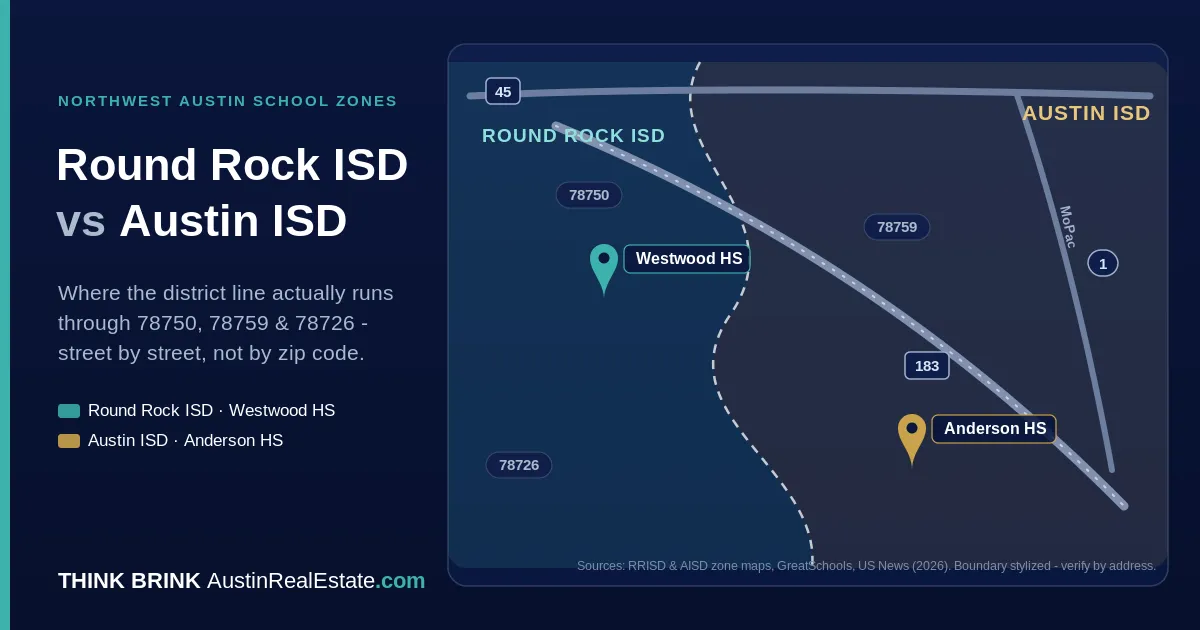
Most people searching for a home in Northwest Austin assume they are shopping one school system. They are not. The 78750, 78759, and 78726 zip codes are split between two of the largest and most sought-after districts in Central Texas: Round Rock ISD and Austin ISD. The boundary between them does not follow zip code lines, city limits, or the way any of it looks on a map. It runs street by street, and in a few neighborhoods it runs through the middle of a subdivision.
That matters more here than it does in most markets, because in Northwest Austin the district your address feeds is one of the biggest single drivers of what you pay and how fast you have to move to get the home. Buyers relocating from California, Seattle, and the Bay Area frequently arrive assuming Austin is one unified school system the way many of their home cities were. It is not, and the difference between the two districts is not just administrative. It changes the high school your child attends, the property tax bill you write every year, and the resale pool you sell into when you leave.
This post lays out what the split actually means for a buyer, where the two districts sit in these zip codes, how they compare on the measures buyers care about, and how to make sure the home you fall in love with feeds the school you think it does. If you want the broader picture of how school assignment shapes pricing across the area, I cover that in depth in how school zoning by address changes what you pay in Northwest Austin.
Why Northwest Austin is split between two districts at all
The short version is history and geography. Round Rock ISD is a Williamson County district that grew south and west into the far north edges of the City of Austin as the metro expanded. Austin ISD is the Travis County district anchored in the core of the city that pushed north and west. Where those two growth patterns met, in the hills and creek drainages northwest of the MoPac and 183 interchange, is roughly where the boundary sits today.
Because the boundary was drawn around old county and development lines rather than around today's neighborhoods, it does not respect the way buyers think about the area. A home can sit inside the Austin city limits, carry a 78750 or 78759 zip code, and still feed Round Rock ISD schools. That is the single most common point of confusion I clear up with buyers. Being inside Austin does not mean you are in Austin ISD. In large stretches of these zip codes, being inside Austin means you are in Round Rock ISD.
The practical takeaway is that you cannot infer the district from the mailing address, the city, or the zip. You have to verify it at the specific property. I will come back to how to do that, because getting it wrong is one of the more expensive mistakes a buyer can make here.
Where each district sits in 78750, 78759, and 78726
Here is the general lay of the land. Treat this as orientation, not as a substitute for verifying an individual address, because the boundary weaves and there are exceptions inside almost every general statement below.
The Round Rock ISD side
Round Rock ISD covers the majority of the established Northwest Austin neighborhoods that buyers target for schools. The high-demand feeder that anchors much of this geography runs through Spicewood Elementary, Canyon Vista Middle School, and Westwood High School, an International Baccalaureate World School. Neighborhoods that feed some version of that pathway include large parts of Spicewood Estates, Balcones Village, and the surrounding 78750 pockets. In 78726, Canyon Creek feeds a Round Rock ISD pathway through Canyon Creek Elementary and Grisham Middle to Westwood as well.
Great Hills is a useful example of how granular this gets. Portions of Great Hills feed Round Rock ISD and portions do not, and the assignment is set at the address level rather than by the neighborhood name. I walk through that neighborhood specifically in the Great Hills buyer guide, because it is one of the places where two homes a few streets apart can carry different district assignments.
The reason the Round Rock side commands so much attention is Westwood. It is one of the most recognized public high schools in the metro, and the feeder that leads to it is a genuine driver of demand and price in the neighborhoods that hold it.
The Austin ISD side
Austin ISD covers the southern and eastern portions of this geography, generally closer to the core of the city. The most relevant AISD feeder for buyers in these zip codes runs through Hill Elementary, Murchison Middle School, and Anderson High School. Anderson carries something Westwood does not: it is the oldest International Baccalaureate high school in Central Texas and the only IB high school in Austin ISD, with an IB Diploma Programme that dates to 1991.
That distinction matters for a specific kind of buyer. A family that specifically wants the AISD IB pathway, or that values being closer in to central Austin, will often prefer the Anderson feeder even when a Round Rock ISD home is available nearby. This is not a case of one district being universally better. It is a case of two strong districts that suit different priorities, which is exactly why the boundary creates such a real pricing effect.
How the two districts actually compare
Buyers want a scorecard, so here is an honest one built on public, verifiable ratings rather than reputation. The figures below were confirmed from public sources during the writing of this post. School ratings change, so treat any specific number as a snapshot and re-check it at the time you are shopping.
The flagship high schools
Westwood High School, the Round Rock ISD flagship for this geography, carries an A-plus overall grade on Niche and a 9 out of 10 rating on GreatSchools. It was ranked 63rd in Texas and 493rd nationally in the U.S. News high school rankings, holds a Texas Education Agency A rating, and reported a 97 percent graduation rate. It is an IB World School.
Anderson High School, the Austin ISD flagship for the Hill and Murchison feeder, carries an A overall grade on Niche and a 7 out of 10 rating on GreatSchools. It reported a 98 percent graduation rate and an average SAT score around 1130, and it runs the oldest IB Diploma Programme in Central Texas.
Read those side by side and the honest conclusion is that both are strong schools with different profiles. Westwood grades higher on the aggregate rating sites and carries more name recognition, which is part of why the neighborhoods feeding it move so quickly. Anderson offers a distinct IB pathway and a closer-in location. Neither is a school you would talk a buyer out of. The premium that attaches to the Westwood feeder is driven as much by demand and scarcity as by any single rating gap.
The middle schools
The middle school layer is where the Round Rock feeder builds a lot of its reputation. Canyon Vista Middle School, which sits in the Westwood pathway, carries a 9 out of 10 GreatSchools rating and ranks among the top middle schools in the district and the metro. Grisham Middle, which serves the Canyon Creek side of the feeder, is the other Round Rock middle school buyers ask about most in 78726. On the Austin ISD side, Murchison Middle feeds Anderson and is the corresponding step in that pathway.
For families with elementary-age children, the middle school assignment often matters more than the high school at the moment of purchase, because it is closer in time. It is worth mapping the full elementary, middle, and high school chain for any address you are serious about rather than anchoring only on the high school name.
The property tax difference, and why it is smaller than people expect
Buyers frequently assume that moving from Austin ISD into Round Rock ISD means a meaningfully lower school tax bill. At the school district line item, that assumption is mostly wrong. The two districts' maintenance and operations plus debt rates are close to each other. Recent public rates put Austin ISD in the neighborhood of 0.92 to 0.93 dollars per 100 dollars of assessed value and Round Rock ISD modestly higher, in the neighborhood of 0.94 to 0.95 dollars per 100 dollars. In other words, the school district piece alone does not move the needle much, and if anything the Round Rock rate has recently sat slightly above the Austin ISD rate.
Where the total tax bill genuinely diverges is at the county and municipal layers, not the school layer. Round Rock ISD homes in these zip codes generally sit in Williamson County, and Austin ISD homes generally sit in Travis County. The combined all-in effective rates that buyers report tend to run lower on the Williamson County side once every taxing entity is stacked together, because the county and city components differ. But that is a function of the county you land in, not of the school district itself, and the exact combination of taxing entities depends on the specific parcel.
The correct way to think about this: do not choose a district expecting a school tax break, because there mostly is not one. Do look at the full, itemized tax estimate for the specific property, including every entity, because the county-level differences are real and they compound over the years you own the home. A tax difference of even a few tenths of a percent on a home in these price ranges is real money over a decade. For a fuller treatment of the ongoing carrying costs of a home here, see living in 78750 and 78759.
One caveat on all of the above: property tax rates, exemptions, and appraised values change every year, and your individual situation, including homestead and any age-based exemptions, affects what you actually pay. Confirm the numbers with the county appraisal district and consult a CPA or tax professional before you rely on any tax figure in a buying decision.
What the district split does to home prices
Here is the part that most directly affects your search. In Northwest Austin, the school feeder is priced into the home. Two houses of similar size, age, and condition can carry a real price gap based on which feeder they assign to, and the gap is largest around the most in-demand pathways.
The Westwood feeder is the clearest example. Homes that assign to the Spicewood or Canyon Creek to Canyon Vista or Grisham to Westwood pathway tend to draw more buyers and move faster than otherwise comparable homes a short distance away that feed a different pathway. That demand is what creates the premium. It is not that the walls or the lot are worth more. It is that a larger pool of buyers is competing specifically for that assignment.
This creates two practical situations buyers should understand. First, if the sought-after feeder is your priority, you are competing in the most demand-heavy segment of the market and you should be prepared to move quickly and decisively when the right home appears. Second, if you are flexible on the feeder, or if the AISD Anderson pathway suits your family just as well, you may find that stepping to the other side of the boundary buys you more house, or a better lot, for the same money. Neither approach is wrong. But you should choose it deliberately rather than discover the price effect after the fact.
The mistake I see is buyers who fall for a home, assume it carries the feeder they wanted because of the neighborhood name, and only learn at the option period, or worse at resale, that it assigns somewhere else. In a neighborhood like Great Hills where the boundary runs through the subdivision, that is a live risk. In 78726, buyers researching Canyon Creek should confirm the exact pathway for the specific home rather than assuming the whole neighborhood is identical; I cover the neighborhood in detail in the Canyon Creek buyer guide.
How to verify the district for a specific address, the right way
Do not rely on the listing. Do not rely on the neighborhood name. Do not rely on the zip code. Listing agents sometimes carry over an assumption from the last home they sold in the area, and the assumption is sometimes wrong. Here is the sequence I use with buyers.
Start with the district's own attendance-zone lookup. Both Round Rock ISD and Austin ISD publish address-level boundary lookup tools, and the district lookup is the authoritative source for which schools a given address feeds. Enter the exact street address, not the neighborhood, and read back all three levels: elementary, middle, and high school.
Confirm the county and the full list of taxing entities through the county appraisal district record for the parcel, because that is where the real tax difference lives and it also confirms which side of the county line you are on. Then, before you write an offer, have your agent verify the assignment one more time against current district maps, since boundaries are occasionally adjusted between school years. If schools are a primary reason you are buying the home, this verification is not optional and it is not a formality. It is the single check that protects the reason you are buying.
Which district fits which buyer
Since both districts are strong, the honest framing is about fit, not about a winner. A few patterns hold up across the buyers I work with.
The Round Rock ISD side, and specifically the Westwood feeder, tends to fit buyers for whom top-tier public high school recognition is the organizing priority, who are willing to compete in a fast, demand-heavy segment, and who value the established Northwest Austin neighborhoods that hold that feeder. These are often dual-income tech households and relocators who did their homework before they landed.
The Austin ISD side, and specifically the Anderson feeder, tends to fit buyers who want the IB Diploma pathway that Anderson offers, who value being closer in to central Austin and its amenities, or who find that stepping across the boundary gets them a better home or lot for the budget. It is not a consolation prize. For a family that specifically wants what Anderson offers, it is the target.
And a real subset of buyers should treat the district as secondary. If your children are grown, if you are child-free, or if you plan to use private school, then the feeder still matters for resale but should not drive your neighborhood choice. In that case, buy the home and the location, and treat the strong district assignment as a resale asset rather than a daily-use one.
Frequently asked questions
Is my Northwest Austin home in Round Rock ISD or Austin ISD?
You cannot tell from the zip code, the city, or the neighborhood name. Homes inside the City of Austin in 78750, 78759, and 78726 can feed either district, and in some neighborhoods the boundary runs through the middle of the subdivision. Verify the specific street address in the district attendance-zone lookup tools, which are the authoritative source, before you rely on any assumption.
Does being in the Austin city limits mean I am in Austin ISD?
No. This is the most common misunderstanding buyers arrive with. Large portions of Northwest Austin sit inside the City of Austin but feed Round Rock ISD schools. City limits and school district boundaries are drawn separately and do not line up. Confirm the district at the address level.
Is Round Rock ISD better than Austin ISD in Northwest Austin?
Both are strong, and the honest answer is that they suit different priorities. On aggregate rating sites the Round Rock flagship Westwood grades slightly higher and carries more name recognition, while the Austin ISD flagship Anderson offers the oldest IB Diploma pathway in Central Texas and a closer-in location. The right choice depends on your family, not on a single overall score.
Which high school will my kids attend if I buy in 78750 or 78759?
It depends on the exact address. Much of the sought-after 78750 and 78759 geography feeds the Round Rock ISD pathway toward Westwood High School, while southern and eastern portions feed the Austin ISD pathway toward Anderson High School. Map the full elementary, middle, and high school chain for the specific home rather than assuming the neighborhood is uniform.
Will I pay lower property taxes in Round Rock ISD than Austin ISD?
Not at the school district line item, where the two rates are close and Round Rock ISD has recently sat slightly higher. Any real difference in your total bill comes from the county and municipal layers, generally Williamson County versus Travis County, not from the school district. Get an itemized tax estimate for the specific parcel and confirm the numbers with the county appraisal district and a tax professional.
Does the school feeder really change what a home costs here?
Yes. In Northwest Austin the feeder is priced into the home, and homes that assign to the most in-demand pathways draw more buyers and sell faster than otherwise comparable homes a short distance away. The premium reflects buyer demand for a specific assignment, not the physical house. If the feeder is your priority, expect to compete for it.
Can two homes in the same neighborhood be in different school districts?
Yes, and Great Hills is a well-known local example. The district assignment is set at the address level, so two homes a few streets apart within the same named neighborhood can feed different districts and different high schools. Never assume the neighborhood name guarantees the assignment. Verify each specific address.
How do I confirm the school assignment before I make an offer?
Use the district attendance-zone lookup tools for the exact street address, confirm the county and taxing entities through the county appraisal district record, and have your agent re-verify against current district maps before you write the offer. If schools are a primary reason for the purchase, do all three. Boundaries are occasionally adjusted between school years.
The honest summary
Northwest Austin is not one school system, and the buyers who do best here treat that as a feature rather than a trap. Round Rock ISD and Austin ISD both run through 78750, 78759, and 78726, both operate strong flagship high schools with real IB programs, and the line between them is drawn street by street rather than by any boundary you can eyeball. The Westwood feeder commands a premium because demand for it is deep. The Anderson feeder offers a distinct IB pathway and a closer-in location that a specific kind of buyer wants. The tax difference is real but lives at the county level, not the school level, and it is smaller than most people assume.
What ties all of it together is verification. Confirm the district, the full feeder chain, and the itemized taxes at the specific address before you commit, because in this market the school line is one of the few things that can quietly change both what you pay today and what you sell into later. Get that right up front and either district can be the right answer. Get it wrong and even a great house can feel like a mistake.
This article is general information for buyers and is not legal or tax advice. Property tax rates, exemptions, and school boundaries change; confirm current figures with the county appraisal district and consult a CPA or attorney for your specific situation.
