What Is Your 78750 or 78759 Home Worth Right Now?
If you own a home in 78750 or 78759 and you've been wondering what it would sell for in today's market, this post is designed to give you a real answer - or at least the framework for getting one - rather than the vague reassurance that "values are holding up well in Northwest Austin."
They are, broadly. But broadly isn't what matters when you're trying to make a decision about your specific home on your specific street in your specific condition. What matters is what a buyer would actually pay for your house today, and that number has more variables attached to it than most homeowners realize until they're under contract.
This post walks through how homes in these two zip codes are actually valued right now - not by automated tools, not by what you hope, and not by what your neighbor got in 2022 - but by the factors that drive real buyer behavior in this specific market.
What Sellers in 78750 and 78759 Should Know About the Market Right Now
What Your TCAD Value Is and What It Isn't
Before anything else, let's clear up the most common source of confusion for homeowners in these zip codes.
Your Travis Central Appraisal District assessed value - the number on your tax bill - is not your market value. It is an estimate of value produced by TCAD for tax purposes, using mass appraisal methodology applied to large groups of properties. It is not what a buyer would pay for your home today. It is not what a lender would appraise your home at for a refinance. It is not what a real estate professional would recommend as your list price.
In some years, TCAD values run below market. In some years they run at or near it. The relationship shifts with the market and with the 10% annual assessment cap that applies to homestead properties. A longtime owner in 78750 whose home has appreciated significantly over many years may have a TCAD assessed value well below current market because the 10% cap has limited how fast the assessed value could climb to match actual appreciation.
What this means practically: do not use your TCAD value as the starting point for what your home is worth. It is a tax document, not a market document. The two numbers can be separated by $50,000, $100,000, or more in either direction depending on your specific situation.
Similarly, Zestimates and automated valuation model outputs from real estate portals are starting points, not answers. These tools use algorithms trained on large data sets and cannot account for the internal variation within neighborhoods in 78750 and 78759 - the difference between a greenbelt lot and an interior lot, between an updated home and an original-condition one, between a confirmed RRISD address and an AISD address on the same street. In a zip code with as much internal variation as these two have, automated valuations can be off by 10% to 20% or more in either direction.
The only reliable measure of what your home is worth right now is a comparative market analysis built from actual recent closed sales of similar homes in your specific location and condition.
The Five Factors That Drive Value in 78750 and 78759
Understanding how your home is valued by buyers helps you understand why the number is what it is - and what, if anything, you can do to influence it before you list.
School assignment is the single factor with the most consistent and measurable impact on value in these two zip codes. A home with confirmed RRISD assignment feeding Westwood High School trades at a premium over a comparable home with AISD assignment, and that premium has been persistent across multiple market cycles. The premium is already priced into what comparable RRISD homes have closed for - it's not something you add on top of the comps, it's what produced the comps. But it is real and meaningful, and it's why two otherwise similar homes in 78750 can have a $40,000 to $80,000 value difference based solely on school assignment.
Condition relative to buyer expectations is the second major driver and the one most sellers underestimate. The buyer pool in 78750 and 78759 skews toward tech professionals and dual-income households relocating from other states. These buyers are comparing your home to everything else in the price range - including fully renovated homes, newer construction in Cedar Park, and other established Northwest Austin options. A home in original 1992 condition is not competing on equal terms with a fully updated home at the same price. Condition affects value directly, and the spread between original-condition and fully-updated can be $75,000 to $150,000 or more in these zip codes at the current price points.
Lot position and character is the third driver and the one most invisible in automated valuations. A home backing to the Balcones Canyonlands Preserve, a greenbelt, or a creek easement commands a premium over a home backing to another house, which commands a premium over a home backing to a busy arterial or commercial property. Within 78750 specifically, the lot premium for preserve-adjacent properties in Spicewood Estates is real and measurable. Within 78759, the premium for hillside lots with views in the Great Hills and Westover Hills sections is similarly real. No automated tool captures this accurately.
Size relative to the neighborhood norm affects value in ways that don't scale linearly. The smallest homes in a neighborhood tend to achieve higher price per square foot than the largest homes, because buyers paying for a specific location are willing to pay a premium per foot for a smaller footprint to get into that location, while buyers who need large square footage have more options to compare against. A 1,800 square foot home in 78750 may actually achieve a higher price per square foot than a 3,400 square foot home in the same neighborhood, even though the 3,400 square foot home sells for more in absolute terms.
Days since last significant update affects how buyers perceive condition and how aggressively they adjust their offers. A kitchen remodeled in 2024 reads differently to buyers than one remodeled in 2016, even if both were high quality. Buyers are paying for something they won't have to redo in the near term, and a 2016 remodel is already pushing toward the point where buyers start asking how much longer they can go before they want to update it again.
How to Sell a Partially Updated Northwest Austin Home Without Overpricing It
Current Value Ranges in 78750 and 78759 by Condition
This is the honest picture of where homes in these two zip codes are trading right now, broken out by condition rather than just zip code. These are ranges, not guarantees - your specific home may sit above or below these ranges based on the five factors above.
78750 - original or minimally updated condition: Homes in this category - original kitchens, original baths, functional but dated throughout - have been trading in the $430,000 to $530,000 range for typical single-family in the 1,800 to 2,600 square foot range. These are homes where buyers are consciously buying a project or a value play and pricing their offer accordingly. Days on market for this category have been running on the longer end of the 78750 average.
78750 - partially updated condition: Homes with kitchen updates, primary bath updates, new flooring, and fresh paint but original secondary baths and older systems have been trading in the $530,000 to $680,000 range for the same size profile. The spread within this category is wide and depends heavily on how recent the updates are, how well they were done, and how much of the original condition remains visible in secondary spaces.
78750 - fully updated or renovated condition: Homes with comprehensive recent updates - kitchen, both baths, flooring, paint, and systems - have been trading from the mid-$600,000s to well above $800,000 depending on size, lot, and school assignment. Premium lots with preserve adjacency or greenbelt backing push values further above those ranges.
78759 - original or minimally updated condition: The wider price range in 78759 reflects the greater neighborhood variation. Original-condition homes in accessible sections like Mesa Park and Barrington Oaks have been trading in the $420,000 to $550,000 range. Original-condition homes in Great Hills or hillside sections with view lots can be significantly higher even without updates, because buyers are paying for the lot rather than the finishes.
78759 - partially updated condition: Similar to 78750, partially updated homes in 78759 have been trading in a wide range from the mid-$500,000s to the mid-$700,000s for typical single-family depending on which section of 78759 and what remains undone.
78759 - fully updated or high-end renovation: The upper end of 78759 for fully renovated homes in Great Hills, Westover Hills, and the premium sections extends well above $1 million on larger or view lots.
The median sales price across 78759 for all property types has been running around $698,000. In 78750, the median sold price has been approximately $535,000, with homes averaging around 86 days on market. Both of those medians include the full range of condition and location within each zip, which is why the condition-segmented ranges above tell a more useful story for any specific seller.
Living in 78750 and 78759: The Northwest Austin Zip Code Guide Buyers and Sellers Should Bookmark
What Automated Tools Get Wrong About Your Home
Most homeowners have checked their Zestimate at some point. Some have checked multiple portal estimates and noticed they don't agree with each other. Here's why those tools systematically underperform in 78750 and 78759 specifically.
These zip codes have more internal variation per square mile than almost any other comparable geography in Austin. Sixteen distinct neighborhoods in 78759 alone, spanning a price range from the high $300,000s to well above $2 million. Neighborhood sections with dramatically different lot characters, view potential, school assignments, and commercial adjacency within a few blocks of each other. A greenbelt-backing lot on a quiet cul-de-sac and a street-facing lot on a busy collector road both show up in the algorithm as "78759, 2,200 square feet, 4 bedroom."
Automated tools also cannot account for condition accurately. They can detect whether permits were pulled for renovations in some cases, but they cannot tell whether a kitchen was professionally renovated with quality materials or whether it was a budget flip. They cannot see whether the primary bath is original 1991 tile or whether it was gutted and rebuilt last year. They cannot assess whether the backyard is a private sanctuary under a mature live oak canopy or a flat, treeless rectangle that backs to a fence line.
For a zip code where condition and lot character routinely produce $75,000 to $150,000 value differences on otherwise comparable homes, a tool that ignores both of those variables produces an estimate that may be directionally useful but is not a reliable basis for pricing or decision-making.
Why Your 2022 Neighbor's Sale Price Is Not Your 2026 Price
The 2022 Austin market was a specific condition that has not repeated and may not repeat on any near-term timeline. Multiple offers, waived contingencies, prices pushed well above asking - that was a compressed period of frenzied buyer activity driven by a specific combination of historically low interest rates, pandemic-era migration, and an Austin economy that was firing on every cylinder simultaneously.
That environment is gone. The question is by how much.
Austin's median home prices are down approximately 2% to 3% year over year as of mid-2026, and down more significantly from the 2022 peak depending on neighborhood and price tier. 78750 and 78759 have held value better than many Austin zip codes through this correction - the school premium, the employer proximity, and the established neighborhood character have provided a floor that less distinctive zip codes don't have.
But "held value better than other zip codes" is not the same as "worth what it was at peak." A home that sold in your neighborhood for $850,000 in the spring of 2022 is probably not worth $850,000 today. It may be worth $780,000 or $800,000 in strong condition and good location - which is still a significant number and still represents enormous appreciation for longtime owners. But the 2022 sale is not the comparable you should be using for today's pricing decision.
The useful comparable set for pricing your home today is closed sales within the past 60 to 90 days in your specific neighborhood, similar size, similar condition, and - critically - similar school assignment. That is the data that reflects what buyers are actually paying right now, in the current rate environment, with current buyer expectations and current competition. Everything older than 90 days is background context, not current market data.
Why Some Northwest Austin Homes Sit While Others Still Sell
The Conversation Between Your TCAD Value, Your Automated Estimate, and Your Actual Market Value
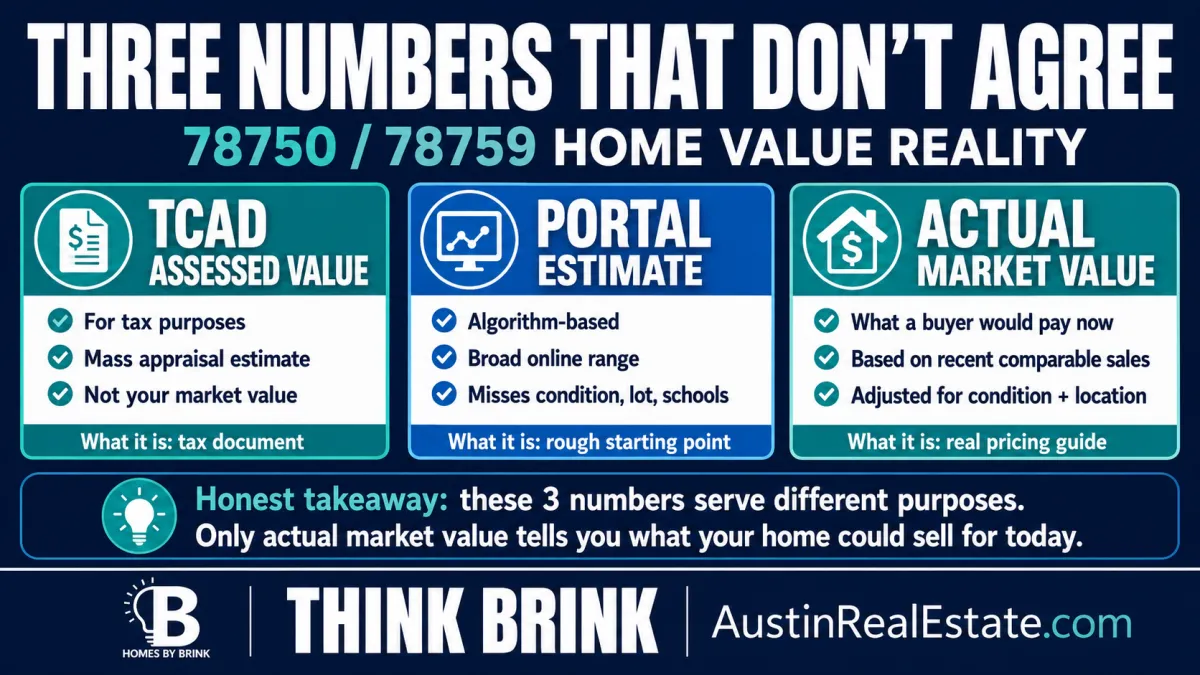
Most 78750 and 78759 homeowners who ask about their home's value are working with three numbers that don't agree with each other: what TCAD says it's worth, what the portal estimates say it's worth, and what they hope it's worth based on neighborhood lore and what a neighbor got a few years ago.
Here's a reasonable framework for thinking about the relationship between those numbers right now.
Your TCAD value is likely below your actual market value if you are a longtime owner who has been capped at 10% annual increases while the market appreciated faster. The gap between TCAD assessed value and actual market value for longtime owners in 78750 and 78759 can be $50,000 to $150,000 or more depending on how long you've owned and how much appreciation has occurred.
Your portal estimate is roughly directionally correct but should be treated as a plus or minus 10% to 15% range rather than a specific number. On a $650,000 home, that means the true value could be anywhere from $552,000 to $748,000 based on what the algorithm thinks. That is not a useful number for making financial decisions.
Your actual market value is what a well-informed buyer in today's market would pay for your specific home in its specific condition at its specific location, based on what comparable homes have actually closed for in the past 90 days. That number requires a human being who knows these zip codes, knows the comparable sales, and has walked your home - not an algorithm.
What a Legitimate Comparable Market Analysis Actually Looks Like
A real CMA for a 78750 or 78759 home is not a printout of every sale in the zip code over the past year. It is a specifically curated set of closed sales that are genuinely comparable to your home on the factors that matter.
Genuinely comparable means: similar square footage within about 15% either way, same school district and ideally same school feeder, same general neighborhood or adjacent comparable neighborhood, similar lot character - not a greenbelt lot compared to an interior lot - similar condition level, and closed within the past 60 to 90 days.
When those parameters are applied rigorously in 78750 or 78759, you may end up with three to five genuinely comparable sales rather than fifteen loosely comparable ones. That's fine. Three well-selected comparables in a coherent analysis are worth more than fifteen loosely filtered sales that include homes in different school districts, different condition categories, and different neighborhood sections.
The adjustments that a good CMA makes between comparables also matter. If your home has a greenbelt lot and the most recent comparable didn't, the CMA should reflect what that difference is worth based on how the market has historically priced it. If your home has an updated kitchen and the comparable had an original one, the adjustment should reflect the actual buyer response to that difference rather than a generic number.
This is craft work, not data entry. A CMA produced by someone who knows 78750 and 78759 specifically - who has toured homes in these neighborhoods, reviewed their own transaction history in these zip codes, and understands where the premiums and discounts actually live - produces a meaningfully better output than a CMA generated by someone who knows the Metro broadly.
What Northwest Austin Sellers Should Know About Buyers Who Want Updated but Not Overpriced
The Three Questions Worth Asking Before You Get a Valuation
If you're thinking about getting a valuation on your 78750 or 78759 home - whether you're actively considering selling, just curious, or planning ahead - here are the three questions worth being clear on before you have that conversation.
What is the purpose of the valuation? A valuation for your own planning purposes, where you want to understand what you have and what your options are, is a different conversation from a pre-listing pricing strategy discussion. Being clear on which you need helps you get the right kind of output from the right kind of conversation.
What is the condition of your home honestly, and what are you planning to do about it before listing if anything? The value of your home today and the value of your home after targeted pre-listing preparation are two different numbers. Understanding both - and the cost and timeline of getting from one to the other - is part of a useful pre-listing conversation.
What is your timeline and what are you trying to accomplish? A seller who needs to be out within 90 days has a different strategic situation than one who is planning 12 months out. Both deserve an accurate valuation, but the strategic conversation that follows it looks different.
The Honest Answer to "What Is My Home Worth"
The honest answer is that no blog post, no automated tool, and no general market commentary can give you an accurate value for your specific home in its specific condition at its specific address in 78750 or 78759. The zip codes are too varied, the condition premium is too significant, and the school assignment impact is too real for any general analysis to substitute for a specific one.
What this post can tell you is the framework: your TCAD value is a tax document, not a market document. Your Zestimate is directionally useful but not reliable for decision-making. The 2022 peak sale in your neighborhood is not your 2026 comp. Your actual market value is a function of school assignment, condition, lot character, size, and how your home compares to what else a buyer could buy with the same money right now.
If you want to know the actual number for your specific home, the only way to get it is a conversation with someone who knows these zip codes and who has done the work of pulling real current comparables, filtering them correctly, and giving you a straight answer rather than a number designed to win a listing.
That conversation is worth having before you decide anything - whether the decision you're leaning toward is to sell soon, to prepare and sell later, or to understand what you have and stay. All three are legitimate outcomes. The number is the starting point for the conversation, not the end of it.
Frequently Asked Questions
Is my TCAD appraisal value the same as my home's market value?
No. Your TCAD assessed value is produced by the Travis Central Appraisal District for tax purposes using mass appraisal methodology. It is not what a buyer would pay for your home and it is not what a real estate professional would use as a list price. Longtime owners in 78750 and 78759 often have TCAD values meaningfully below current market value because the 10% annual assessment cap has limited how fast assessed value could catch up to actual appreciation.
Can I trust my Zestimate to know what my home is worth?
Treat it as a rough range, not a specific number. Automated valuations in 78750 and 78759 are particularly unreliable because of the significant internal variation in these zip codes - school assignments, lot character, condition, and neighborhood section all affect value dramatically and none of these are visible to an algorithm. The Zestimate may be directionally useful but can easily be 10% to 15% off in either direction on any specific property.
How much has my 78750 or 78759 home lost in value from the 2022 peak?
It depends on your specific home, neighborhood, and condition. Austin's overall market is down approximately 2% to 3% year over year and more significantly from the 2022 peak. 78750 and 78759 have held value better than many Austin zip codes due to the school premium, employer proximity, and established neighborhood character. The only way to know the specific number for your home is a current comparable market analysis using closed sales from the past 60 to 90 days.
What is the biggest factor affecting my home's value in these zip codes?
School assignment has the single most consistent and measurable impact on value. A confirmed RRISD address feeding Westwood High School commands a real and persistent premium over a comparable home with AISD assignment. The second biggest factor is condition - the spread between original-condition and fully-updated homes in 78750 and 78759 can be $75,000 to $150,000 or more at current price points.
What is the current median home price in 78750 and 78759?
The median sold price in 78750 has been running around $535,000 with homes averaging approximately 86 days on market. The median across 78759 for all property types has been running around $698,000. Both medians span a wide range of condition and neighborhood sections within each zip, so the median is context rather than guidance for any specific home.
How do I get an accurate valuation for my specific home?
You need a comparative market analysis built from actual recent closed sales - within the past 60 to 90 days - of homes genuinely comparable to yours on school assignment, condition, lot character, size, and neighborhood section. This requires someone who knows 78750 and 78759 specifically, has walked your home, and is giving you a straight answer rather than a number designed to win your business.
Does it make sense to get a valuation even if I'm not planning to sell soon?
Yes, for several reasons. Understanding what you own is foundational to financial planning, especially for longtime owners whose equity position has changed significantly over the years. If you're considering making updates before listing, knowing what the home is worth before and after helps you make smarter decisions about where to spend. And if you're thinking about downsizing at some point, the valuation conversation is the natural starting point for understanding what the financial picture actually looks like.
