How to Sell a Partially Updated Northwest Austin Home Without Overpricing It
There is a specific kind of seller in 78750 and 78759 who is in a genuinely difficult position right now, and they tend not to know it until they've been on the market for 60 days and their agent is asking for a price reduction.
Here's the situation: they bought in Canyon Creek, Spicewood Estates, Balcones Woods, Jollyville, or one of the other established Northwest Austin neighborhoods in the 1990s or early 2000s. Over the years they updated some things - maybe a kitchen remodel 8 years ago, a primary bath gut job 4 years back, new flooring throughout, fresh paint. The house looks better than it did. They've spent real money. And they've watched neighbors sell for numbers that felt validating.
So when it's time to sell, they price for what they put in plus appreciation. And then the house sits.
This post is about why that happens, what the current buyer pool in these zip codes actually values, and how to position a partially updated home so it sells at the right price rather than sitting until the market teaches you what that price is.
Why Some Northwest Austin Homes Sit While Others Still Sell
The Partial Update Problem
A fully renovated home in Northwest Austin is a relatively easy sell. Buyers see it, understand it, and are willing to pay for it because they don't have to do the work themselves.
An original-condition home priced honestly for its condition is also a manageable sell. Buyers who are looking for a project or who want to customize recognize the opportunity, and if the price is accurate they can make the math work.
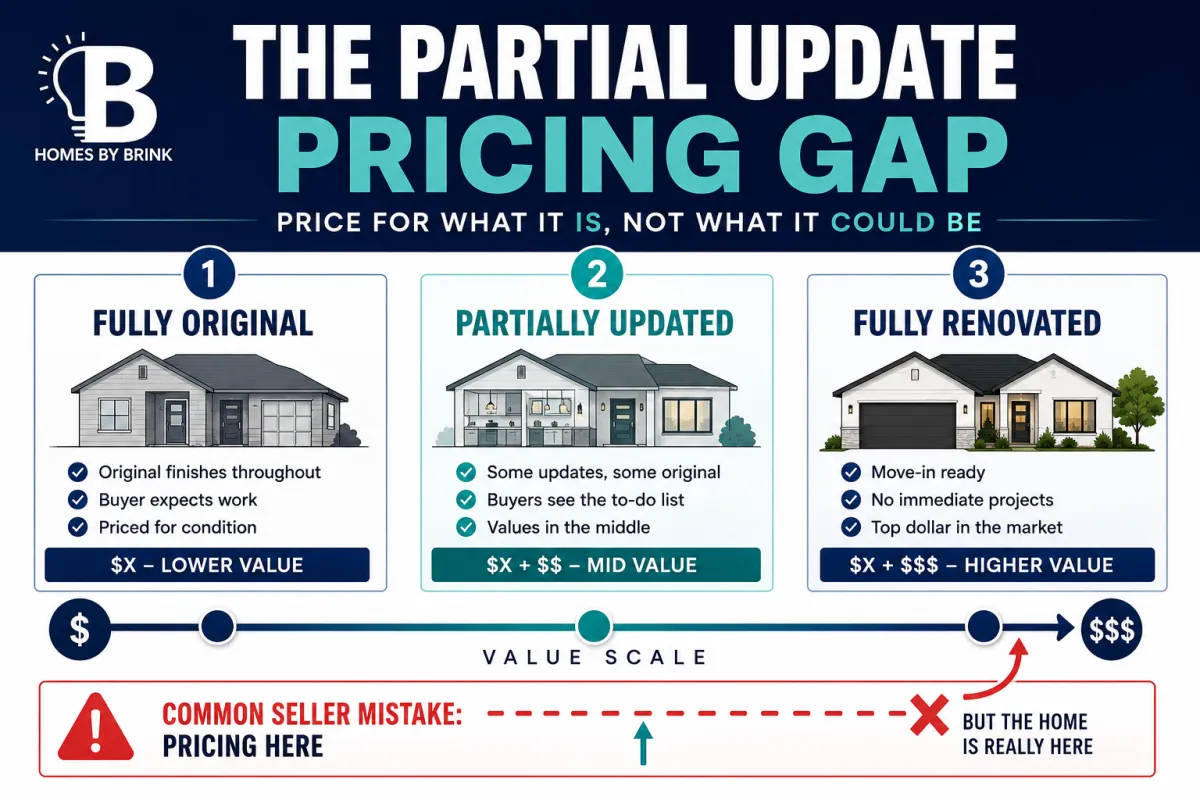
The hard sell is the partially updated home priced as if it were fully renovated. This is the most common pricing mistake in 78750 and 78759, and it comes from a specific mental accounting error that sellers make almost universally.
The error works like this: the seller adds up what they spent on updates - $45,000 kitchen, $30,000 primary bath, $15,000 flooring - and concludes that $90,000 in improvements equals $90,000 in added value. Then they layer that onto the base price they expect for the home's location and size, and arrive at a number that feels completely justified from where they're sitting.
The problem is that buyers don't pay for what you spent. They pay for what they're getting relative to everything else they can buy with the same money. And in 78750 and 78759 right now, buyers have enough choices and enough time to be very specific about what they're willing to pay for.
What Today's Northwest Austin Buyers Actually See
When a buyer walks into a partially updated home in these zip codes, here is what they're evaluating - often in real time and often in comparison to three or four other homes they've toured the same day.
They notice what's updated immediately. A renovated kitchen reads well. A primary bath remodel reads well. New flooring reads well. These things register.
Then they inventory what isn't done. If the secondary bathrooms are still original - the pink and beige tile, the dated vanities, the builder-grade fixtures from 1991 - they see that. If the windows are original single-pane, they see that too, both because the light looks different and because they're already thinking about what it costs to replace them. If the HVAC is original or on its second system from 2009, they're doing mental math about when it goes. If the exterior paint is faded and the gutters are pulling away and the landscaping is tired, they're calculating what it takes to get the house presentable.
The buyer doesn't add up your improvements and subtract their to-do list. They arrive at a holistic number - a single price that reflects what the home is worth to them in its current condition relative to their alternatives. That number is almost always lower than what the seller expects, and the gap between seller expectations and buyer perception is exactly where partially updated homes die on the market.
Should You Sell Your Northwest Austin Home Before the Repairs Pile Up?
The Buyer Pool Shift That Changed Everything
In 2021 and early 2022, buyer behavior in Northwest Austin was different from what it is now. Buyers were competing against multiple offers, waiving inspection contingencies, and making decisions fast. In that environment, a partially updated home could attract an aggressive offer because buyers feared losing out to someone else more than they feared the incomplete renovation.
That environment is gone. Northwest Austin homes in 78750 and 78759 are now averaging over 80 days on market, and buyers in these zip codes have time to evaluate. They're visiting multiple homes. They're doing the math on what each one costs to bring to the standard they want. They're negotiating. And they're walking away from homes that are priced as if it's still 2022.
The buyers in 78750 and 78759 specifically are not financially unsophisticated. They're often tech employees, medical professionals, or executives who analyze numbers for a living. They pull the TCAD records. They look at what your neighbors sold for and when. They know what a full renovation costs because many of them have either done one or gotten quotes. They can calculate fairly precisely what they'd be taking on with a partially updated home, and they'll offer accordingly or move on.
Why the Updates You Made May Not Be Worth What You Think
This is the part sellers need to hear before they list, not after they've been on the market for 45 days.
Every update you made has a depreciation curve. A kitchen remodel from 4 years ago is worth more to a buyer than a kitchen remodel from 12 years ago - even if both were high-quality jobs. Buyers are not paying full replacement cost for an 8-year-old kitchen. They're paying for something that looks reasonably current and won't need to be done again for a while. That's not zero value, but it's not full renovation credit either.
Buyer taste also evolves. The all-white kitchen with subway tile that was fresh in 2019 is not as differentiated in 2025 as it was when you did it. The gray LVP flooring that was everywhere during the renovation boom of 2020 through 2022 is now so common that buyers don't experience it as a special feature - it's just what floors look like. Updates that were ahead of the curve when you made them may have been absorbed into baseline expectations by the time you sell.
Some updates have high visibility and low buyer premium. Recessed lighting, fresh paint, and new door hardware all make a house feel more current, and buyers appreciate them - but they don't pay meaningful premiums for them because they're easy and relatively inexpensive. The updates that command real buyer premiums in these zip codes are kitchen renovations that include new cabinets, countertops, and appliances; primary bath gut jobs; and window replacements. Everything else is table stakes.
And if the expensive, visible updates are done but the secondary spaces are original, buyers are applying a discount for the remaining work that often exceeds what they're crediting you for the work you did.
How to Think About Pricing a Partially Updated Home
The right framework for pricing a partially updated home is not renovation cost accounting. It's comparable sale analysis with honest condition adjustment.
Start with what fully original-condition homes in your neighborhood and size range have sold for in the past 90 days. Then look at what fully renovated homes in the same parameters have sold for. The spread between those two numbers is the renovation premium in your specific market.
Your partially updated home sits somewhere in that spread - not at the top because you've done some work, but not at the bottom either because you haven't done all of it. Where exactly it sits depends on two things: which updates you've done and how recently, and what updates remain.
If you've done the kitchen and primary bath - the two updates buyers weight most heavily - and the remaining work is secondary baths, windows, and cosmetics, you're probably in the upper half of that spread. If you've done cosmetic updates but the primary bath and kitchen are still original, you're in the lower half regardless of how much the cosmetics cost you.
The other honest adjustment: how long ago you did the updates. An 8-year-old kitchen in good condition gets some credit but not full renovation credit. A 15-year-old kitchen remodel that was high-end at the time is now just a kitchen. Run the math forward from when the work was done, not backward from what you spent.
What Sellers in Northwest Austin Should Not Over-Improve Before Listing
What Actually Moves Partially Updated Homes in This Market
In the current 78750 and 78759 market, the partially updated homes that sell without price reductions share a consistent set of characteristics. The ones that sit and eventually reduce share a different set.
Homes that sell:
The pricing is set to reflect actual condition, not aspirational condition. The seller and their agent ran real comparable analysis and priced where the data pointed rather than where the seller hoped.
The home is presented impeccably within its condition. Clean, decluttered, staged to minimize what's dated and highlight what's been done. Good professional photography that doesn't oversell and doesn't undersell. Listing language that is honest about the updates completed and straightforward about the condition.
The seller made targeted low-cost improvements before listing that meaningfully changed the buyer's first impression - fresh exterior paint if needed, landscaping cleanup, interior paint in the most dated colors, lighting fixture updates in the main living areas. These are not renovation investments; they're presentation investments, and they have a high return relative to their cost.
The home's pricing creates space for the buyer to feel they have room to win. In a market where buyers are negotiating, a home priced at its ceiling leaves no room for the buyer to feel they've gotten a good deal. A home priced just below its ceiling often closes at a number the seller would have been happy with anyway, but gets there faster and with less concession drama.
Homes that sit:
The price is based on renovation cost accounting rather than comparable sales. The seller spent $90,000 on updates and wants $90,000 or more in return. The market doesn't work that way, and no amount of waiting changes it.
The listing photos show the dated elements prominently. A bathroom that still has original 1993 tile shouldn't be the hero shot. A bedroom with dated carpet and brass light fixtures doesn't need to lead. Good staging and thoughtful photography can de-emphasize what's incomplete without being dishonest about it.
The seller is anchoring to what their neighbor got in 2021 or 2022. That was a different market. Using peak-cycle comparable sales to price a home in the current environment is one of the fastest ways to guarantee a long days-on-market number and an eventual price reduction that lands you lower than you would have started if you'd priced correctly from day one.
The Specific Updates Worth Making Before You List
If you're getting ready to list a partially updated home in 78750 or 78759, here is a practical guide to what's worth spending money on before you go live and what isn't.
Worth doing before you list:
Fresh paint throughout in a neutral that doesn't read as dated. If the walls are original Southwest-palette paint from 1994, or the dark accent colors from 2015, updating paint is one of the highest-return pre-listing investments you can make. Budget $5,000 to $10,000 depending on size and you'll get it back and then some in buyer perception.
Landscaping and exterior presentation. The first thing buyers see online is the exterior photo. Overgrown landscaping, a tired yard, and a faded front door are things that can cause buyers to skip your listing before they ever set foot inside. A day of landscaping cleanup, fresh mulch, and a new front door paint color or hardware are relatively inexpensive and have a disproportionate impact on first impressions.
Interior light fixture updates in the main living areas. Replacing dated brass or bronze fixtures in the entry, dining room, and kitchen with something current costs $500 to $2,000 and meaningfully changes the feel of the most-trafficked spaces. Buyers notice lighting more than sellers realize.
Cleaning and decluttering to a standard beyond what you'd expect. Professional deep clean, carpets cleaned or replaced if worn, garage organized, storage spaces edited. Buyers are evaluating every space and every corner. A home that is immaculate in its condition - even if that condition includes original 1991 tile in one bathroom - reads better than a home that's partially renovated but messy.
Hardware updates on cabinets and doors. Replacing dated cabinet pulls and door handles with brushed nickel or matte black costs very little and changes the visual profile of kitchens and bathrooms meaningfully.
Not worth doing before you list:
Full bathroom renovations if the goal is listing soon. A bathroom renovation takes time, disrupts the house, and rarely returns full cost in resale value in these zip codes. The exception is if the primary bath is genuinely the weakest element of the home and leaving it original will cost you more in buyer discounting than the renovation would cost. In that case it's a conversation worth having, not a blanket no.
New kitchen if the current one is functional and reasonably presentable. Buyers who specifically want a kitchen their way will redo it regardless of what you did. Buyers who want a move-in-ready kitchen are better served by your price reflecting the existing condition honestly.
Luxury finishes in secondary spaces. Putting high-end tile in the guest bath of a home that has dated everything else doesn't create a coherent buyer experience. It creates a confused one. Updates should create a consistent impression, not isolated pockets of renovation surrounded by dated original condition.
Anything structural or major that you can't recover from the sale price. If the roof needs replacing, a foundation has issues, or the HVAC is at end of life, get quotes and decide whether to address or disclose and price accordingly. Don't put a new roof on a home and then also drop $40,000 on a kitchen and expect to recover both.
What If Your Northwest Austin Home Needs Too Much Work to Sell?
The Pricing Conversation You Need to Have With Your Agent
If you're a seller in 78750 or 78759 with a partially updated home, the most valuable conversation you can have before you list is a brutally honest comparable analysis with your agent - one that separates what you want the house to be worth from what the market says it's worth.
Ask for comparables filtered by condition. Not just location and square footage, but actual condition - updated, partially updated, and original. The spread between those categories in your specific neighborhood and size range is the data that should be driving your price, not what you spent on the kitchen or what your neighbor got three years ago.
Ask your agent to walk the house with you and identify specifically what a buyer will see and what it will cost them to address. Not to scare you, but to give you the realistic picture of what's sitting between your house and the comparable fully renovated sale down the street. That gap is what you're pricing around.
Ask about the cost of getting it wrong. A home that sits for 90 days in this market and then reduces develops a buyer perception problem that goes beyond the price reduction itself. Buyers wonder why it sat. They come in with lower offers. They negotiate harder. The math on overpricing and then reducing almost always lands sellers in a worse position than pricing accurately from day one.
What People Don’t Know About Downsizing in Northwest Austin
The Honest Bottom Line
Partially updated homes in 78750 and 78759 are not hard sells. They sell every week in this market. The ones that sell well are priced for what they are, presented impeccably within their condition, and listed by sellers who understood going in that the renovation credit they expected and the renovation credit the market gives are often meaningfully different numbers.
The location premium in these zip codes is real. The school access is real. The lot character and the established neighborhoods are real. Buyers in 78750 and 78759 are paying for those things. They're just not paying separately for renovation decisions you made 10 years ago as if time doesn't move in one direction.
Price honestly, present beautifully, and let the location do what it does. That's how partially updated homes in Northwest Austin sell without becoming the cautionary tale that your neighbors whisper about at the mailbox.
Frequently Asked Questions
Should I finish the renovation before listing, or sell as-is?
It depends on what's left and what it costs. If the remaining work is primarily cosmetic - secondary baths, fixtures, paint - the calculation usually favors pricing to reflect current condition and letting the buyer handle it. If a major element like the primary bath or kitchen is original and creating significant buyer resistance, finishing it or pricing aggressively for its current state are both legitimate approaches depending on your timeline and budget. There's no universal right answer - it requires a specific conversation about your home and your market.
How much of my renovation cost will I recover at sale?
Kitchen and primary bath renovations in 78750 and 78759 typically return 60% to 80% of cost at sale, though the return varies based on quality of work, how recent it was done, and how it compares to comparable homes in the neighborhood. Cosmetic updates like paint and fixtures return higher percentages but on smaller dollar amounts. Full renovation cost recovery is rarely realistic and shouldn't be the basis for pricing.
Why do partially updated homes in Northwest Austin sit on the market?
Most commonly, overpricing. The seller adds renovation costs to their expected base price and arrives at a number that doesn't reflect what buyers will pay given the remaining work. The second most common reason is presentation - the dated elements of the home are too prominent in photos and showings, causing buyers to discount heavily or move on.
How should I decide what to fix before listing?
Focus on first impression items - exterior, paint, landscaping, lighting - before major renovation decisions. For larger items, compare the cost of the improvement to the likely buyer discount for leaving it. If buyers will discount $40,000 for an original primary bath and the renovation costs $35,000, the renovation may be worth doing. If the discount is $20,000 and the renovation costs $40,000, price adjustment is the more practical tool.
Is the current market in 78750 and 78759 good for sellers?
Relatively yes, but with conditions. Both zips have been running below the six-month inventory threshold that defines a seller's market, which means demand is present. But average days on market are running over 80 days, which means buyers have time to evaluate and negotiate. Homes that are priced accurately for their specific condition are still moving. Homes that are overpriced are sitting, and in a market with 80-plus day averages, sitting is expensive.
What's the biggest mistake sellers make in Northwest Austin right now?
Using renovation cost accounting instead of comparable sale analysis to set the list price. What you spent is not what the market pays. Current closed comparable sales filtered by condition are the only reliable guide to where your specific home should be priced.
