What Relocating Buyers Should Know About Travis County vs Williamson County Property Taxes in Northwest Austin
If you are relocating to Northwest Austin from California, Seattle, or anywhere with a state income tax, the first thing your new-hire paperwork made attractive was Texas having no state income tax. The second thing you learned, usually about the time you started looking at listings, is that Texas makes up for it on the property tax side. What most relocating buyers do not realize is that in the neighborhoods I work, which zip code you land in can put you in one of two different counties with two different tax structures, and that difference follows you for as long as you own the home.
This is a guide to how Travis County and Williamson County property taxes actually differ for buyers in Northwest Austin, why the county line matters less than the stack of taxing districts sitting on top of it, and how to read a tax bill before you make an offer instead of after you close. I am James Brinkman, a broker who works the 78750, 78759, and 78726 zip codes, and I have watched more than one relocating family budget for the mortgage and get surprised by the escrow.
One caveat before the numbers: I am a real estate broker, not a CPA or a tax attorney. The figures below are current public rates as of this writing, but tax law and exemption amounts change, and your specific situation deserves professional advice. Use this to ask better questions, not as a substitute for your accountant.
Where the county line actually runs in Northwest Austin
Here is the thing relocating buyers almost never know: Austin is not one county. The city sits primarily in Travis County, but its northern edge spills into Williamson County, and the line runs right through the area buyers are targeting for the tech corridor.
The core of what I work, the established 78750, 78759, and 78726 neighborhoods, sits in Travis County. Spicewood Estates, Balcones Woods, Great Hills, Canyon Creek, Balcones Village, Angus Valley, Northwest Hills, all Travis County. When you move north and west into the newer master-planned territory, you cross into Williamson County. Avery Ranch, which uses the 78717 zip code, is Williamson County. Parts of 78727 and 78729 sit near the line, and some addresses on the north side of those zips fall into Williamson while addresses a mile south are in Travis.
This matters because two homes that look identical on a map, same schools in some cases, same drive to the Apple campus on Parmer, can carry different county tax rates and, more importantly, sit under different combinations of city, school, and special-district taxes. The county is only one line on the bill. It is rarely the biggest line.
Why buyers fixate on the wrong number
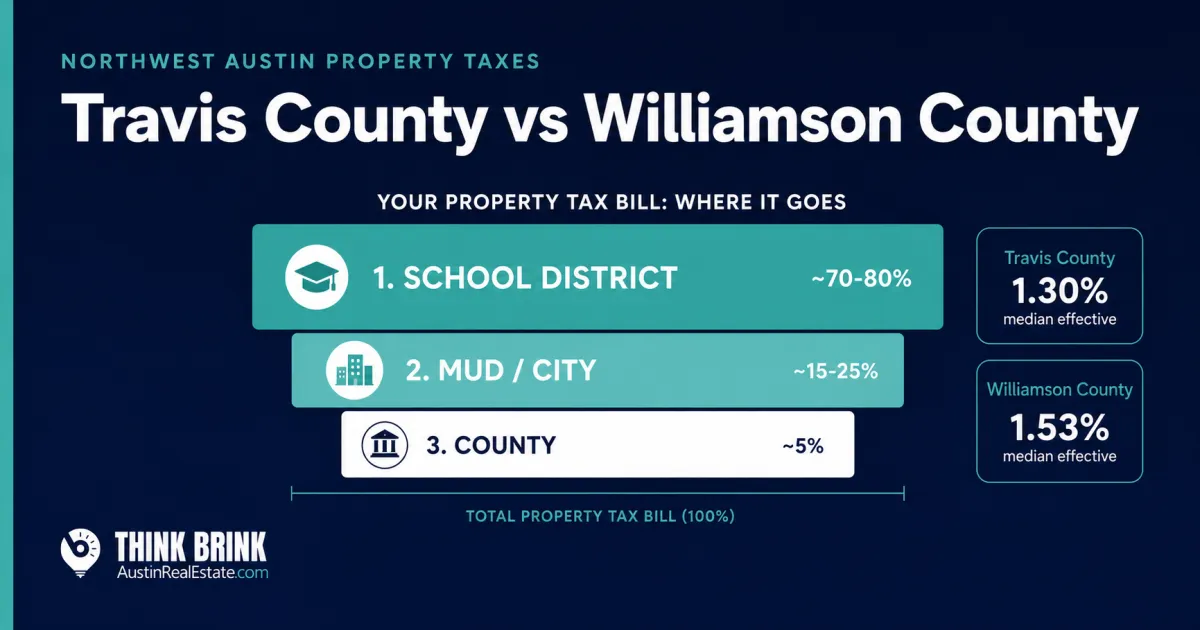
Relocating buyers tend to ask me one question: which county is cheaper? It is the wrong question, and I will explain why. The county tax rate is a real number, but it is a small slice of your total bill. In Travis County the county government rate for the current tax year is about $0.375845 per $100 of taxable value. In Williamson County the county rate is about $0.413776 per $100. On a $600,000 assessed value, that county-rate difference works out to roughly $227 a year. Real money, but not the number that decides your budget.
The number that decides your budget is the total rate, which stacks the county rate with your school district, the city or municipal utility district, the community college district, and any special assessment your neighborhood carries. That total is where Travis and Williamson genuinely diverge, and it is where the surprises live.
What the total effective rate actually looks like
When you combine every taxing jurisdiction, the median effective property tax rate, meaning taxes paid as a share of value, runs about 1.30 percent in Travis County and about 1.53 percent in Williamson County based on recent county-level data. In Round Rock specifically, inside Williamson County, the effective rate averages closer to 1.68 percent. For most Austin-area homeowners the combined effective rate lands somewhere in the 1.8 to 2.5 percent range of assessed value depending on exactly which districts overlap at the address.
Put that in dollars. On a $600,000 home, a 1.30 percent effective rate is about $7,800 a year. At 1.53 percent it is about $9,180. At 1.8 percent it is $10,800, and at 2.2 percent it is $13,200. That spread, more than $5,000 a year between the low and high ends, is not driven by the county line. It is driven by the whole stack, and two homes in the same county can sit at opposite ends of it.
So when a relocating buyer tells me they are choosing Williamson County to save on taxes, or avoiding it for the same reason, I stop them. The county is not the variable that moves your bill the most. The school district and any municipal utility district are.
The school district is the biggest line on the bill
In this part of Austin your school district rate dwarfs your county rate. Round Rock ISD, which covers much of Northwest Austin including large parts of 78750, 78759, and the tech corridor, adopted a total tax rate of about $0.8931 per $100 for 2025, split into a maintenance and operations rate of roughly $0.7101 and a debt service rate of about $0.1830. Austin ISD, which covers the 78731 and 78759 pockets closer to MoPac and the AISD-zoned parts of Northwest Austin, adopted a total rate of about $0.8705 per $100 for 2025.
Look at those two numbers next to the county numbers. The school rate is more than double the county rate in both cases. So the district your address feeds into moves your bill far more than whether you are technically in Travis or Williamson County. This is exactly why I tell relocating buyers to shop the tax stack at the address level, not the county level. Confusingly, Round Rock ISD is a Williamson County district by name but serves homes in both counties, so you can live in Travis County and pay the Round Rock ISD rate. The district boundary and the county boundary are not the same line.
If you want the deeper breakdown of how RRISD and AISD boundaries interleave in this area, I wrote a full guide on RRISD versus AISD boundaries where the two districts meet in Northwest Austin. The short version: you cannot assume the school district from the zip code or the county, and both drive the tax bill.
Austin ISD, recapture, and why a lower rate can still hurt
There is a wrinkle with Austin ISD that relocating buyers deserve to understand, because it is counterintuitive. Austin ISD has a slightly lower adopted rate than Round Rock ISD, but AISD is a heavy recapture district under the Texas school finance system informally called Robin Hood. Because property values inside AISD are high, the state recaptures a large share of what AISD collects and redistributes it to lower-wealth districts across Texas. In recent budget years, roughly half of every local tax dollar AISD collected was subject to recapture and sent to the state, with the district estimating hundreds of millions of dollars remitted annually.
What does that mean for you as a buyer? Two things. First, the taxes you pay on an AISD home do not all stay in your kid's school, which frustrates a lot of families once they learn it. Second, and more practically, recapture pressure and the politics around school funding make future rate and bond decisions genuinely uncertain in a way that is hard to forecast. It does not make AISD a worse choice, plenty of the strongest feeders in my area are AISD, but it is context relocating buyers should have before they assume the lower headline rate means a permanently lower bill.
Municipal utility districts: the line item that catches relocating buyers
If there is one thing that blindsides buyers moving into the newer Williamson County and north-corridor developments, it is the municipal utility district, or MUD. A MUD is a special taxing district created to finance the water, sewer, drainage, and road infrastructure for a new development. The developer fronts the cost, and the MUD levies an additional tax on homeowners to pay off the bonds over time.
A MUD assessment can add a meaningful amount to your rate, sometimes half a percentage point or more on top of everything else, in the early years of a development before the bonds are paid down and the rate steps down over time. This is why a brand-new home in a master-planned community in Williamson County can carry a materially higher total tax rate than an established home a few miles south in Travis County, even though the county rate difference is small. It is not the county. It is the MUD sitting on top of the county.
The older, established Travis County neighborhoods I work, Spicewood Estates, Balcones Woods, Great Hills, Northwest Hills, generally do not carry MUD assessments, because their infrastructure was paid off decades ago and they sit inside the City of Austin's full-purpose jurisdiction. That is a quiet advantage of buying established that rarely shows up in the listing. I broke down how these assessments work in detail in my guide to MUDs and PIDs in the North Austin corridor and what the extra assessment actually buys you.
How to find the MUD before you fall in love with the house
Every seller in Texas is required to provide notice if a property sits within a MUD, and the tax rate detail is available from the county appraisal district and the MUD itself. But relocating buyers often do not know to look until they are deep into the transaction. My rule is simple: before you write an offer on any home built in the last fifteen years north or west of the established core, ask your agent to pull the full tax rate breakdown by jurisdiction from the appraisal district. If there is a MUD line, ask what the current rate is and where it sits in its payoff schedule. A MUD that is nearly paid down is very different from one on a fresh development.
The exemptions that level the field
Whatever county and district you land in, Texas gives homeowners tools to lower the taxable value, and relocating buyers routinely leave money on the table by not filing for them promptly. The most important is the residence homestead exemption.
For your primary residence, the school district portion of your taxable value is reduced by a state homestead exemption that in recent years was set at $100,000 and, following a statewide measure Texas voters approved in November 2025, is being raised to $140,000. On top of that, counties and other districts offer their own homestead exemptions, and the exemption freezes in some categories for homeowners who are 65 or older or disabled. You claim it by filing Form 50-114 with your county appraisal district, and the deadline for the current tax year's bill is generally April 30. It is not automatic, and a lot of relocating buyers forget to file in the chaos of moving.
The second tool is the appraisal cap. Once you have an active homestead exemption in place, Texas Tax Code Section 23.23 limits how fast your assessed, taxable value can rise to 10 percent per year, no matter how much the market value of your home actually jumps. In an appreciating market that cap is worth a great deal over time, but it only kicks in with the homestead exemption filed, and it resets when the home sells. That last point matters for buyers: the seller's capped value does not transfer to you. When you buy, the home is reassessed at market, so your first-year tax bill can be noticeably higher than what the prior owner was paying. Budget for the reassessment, not the seller's old number.
I go deeper on both of these, including how the cap resets and how to time your filing, in my guide to Texas homestead exemptions and property tax caps, and in the broader property taxes and exemptions guide for Northwest Austin buyers.
How to actually compare two homes across the county line
Say you are deciding between an established home in the Travis County part of 78750 and a newer home in a Williamson County development to the north. Here is the honest way to compare them on taxes.
First, get the total tax rate for each specific address from the appraisal district, not the county rate. Add up county, school district, city or MUD, community college, and any special district. That combined rate, applied to the price you expect to pay, is your real first-year estimate. Do not use the seller's current bill, because your reassessment will likely reset the value upward.
Second, apply the exemptions you will actually qualify for. If both will be your homestead, both get the school district exemption, so the comparison is on the rate and the assessed value, not the exemption.
Third, look at the trajectory, not just the snapshot. A Williamson County home with a fresh MUD may cost more per year now but step down as the MUD bonds amortize. An established Travis County home has no MUD to step down, but it also has no MUD, so its rate is more stable and predictable. Which you prefer depends on how long you plan to stay and how much you value predictability.
Fourth, remember that the tax bill is downstream of value. A home that costs $150,000 less to buy carries a smaller tax bill even at a higher rate, and in this market the established Travis County neighborhoods and the newer Williamson County developments often sit at different price points. Run the actual dollars, not the percentages.
A quick worked example
Take a $600,000 assessed value in each scenario. In an established Travis County neighborhood with no MUD, a total effective rate around 1.9 percent produces roughly $11,400 a year before exemptions, and the homestead exemption knocks the school-tax portion down from there. In a newer Williamson County development carrying a MUD, a total effective rate around 2.4 percent produces roughly $14,400 a year before exemptions on the same value. That $3,000 annual gap is almost entirely the MUD and the higher combined district stack, not the roughly $227 county-rate difference. This is the whole point: the county line is the smallest part of the story, and the district stack is nearly all of it. Verify the exact rates for any specific address with the appraisal district, because they vary block to block.
What this means for the neighborhoods I actually work
For most of my buyers targeting the established core of Northwest Austin, 78750, 78759, and 78726, you are in Travis County, under either Round Rock ISD or Austin ISD depending on the exact address, with no MUD. Your total effective rate tends to land in the more predictable middle of the range, and your biggest tax variable is the school district, not the county. That predictability is part of why these neighborhoods hold value the way they do. If you want the full lay of the land on the core, my pillar guide to living in 78750 and 78759 covers the neighborhoods and their school feeders.
For buyers pushing north and west into the tech corridor toward Avery Ranch and the newer 78717, 78727, and 78729 developments, you may cross into Williamson County, and you are more likely to encounter a MUD. That is not a reason to avoid those areas, they offer newer construction and often more house for the money, but it is a reason to pull the full tax breakdown before you commit and to understand that your all-in monthly payment will reflect that stack.
Frequently asked questions
Is Williamson County or Travis County cheaper for property taxes in Austin?
On the county rate alone, Travis County is slightly lower, about $0.375845 per $100 versus about $0.413776 per $100 in Williamson County. But the county rate is a small part of your bill. The total effective rate, including school district and any MUD, runs about 1.30 percent median in Travis County and about 1.53 percent in Williamson County, and individual addresses vary widely. The real driver is the district stack at your specific address, not the county.
Which Northwest Austin neighborhoods are in Williamson County?
The established core, 78750, 78759, and 78726, is in Travis County. As you move north and west into the tech corridor, you cross into Williamson County. Avery Ranch in the 78717 zip code is Williamson County, and parts of 78727 and 78729 near the county line have Williamson County addresses. Two homes a mile apart can be in different counties, so confirm at the address level.
Why is my property tax bill higher than the previous owner's?
When you buy a home in Texas, it is reassessed at market value, and the previous owner's 10 percent homestead appraisal cap does not transfer to you. If the prior owner held the home for years while values rose, their capped taxable value was likely well below market, so your first reassessed bill can be noticeably higher. Always budget from a reassessment estimate, not the seller's current bill.
What is a MUD tax and how much does it add?
A municipal utility district, or MUD, is a special taxing district that finances water, sewer, drainage, and roads for a new development. It levies an additional tax to repay the infrastructure bonds. A MUD can add a meaningful amount to your rate, sometimes half a percentage point or more in the early years, and it typically steps down over time as the bonds are paid off. Established neighborhoods generally do not have MUDs. Ask for the full rate breakdown before you offer on any newer home.
Do I pay Austin ISD or Round Rock ISD taxes in Northwest Austin?
It depends on the exact address, not the county or zip code. Round Rock ISD covers much of Northwest Austin, including parts of both Travis and Williamson counties, while Austin ISD covers the pockets closer to MoPac and 78731. The school rate is more than double the county rate, so which district you feed into matters far more to your bill than which county you are in. Confirm the district at the address before you write an offer.
How much can I save with the Texas homestead exemption?
For your primary residence, the school district portion of your taxable value is reduced by a state homestead exemption recently set at $100,000 and being raised to $140,000 following a measure Texas voters approved in November 2025, plus additional county and district exemptions. You must file Form 50-114 with your county appraisal district, generally by April 30, and it is not automatic. The exemption also activates the 10 percent annual appraisal cap on your taxable value.
Does buying in a lower-tax county mean a lower monthly payment?
Not necessarily. Your monthly payment reflects the total tax stack at the specific address and the price you pay, not the county rate. A less expensive home at a higher rate can carry a smaller bill than a pricier home at a lower rate. Run the actual dollars for each address you are considering rather than comparing county percentages.
When are property taxes due in Travis and Williamson counties?
In both counties, tax bills are typically mailed in the fall, and payment is due by January 31 of the following year without penalty. If you have a mortgage, your lender usually collects taxes monthly through escrow and pays the bill on your behalf, which is why a reassessment can raise your monthly payment mid-year through an escrow adjustment. Confirm the specifics with your lender and the county tax office.
The honest summary
If you take one thing from this, let it be that the county line is the smallest variable in your Northwest Austin property tax bill. The order of magnitude runs the other way: the school district and any municipal utility district drive your bill, the city and college districts fill in the middle, and the county rate is the small change at the bottom. Relocating buyers who fixate on Travis versus Williamson are optimizing the wrong number.
What actually protects you is doing the address-level homework before you offer: pull the full tax rate breakdown by jurisdiction, estimate from a reassessed value rather than the seller's capped bill, confirm the school district, check for a MUD on anything newer, and file your homestead exemption the day you are eligible. Do that, and the county the home sits in becomes a footnote instead of a surprise.
If you are relocating and want help reading the real tax picture on specific homes before you commit, that address-level analysis is exactly the kind of thing I do with buyers. And once more, because it publishes under my license: I am a broker, not a tax professional, so confirm anything that affects your finances with your CPA or a tax attorney before you rely on it.
