MUDs and PIDs in the North Austin Corridor: What the Extra Assessment Actually Buys You
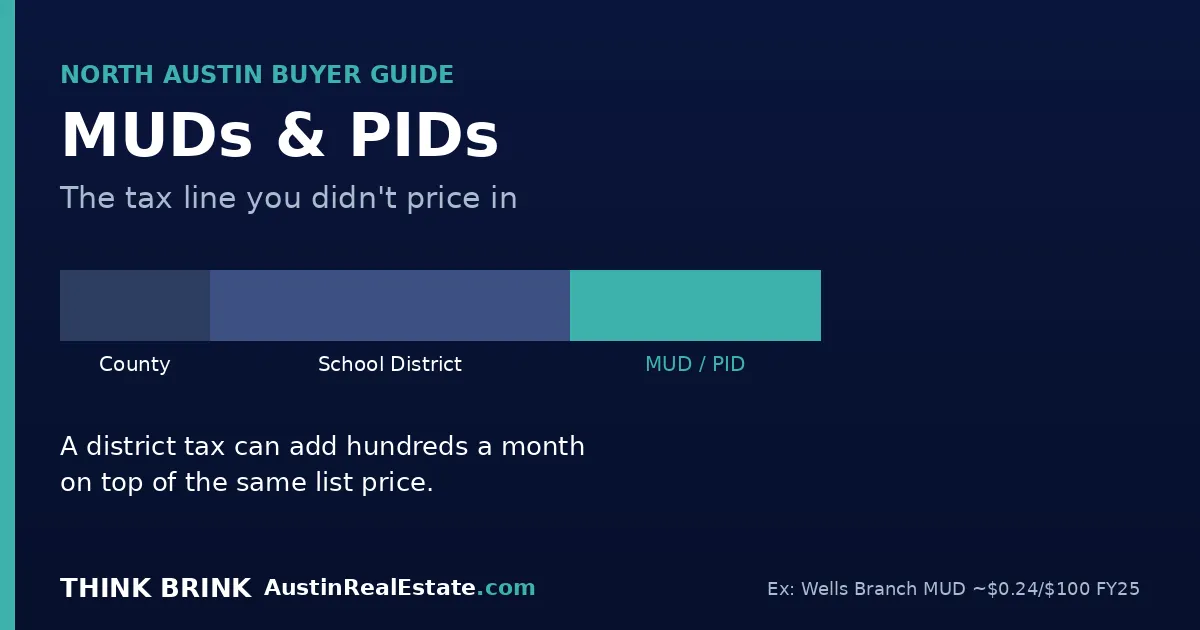
Two homes in the North Austin tech corridor can be listed at the exact same price, sit on nearly identical lots, and cost you very different amounts every month. One of the biggest reasons is a line item most buyers never think about until it shows up in the closing disclosure: a MUD or a PID. A Municipal Utility District or a Public Improvement District can add hundreds of dollars a month to your effective payment, and because it is folded into the property tax bill rather than the list price, it is easy to miss right up until it is your problem.
I get asked about these constantly, usually in a slightly panicked text after a buyer has been under contract for a week and finally read the tax detail. So let me lay it out the way I wish every buyer heard it before they wrote the offer: what these districts are, why they exist, what the extra assessment actually buys you, how the number changes over the years, and exactly what to verify on a specific house before you commit.
One caveat up front, because this touches taxes: I am a broker, not a CPA or a tax attorney. The mechanics below are how these districts generally work, but for the specific tax consequences on a specific home and your specific situation, confirm the numbers with the taxing entity and run them past a CPA or tax professional before you rely on them.
What a MUD actually is
A Municipal Utility District is a special-purpose local government created to finance and provide infrastructure, mainly water, wastewater, and drainage, in an area that a city was not going to build out on its own. When a developer wants to turn raw land on the edge of the metro into a subdivision, someone has to pay for the pipes, the treatment capacity, the storm drainage, and sometimes the roads and parks. Rather than fund all of that up front and bake it into the lot price, the developer petitions to create a MUD. The district issues bonds to pay for the infrastructure, and then it levies a property tax on the homes inside the district to pay those bonds back over time.
That is the key mental model. A MUD is essentially a financing mechanism. The infrastructure that would otherwise be a huge lump sum inside your purchase price gets spread out across decades and paid through an annual tax instead. You are not getting something for nothing, and you are not getting fleeced. You are paying for real infrastructure on an installment plan, with interest, through your tax bill.
How the MUD tax shows up
The MUD rate is stated the same way every other property tax is, as a dollar figure per 100 dollars of assessed value, and it sits on your bill in addition to the county, the school district, the community college district, and any other authority. So a home might pay Travis County, the school district, Austin Community College, and then a MUD, all stacked. The MUD portion is a separate line, and it is very real money.
For a concrete, verifiable local example: the Wells Branch Municipal Utility District, which covers the established Wells Branch neighborhood in North Austin, adopted a rate in the neighborhood of 24 cents per 100 dollars of valuation for its FY2025 cycle. On a home assessed around 400,000 dollars, a rate like that runs on the order of a thousand dollars a year, roughly 80 to 85 dollars a month, entirely separate from your county and school taxes. That is a mature, long-established district with a relatively modest rate. Newer MUDs on the fringe of the metro, where the bonds were just issued and there are fewer homes to spread the cost across, frequently carry much higher rates, sometimes well north of that, precisely because the debt is fresh and the rooftop count is still low.
Why newer MUDs cost more, and why the rate usually falls over time
This is the part that actually helps you as a buyer, because it reframes the MUD from a permanent penalty into a curve you can read.
A brand-new MUD in a just-opened development is in the worst part of its life cycle for a homeowner. The district has issued a lot of debt to build all the infrastructure, and only a handful of homes exist to share the repayment. High debt divided by few rooftops equals a high tax rate. As the development fills in and hundreds more homes get built and added to the tax roll, the same debt is spread across many more properties, so the rate per home tends to come down. On top of that, the district keeps paying down principal, and over a long horizon many MUDs decline substantially, and a few are eventually dissolved or annexed by a city once the bonds are retired.
The practical takeaway: the MUD rate on a five-year-old master-planned community is often nothing like what it will be in fifteen years, and the rate on a mature district like Wells Branch reflects decades of that decline already having happened. When you are comparing a home in a new-build MUD to a home in an established one, you are not just comparing today's rate, you are comparing where each sits on that curve. Do not assume today's number is forever, in either direction.
What a PID is, and how it differs from a MUD
A Public Improvement District is a related but distinct animal, and buyers routinely confuse the two. A PID is a defined area, created by a city or county, where an assessment is levied on the properties to pay for improvements or services that specifically benefit that area, things like landscaping, enhanced maintenance, trails, common areas, or sometimes the same kind of infrastructure a MUD would fund.
The most important differences for a buyer come down to structure and payoff:
A MUD is a governmental entity that levies an ongoing property tax tied to your assessed value. A PID levies an assessment, which is often a fixed obligation tied to your specific lot rather than a rate on fluctuating value.
A PID assessment frequently has a defined payoff. In many PIDs the assessment is a set amount that can be paid off in a lump sum, or that amortizes over a fixed number of years and then disappears. A MUD tax, by contrast, tends to persist as long as the district and its rolling debt exist.
Because a PID can sometimes be paid off, whether the seller has already paid it down, or whether you are inheriting the full remaining balance, becomes a real negotiation point.
That last point is where I most often see money left on the table. If a home sits in a PID with a payable assessment, the status of that balance is a legitimate thing to ask about and, in some cases, to negotiate around. Buyers who do not know the PID exists never think to ask.
What the extra assessment actually buys you
It is easy to resent a line item you did not expect. But it is worth being fair about what MUDs and PIDs deliver, because the answer is usually real.
In a MUD, the money buys the water and wastewater system, the drainage that keeps the neighborhood from flooding, and often the roads, parks, trails, and detention ponds that make a master-planned community feel like one. Without the district, either those amenities do not get built, or their full cost gets loaded into a higher purchase price. In a PID, the assessment typically buys enhanced maintenance and amenities, the landscaped entrances, the trail systems, the common-area upkeep that keeps a community looking sharp long after the builder is gone.
The honest framing is this: a MUD or PID home is often priced a little lower than an equivalent non-district home, because the market knows the ongoing tax offsets some of the value. You are trading a lower entry price and nicer or more complete infrastructure for a higher ongoing tax. Whether that trade is good for you depends entirely on your time horizon and your monthly budget, which is the calculation almost nobody actually runs.
How to run the real number before you offer
The mistake is comparing list prices. The fix is comparing all-in monthly cost. Here is the process I walk buyers through when a district is in play:
Pull the full tax detail for the specific property, not the neighborhood. The county appraisal district and the tax office list every taxing entity on the parcel, and the MUD or PID will be a named line among them.
Add up the total tax rate from every entity combined, then apply it to a realistic assessed value, not the list price. Texas taxes on assessed value, and that number can differ from what you pay.
For a PID, find out whether there is a payable balance, what it is, and whether it can be paid off. Ask whether the seller has paid down any of it.
For a MUD, ask how old the district is and where it is on its rate curve. A high rate on a young district may fall; a low rate on a mature one is close to its floor.
Convert the total annual tax to a monthly figure and add it to principal, interest, and insurance. Compare that all-in monthly number against the non-district homes you are also considering. This is the only apples-to-apples comparison that matters.
When you do this, a MUD or PID home sometimes still wins, because the lower purchase price and the amenities outweigh the tax for your situation. And sometimes it loses, because the all-in monthly is higher than a comparable non-district home a mile away. Either way, you decided with the real number instead of getting surprised at closing. For the broader picture of how taxes and exemptions work in this area, I keep a companion post on what Northwest Austin buyers should know about property taxes and exemptions before making an offer.
Where MUDs and PIDs show up in the North Austin corridor
As a rule of thumb, the closer in and the more established the neighborhood, the less likely you are to encounter a fresh, high-rate MUD, because the infrastructure was funded and largely paid off long ago. Older established pockets inside the city of Austin generally are not sitting in new MUDs. The established Wells Branch neighborhood carries a mature, modest MUD rate as noted above. The higher-rate districts tend to cluster where the metro is still expanding outward, in the newer master-planned communities pushing north and northeast past the traditional corridor, where the bonds are recent and the rooftops are still filling in.
This ties directly into the new-construction-versus-established decision a lot of corridor buyers are already weighing. New builds in outlying master-planned communities often come with a MUD or PID precisely because that is how the new infrastructure got financed, while established homes closer to the core usually do not. If you are running that comparison, my post on new construction versus established homes in the Apple corridor covers the broader tradeoffs, and the district tax belongs squarely in that math. For buyers hunting the value end of the market, it also intersects with my guide to where the value still is in the North Austin tech corridor under 500K, because a low list price with a high district tax is not always the deal it looks like.
Frequently asked questions
What is a MUD tax in Austin and why am I paying it?
A MUD, or Municipal Utility District, tax is a property tax levied by a special local district that financed the water, wastewater, drainage, and sometimes roads and parks for your neighborhood. The district issued bonds to build that infrastructure and repays them through a tax on the homes inside the district. You pay it because your home sits inside the district that funded the infrastructure it depends on.
What is the difference between a MUD and a PID?
A MUD is a governmental district that levies an ongoing property tax based on your assessed value, primarily to fund utility infrastructure. A PID, or Public Improvement District, levies an assessment, often a fixed amount tied to your lot, to pay for improvements or services that benefit the area, and that assessment can sometimes be paid off in a lump sum or over a set number of years and then ends. A MUD tax tends to persist; a PID assessment often has a defined payoff.
Does a MUD tax ever go away or go down?
MUD rates commonly decline over time. A new district has a lot of debt and few homes to share it, so the rate starts high. As more homes are built and the debt is paid down, the same cost spreads across more properties and the rate tends to fall. Some MUDs are eventually dissolved or annexed by a city once the bonds are retired. A mature district like Wells Branch already reflects much of that decline.
How much does a MUD add to my monthly payment?
It depends entirely on the district's rate and your home's assessed value. As a real example, the Wells Branch MUD adopted a rate around 24 cents per 100 dollars of valuation for FY2025, which on a home assessed near 400,000 dollars runs roughly 80 to 85 dollars a month. Newer, high-rate districts on the metro fringe can add substantially more. Always pull the specific district's current rate and apply it to a realistic assessed value.
Can I negotiate or pay off a PID assessment?
Often, yes, depending on the specific PID. Many PID assessments can be paid off in a lump sum or amortize over a fixed term. Whether the seller has already paid down part of the balance, and who is responsible for the remainder, can be a negotiation point. Ask for the specific PID's payoff details before you assume you are inheriting the full amount.
Are MUD and PID homes a bad deal?
Not inherently. District homes are often priced somewhat lower than comparable non-district homes because the market prices in the ongoing tax, and the assessment funds real infrastructure and amenities. The right question is whether the all-in monthly cost, list price plus the district tax, beats the non-district homes you are also considering. Sometimes it does, sometimes it does not. Run the real number.
How do I find out if a house is in a MUD or PID?
Pull the property's tax detail from the county appraisal district and tax office, which list every taxing entity on the parcel by name. Your agent and the title company can also confirm district membership, and Texas law requires certain MUD and PID disclosures to buyers. Do this before you write the offer, not after you are under contract.
The honest summary
MUDs and PIDs are not scams and they are not automatically deal breakers. They are financing tools that spread the cost of infrastructure and amenities across the homeowners who benefit from them, paid through your tax bill instead of your purchase price. The danger is not the district itself, it is buying without knowing the district is there, or comparing homes on list price while ignoring a tax line that can swing your monthly payment by a meaningful amount. Pull the full tax detail on the specific property, add up every entity, convert it to a monthly number, and compare all-in cost against the non-district homes on your list. Do that, and a MUD or PID becomes just another factor you priced in on purpose rather than a surprise you discovered at closing.
This is general information, not tax advice. For how a specific district's assessment affects your situation and your return, confirm the figures with the taxing entity and consult a CPA or tax attorney. If you want help pulling the tax detail on a specific North Austin home and running the real all-in number before you offer, that is exactly the kind of thing I do for buyer clients. Reach out with an address and I will break it down.
