What Buyers Should Know About the North Austin Tech Corridor Under $500K: Where the Value Still Is
Most of what gets written about the North Austin tech corridor assumes you have $600,000 or more to spend. The Apple relocation packages, the dual-income tech households, the Great Hills and Canyon Creek move-up buyers. But a large share of the people I actually work with are trying to get into this area under $500,000, and they keep being told, in one way or another, that it cannot be done anymore. It can. It just requires knowing which neighborhoods, which property types, and which condition tiers still land under that number, and being honest about what you give up to get there.
This is the buyer guide for that person: someone who wants to be in the MoPac, 183, and Parmer tech corridor, close enough to the Domain or the Apple campus to make the commute reasonable, in a Round Rock ISD or decent Austin ISD zone, without crossing $500,000. Here is where the value still is, with the figures I can verify, and where I am telling you the number qualitatively because I will not invent one.
A note on the numbers before we start
Every price figure below is either verified against a public source with a date attached or described qualitatively. Neighborhood-level medians bounce around month to month, especially in a market that has been choppy, so treat any single month's median as a snapshot and not a guarantee of what you will pay for a specific house. Condition, lot, and updates swing individual home prices far more than the neighborhood median suggests. With that said, here is the real map of where under-$500,000 still works in this corridor.
Wells Branch: the clearest under-$500K single-family value
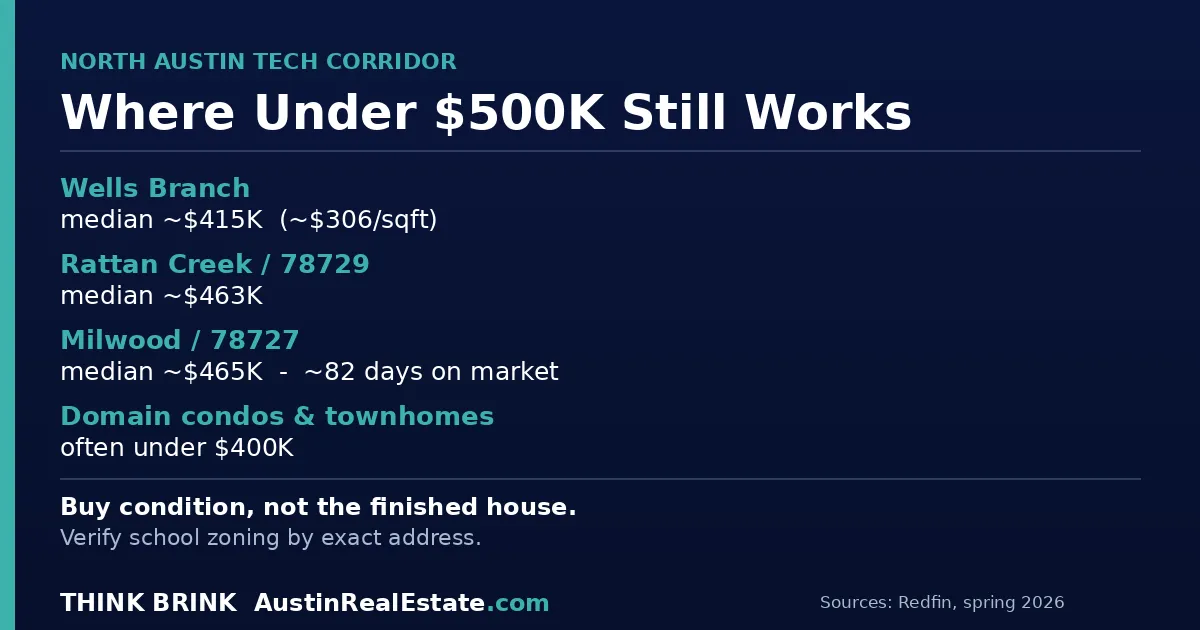
If I had to point a budget-conscious buyer at one established single-family neighborhood in the corridor and say "start here," it would be Wells Branch. Over the three months ending May 2026, Wells Branch homes sold at a median of about $415,000, with a median price per square foot around $306, per Redfin. That median sits comfortably under our number, and it buys you an established, amenity-rich neighborhood rather than a compromise.
Wells Branch has its own MUD-supported amenities, a genuine community feel, mature trees, and a location that puts you within reasonable reach of both the Domain and the Parmer employers. The tradeoffs are honest ones: the housing stock is largely 1980s and 1990s, so you are buying homes that may need updating, and the neighborhood is served by a mix of school districts depending on exact address, so verify zoning carefully. I go deeper on all of that in my Wells Branch buyer guide. But as a place where a real single-family home under $500,000 is not a fantasy, Wells Branch is the corridor's clearest answer.
Rattan Creek and the 78729 pocket: under the number, with noise
The 78729 zip, which includes Rattan Creek, showed a median sale price around $463,500 in March 2026, per Redfin. That is under our threshold, though I will flag that 78729's month-to-month data has been unusually noisy, with different platforms showing meaningfully different figures, so lean on the pattern rather than any single month.
What Rattan Creek and the surrounding 78729 neighborhoods give a budget buyer is Round Rock ISD zoning, established housing, and genuine tech-corridor centrality, since 78729 sits right in the Parmer and 183 employment web. The schools here feed the McNeil High IB pathway, and the value pockets often correspond to the lower-rated middle-school zonings, which is a legitimate way to save money if you understand what those ratings measure. My Rattan Creek buyer guide covers the neighborhood specifics, and my post on the two McNeil-feeder middle schools explains the school-zoning value angle in detail.
Milwood and the 78727 edge: right at the line
Milwood is the neighborhood that sits closest to our ceiling and sometimes just over it, which makes it a useful illustration of how to shop the number. In the most recent month with data, Milwood homes sold at a median around $465,000 with roughly 82 days on market, and the broader 78727 zip showed a median in the high $470,000s in spring 2026, per Redfin. So the median Milwood home is under $500,000, but you are shopping right at the edge, which means condition and updates will push individual homes above or below the line.
The strategic point about Milwood: because it sits right at the threshold, this is a neighborhood where the under-$500K buyer wins by targeting the homes that need cosmetic work. An updated Milwood home may list above $500,000; a dated but sound one in the same section can land well under it. The 82-day-on-market figure tells you the market here is not frantic, which means a patient buyer has room to negotiate. Milwood's draw is location and RRISD zoning that includes some of the stronger corridor feeders; my Milwood buyer guide breaks down the sections and school splits.
Condos and townhomes: the under-$400K path near the Domain
If your priority is being genuinely close to the Domain or North Burnet employers and single-family under $500,000 there is out of reach, the condo and townhome market is the path most budget buyers overlook. Attached product in and around the Domain, Gracywoods, and the North Lamar corridor frequently trades well under the single-family medians above, and it puts you closer to the office than an equivalently priced house farther out would.
The tradeoffs are the usual attached-housing ones: HOA dues that add to your monthly cost, less control over the exterior and the building, and resale that can be more sensitive to the specific complex than to the neighborhood. But for a single buyer or a couple who values a short commute over a yard, a Domain-adjacent condo or townhome is often the most house-for-the-money-near-the-office option in the whole corridor. I cover that market specifically in my guide to Domain-adjacent condos and townhomes.
The neighborhoods where I am telling you qualitatively
Several corridor neighborhoods belong on an under-$500K list but I do not have a clean, current verified median to attach to each this month, so I will describe them by pattern rather than pin a number I cannot stand behind.
Scofield Farms, in the 78727 area, is an established neighborhood with a mix of housing eras that has historically offered corridor access at a relative value, with some inventory under our number depending on size and condition. The established Anderson Mill area, in 78729 and 78750, is another where the older housing stock and the lower-rated middle-school zoning combine to keep prices more accessible than the district and location alone would suggest. North Shoal Creek and the older 78757 pockets closer in toward the Domain also produce under-$500K single-family from time to time, particularly on the homes that have not been renovated. For each of these, the honest guidance is the same: the under-$500K home in these neighborhoods is usually the one that needs work, and your budget stretches furthest if you are willing to take on cosmetic updates rather than pay the premium for a finished house.
How to actually buy under $500K in this corridor
The buyers who succeed under this ceiling share a few habits, and they are worth stating plainly.
Buy condition, not the finished house
The single biggest lever a budget buyer has is condition. In almost every corridor neighborhood, the difference between a renovated home and a dated-but-sound one in the same section is larger than the difference between neighborhoods. If you can live with, or gradually improve, original kitchens and baths, your money goes dramatically further. The renovation premium is where the finished-house buyers are spending, and it is exactly what a patient budget buyer can skip. I lay out how to weigh condition and cost in my post on mid-century versus 1980s and 1990s homes in North Austin.
Use school zoning to your advantage, not against it
Homes zoned to lower-rated schools cost less, and in this corridor many of those lower ratings are demographic artifacts rather than measures of a bad school, with the same high school pathway waiting at the end. A buyer without school-age children, or one who understands what the ratings measure, can use that gap to buy more house or a better location for the money.
Factor the total monthly cost, not just the price
An under-$500K purchase can carry higher-than-expected monthly costs through HOA dues, MUD or PID assessments, and Texas property taxes, which are high relative to other states. A California or Seattle buyer used to a lower tax rate can be surprised by the tax line. Run the full monthly number, including taxes and any district assessments, before you fixate on the sale price, and remember to file your homestead exemption once you own and occupy the home.
Be patient and negotiate
Days-on-market figures in the corridor have lengthened compared to the frenzy of a few years ago, with many neighborhoods seeing homes sit for a couple of months. That is good news for a budget buyer: it means room to negotiate on price, on closing costs, and on repairs. The under-$500K buyer who moves deliberately, gets pre-approved, and is ready to act on the right dated-but-sound home has more leverage now than at almost any point in recent memory.
Frequently asked questions
Can you still buy a single-family home in the North Austin tech corridor under $500,000?
Yes. Wells Branch had a median sale price around $415,000 over the three months ending May 2026, and neighborhoods like Rattan Creek and the broader 78729 area showed medians in the mid-$460,000s in spring 2026, per Redfin. Milwood's median sat around $465,000. So the median home in several corridor neighborhoods is under $500,000, though condition and updates swing individual homes above or below that line, and month-to-month figures move.
Which North Austin neighborhood gives the best value under $500K?
For established single-family, Wells Branch is the clearest answer, with a recent median around $415,000 and real neighborhood amenities. Rattan Creek and the 78729 pocket offer Round Rock ISD zoning under the number. Milwood sits right at the line and rewards buyers targeting homes that need cosmetic work. If you want to be closest to the Domain, condos and townhomes there and near North Lamar frequently trade under $400,000. The best value depends on whether you prioritize a yard, schools, or a short commute.
Why are homes zoned to lower-rated schools cheaper, and is that a mistake to buy?
Homes zoned to lower-rated schools cost less because school ratings are one of the first filters buyers apply. But in this corridor, many lower middle-school ratings reflect a more economically diverse student body rather than worse teaching, and those schools often feed the same strong high schools as the higher-rated ones. For a buyer without school-age children, or one who understands what the ratings measure, buying into a lower-rated zoning can be a smart way to get more home for the money, not a mistake.
Are condos and townhomes near the Domain a good idea for a budget buyer?
For the right buyer, yes. Attached homes near the Domain and North Burnet frequently trade well under single-family prices and put you closer to major employers than a similarly priced house farther out. The tradeoffs are HOA dues that raise your monthly cost, less control over the building and exterior, and resale that can hinge on the specific complex. For a single buyer or couple who values a short commute over a yard, it is often the most house-for-the-money-near-the-office option in the corridor.
What monthly costs do budget buyers in the corridor underestimate?
Texas property taxes, which are high relative to many other states, plus HOA dues and any municipal utility district or public improvement district assessments in newer developments. A buyer relocating from a lower-tax state can be surprised by how much the tax line adds to the monthly payment. Run the full monthly number including taxes and district assessments before you anchor on the sale price, and file your homestead exemption after you buy to reduce the taxable value on your primary residence.
Is now a good time to buy under $500K in North Austin?
The market has cooled from the frenzy of a few years ago, with longer days on market in many corridor neighborhoods, which generally favors a prepared buyer. Longer market times mean more room to negotiate on price, closing costs, and repairs. Whether it is the right time for you depends on your rate, your timeline, and your finances rather than the market alone, but the negotiating leverage for a budget buyer is better now than it was during the peak.
Should I buy a home that needs updating to stay under $500K?
Often, yes, if you can take it on. In most corridor neighborhoods the price gap between a renovated home and a dated-but-sound one in the same section is larger than the gap between neighborhoods, so buying condition rather than a finished house is the single biggest lever a budget buyer has. The key is distinguishing cosmetic updates, which you can do over time, from structural or system problems, which is exactly what a thorough inspection is for.
Which school districts serve the under-$500K corridor neighborhoods?
It varies by exact address. Much of the corridor, including Wells Branch depending on the section, Rattan Creek, Milwood, Scofield Farms, and Anderson Mill, is served by Round Rock ISD, while pockets closer in toward the Domain fall under Austin ISD or Pflugerville ISD. Because district and campus assignment is set by specific address and does not follow neighborhood names cleanly, always verify the exact assignment for a given property before you rely on it.
The honest summary
Under $500,000 in the North Austin tech corridor is not a fantasy, it is a strategy. Wells Branch is the clearest single-family value, with a recent median around $415,000. Rattan Creek and the 78729 pocket put you under the number in Round Rock ISD. Milwood sits right at the line and rewards buyers who target homes needing cosmetic work. And condos and townhomes near the Domain open the door for buyers who want to be closest to the office. Across all of them, the budget buyer wins by buying condition rather than the finished house, using school-zoning gaps intelligently, running the full monthly cost including taxes, and taking advantage of a market that has handed patient buyers real negotiating leverage.
If you are trying to get into the corridor under $500,000 and want a straight answer about which neighborhoods and which specific homes actually clear that bar right now, that is exactly the kind of search I run with North Austin buyers. For the wider view of how these neighborhoods fit together, start with my North Austin neighborhood guide.
