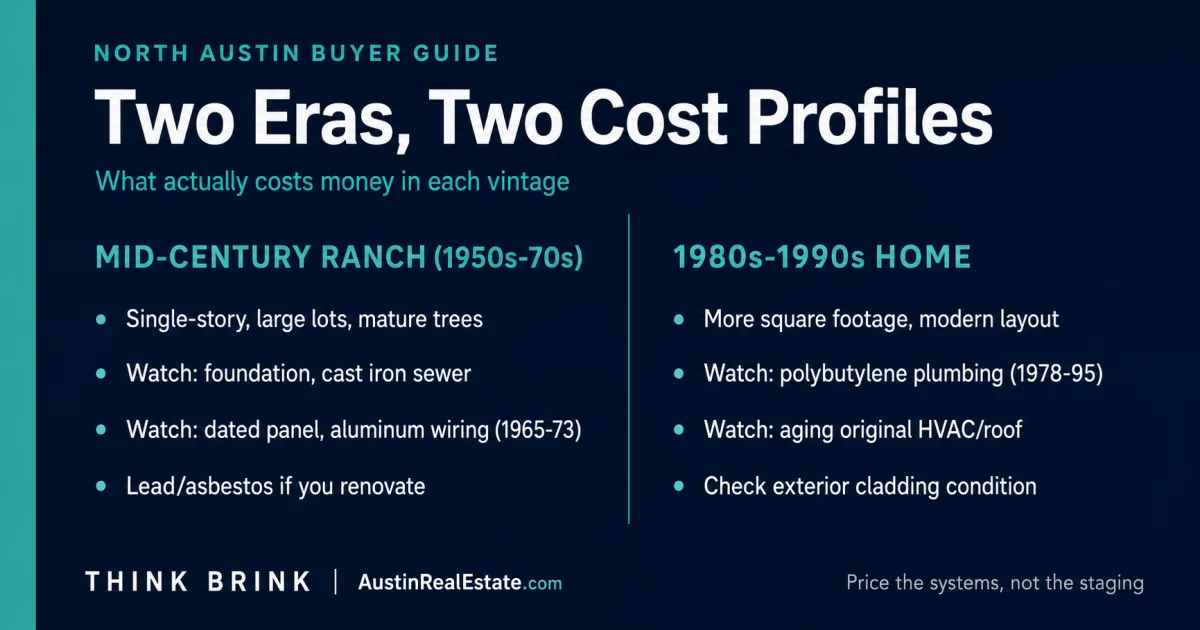
Mid-Century vs 1980s-1990s Homes in North Austin: What Buyers Should Weigh on Condition and Cost
In North Austin you are usually choosing between two very different eras of house, and the era determines how the home will cost you money for as long as you own it
Most of the established housing in North and Northwest Austin falls into two broad vintages. There is the mid-century stock, the ranch homes built roughly from the 1950s through the early 1970s, and there is the later stock, the homes built roughly from the late 1970s through the 1990s as the tech corridor filled in around MoPac, 183, and Parmer. Buyers tend to shop by neighborhood, price, and school feeder, which is exactly right, but they often treat the age of the house as a footnote. It is not a footnote. The decade a home was built determines what is behind the walls, how it will age, which systems are likely to fail first, and how much money you should be setting aside before you even move in.
This guide walks through what each vintage actually gives you, where each one tends to cost money, and how to think about condition and price so that you buy the era that fits your budget and your tolerance for projects. I am going to be specific about the systems, because the systems are where the real money is, and they are almost never the things buyers are looking at during a showing.
Why the build era matters more than buyers expect
When you tour a house, you are looking at finishes: the kitchen, the floors, the paint, the light fixtures. Finishes are the cheapest and easiest things to change, and they are also what sellers spend money on to make a home show well. The expensive parts of a house, the foundation, the framing, the plumbing supply lines, the sewer lines, the electrical system, the roof structure, and the original mechanical systems, are largely determined by when and how the home was built, and they are mostly invisible during a showing.
This is why two homes at the same price in the same neighborhood can be wildly different purchases. A beautifully renovated mid-century ranch with a staged kitchen sitting on top of original cast iron sewer lines and a fifty-year-old electrical panel is a very different financial proposition from a plainer 1990s home with copper plumbing and a panel that meets modern standards. The finishes tell you how the home looks. The build era tells you how it will behave. Buyers who understand this stop overpaying for staging and start pricing the systems, which is the entire point of this guide and a theme I return to often, including in how to sell a partially updated Northwest Austin home, where the same logic runs in reverse for sellers.
The mid-century ranch: 1950s to early 1970s
The mid-century ranch is the backbone of a lot of the most desirable established North Austin neighborhoods. These are typically single-story homes, long and low, on lots that are generous by any modern standard, with mature tree canopy that took half a century to grow. Buyers love them for the lot, the character, the single-level layout, and the location, since these neighborhoods were built close in and the city grew out around them. Neighborhoods like North Shoal Creek are a classic example of this vintage, and I cover one of them in detail in what buyers should know about North Shoal Creek.
What the mid-century ranch gives you
The strengths of this era are real and hard to replicate with new construction. You get a single-story layout, which matters for accessibility and aging in place and is genuinely scarce in newer stock because builders maximize square footage vertically on smaller lots. You get a large lot, often a quarter acre or more, with established trees. You get solid framing, since much of this era was built with old-growth dimensional lumber that is often sturdier than modern framing. And you get a close-in location that newer, farther-out subdivisions cannot match.
Where the mid-century ranch costs money
Here is where you need to be clear-eyed, because a home built fifty to seventy years ago has systems that were installed when the technology and codes were completely different. The big-ticket items to understand in this vintage are as follows.
Foundations come first, because Central Texas clay soil expands and contracts with moisture, and a home that has sat through fifty years of that movement has a longer history of stress than a newer one. Some mid-century homes are slab-on-grade and some are pier-and-beam, and each has its own failure and repair profile. Any sign of movement, sticking doors, cracks that run at angles from door and window corners, sloping floors, warrants a professional structural opinion before you offer, because foundation repair is the single most expensive surprise a buyer of an older home can hit.
Plumbing is next. Homes of this era were often built with cast iron sewer lines and galvanized steel supply lines. Cast iron sewer pipe has a real service life, and after five to seven decades it can crack, corrode, or collapse, which is an expensive and disruptive repair because the lines run under the slab or the house. Galvanized supply lines corrode from the inside and restrict water flow over time. Many of these homes have had some or all of this replaced. Many have not. A sewer scope, which is a camera run through the line, is one of the highest-value inspections you can buy on a home of this age, and I recommend it on essentially every mid-century purchase.
Electrical systems in this vintage deserve careful attention. A home built in the 1950s or 1960s may still have an undersized original panel, out-of-date wiring methods, and too few circuits for the way we use electricity today. Homes built in the roughly 1965 to 1973 window can contain aluminum branch wiring, which is a known fire-safety concern that insurers scrutinize and that requires specific remediation. An electrical inspection should confirm the panel, the wiring type, and the grounding, because these are safety issues, not just convenience ones.
Then there are the age-related materials. Homes built before 1978 can contain lead-based paint, and homes built before roughly 1980 can contain asbestos in flooring, popcorn ceilings, insulation, and other materials. Neither is necessarily a crisis if the material is intact and undisturbed, but both matter enormously if you plan to renovate, because disturbing them triggers real handling and abatement requirements and cost. If your plan for a mid-century ranch involves opening up walls, factor this in.
Finally, roofs, HVAC, and windows. A mid-century home has likely had its roof and HVAC replaced at least once, but you need to confirm the age and condition rather than assume. Original single-pane windows are common and are a comfort and energy issue rather than a safety one, but replacing them across a whole house is a meaningful cost.
The 1980s and 1990s home: the tech-corridor build-out
The later stock is what filled in much of the North Austin tech corridor as employers moved in along MoPac, 183, and Parmer. These homes are typically larger than the mid-century ranches, frequently two-story, with floor plans that start to resemble what buyers expect today: primary suites, more bathrooms, attached two-car garages, and open-ish living areas. They sit on smaller lots than the mid-century stock, with younger trees, in subdivisions that were master-planned rather than built out lot by lot.
What the 1980s-1990s home gives you
The appeal of this era is that you get more house and a more modern layout for the money, with systems that are one or two generations newer than the mid-century stock. Copper supply plumbing became standard, modern electrical panels and copper branch wiring are typical, and the floor plans need less structural reworking to feel current. For a buyer who wants more square footage and a layout closer to move-in expectations without paying new-construction prices, this vintage is often the sweet spot. It is a big part of why the tech corridor neighborhoods hold the appeal they do, which I lay out in the North Austin neighborhood guide.
Where the 1980s-1990s home costs money
This vintage has its own specific set of concerns, and they are different from the mid-century list, which is exactly why the era matters.
Polybutylene plumbing is the one to know cold. Polybutylene supply piping was widely installed from roughly 1978 into the mid 1990s, and it has a well-documented history of failing at the fittings and rupturing, to the point that it was the subject of major class-action litigation and is difficult or expensive to insure in some cases. If a home from this window still has polybutylene supply lines, that is a real and significant issue that you want identified before you offer and priced into your decision. A qualified inspector can identify it, and a re-pipe is a substantial cost.
Foundations still matter, because the same Central Texas clay is under these homes too. They have had fewer decades to move than the mid-century stock, but slab foundations from this era can and do develop issues, and the inspection discipline is the same: look for the telltale signs and get a structural opinion if anything shows.
Exterior cladding is worth checking on this vintage. Some homes from this era used hardboard or composite wood siding products that can deteriorate with moisture exposure if not maintained, and repairs or replacement can be significant. Confirm what the exterior is made of and what condition it is in.
Then there is the simple math of aging systems. A home built in 1990 is now more than three decades old. The original HVAC, water heater, roof, and windows may be original or near it, which means they are at or past the end of their service lives even though the house does not feel old. Buyers sometimes relax on a 1990s home because it looks modern, then get surprised by a cluster of end-of-life mechanical replacements in the first few years. Confirm the age of every major system and budget for the ones running on borrowed time.
How to think about condition and price across both eras
The single most useful mental model for buying either vintage is to separate the home into three tiers: updated, partially updated, and dated. An updated home has had its expensive systems and its finishes brought current. A dated home has neither. A partially updated home, which is the most common and the most dangerous to price, has new finishes over old systems, or new systems behind old finishes, and the two situations are worth very different amounts.
The most frequent mistake I see, in both eras, is a buyer paying an updated price for a partially updated home because the finishes are new and the staging is good. A gleaming kitchen tells you nothing about the sewer line, the panel, or the polybutylene. The price you pay should track to where the home genuinely sits across all of its systems, not to how it photographs. This is the buyer-side version of the pricing discipline I describe for sellers in how to sell a partially updated Northwest Austin home, and it is the same skill viewed from the other side of the table.
Which era is the better buy?
There is no universal answer, and anyone who gives you one is selling something. The mid-century ranch is the better buy if you want a single-story home on a large lot in a close-in established neighborhood with mature trees, and you are either willing to renovate or willing to pay appropriately for a home already done well. It rewards buyers who can see past dated finishes and price the systems honestly. The 1980s-1990s home is the better buy if you want more square footage and a more modern layout with newer-generation systems for the money, and you are disciplined about checking for polybutylene, confirming the age of the mechanicals, and inspecting the cladding. Each era can be a great value or an expensive mistake, and the difference is entirely in how carefully you price the systems.
If you are also weighing either of these established vintages against buying new, that is a genuinely different calculation involving warranties, systems, lot size, and location, and I break it down specifically for one part of the market in new construction vs established homes in the Apple corridor.
What to check before you offer, by era
Here is the pre-offer checklist, split by vintage, ordered roughly by how expensive each item is to get wrong.
For a mid-century ranch, confirm the following before you offer:
Foundation condition. Get a structural opinion on any sign of movement. This is the most expensive thing to be wrong about in a home of this age.
Sewer line condition. Buy the sewer scope. Cast iron and galvanized lines of this age are a common and costly failure point, and the camera pays for itself.
Electrical panel and wiring type. Confirm the panel capacity and whether aluminum branch wiring is present, which is a safety and insurance issue requiring remediation.
Lead and asbestos exposure if you plan to renovate. Homes before 1978 and 1980 respectively can contain these, which changes the cost and process of any remodel.
Roof, HVAC, and window age. Confirm rather than assume, and price any updates into your offer.
For a 1980s-1990s home, confirm the following before you offer:
Polybutylene plumbing. Identify whether it is present. If it is, treat a re-pipe as a real cost and an insurance consideration, not a maybe.
Foundation condition. Fewer decades of movement, but the same clay soil applies, so inspect with the same discipline.
Exterior cladding. Confirm the siding material and its condition, since some products from this era deteriorate with moisture.
Age of all major mechanicals. HVAC, water heater, roof, and windows may be original and at end of life even on a home that looks modern.
The true condition tier. Decide whether you are buying updated, partially updated, or dated, and make sure the price matches the systems and not the staging.
Handle the list that matches your era and the house will not surprise you after closing.
Frequently asked questions about mid-century vs 1980s-1990s homes in North Austin
Are older mid-century homes in Austin a bad idea to buy?
No. Mid-century ranch homes offer single-story layouts, large lots, mature trees, and close-in locations that are hard to find in newer stock, and their old-growth framing is often sturdier than modern lumber. The key is that their systems, including foundation, sewer lines, and electrical, are decades old, so you either renovate them or pay appropriately for a home already updated. A well-inspected mid-century home priced honestly can be one of the better values in North Austin.
What is polybutylene plumbing and why does it matter in 1980s and 1990s homes?
Polybutylene is a gray plastic supply piping widely installed from about 1978 into the mid 1990s. It has a documented history of failing at the fittings and rupturing, was the subject of major class-action litigation, and can be difficult or costly to insure. If a home from that era still has it, budget for a full re-pipe and treat it as a significant issue to identify before you offer. A qualified inspector can confirm whether it is present.
Which is more expensive to maintain, a mid-century home or a 1990s home?
It depends entirely on what has already been updated, but the failure profiles differ. Mid-century homes concentrate risk in foundations, cast iron and galvanized plumbing, and dated electrical. Later homes concentrate risk in polybutylene plumbing, aging original mechanicals, and certain exterior cladding products. A mid-century home that has had its systems modernized can be cheaper to own than a 1990s home running entirely on original systems, so the vintage alone does not decide it. Condition does.
Should I get a sewer scope on an older Austin home?
Yes, especially on mid-century homes with cast iron or galvanized lines. A sewer scope runs a camera through the line to reveal cracks, corrosion, root intrusion, or collapse before you buy. Because sewer lines run under the slab or the house, a failure is expensive and disruptive to repair, which makes the relatively small cost of the scope one of the highest-value inspections you can buy on an older home.
Do 1980s and 1990s homes have aluminum wiring problems?
Generally no. Aluminum branch wiring was primarily a concern in homes built in the roughly 1965 to 1973 window. By the 1980s and 1990s, copper branch wiring and modern panels were standard, so this is more a mid-century concern than a later-vintage one. That said, always have the electrical system inspected regardless of era, since panels and prior modifications vary home to home.
Is it worth paying more for a renovated older home versus doing the work myself?
That depends on your budget, your timeline, and your tolerance for projects. A renovated older home costs more up front but spares you the money, time, and disruption of doing the work, and a genuinely complete renovation that includes the systems, not just the finishes, can be worth the premium. The trap is paying a renovated price for a home where only the finishes were done. Confirm that the expensive systems were actually addressed before you pay for a renovation you might only be getting cosmetically.
Why do lot sizes differ so much between the two eras in North Austin?
The mid-century neighborhoods were platted when land was less expensive and lots were laid out generously, often a quarter acre or more, with room between houses and space for the large trees you now see. As land values rose through the 1980s and 1990s and subdivisions were master-planned for density, lots shrank and homes grew taller to fit more square footage on less ground. That is why a mid-century ranch typically sits on a bigger lot than a larger 1990s two-story nearby.
How do I know which era fits my situation?
Start with your priorities. If a single-story layout, a large lot, mature trees, and a close-in location matter most, and you can either renovate or pay for one already done, the mid-century ranch fits. If more square footage, a modern layout, and newer-generation systems for the money matter most, and you will be disciplined about polybutylene and mechanical age, the 1980s-1990s home fits. Both can be excellent buys when the price reflects the systems, so the right era is the one whose tradeoffs match how you actually live and what you can budget for.
The honest summary
In North Austin you are usually choosing between two eras of house, and the era decides how the home will cost you money for as long as you own it. The mid-century ranch gives you a single-story layout, a big lot, mature trees, and a close-in location, in exchange for foundations, sewer lines, and electrical systems that are decades old and often need attention. The 1980s-1990s home gives you more square footage and a more modern layout with newer-generation systems, in exchange for era-specific risks like polybutylene plumbing, aging original mechanicals, and certain cladding products. Neither era is better in the abstract. The better buy is the one whose tradeoffs fit your budget and your appetite for projects, bought at a price that reflects the systems rather than the staging.
The buyers who do well with either vintage are the ones who stop shopping finishes and start pricing systems, who buy the right inspections, and who treat the build era as a central fact about the purchase rather than a line on the listing. If you want help reading a specific home's real condition, deciding which era fits your situation, and figuring out what a house is actually worth once you account for what is behind the walls, that is exactly the conversation I am here to have.
