What Buyers Should Know About North Shoal Creek Before Making an Offer (78757)
North Shoal Creek is one of the few places in central North Austin where you can still buy a single-story ranch home inside the Anderson High feeder, and that combination is the whole story
North Shoal Creek does not get the search volume of Great Hills or the name recognition of Canyon Creek, and buyers moving into Austin from out of state often have never heard of it. What it has is a genuinely rare combination for this part of the city: established 1960s and 1970s ranch homes on real lots, sitting inside the Austin ISD Anderson High School feeder, wrapped by four major roads that put nearly everything in North Austin within a fifteen to twenty minute drive. If you have been trying to find a single-family home in central North Austin that is close to the Burnet Road corridor, feeds a well-regarded high school, and does not require a hillside budget, North Shoal Creek is very likely on your short list whether you know its name or not.
This guide covers what the neighborhood actually is, where the boundaries fall, what the schools mean for your money, what the housing stock will and will not give you, and what to check before you make an offer. As with everything I write, I am going to be honest about the tradeoffs, because the tradeoffs are exactly what separate the buyers who are happy here from the ones who should have looked somewhere else.
Where North Shoal Creek is, and why its four borders define the neighborhood
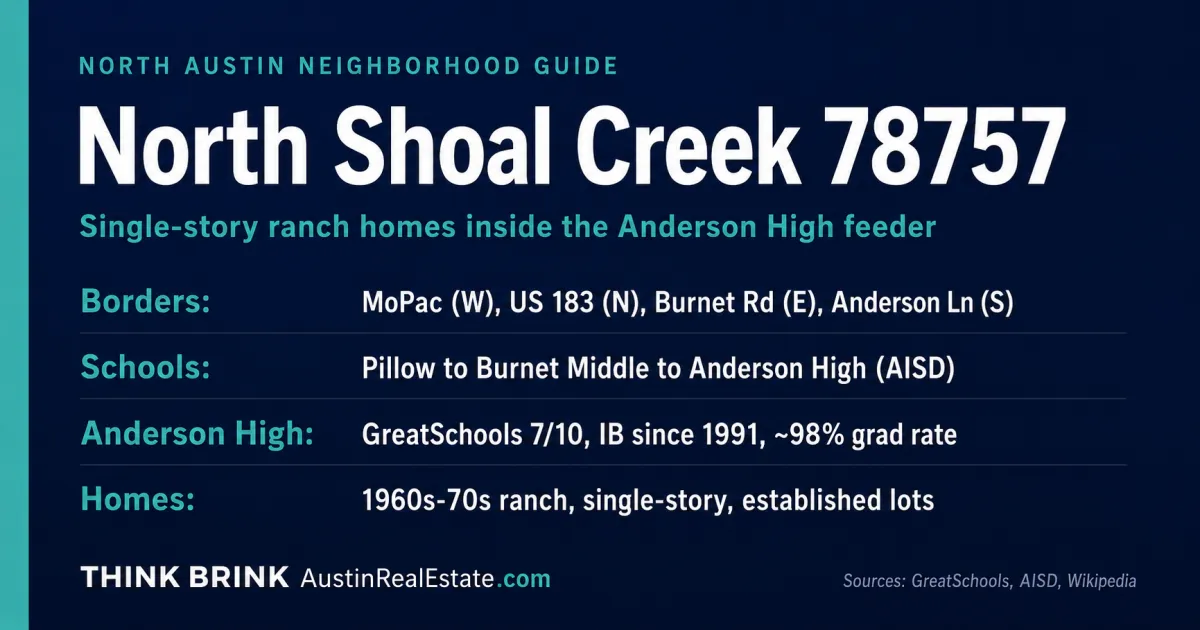
North Shoal Creek sits in the 78757 zip code in north-central Austin, and it is defined almost entirely by the four roads that box it in. MoPac forms the western edge, Research Boulevard, which is US 183, runs along the north, Burnet Road is the eastern border, and Anderson Lane closes it off on the south. That rectangle is the neighborhood.
Those four borders are the reason the neighborhood works the way it does. MoPac and 183 are two of the most important arterials in the entire city, and having direct access to both from the edge of your neighborhood is a real commuting advantage. Burnet Road on the east is one of Austin's best food, retail, and entertainment corridors. Anderson Lane on the south connects you across to the MoPac and Alpha corridors and toward central Austin. From nearly anywhere in North Shoal Creek, most major North Austin destinations are a fifteen to twenty minute drive.
The flip side of being boxed by four major roads is exactly what you would expect: the perimeter carries traffic and noise, and homes right on MoPac, 183, Burnet, or Anderson live very differently from homes on the quiet interior streets. This is one of the most important things to understand about buying here, and I will come back to it, because the gap between a perimeter home and an interior home is one of the biggest value questions in the neighborhood.
The location is the reason to buy, but confirm which part of the location you are buying
The pitch for North Shoal Creek is central access without a central-Austin price, and that pitch is accurate. But central access cuts both ways inside a neighborhood ringed by highways and major roads. A home three streets into the interior gets the access benefit with the noise buffered by other houses. A home backing to MoPac or fronting Burnet gets the access and the traffic. When you evaluate a specific listing here, the first question is not the kitchen, it is where in the rectangle the house actually sits.
The Anderson High feeder is the reason this neighborhood holds its value
This is the part that matters most for a lot of buyers, and it is the reason North Shoal Creek belongs in a different conversation than the more affordable pockets further out.
North Shoal Creek is served by Austin Independent School District. The typical feeder pattern runs Pillow Elementary to Burnet Middle School to Anderson High School. Anderson is the anchor, and it is a genuine draw. Anderson High School carries a GreatSchools rating around 7 out of 10 on current data, has held an International Baccalaureate program since 1991, and is recognized as the oldest IB program in central Texas and the only IB high school in Austin ISD. Its graduation rate runs around 98 percent, well above the state average. For an Austin ISD high school, that is a strong, well-established profile, and it is the single biggest reason homes in this neighborhood hold their value the way they do.
I want to be balanced about the earlier grades, because it matters. Pillow Elementary carries a lower GreatSchools rating, in the low single digits on current data, than Anderson does. GreatSchools ratings lean heavily on standardized test scores and do not capture everything about a school, but I am not going to pretend the elementary rating is something it is not. Families who prioritize the elementary years sometimes weigh that carefully, and some choose private or magnet options for the early grades while valuing the Anderson pathway for high school. That is a legitimate way to think about it, and it is worth being honest that the feeder is stronger at the top than at the bottom.
If you are trying to understand how much of your purchase price in North Austin is really being driven by school assignment, and how the Austin ISD pathways compare to the Round Rock ISD ones a little further west, I break that down in Round Rock ISD vs Austin ISD in Northwest Austin. The short version is that the Anderson feeder is a real premium driver, and North Shoal Creek is one of the more attainable ways into it.
Confirm the school assignment at the address, every time
As with any neighborhood, school attendance is assigned by address, not by neighborhood name, and boundaries can shift. Before you make an offer, confirm the specific elementary, middle, and high school assignment for the exact address directly with Austin ISD. This is especially worth doing near the edges of the neighborhood, where the boundary may not follow the road you assume it does. It takes thirty minutes and it protects the single biggest reason most people buy here.
What the housing stock is actually like
North Shoal Creek is an established neighborhood, and the homes tell you exactly when it was built. The core of the neighborhood is ranch-style homes from the early 1960s through the mid 1970s, largely single-story, on lots that are generous by anything built in the last twenty years. You will see the classic North Austin mix of ranch homes with natural stone facades, some with the pastel character of the era, and a scattering of taller, updated, or rebuilt homes especially toward the Pillow Elementary side.
What this means for a buyer is that condition, not floor plan, is the main thing you are shopping for. These are homes that are fifty to sixty years old. Some have been beautifully renovated with updated kitchens, opened-up living areas, and modern systems. Many are somewhere in between. And some are close to original. The price you pay should track directly to where a specific home sits on that spectrum, and the most common mistake I see is a buyer paying an updated price for a home that has updated finishes sitting on top of original systems.
Single-story ranch homes are a scarcer product than buyers realize
Here is something worth understanding about why North Shoal Creek stays in demand. The single-story ranch home on a real lot, close to central Austin, in a good high school feeder, is a genuinely limited product type. New construction almost never delivers it, because builders maximize square footage vertically on smaller lots. Buyers who specifically want a one-level home, whether for aging in place, for accessibility, or simply for preference, find that established neighborhoods like North Shoal Creek are one of the few places to get it in this location. That scarcity supports values and it is part of why the neighborhood does not sit on the market the way you might expect for its age.
The renovation question, and the systems that actually cost money
Because so much of the value equation here is condition, it is worth being specific about what to watch. In homes of this age, the expensive problems are almost never the ones in the listing photos.
Foundations are the first thing. Central Texas soil moves, and homes from this era have had decades of that movement. Any sign of foundation issues warrants a professional opinion before you offer, because foundation work is the single most expensive surprise a buyer of an older home can hit. Next is the roof, the HVAC, and the plumbing. A home built in the 1960s may have had its systems updated once or twice, or it may be running on something much older than it looks. Cast iron sewer lines, aging electrical panels, and original HVAC are all real considerations in this vintage of home. None of these are reasons not to buy. They are reasons to inspect thoroughly and price the work honestly.
The buyers who do best in North Shoal Creek are the ones who treat a dated home as an opportunity priced correctly, not as a finished home at a discount. A dated ranch on a good interior street, bought at a price that accounts for the renovation, can be one of the better values in central North Austin. The same home bought at a near-updated price because the seller staged it well is how people end up over budget. If you want the deeper version of how to evaluate a home that is only partway updated, I wrote about that decision specifically in how to sell a partially updated Northwest Austin home, and the same logic works in reverse when you are the buyer.
Commutes and daily life from North Shoal Creek
The commute story here is genuinely strong, and it is the practical payoff of those four bordering roads.
With MoPac on the west edge and 183 on the north, you have direct access to two of the highest-capacity corridors in the city. To The Domain and the North Burnet job core, you are a short drive north and east, generally well under fifteen minutes. To the Apple campus on Parmer near MoPac, you take MoPac north, a manageable drive that beats what most central and south Austin commuters deal with. To downtown, MoPac or Burnet Road south gets you there typically in the twenty to twenty-five minute range depending on the hour. To the 183 tech corridor and the neighborhoods to the northwest, you are right on the on-ramp.
The honest caveat, again, is peak-hour traffic on the very roads that make the location good. MoPac and 183 both back up at rush hour, and Burnet and Anderson carry heavy local volume. The access is real, but it is access to busy roads, and the difference between a 7 a.m. drive and an 8:30 a.m. drive can be significant. If your commute matters, drive it at your real commute time before you commit. For a broader look at how North Austin commutes actually behave once you are living them, the guide for Domain and North Burnet workers on living close to the office is a useful companion to this one.
On daily life, the Burnet Road and Anderson Lane corridors are one of North Shoal Creek's underrated assets. Burnet Road in particular is one of the better eating and drinking streets in Austin, with a deep mix of restaurants, bars, and long-running local spots, and the Anderson Lane retail includes an Alamo Drafthouse and a range of shops and eateries. You get genuine walkable-adjacent amenity density on the neighborhood's edges without living in a high-rise. Grocery, services, and big-box retail are all minutes away. This is a neighborhood where you are close to a lot without being on top of it.
How to think about price and value
I am going to keep the pricing qualitative here rather than quote a single median, because listing data for this neighborhood blends single-family homes with condos and smaller units, and the blended figure can badly mislead you about what an actual house costs. What holds true across the cycle is more useful than a number that may be stale by the time you read this.
North Shoal Creek generally prices below the hillside and top-feeder neighborhoods to the west, the Great Hills and Spicewood Estates tier, while sitting above the more distant and lower-rated-feeder pockets further out. You are paying for the Anderson feeder and the central location, and you are saving relative to the western neighborhoods because the homes are older ranch stock rather than larger or newer product. Within the neighborhood itself, the two biggest swing factors on price are condition and position in the rectangle. An updated home on a quiet interior street commands a real premium over a dated home backing to MoPac, and rightly so.
The value play in North Shoal Creek is the interior-street dated or partially updated ranch, bought at a price that reflects the work it needs, in a location and feeder that do not go on sale. If you can see past dated finishes and price the renovation honestly, that is where the neighborhood rewards you. If you need turnkey, you will pay up for it here just like anywhere, and you should make sure the systems under the finishes justify the price. For a wider frame on how the whole central North Austin corridor is priced and where the value pockets sit, the North Austin neighborhood guide puts North Shoal Creek in context with its neighbors.
Who North Shoal Creek is right for, and who it is not
North Shoal Creek is a strong fit if you want a single-family home, especially a single-story ranch, in a central North Austin location with direct MoPac and 183 access. It is a strong fit if the Anderson High feeder matters to you and you want an attainable way into it. It is a strong fit if you value being close to the Burnet Road corridor and the North Austin job base. And it is a strong fit if you are comfortable buying an older home and either renovating it or paying appropriately for one already updated.
North Shoal Creek is the wrong fit if you want new construction with a warranty and modern systems out of the box, because the neighborhood is almost entirely older homes. It is the wrong fit if the elementary rating is a dealbreaker and you are not open to the private or magnet options that some families use for the early grades. It is the wrong fit if you need a large two-story home with a big modern floor plan, since the ranch stock here runs smaller and lower. And it is the wrong fit if you cannot tolerate any arterial noise and every home you are shown happens to sit on the perimeter, in which case you simply need to be shown interior streets instead.
If you are weighing North Shoal Creek against the other 78757 pockets nearby, including the Burnet and North Lamar area to the south and east, the Wooten and Burnet/North Lamar pocket guide covers the neighboring options in the same part of the city.
What to check before you make an offer on a North Shoal Creek home
If North Shoal Creek is your neighborhood, here is the pre-offer checklist, ordered roughly by how much it costs to get wrong.
The exact school assignment for the specific address. Confirm Pillow, Burnet, and Anderson, or whatever the current assignment is, directly with Austin ISD for that address, especially near the neighborhood edges.
Foundation and structural condition. Get a professional opinion on any sign of movement. This is the most expensive thing to be wrong about in a home of this age.
Roof, HVAC, plumbing, and electrical age. In 1960s and 1970s homes, verify the systems, including sewer lines and the electrical panel, and price any updates into your offer.
Where the home sits in the rectangle. An interior street versus a home on MoPac, 183, Burnet, or Anderson is a major difference in daily livability and resale. Understand the tradeoff you are buying.
The true condition tier. Decide whether you are buying updated, partially updated, or dated, and make sure the price matches the tier rather than the staging.
Your commute at your real commute time. Drive MoPac, 183, or Burnet at the hour you would actually be driving them.
Handle those six and the neighborhood will not surprise you after closing.
Frequently asked questions about buying in North Shoal Creek
What high school does North Shoal Creek feed into?
North Shoal Creek is in Austin ISD, and the typical feeder pattern runs Pillow Elementary to Burnet Middle School to Anderson High School. Anderson is the neighborhood's anchor school, with a GreatSchools rating around 7 out of 10, a long-running International Baccalaureate program, and a graduation rate near 98 percent. Always confirm the assignment for a specific address with Austin ISD before buying.
Is North Shoal Creek in Austin ISD?
Yes. North Shoal Creek is served by Austin Independent School District, unlike some nearby North Austin neighborhoods that fall into Round Rock ISD or Pflugerville ISD. The Austin ISD Anderson High feeder is one of the main reasons buyers target this neighborhood.
What kind of homes are in North Shoal Creek?
North Shoal Creek is an established neighborhood built mostly from the early 1960s through the mid 1970s, dominated by single-story ranch-style homes on generous lots, many with natural stone facades. Condition varies widely from fully renovated to near-original, and that condition spread is the biggest driver of price differences within the neighborhood.
Where exactly is North Shoal Creek in Austin?
North Shoal Creek sits in the 78757 zip code in north-central Austin, bordered by MoPac on the west, Research Boulevard, which is US 183, on the north, Burnet Road on the east, and Anderson Lane on the south. Those four major roads give the neighborhood strong access to the rest of North Austin.
Why would I buy an older home in North Shoal Creek instead of new construction?
Buyers choose North Shoal Creek for the combination of a central location, direct MoPac and 183 access, the Anderson High feeder, and single-story ranch homes on real lots, none of which new construction in this part of Austin typically offers. The tradeoff is that the homes are older and often need updating, so you are trading modern systems for location, lot, and school assignment.
Is North Shoal Creek a good place to live if I work at The Domain or Apple?
For Domain and North Burnet workers, North Shoal Creek offers a short drive north and east, generally under fifteen minutes. For Apple's Parmer campus, MoPac north from the neighborhood is a manageable commute that beats what most central and south Austin residents deal with. Drive your specific route at your real commute time before buying, since MoPac and 183 both back up at peak hours.
How noisy is North Shoal Creek given the highways around it?
The neighborhood is bordered by MoPac, 183, Burnet Road, and Anderson Lane, so homes on the perimeter experience noticeably more traffic and noise than homes on the quiet interior streets. This is one of the most important things to evaluate on a specific listing, because an interior-street home and a perimeter home offer very different daily experiences even at similar prices.
Is North Shoal Creek cheaper than Great Hills or Spicewood Estates?
Generally yes. North Shoal Creek typically prices below the hillside and top-feeder neighborhoods to the west because its homes are older, mostly single-story ranch stock rather than larger or newer product. You are paying for central location and the Anderson feeder while saving relative to those western neighborhoods, which is exactly what makes it attractive to value-focused buyers.
The honest summary
North Shoal Creek is a location-and-schools neighborhood built on an older, single-story housing stock, and that is precisely why it holds its value. You are buying central North Austin access, direct MoPac and 183 connectivity, proximity to the Burnet Road corridor, and a spot in the Anderson High feeder, in a house on a real lot rather than a condo or a new-build tower. In exchange, you accept homes that are fifty to sixty years old and often need work, an elementary rating that is weaker than the high school, and the reality that the same roads that make the location great also carry traffic on the perimeter.
For a buyer who wants a single-story home in a strong feeder near the center of North Austin, and who can price renovation honestly and choose an interior street wisely, North Shoal Creek is one of the better values in this part of the city. For a buyer who needs turnkey new construction or a top-rated elementary above all else, it is the wrong neighborhood, and knowing that now is worth a lot. If you want help sorting the interior streets from the perimeter, reading a home's real condition, and figuring out what a specific North Shoal Creek house is worth at today's numbers, that is the conversation I am here to have.
