What Buyers Should Know About Wooten and the Burnet/North Lamar Pocket Before Making an Offer
Most of the buyers I talk to about Wooten did not start their search here. They started further out - in the Round Rock ISD neighborhoods off Spicewood Springs, or in the newer master-planned sections up near Parmer - and then the math caught up with them. They wanted to be closer to central Austin, closer to the Domain, and on a lot they could actually afford, and Wooten kept showing up as the answer. It is one of the few pockets left in this part of town where a single-family home on a real lot, inside the urban core, still trades below what the far northwest asks for something comparable.
That is the short version of why Wooten is worth understanding. The longer version, which is what actually matters when you are about to write an offer, is that Wooten is a genuinely different product than the neighborhoods I usually write about in 78750 and 78759. The homes are older. The school assignment is Austin ISD, not Round Rock ISD. And the condition range from house to house is enormous. Buyers who understand those three things before they start looking do fine here. Buyers who assume Wooten works like the far northwest tend to get surprised. This guide is meant to close that gap.
Where Wooten Actually Is
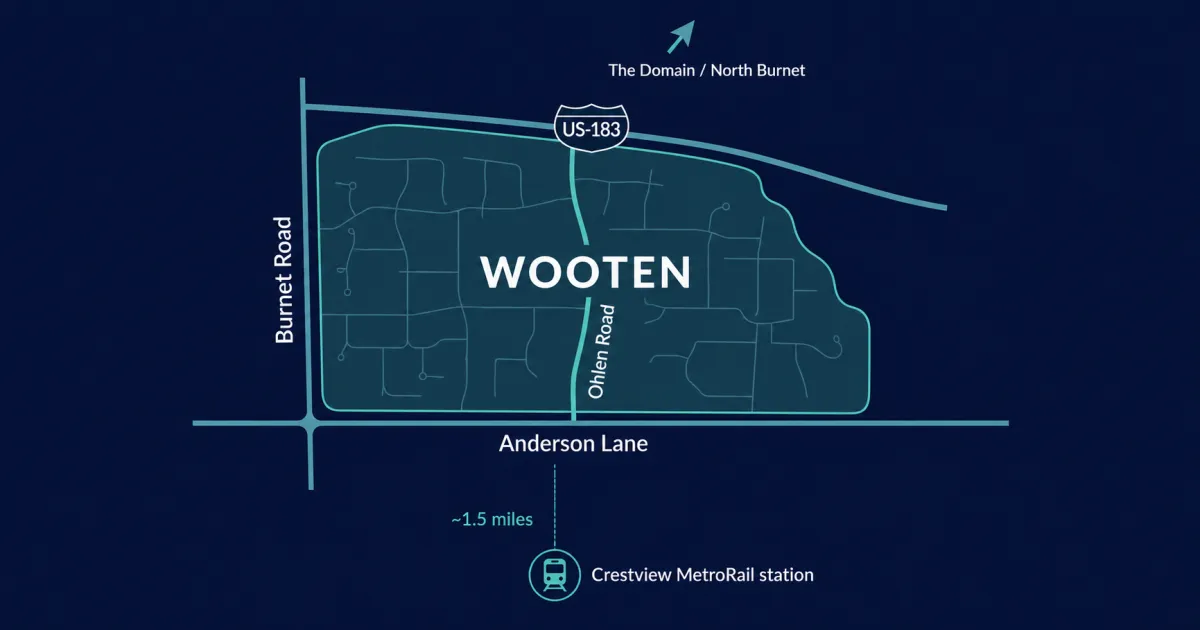
Wooten sits in north central Austin, roughly seven miles north of downtown and about six miles north of the University of Texas. The neighborhood is bounded by Burnet Road on the west, Anderson Lane on the south, and Research Boulevard - US-183 - on the north, and it is bisected by Ohlen Road running through the middle. Its zip code is 78757, which it shares with several of the neighborhoods people know better by name: Crestview to the south, Allandale to the southwest, and North Shoal Creek to the west.
That location is the entire case for Wooten. You are inside Loop 1 territory, close to Burnet Road's restaurant and retail spine, a short drive from the Domain and the North Burnet tech district, and a straight shot down MoPac or Lamar into central Austin. The Crestview MetroRail station sits about a mile and a half south of the neighborhood, which puts the Red Line - and a rail commute toward downtown or up toward Lakeline - within reach without a car for part of the trip. Very little of Northwest Austin can say that. The tradeoff for that centrality is that Wooten is a built-out, mature neighborhood surrounded by commercial corridors, not a quiet cul-de-sac enclave. You are trading seclusion for access, and that is the right trade for some buyers and the wrong one for others.
The character of the housing stock
Wooten was developed primarily between the 1940s and the late 1960s, and the housing stock reflects that. The core of the neighborhood is classic mid-century single-family homes - ranch-style layouts, lower rooflines, original hardwoods under a lot of the carpet, smaller footprints than what got built in the 1980s and 1990s further north. Mixed in are low-rise apartment buildings and some duplex and townhome product, a legacy of how north central Austin developed. The neighborhood population runs a little over 6,000.
What this means for a buyer is that the phrase "a house in Wooten" covers a very wide range. You will see original 1958 homes that have never been meaningfully updated, sitting next door to studs-out renovations and the occasional tear-down-and-rebuild. That range is the single most important thing to internalize before you start touring, because it drives everything about how you evaluate a specific property and what you should be willing to pay for it.
The Condition Question Is the Whole Ballgame Here
In a newer neighborhood, two homes on the same street are usually within a decade of each other in age and built to similar standards, so condition differences are mostly cosmetic. In Wooten, condition is structural. A mid-century home that has been lovingly maintained and thoughtfully updated is a genuinely great house. A mid-century home that has been deferred for thirty years is a project, and the gap between those two - in foundation, plumbing, electrical, roof, and HVAC - can be six figures of work.
So the first thing I tell buyers looking in Wooten is to price the house you are looking at, not the neighborhood. Here is the checklist that matters most in homes of this vintage:
- Foundation. Central Texas clay soil moves, and homes from the 1950s and 1960s have had decades of it. Look for the telltale signs - sticking doors, cracks stair-stepping through brick, sloping floors you can feel - and budget for a structural engineer's report, not just the general inspection, on anything that raises a flag.
- Plumbing. Cast iron and galvanized supply lines were standard in this era and they do not last forever. A sewer scope is cheap relative to what a full repipe or a collapsed cast-iron lateral costs, and it is one of the best few hundred dollars a Wooten buyer can spend.
- Electrical. Original panels, aluminum wiring runs, and two-prong outlets are common in un-updated homes here. None of it is a dealbreaker, but all of it is a line item, and some of it affects your insurance.
- The envelope. Roof age, single-pane windows, and the state of the HVAC and ductwork determine both your comfort and your summer electric bill in a way that matters more in an older home than a newer one.
None of this is meant to scare anyone off. Mid-century homes in Wooten are, on the whole, well-built - they were framed when lumber was cheap and dense, and a lot of them have great bones. The point is that in this neighborhood, the inspection is not a formality you do after you fall in love. It is the core of your decision, and the difference between a smart Wooten purchase and a painful one usually comes down to how honestly a buyer priced the condition before they offered.
Schools: This Is an Austin ISD Neighborhood
This is the point where Wooten diverges most sharply from the neighborhoods I usually cover in 78750 and 78759, and it is the thing out-of-area buyers most often get wrong. Wooten is zoned to Austin ISD, not Round Rock ISD. The feeder pattern runs Wooten Elementary to Burnet Middle School to Juan Navarro Early College High School.
Wooten Elementary sits right in the heart of the neighborhood on Wooten Drive, next to Wooten Neighborhood Park, and it is a genuine anchor for the community. Burnet Middle is the AISD middle school for the pocket. Navarro - the early college high school - offers something distinctive that is worth understanding: through its early college model, students can earn college credit and, in some pathways, an associate degree alongside their diploma. That is a real, concrete benefit for the right family, and it is not something the marquee northwest high schools offer.
I am going to be straight about the tradeoff, because that honesty is the whole reason my content exists. On the standardized-rating scales that relocating buyers lean on - the GreatSchools numbers, the state accountability letter grades - the AISD feeder here does not carry the same reputation as the Round Rock ISD Westwood pathway that anchors Spicewood Estates and the RRISD side of Great Hills. If your home search is being driven primarily by chasing the highest-rated high school feeder in the region, Wooten is not going to be the answer, and I would rather tell you that now than have you find out after you have bought. If, on the other hand, you value an early-college pathway, a walkable neighborhood elementary, and a central location, and you are evaluating schools on fit rather than on a leaderboard, Wooten deserves a real look.
One critical mechanical point, and it is the same one I make in every school-driven search: verify the assignment at the exact address before you write an offer. AISD attendance boundaries have been adjusted over the years, and a house you assume is zoned to a particular campus may not be. Do not rely on a listing's school section or on what the neighbor told the seller. Confirm it with the district for the specific address. I walk through why address-level zoning changes what you pay in more detail in how school zoning by address changes what you pay in Northwest Austin, and the difference between the AISD and RRISD sides of this region is the whole subject of Round Rock ISD vs Austin ISD in Northwest Austin.
The Commute Case: Why Tech Buyers Keep Landing Here
The reason I see so many tech-employed buyers in Wooten has nothing to do with schools and everything to do with geography. Wooten is genuinely close to the employment centers that are pulling people to this side of Austin, and that proximity is the neighborhood's strongest single argument.
The Domain and the broader North Burnet tech district - the cluster that has drawn Amazon, IBM, Indeed, and others - sit just up Burnet Road and Braker Lane from Wooten. For someone working in that district, this is a short drive rather than a corridor slog, and on a good day it is a very short one. Downtown is a straight run down Lamar or MoPac. And the Apple campus up on Parmer, while further out, is a reasonable MoPac-and-183 commute from here rather than an unreasonable one.
The MetroRail piece is worth repeating because it is rare in this market. With the Crestview station about a mile and a half south, a Wooten resident has a legitimate rail option for part of a downtown commute - something almost none of the far-northwest neighborhoods can offer. If a car-light lifestyle is part of what you are buying for, that access is a real feature, not a brochure line. I lay out how the whole tech corridor connects in the North Austin neighborhood guide, and the Domain-specific commute picture in what Domain-area buyers should know about Northwest Austin neighborhoods and commutes.
What You Are Actually Paying For
I am not going to quote you a median price in this post, and I want to explain why, because it matters for how you should read anything you find online about Wooten values. Neighborhood-level price data in a pocket this small, with a housing stock this varied, is noisy. A quarter with two tear-down sales and a quarter with two renovated sales can produce wildly different "median" numbers that tell you almost nothing about the house you are considering. When you see a confident single price-per-square-foot figure for Wooten, treat it with suspicion - the condition spread makes averages misleading here more than in most neighborhoods.
What I can tell you qualitatively, and stand behind, is the shape of the value proposition. Wooten generally trades below the established Round Rock ISD neighborhoods of the far northwest for a comparable-size home, and the two biggest reasons are the school assignment and the age of the housing stock. You are paying less per foot than you would in Spicewood Estates or the RRISD side of Great Hills, and in exchange you are accepting an AISD feeder and an older home that may need work. For a lot of buyers - especially those without school-age children, or those who prize central location and the Burnet Road lifestyle over a specific feeder - that is an excellent trade. The centrality you get for the money is hard to match anywhere else inside the loop.
Because the condition range is so wide, the smart way to think about your budget in Wooten is total cost of ownership at move-in condition, not sticker price. A home that looks cheap on paper may need $80,000 of foundation, plumbing, and systems work to be the house you actually want, and a home that looks expensive may already have all of that done. Run the all-in number on each specific property. The house that pencils out best is frequently not the one with the lowest list price.
Lot value and the tear-down dynamic
One more thing that separates Wooten from a stable suburban neighborhood: land here has independent value. Because the location is central and the original homes are small, some buyers and builders are purchasing for the lot as much as the house, with an eye toward a significant renovation or a rebuild. That dynamic supports values on the land side, but it also means you are sometimes competing against someone who is pricing the dirt, not the structure. If you are buying an original home to live in and update slowly, that is fine - just know who else might be at the table so you understand the pricing pressure on the better lots.
Who Wooten Fits, and Who It Does Not
After walking a lot of buyers through this neighborhood, the fit pattern is pretty clear.
Wooten fits you if: you want to be central and close to the Domain and downtown without paying central-Austin-marquee prices; you like mid-century homes and are comfortable either buying one already updated or taking one on as a project; you value MetroRail access and the Burnet Road lifestyle; and your school priorities are about fit and the early-college pathway rather than chasing the highest-rated feeder in the metro. For a dual-income tech household without school-age kids, or with kids where the AISD early-college model appeals, Wooten is one of the better values inside the loop.
Wooten probably does not fit you if: your search is primarily driven by landing in the top-rated Round Rock ISD high school feeder; you want a newer, larger, turnkey home and have no appetite for renovation or older-home maintenance; or you are looking for a quiet, gated, homogeneous subdivision feel. Those buyers are usually happier further northwest, and I would point them toward the RRISD neighborhoods I cover in 78750 and 78759 instead.
The honest summary is that Wooten is a location-and-value play with a school-and-condition asterisk. Buyers who go in clear-eyed about the asterisk tend to be very happy they bought here. Buyers who ignore it tend to be the ones who get surprised at the inspection or at the first property-tax statement. Know which one you are before you write the offer.
Frequently Asked Questions
What school district is Wooten in - Austin ISD or Round Rock ISD?
Wooten is in Austin ISD. The feeder pattern is Wooten Elementary to Burnet Middle School to Juan Navarro Early College High School. This is different from the Round Rock ISD neighborhoods further northwest like Spicewood Estates and the RRISD portion of Great Hills, which feed Westwood High School. Always confirm the assignment for the exact address with the district, since AISD boundaries have shifted over the years.
Is Wooten a good neighborhood to buy in near the Domain?
For proximity to the Domain and the North Burnet tech district, Wooten is one of the better single-family values inside the loop. It sits just down Burnet Road from the employment center, offers a short commute rather than a corridor slog, and generally trades below the far-northwest neighborhoods for a comparable home. The tradeoffs are an older housing stock that often needs work and an Austin ISD school assignment rather than the higher-rated Round Rock ISD feeders.
Why are homes in Wooten cheaper than in Northwest Austin neighborhoods like Spicewood Estates?
Two main reasons. First, the school assignment: Wooten feeds Austin ISD schools rather than the highly rated Round Rock ISD Westwood pathway. Second, the age and condition of the housing stock: Wooten homes were mostly built between the 1940s and 1960s and range from fully renovated to never-updated, while the far-northwest neighborhoods have newer, more uniform housing. You are paying less per foot and accepting an older home and a different feeder in exchange for a more central location.
What should I inspect before buying a mid-century home in Wooten?
Prioritize the systems that are expensive to fix in homes of this vintage: the foundation, which moves on Central Texas clay soil; the plumbing, where original cast-iron and galvanized lines may need a sewer scope and possibly a repipe; the electrical panel and wiring; and the roof, windows, and HVAC. On any home showing structural warning signs, pay for a structural engineer's report in addition to the general inspection. In Wooten, condition varies so widely that the inspection is the core of your decision, not a formality.
Does Wooten have access to public transit or MetroRail?
Yes. The Crestview MetroRail station on the Red Line sits about a mile and a half south of Wooten, giving residents a rail option toward downtown or up toward Lakeline for part of a commute. Several bus routes run along Burnet Road and the surrounding corridors as well. This transit access is unusual for a single-family neighborhood in this part of Austin and is one of Wooten's distinguishing features.
Is Wooten a good fit for families with school-age children?
It depends on how you weigh schools. Wooten Elementary is a walkable neighborhood anchor, and Navarro Early College High School offers a distinctive pathway where students can earn college credit and, in some cases, an associate degree. But on the standardized rating scales, the AISD feeder here does not carry the same reputation as the Round Rock ISD Westwood pathway further northwest. Families who value the early-college model and central location will find Wooten appealing; families whose search is driven by landing in the top-rated feeder usually look elsewhere.
Are Wooten homes being bought as tear-downs?
Some are. Because Wooten's location is central and the original homes are small, a portion of buyers and builders purchase for the lot with plans for a major renovation or a rebuild. That supports land values but also means you may occasionally be competing against someone pricing the dirt rather than the structure, especially on the better lots. If you are buying an original home to live in, it is worth knowing who else might be at the table.
Is now a good time to buy in Wooten?
Timing in a pocket this small is less about the calendar than about the specific home. Because condition varies so much house to house, the better question than "is now the right time" is "is this the right house at the right all-in price." Focus on running the total-cost-of-ownership number - purchase price plus the work the home actually needs - on each property rather than trying to time the neighborhood. If you want to talk through a specific listing, that is exactly the kind of conversation I am glad to have.
James Brinkman is a licensed Texas real estate broker (TX #0443653) with CRS, ABR, and SRES designations, working Northwest and North Austin under AustinRealEstate.com. This guide is educational and not a substitute for professional advice on a specific property. Verify school assignments with the district and any tax or legal questions with the appropriate professional before you buy.
