What Domain-Area Buyers Should Know About Northwest Austin Neighborhoods and Commutes
The Domain is the closest thing North Austin has to a second downtown, and if you work there, the home search question is not really "where are the good neighborhoods." It is "where do I live so that being ten or fifteen minutes from Burnet and Braker doesn't cost me a fortune, a school district I don't want, or a house I settle for." That is a more specific question than most relocation guides answer, and it is the one this post is built around.
I work primarily in the 78750, 78759, and 78726 zip codes just north and west of the Domain, and I talk to Domain-area buyers constantly - people at Amazon, Indeed, IBM, and the smaller firms scattered through North Burnet and Broadmoor. What follows is the practical version: which neighborhoods actually put you inside a reasonable commute, what each one trades off, and where the map lies to you about drive times.
First, get clear on where "The Domain" actually is
People say "the Domain" and mean three overlapping things. There is the retail and residential core off Domain Drive and Century Oaks. There is Domain Northside across Burnet Road. And there is the larger North Burnet / Uptown employment district that stretches down Burnet Road, along West Braker Lane, and toward the Broadmoor tract near MoPac and Braker, where a lot of the office square footage actually sits.
This matters for your search because the difference between an office at Broadmoor near MoPac and one at Domain Northside off Burnet can swing your practical commute by five to ten minutes depending on which direction you approach from. Before you fixate on a neighborhood, pin down your actual building, because your best route home depends on it.
The major employers here include Amazon, Indeed, IBM, Vrbo, and a rotating cast of tech and finance tenants. Meta leased space in the district but never fully moved in, and IBM has been backfilling some of that footprint - a useful reminder that where the jobs are can shift, so buying purely to shave three minutes off one specific building's commute is a fragile plan. Buy the neighborhood you want to live in within a reasonable radius, not the single address closest to your current desk.
The honest commute picture, by route
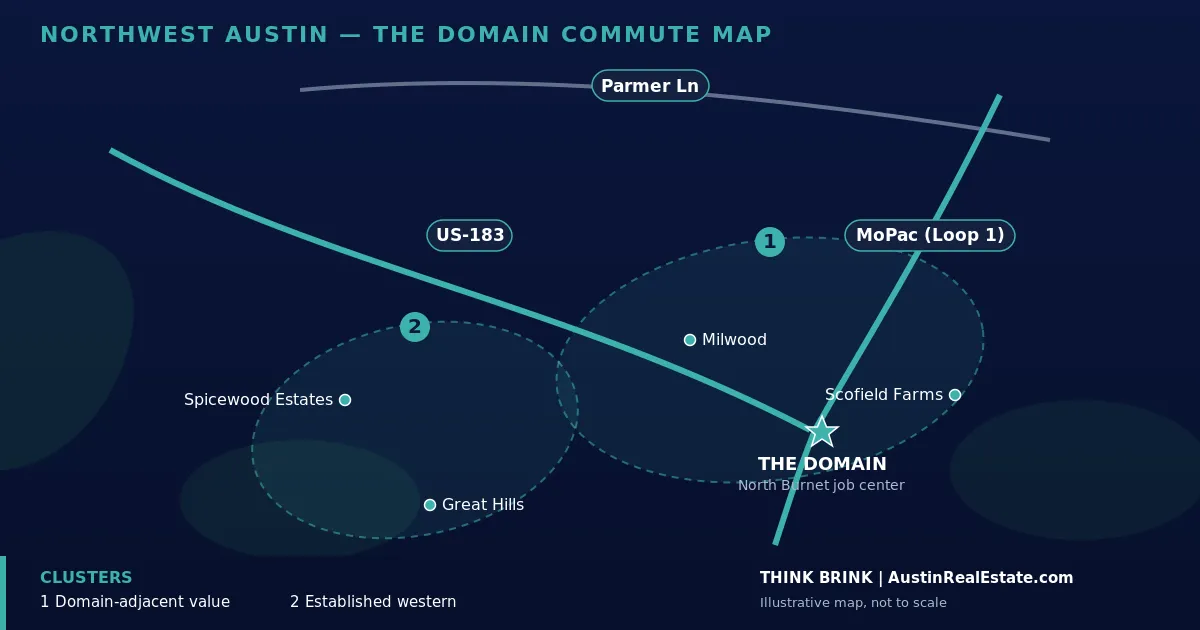
The Domain sits at a rare spot in Austin: it is close to the intersection of MoPac and US-183, which means Northwest Austin buyers can approach it from several directions instead of funneling onto one clogged artery. That is genuinely one of the best things about working there. But each route has its own personality, and Google's optimistic midday estimate is not what your 8:15 a.m. Tuesday looks like.
MoPac (Loop 1)
MoPac is the spine for most of my 78750 and 78759 buyers heading to the Domain. From the established neighborhoods along the MoPac corridor, you are dropping down to the Braker or Parmer exits, and in free-flowing conditions it is a short hop. The catch is that MoPac's northbound afternoon and southbound morning volumes are heavy, and MoPac has a history of backing up around the 183 interchange. The saving grace for Domain workers is that you are often exiting before the worst of it, and you are frequently going against the dominant downtown-bound flow in the morning. That counter-commute is the quiet advantage of living north of your job instead of south of it.
Burnet Road
Burnet Road is the underrated surface-street route into the Domain, and for a lot of neighborhoods it is faster and more predictable than jumping on the highway for two exits. Burnet runs right through the heart of the district, so if you live in a neighborhood with clean Burnet access, you can often skip the freeway entirely. Surface streets have lights, but they do not have the all-or-nothing failure mode of a highway incident. On the days MoPac locks up, the Burnet people barely notice.
US-183
183 is the route for buyers coming from the west and northwest - the Jollyville corridor, parts of 78759, and the far northwest. It feeds the Domain area from the 183 and MoPac side. It moves well off-peak and gets dense at rush hour like everything else, but for west-side neighborhoods it is often the most direct line in.
Parmer Lane
Parmer matters mostly if your building sits on the north edge of the district or if you are coming from the Parmer tech corridor and Apple side of things. It is a wide, fast arterial for much of its length. For most core-Domain commutes it is a secondary route, but it is the connective tissue between the Domain and the Apple campus world, which matters for two-tech households where one person works at each.
If commute tradeoffs are the thing you are really wrestling with, I go much deeper on how relocating tech workers misjudge Austin drive times in what relocating tech workers get wrong about Northwest Austin commutes. The short version: measure your commute at the hour you will actually drive it, on a weekday, before you fall in love with a house.
The neighborhoods, and what each one trades off for Domain workers
Here is where Domain-area buyers actually land, grouped by what they are optimizing for. None of these is "the best." They are different answers to different questions, and the right one depends on your budget, your school needs, and how much house versus how much location you want.
If you want the shortest, most reliable commute: the North Burnet-adjacent and Milwood-area neighborhoods
The neighborhoods clustered along the Parmer, Burnet, and MoPac triangle put you closest to the Domain with the least drama. Milwood is the workhorse of this group - established, mid-density, priced below the marquee 78750 names, and close enough that you have several route options into the district. It is a practical choice for a first Austin home when the commute is the priority and you do not need a trophy address. I break down the full buyer picture in the Milwood buyer guide.
Scofield Farms, a little to the north and east, is another strong Domain-commute value. It sits well for both the Domain and the Parmer corridor, and it tends to undercut the pricing of the more established western neighborhoods. If you are weighing it, the Scofield Farms buyer guide covers the specifics on lots, sections, and what to check before offering.
The tradeoff with this group: you are trading the prestige, lot sizes, and in some cases the school assignments of the western 78750 neighborhoods for proximity and price. For a lot of Domain workers, especially those without school-age kids, that is exactly the right trade.
If you want established character and strong schools, and will drive a few more minutes: the 78750 and 78759 neighborhoods
West of MoPac, the established Northwest Austin neighborhoods - Spicewood Estates, Balcones Woods, Great Hills, and the broader 78750 and 78759 cluster - give you bigger lots, mature trees, and in several cases the most sought-after school feeders in the area. These are not as close to the Domain as Milwood or Scofield, but "not as close" here often means a ten-to-twenty-minute commute rather than a five-to-ten-minute one. For buyers who plan to stay, raise kids, and want a neighborhood with genuine identity, that difference is minor and the upgrade in home and setting is real.
Balcones Woods is worth singling out for Domain buyers specifically because it is genuinely central - it sits close to the MoPac and 183 action while staying an established, HOA-anchored neighborhood, and it has historically moved fast because buyers recognize that combination. Great Hills gives you the 183 and 360 access and the Arboretum adjacency, with a wide price range depending on whether you are buying a flat lot or a hillside view lot. The pillar overview of this whole area is living in 78750 and 78759, which is the right starting point if you are new to the geography.
The tradeoff: you pay more per square foot in most of these neighborhoods than in the Domain-adjacent options, and you accept a slightly longer commute in exchange for lot size, schools, and staying power.
If you want newer homes and a bit more space, and the commute can stretch: the far northwest and the 78726 side
Push out to Canyon Creek, Grandview Hills, and the 78726 neighborhoods and you get newer construction, larger and more uniform homes, and a more suburban feel, at the cost of a longer and less flexible commute to the Domain. From here you are typically taking 620 or 183 to reach the district, and morning traffic on those routes is real. This is the right zone for buyers who prioritize the house and the neighborhood feel over commute minutes, or for two-income households where the Domain job is the secondary commute.
The tradeoff here is the most honest one in this whole post: you are buying more house and newer finishes by accepting that the Domain commute is a genuine drive, not a quick hop. Some buyers happily make that trade. Others realize after a month of the drive that they should have paid up for something closer. Test the commute before you commit.
Should you live near the Domain at all, or somewhere else?
A fair question that too few relocation guides ask: does it even make sense to organize your home search around the Domain? A few honest considerations.
If your household is fully remote or hybrid with one or two office days a week, the commute should weigh far less in your decision than it does for a five-day-in-office worker. In that case, buy the neighborhood, schools, and house you want within a reasonable radius and stop optimizing for a drive you rarely make. I would rather you love your street and drive twenty minutes twice a week than settle for a house you tolerate to save ten minutes on days you are not even in the office.
If you are five days in office and the commute is your dominant daily pain point, then yes, weight it heavily - but weight the reliability of the commute, not just the raw distance. A neighborhood with two or three viable routes to the Domain is worth more than one that is marginally closer but funnels you onto a single road that fails badly when there is an incident.
And if you have school-age kids, the school assignment will usually override the commute in importance, because you live with the schools for years and the commute for minutes. That is the point where this search stops being a Domain-commute question and becomes a school-district question, which deserves its own careful look.
The tech corridor context: the Domain is one node, not the whole map
The Domain is part of a larger North Austin tech corridor that runs along MoPac, 183, and Parmer, anchored on the far end by the Apple campus. If you are choosing between Domain-area living and the broader corridor, the pillar guide to the whole area is the North Austin neighborhood guide, and the neighborhood-by-neighborhood breakdown of the space between the three highways is in best neighborhoods in North Austin between MoPac, 183, and Parmer.
The practical reason this matters: a lot of Domain households are two-tech households, and the second job is often at Apple, the Parmer corridor, or downtown. When that is the case, the best neighborhood is frequently the one that splits the difference between two commutes rather than the one that is closest to either job alone. The center of gravity of your household's driving, not one person's office, is what you should be centering the search on.
What to actually check before you make an offer near the Domain
Once you have narrowed to a neighborhood, a few Domain-specific things are worth verifying before you write an offer.
Drive the real commute. Not the Sunday-afternoon version. Pick a Tuesday or Wednesday, leave at the time you would actually leave, and drive from the specific house to your specific building. Then drive it home at 5:30. Do this before you are emotionally committed, not after.
Confirm the school assignment at the address. School zoning in this part of Austin is set at the address level and does not track neighborhood names or zip codes cleanly. Two houses in the same neighborhood can feed different schools, and the district boundary is not always where you would guess. Verify the specific campus for the specific address, in writing, before you assume anything.
Understand which route you would lose. If a neighborhood's commute depends heavily on one road, ask what happens when that road has a problem. Neighborhoods with multiple viable exits toward the Domain are more resilient to the bad days.
Check the noise and flight-path realities. Some neighborhoods close to the highways trade a few commute minutes for road noise. Stand in the backyard, not just the living room, and listen. This is a personal-tolerance issue, and it is much easier to assess before you buy than to fix after.
Frequently asked questions
Where do most people who work at The Domain live?
There is no single answer, but the common landing spots for Domain workers in Northwest Austin fall into three groups: the Domain-adjacent value neighborhoods like Milwood and Scofield Farms for the shortest commute and lower prices; the established 78750 and 78759 neighborhoods like Balcones Woods, Spicewood Estates, and Great Hills for buyers who want bigger lots and stronger school feeders and will drive ten to twenty minutes; and the newer far-northwest neighborhoods for buyers who prioritize house size and are willing to accept a longer commute. Which group fits depends on your budget, whether you have school-age kids, and how many days a week you are actually in the office.
How long is the commute to The Domain from Northwest Austin?
It depends heavily on which neighborhood and which route, so I will describe it qualitatively rather than pretend one number fits. From the Domain-adjacent neighborhoods along the Burnet, Parmer, and MoPac triangle, it is a short hop and often a surface-street drive that avoids the freeway entirely. From the established western 78750 and 78759 neighborhoods, it is a modestly longer drive, usually helped by the fact that morning traffic runs against you since you are coming from north of your job. From the far-northwest and 78726 neighborhoods, it is a genuine drive on 620 or 183 that gets heavy at rush hour. The right move is to test your specific route at your actual commute time before buying.
Is it better to take MoPac or Burnet Road to The Domain?
It depends on where you live and how much you value predictability. MoPac is faster when it is flowing and is the natural route from the established western neighborhoods, but it has a well-earned reputation for backing up near the 183 interchange. Burnet Road is a surface street with lights, but it runs straight through the Domain, so for neighborhoods with clean Burnet access it is often more predictable and occasionally faster - and it does not fail catastrophically the way a highway does when there is an incident. Many Domain workers keep both in their back pocket and choose based on the day.
Which Northwest Austin neighborhoods have the best schools for Domain families?
Generally the established western neighborhoods in 78750 and 78759 anchor the most sought-after Round Rock ISD feeders, including the Westwood High School pathway. But school assignment is set at the address level, not the neighborhood level, so you cannot assume a neighborhood name guarantees a specific school. If schools are your priority, verify the exact campus for the exact address, and read up on how zoning works here, because it directly affects both your children's schools and what you pay for the home.
Should I buy close to The Domain if I only go to the office a few days a week?
Probably not at the expense of everything else. If you are hybrid or mostly remote, the commute should carry far less weight in your decision, and you are usually better off buying the neighborhood, schools, and house you actually want within a reasonable radius rather than paying a premium or settling for a compromise home just to shave minutes off a drive you make twice a week. Weight the commute in proportion to how often you actually make it.
Is the Domain area a good long-term bet given that employers move around?
The Domain and the surrounding North Burnet district are one of Austin's most established employment centers, with a deep and diverse tenant base rather than a single anchor. Individual companies come and go - Meta leased space here and never fully occupied it, and IBM has backfilled some of that footprint - which is exactly why I steer buyers away from choosing a house purely to be closest to one specific building. Buy a neighborhood you would be happy in even if your particular office changed, because over a typical ownership period, it very well might.
What is the difference between living near the Domain and living in the Apple corridor?
They are two nodes of the same North Austin tech corridor, connected by Parmer Lane and MoPac. The Domain is more central and more mixed-use, with retail, dining, and residential density right at the job center. The Apple corridor toward Parmer is more suburban and spread out. Many households have one worker at each, in which case the smart move is to center the home search on the point that balances both commutes rather than optimizing for one. If that is your situation, the corridor-wide guides are the better starting place than a single-neighborhood guide.
The honest fit check
Living near the Domain is a good fit if you value being close to a real job center with retail and dining built in, you want route flexibility rather than dependence on a single road, and you are clear-eyed about the tradeoff between commute proximity and everything else your budget could buy further out. The Domain-adjacent neighborhoods are the right call when the commute is your top priority and you do not need a trophy lot or a specific school feeder.
It is not the right frame if you are mostly remote, in which case you should stop optimizing for a commute you rarely make, or if you have specific school needs that pull you toward the established western neighborhoods regardless of the extra minutes. And it is the wrong frame entirely if you are buying the single closest house to one specific building rather than a neighborhood you would be happy in for years.
If you tell me your building, your budget, whether you have school-age kids, and how many days a week you are actually in the office, I can tell you in about five minutes which of these neighborhood groups fits you and which to rule out - and save you the month of driving it would otherwise take to figure that out. That is the conversation I would rather have before you make an offer than after.
