What Buyers Should Know About Scofield Farms Before Making an Offer
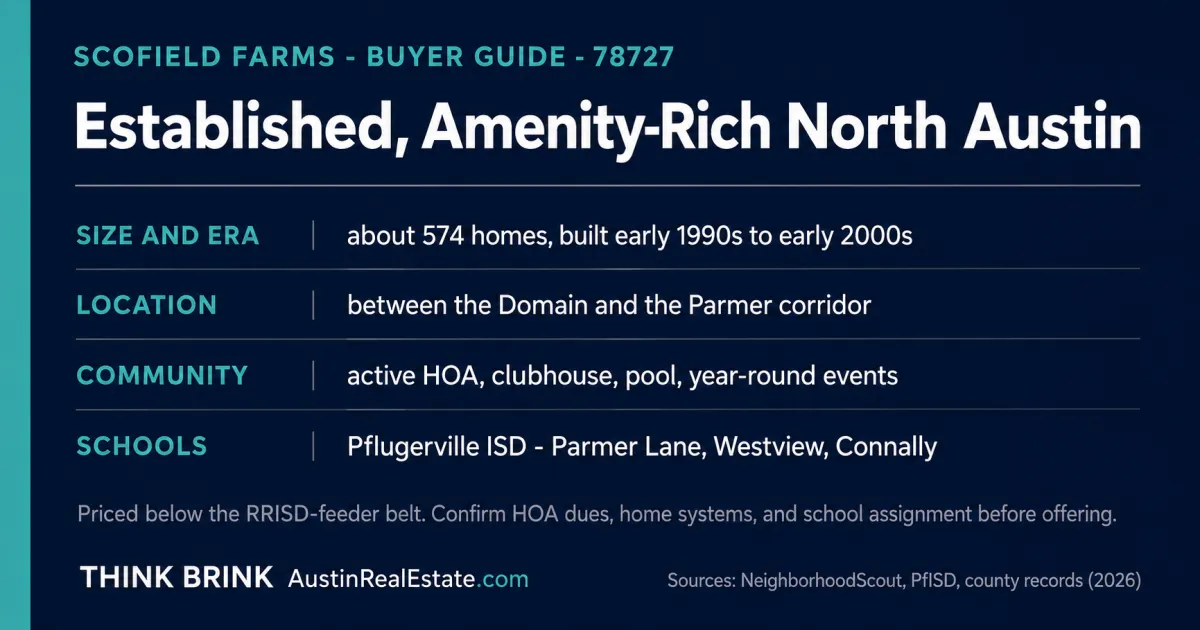
Scofield Farms does not have the name recognition of Great Hills or the search volume of Canyon Creek. What it has is something a specific kind of buyer is looking for and often cannot find anywhere else in this part of Austin: an established, walkable, amenity-rich neighborhood of roughly 574 homes, priced below the 78750 and 78759 established belt, sitting almost exactly between the Domain and the Parmer tech corridor. If you are a tech worker or a family who wants a real neighborhood with a pool and an active community rather than a subdivision that is just a collection of streets, Scofield Farms deserves a serious look. It also comes with one tradeoff that you need to understand clearly before you write an offer, and I will get to it directly.
This is a buyer's guide to Scofield Farms in the way I would walk a client through it in person: what the neighborhood is, where it sits, what the homes are like, what the schools mean for your decision, and the specific things to check before you make an offer.
Where Scofield Farms sits and why the location works
Scofield Farms is in the 78727 zip code in North Austin, tucked into the corridor between MoPac and I-35 north of the Parmer Lane and 183 area. That position is the neighborhood's biggest structural advantage. You are close to two of the largest employment centers in the region at once: the Domain, with Amazon, Indeed, and a dense cluster of tech and retail employment, and the Parmer corridor, anchored by Apple's Parmer Lane campus and the broader tech development along Parmer.
For a two-career household where one person works toward the Domain and the other toward Parmer or downtown, that central position is hard to beat. You are not optimizing your whole life around a single commute. You have reasonable access in multiple directions, plus quick connections to both MoPac and I-35 for everything else. That flexibility is exactly what makes the North Austin tech corridor neighborhoods worth understanding, and I lay out the whole corridor in my guide to the best neighborhoods in North Austin between MoPac, 183, and Parmer.
The tradeoff on location is honesty about traffic. Being central means the arteries around you carry a lot of commuter volume. Parmer, MoPac, and I-35 all back up at peak hours. Your drive to any single destination from Scofield Farms is generally reasonable, but "central" does not mean "immune to Austin traffic." As with anywhere in this corridor, test your actual commute at your actual hour before you decide.
What the homes are actually like
Scofield Farms began developing in the early 1990s and built out through the 1990s and into the early 2000s. That build era matters, because it puts the housing stock in a genuinely useful middle ground. These are not the 1970s and 1980s homes of the established Northwest belt, and they are not brand-new construction thirty minutes farther out. They are homes from an era that produced practical, family-oriented floor plans: functional room counts, reasonable ceiling heights, two-car garages, and yards that are usable without being estate-sized.
For a buyer, that build era is a real advantage on livability. You are more likely to find an open-enough floor plan and a layout that works for a modern family than you would in the oldest established neighborhoods, without paying the premium that brand-new construction commands. The tree canopy has had thirty-plus years to mature, so the neighborhood reads as established and green rather than raw.
The thing to watch, as with any neighborhood of this age, is systems and updates. Homes built in the 1990s and early 2000s are now at the age where roofs, HVAC systems, water heaters, and original finishes may be at or past their service life. This is not a red flag. It is simply the inspection discipline you bring to any home in this age range. Some Scofield Farms homes have been beautifully updated and some are still largely original, and the price should reflect which one you are looking at. Do not pay updated-home money for a home that still needs its major systems addressed.
The community and amenities, which are the real draw
What sets Scofield Farms apart from a lot of comparably priced North Austin neighborhoods is that it functions as an actual community. There is an active homeowners and residents association that maintains a neighborhood clubhouse and pool, and the association runs a genuine calendar of events through the year, things like an Easter egg hunt, a pool opening party, a holiday hayride, movies in the park, and live music. That kind of programming is unusual at this price point and it is a meaningful part of what you are buying.
For families with kids, that community identity is often the deciding factor. It is the difference between a neighborhood where you know your neighbors and your kids have a built-in social world, and one where you happen to share streets with strangers. For buyers relocating from out of state who do not yet have a social network in Austin, that built-in community can genuinely accelerate how quickly a new place feels like home.
The counterweight is the HOA itself. An active association with amenities means dues and means rules. Before you buy, get the current HOA dues, read the covenants and restrictions, and make sure you are comfortable with both the cost and the constraints. Most buyers who want this kind of neighborhood consider the dues well worth it for the pool, the maintenance, and the programming. But you should go in knowing the number and the rules rather than discovering them at closing.
Schools: the one tradeoff to understand clearly
Here is the tradeoff I mentioned at the top, and it is the single most important thing for a family to understand about Scofield Farms. The neighborhood is zoned to Pflugerville ISD, not to Round Rock ISD or Austin ISD. Specifically, Scofield Farms addresses are generally zoned to Parmer Lane Elementary, Westview Middle School, and Connally High School.
This matters because much of the reason the established Northwest Austin belt commands its premium is the Round Rock ISD Westwood High School feeder, which carries a 9 out of 10 GreatSchools rating and a well-known International Baccalaureate program. Scofield Farms does not feed that pathway. The Pflugerville ISD schools it feeds carry more moderate ratings, and that difference is a real part of why Scofield Farms is priced below neighborhoods just a few miles west.
Whether that tradeoff is right for you depends entirely on your situation. For a buyer without school-age children, or one who is considering private school, or one who simply values the community, the amenities, and the central location more than a top-tier public feeder, the Pflugerville ISD zoning is the very thing that makes Scofield Farms a value. You are getting an established, amenity-rich, centrally located neighborhood at a price the RRISD feeder neighborhoods will not touch, precisely because the school premium is not baked in. For a family whose top priority is the Westwood pathway specifically, Scofield Farms is not the neighborhood, and that is worth knowing before you fall for a house here. School district boundaries can be adjusted over time, so confirm the current assignment for any specific address directly with Pflugerville ISD before you rely on it.
How Scofield Farms compares to its neighbors
The most useful way to place Scofield Farms is against the neighborhoods buyers usually cross-shop it with. Against Milwood, which sits nearby in the same corridor, Scofield Farms tends to offer a stronger central community identity and the amenity package, while Milwood is often cross-shopped for its own school considerations. Against the established Northwest belt neighborhoods farther west, Scofield Farms is the value play: less prestige and a more moderate school feeder in exchange for a meaningfully lower price and, in many cases, a more practical house.
If you are weighing this neighborhood against options in the suburbs to the north, it is also worth thinking through the broader established-Austin-versus-suburb question, which I cover in my comparison of Northwest Austin versus Round Rock. Scofield Farms gives you an established, in-the-city-limits North Austin address with amenities, which is a different proposition than a newer home farther out in Round Rock or Pflugerville proper.
What to check before you make an offer
Verify the exact school assignment
Do not assume the feeder based on the neighborhood name. Confirm the specific elementary, middle, and high school for the exact address with Pflugerville ISD, because boundaries and assignments can change. If schools are central to your decision, this is the first thing to nail down.
Get the HOA numbers and rules in writing
Ask for the current annual dues, the covenants and restrictions, and any pending assessments or reserve-study information. The amenities are a genuine benefit, but you want to know the cost and the rules before you are committed, not after.
Inspect the major systems hard
Given the 1990s-to-early-2000s build era, budget your inspection attention on roof, HVAC, water heater, and any original plumbing and electrical. Find out what has been replaced and when. Let the condition of those systems inform your offer price rather than treating a dated home and an updated home as interchangeable.
Drive your real commute
Central location is the neighborhood's biggest selling point, so make sure it delivers for your specific commute. Drive from the actual home to your actual workplaces at 8 a.m. on a weekday. The Domain, Parmer, and downtown are all reachable, but you want to feel the real drive, not the midday one.
Understand the price you are paying and why
Scofield Farms is priced where it is for reasons: the school feeder, the build era, and the location all factor in. Make sure the specific home's condition justifies its price relative to what else is available in the neighborhood, and lean on current, comparable sales rather than assumptions. If you want to understand the full carrying cost beyond the sale price, my breakdown of what it actually costs to own a home in this part of Austin applies here too, with the caveat that Scofield Farms taxes fall under different jurisdictions, so confirm the exact rate for the address.
A quick fit check
Scofield Farms is the right neighborhood for you if you want an established, amenity-rich, genuinely social community with a pool and a real events calendar, you value a central position between the Domain and the Parmer corridor, and you are either fine with the Pflugerville ISD feeder or schools are not the driver of your decision. You are buying community, location, and value, and accepting a more moderate school pathway to get them at this price.
It is probably not the right neighborhood if your single non-negotiable is the Round Rock ISD Westwood feeder, in which case you should be shopping the established Northwest belt and paying the premium that comes with it. Neither choice is wrong. They are optimized for different priorities, and the whole point of understanding Scofield Farms before you offer is knowing which one you are actually choosing.
Frequently Asked Questions
What school district is Scofield Farms in?
Scofield Farms is zoned to Pflugerville ISD, not Round Rock ISD or Austin ISD. Addresses in the neighborhood are generally zoned to Parmer Lane Elementary, Westview Middle School, and Connally High School. Because boundaries can change, confirm the current assignment for the specific address with Pflugerville ISD before relying on it, especially if schools are central to your decision.
Is Scofield Farms a good neighborhood for tech workers?
Yes, particularly for two-career households. Scofield Farms sits centrally in the North Austin corridor between MoPac and I-35, close to both the Domain, with employers like Amazon and Indeed, and the Parmer corridor anchored by Apple. That central position means you are not forced to optimize around a single commute, which is a real advantage when two people work in different directions.
When were the homes in Scofield Farms built?
The neighborhood began developing in the early 1990s and built out through the 1990s and into the early 2000s. That build era gives it practical, family-oriented floor plans and a mature tree canopy, without the price premium of new construction. The main thing to check is the condition of major systems like roof and HVAC, which are now at the age where they may need attention.
Does Scofield Farms have an HOA and amenities?
Yes. Scofield Farms has an active homeowners and residents association that maintains a clubhouse and pool and runs a real calendar of community events through the year, including an Easter egg hunt, pool parties, a holiday hayride, movies in the park, and live music. Before buying, get the current dues and the covenants in writing so you understand both the cost and the rules.
Why is Scofield Farms cheaper than nearby Northwest Austin neighborhoods?
The price difference comes largely from the school feeder and the location. Much of the established Northwest belt commands a premium for the Round Rock ISD Westwood pathway, which Scofield Farms does not feed. Its Pflugerville ISD zoning, combined with its position and build era, is exactly why it offers an established, amenity-rich neighborhood at a lower price than the RRISD feeder neighborhoods a few miles west.
How is the commute from Scofield Farms to the Domain and Apple?
Both are reachable and the central location is the neighborhood's biggest advantage, but the arteries around it, Parmer, MoPac, and I-35, carry heavy peak-hour traffic. Your drive to any single destination is generally reasonable, but central does not mean immune to Austin traffic. Drive your actual route to your actual workplace at 8 a.m. on a weekday before you rely on any estimate.
What should I inspect before buying a home in Scofield Farms?
Given the 1990s-to-early-2000s build era, focus inspection attention on the roof, HVAC, water heater, and any original plumbing and electrical, and find out what has been replaced and when. Also get the HOA dues and covenants in writing and confirm the school assignment for the address. Let the condition of the major systems inform your offer rather than paying updated-home prices for an original home.
Is Scofield Farms a good place to buy right now?
For the right buyer, the central location and community amenities make it a durable choice, but timing depends more on your own plans and financing than on the calendar. The neighborhood's value proposition, an established amenity-rich community at a below-premium price, holds up across market conditions. The better question is whether the specific home and its condition fit your budget and how long you plan to stay.
If Scofield Farms is on your list, I can help you weigh it honestly against the RRISD feeder neighborhoods and against its North Austin neighbors, and pressure-test whether the school tradeoff is the right one for your situation before you write an offer. Reach out and we will walk through it against current listings.
