What Relocating Tech Workers Get Wrong About Northwest Austin Commutes
Almost every tech worker moving to Austin from California, Seattle, or the Northeast makes the same first move: they open a map, drop a pin on their office, draw a rough circle around it, and start shopping for houses inside that circle. It feels rational. It is also the single most common way relocating buyers end up in a home with a commute they did not sign up for.
The problem is that a Northwest Austin commute is not a function of distance. Two homes the same number of miles from Apple's Parmer campus can produce a 12-minute drive and a 35-minute drive depending on which direction you are traveling, which roads you have access to, and whether you are willing to pay a toll. I have watched relocating buyers fixate on a listing that was technically closer to their office and end up with a worse daily drive than the home three miles farther out that they passed on.
This post is about the things that actually determine your commute in Northwest Austin, the mistakes I see relocating tech workers make over and over, and how to test a commute properly before you write an offer. If you are new to the area and choosing between neighborhoods, read this before you fall in love with a house based on a number of miles.
Mistake one: treating distance as the commute
Apple's Austin operation sits at the corner of Parmer Lane and MoPac, with the original complex at 5501 West Parmer and the newer campus at 6900 West Parmer, together holding more than 10,000 employees. The single most important thing about that location is what it is not next to: it is not on Interstate 35. It sits off MoPac and US 183, which are the two roads that make Northwest Austin commutes as good as they are.
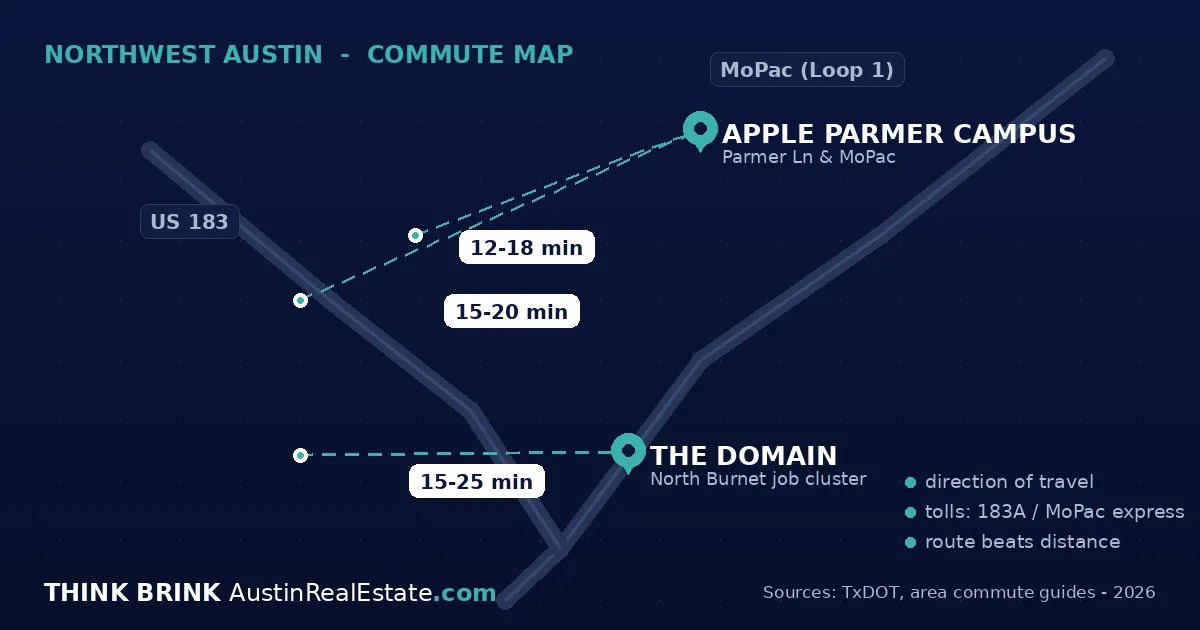
Here is why distance lies. From the Arboretum area, roughly 8 to 10 miles out, the drive to Parmer via MoPac runs about 15 to 20 minutes on a normal morning. From the McNeil area, 6 to 8 miles out, the drive is about 12 to 18 minutes. Those two numbers are close even though the mileage is not, because the roads and the direction of travel matter more than the raw distance. A home that is physically closer but sits on the wrong side of a bottleneck, or that forces you onto a surface street with a dozen lights, can lose every mile of advantage it had on paper.
When you evaluate a Northwest Austin home for commute, throw out the mileage number. It tells you almost nothing. What you want to know is the route, the direction, and the time of day you will actually be driving it.
Direction of travel is half the battle
Austin traffic, like traffic everywhere, is directional. The general-purpose lanes on MoPac load up heavily between roughly 7:30 and 9:00 in the morning and again from about 5:00 to 6:30 in the evening. But whether that load is a problem for you depends entirely on which way you are going.
If you live north of your office and drive south in the morning against the heavier inbound flow, your commute can be dramatically better than someone who lives the same distance south and drives north into it. Relocating buyers almost never think about this. They assume traffic is traffic. It is not. Before you commit to a neighborhood, figure out which direction you will be driving during peak hours and whether that direction is the loaded one. This one factor can swing a commute by 15 minutes in either direction on the identical stretch of road.
Mistake two: assuming the toll roads are optional
Northwest Austin is threaded with toll infrastructure: the MoPac express lanes, the 183A toll north of the airport corridor, and the broader 183 corridor, which saw its northbound express lanes open as part of the 183 North Mobility Project in January 2026. Relocating buyers tend to treat tolls as an occasional convenience. For a daily commuter, they are closer to a fixed monthly cost that belongs in your housing budget.
The 183A toll can shave 10 to 15 minutes off a north-south trip, but running it every workday adds somewhere in the range of $150 to $250 a month for a daily commuter. The MoPac express lane price floats with congestion, which means the days you most want it are the days it costs the most. None of this is a reason to avoid the toll roads. It is a reason to price them honestly.
Here is the mistake in practice: a buyer chooses a home farther out because the price per square foot is better, tells themselves the commute is fine because they will just take the toll, and does not add the toll cost to the true monthly number. When you fold $200 a month in tolls into the comparison, the cheaper house farther out is often not actually cheaper. This is the same tradeoff I walk through in detail in what Apple corridor buyers should know about commute vs price tradeoffs, and it catches relocating buyers more than any other single miscalculation.
Mistake three: budgeting for the five-day commute you no longer drive
Most Austin tech roles are hybrid now, and that changes the entire math of where you should live. A relocating buyer coming from a five-day-in-office culture often carries the old mental model with them: minimize the commute above all else, because you are doing it every day. If you are in the office three days a week, or two, the calculus is different.
When you drive to the office three days instead of five, a slightly longer commute costs you far less over a year, and the things you do have every single day, the lot, the neighborhood, the school zone, the square footage, start to matter more relative to the drive. I have had buyers talk themselves out of a home they loved because the commute was 25 minutes instead of 15, without stopping to ask how many times a week they would actually make that drive. Ten extra minutes, three days a week, is 30 minutes a week. That is a rounding error against a house you will live in for a decade.
The opposite mistake exists too. Some buyers assume hybrid means they can live anywhere and get burned when a return-to-office push turns two days into four. The honest move is to find out your team's real, current in-office expectation, plan for it to tighten rather than loosen, and buy for the commute you will realistically drive, not the one in the offer letter.
Mistake four: shopping for one office when you have two commutes
Relocating households are usually two-income households, and the second commute is the one that gets ignored. A buyer optimizes ruthlessly for their own drive to Apple or the Domain and forgets that their spouse works downtown, or in Round Rock, or at a hospital in a completely different part of the metro. A home that is perfect for one commute can be genuinely bad for the other.
Northwest Austin actually handles the two-commute problem better than most parts of the metro, because it sits at the intersection of several corridors. From much of the 78750 and 78759 core, you have reasonable access to the Parmer tech campuses via MoPac and 183, to the Domain and North Burnet job cluster, and to downtown via MoPac. But reasonable access to three places is not the same as good access to the two specific places your household drives to. Map both commutes before you decide, at the hours each person actually leaves, and weight them by how often each person is in the office.
The Domain is a different commute than Apple
Buyers relocating to work at the Domain, North Burnet, or the Amazon and Indeed offices in that cluster sometimes assume an Apple-corridor neighborhood is automatically right for them. It often is, but the routes are different and the traffic patterns are different. The Domain sits closer to the MoPac and 183 junction, which changes which neighborhoods have the cleanest shot. If your office is in that cluster rather than out on Parmer, the neighborhoods that optimize your drive shift accordingly. Do not inherit someone else's commute assumptions just because you both work in tech.
Mistake five: never driving the commute before buying
This is the one that still surprises me. Relocating buyers will spend forty hours researching schools and comps and lot orientation, then buy a house without ever having driven the commute at the time of day they will drive it. They flew in for a weekend, toured homes on a Saturday afternoon when the roads were empty, and extrapolated.
Saturday afternoon traffic tells you nothing about a Tuesday at 8:15 a.m. If you are serious about a neighborhood, drive the actual route from the actual house to the actual office at the actual time. If you cannot be in town on a weekday morning, use a maps app and check the projected drive time for a Tuesday or Wednesday at your real departure time, not the live time on the weekend you happen to be looking. Do the same for the evening return, which in Northwest Austin is often the worse of the two directions. A commute has two halves and buyers only ever test the morning.
How Northwest Austin commutes actually break down
Here is the framework I give relocating buyers instead of the pin-and-circle method. There are really four questions that determine your Northwest Austin commute, in order of how much they matter.
Which corridor is your office on? Parmer and MoPac for Apple, the MoPac and 183 junction for the Domain and North Burnet, MoPac south for downtown. Your corridor determines which neighborhoods have a clean route versus a route that fights across town.
Which direction do you drive at peak? Into the loaded flow or against it. This can swing your time more than a couple of miles ever will.
Are you paying tolls, and have you priced them? If your route depends on 183A or the MoPac express lanes to hit the time you are quoting yourself, that time comes with a monthly bill that belongs in your housing budget.
How many days a week are you actually driving it? A hybrid schedule changes how much a longer commute should weigh against everything else the house gives you.
Answer those four honestly and the neighborhood shortlist mostly writes itself. The established core of 78750 and 78759 tends to win for Apple and Domain commuters because it sits on the right side of MoPac and 183 with multiple routes in. If you want the neighborhood-by-neighborhood version of this, the North Austin neighborhood guide for the MoPac, 183, and Parmer corridor walks through how each area sits relative to the job centers, and the best neighborhoods between MoPac, 183, and Parmer narrows it further.
The Cedar Park and suburb comparison relocating buyers get backward
A lot of relocating tech workers arrive convinced they should look at Cedar Park, Leander, or the farther-out master-planned communities because the price per square foot is lower and the houses are newer. Sometimes that is the right call. But buyers frequently underestimate what the additional distance does to the daily drive, and overestimate how much house they are actually gaining once tolls and time are priced in.
From Cedar Park, the drive to the Parmer campus runs roughly 15 to 25 minutes on a typical morning and stretches to 20 to 30 in the heart of rush hour, often leaning on the 183A toll to hold those times. That is not a bad commute. But it is a longer and more toll-dependent commute than what the established Northwest Austin neighborhoods deliver, and the newer-and-cheaper appeal fades somewhat when you add the drive and the toll cost back in. I lay out the full version of this in Northwest Austin vs Cedar Park: which one actually fits your situation. The short version: the suburbs can be the right answer, but make the comparison with tolls and real drive times included, not with sticker price and mileage.
What I tell relocating buyers to do before they shop
Get your household's real in-office expectations in writing, for both earners, and assume they tighten. Identify the corridor each office is on. Then, and only then, start looking at neighborhoods, and evaluate each one on route and direction rather than distance. Price the tolls if your route needs them. And before you write an offer, drive the commute, both directions, at the real times, or check the projected weekday times if you cannot be here midweek.
Do that and you will avoid the trap that catches so many relocating buyers: paying for a house inside the circle on the map that turns out to have a worse daily drive than the one you talked yourself out of. The circle is a bad tool. The four questions are a better one.
Frequently Asked Questions
How long is the commute from Northwest Austin to Apple's Parmer campus?
It depends heavily on where in Northwest Austin you are and which direction you drive. From the Arboretum area, roughly 8 to 10 miles out, the drive to Parmer via MoPac runs about 15 to 20 minutes on a normal morning. From the McNeil area, 6 to 8 miles out, it is about 12 to 18 minutes. The established 78750 and 78759 neighborhoods generally deliver strong Apple commutes because they sit on the right side of MoPac and 183. Always test the specific route from the specific home at the time of day you will actually drive it.
Is it worth living in Cedar Park to commute to Apple or the Domain?
It can be, but relocating buyers often make the comparison wrong. From Cedar Park the drive to Parmer runs roughly 15 to 25 minutes on a typical morning and 20 to 30 in peak rush, frequently relying on the 183A toll. That is a reasonable commute, but longer and more toll-dependent than the established Northwest Austin neighborhoods. Before deciding, add the monthly toll cost and real drive times back into the comparison rather than judging on price per square foot and mileage alone.
How much do the toll roads cost for a daily Northwest Austin commuter?
The 183A toll can shave 10 to 15 minutes off a north-south trip but adds roughly $150 to $250 a month for someone driving it every workday. The MoPac express lane price is dynamic and rises with congestion, so it costs the most on the days you most want it. If your quoted commute time depends on these roads, treat the toll as a fixed monthly housing cost rather than an occasional expense.
Does a hybrid work schedule change where I should buy in Northwest Austin?
Yes, significantly. If you are in the office two or three days a week rather than five, a slightly longer commute costs you far less over a year, and the things you have every day, the house, the lot, the neighborhood, the school zone, should weigh more heavily in the decision. Find out your team's real current in-office expectation, plan for it to tighten rather than loosen, and buy for the commute you will actually drive.
My spouse and I work in different parts of Austin. How do we choose a neighborhood?
Map both commutes, at the hours each person actually leaves, and weight them by how often each person is in the office. Northwest Austin handles the two-commute problem better than most of the metro because it sits at the intersection of the Parmer, Domain, and downtown corridors, but reasonable access to three places is not the same as good access to your two specific offices. Do not optimize entirely for one earner and ignore the other.
Why does a closer house sometimes have a worse commute?
Because Northwest Austin commutes are determined by route and direction of travel, not distance. A home that is physically closer but sits on the wrong side of a bottleneck, forces you onto a light-heavy surface street, or puts you driving into the loaded direction at peak can easily lose to a home several miles farther out with a clean route in the against-traffic direction. Throw out the mileage number and evaluate the actual route.
Should I buy a home before driving the commute myself?
No. Drive the actual route from the actual home to the actual office at the time of day you will drive it, both the morning trip and the evening return, since the return is often the worse direction in Northwest Austin. If you cannot be in town on a weekday, use a maps app to check the projected drive time for a Tuesday or Wednesday at your real departure time rather than the live weekend time. Testing only the empty-roads version is how buyers end up surprised.
The honest summary
Relocating tech workers get Northwest Austin commutes wrong because they import a distance-based, five-day-a-week, single-earner mental model from wherever they are moving from. The reality here is that route beats distance, direction of travel beats both, tolls are a real monthly cost, hybrid schedules change the weighting, and the second earner's commute matters as much as the first. Answer the four questions, corridor, direction, tolls, and days per week, then drive the route before you buy. Do that and Northwest Austin's genuine commute advantage, sitting off MoPac and 183 rather than fighting I-35, actually works in your favor instead of getting squandered on a house you picked off a map.
If you are relocating and want a straight read on which neighborhoods fit your specific commute and household, that is exactly the conversation I have with new-to-Austin buyers every week, and it is a lot cheaper to have it before you write an offer than after.
