What Apple Corridor Buyers Should Know About Commute vs Price Tradeoffs
If you work at Apple's Parmer Lane campus, or you are relocating to take a job there, the single decision that will shape your daily life for the next several years is not which house you buy. It is how you weigh commute against price. Those two things pull in opposite directions across the Northwest and North Austin corridor, and almost every buyer I work with underestimates how sharply that tradeoff bites until they have driven it a few mornings.
This is a guide to that tradeoff specifically. Not a generic neighborhood roundup. The goal is to give you a framework you can actually use to decide how much commute you are willing to trade for how much house, and to name the neighborhoods where each side of that trade lands.
Where the Apple campus actually is, and why it matters for this decision
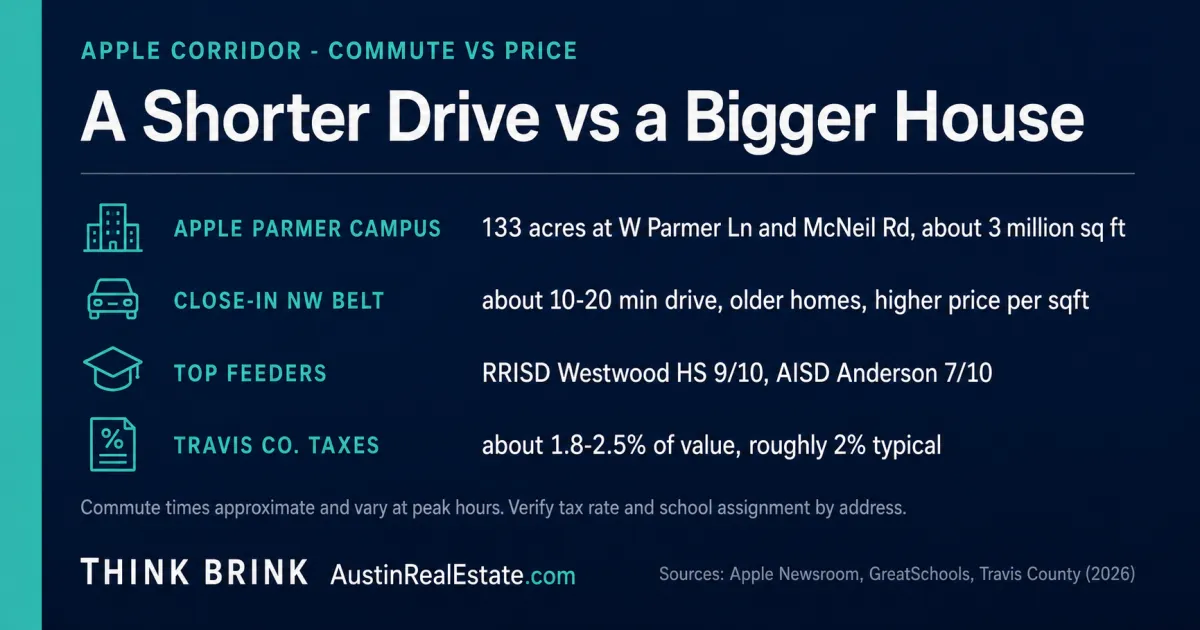
Apple's Austin campus sits on a 133-acre site at West Parmer Lane and McNeil Road, on the north edge of the Northwest Austin residential belt. It is roughly 3 million square feet of office space designed to house around 5,000 employees initially, with room the company has publicly said it could scale toward 15,000 over time. There is also a 50-acre nature preserve on the site that is open to the public.
The location detail that matters for your home search is this: the campus is on Parmer, north of the established 78750 and 78759 neighborhoods and east of the 78726 hill-country neighborhoods. That geography creates three broad directions you can live from Apple, and each one has a completely different price-to-commute profile.
You can live south and west of the campus in the established Northwest Austin neighborhoods off MoPac and 183. You can live in the newer master-planned areas farther north toward Cedar Park and Leander. Or you can live east and northeast in the North Austin tech-corridor neighborhoods between MoPac and I-35. Each of those directions answers the commute-versus-price question differently, and the right answer depends entirely on what you are optimizing for.
Why commute and price pull against each other here
The general rule in this corridor is the one you would expect: the closer and more convenient a neighborhood is to the Parmer campus and the major employers, the more you pay per square foot, and the older or smaller the house you get for a given budget. The farther out you go, the newer and larger the house for the money, and the longer and less predictable the drive.
What makes Northwest Austin different from a generic version of that rule is that the established neighborhoods closest to Apple were mostly built decades ago. So proximity does not just cost you money. It often costs you house age and updates too. A buyer who wants a short commute and a newer, larger home is fighting against the grain of how this area developed, and that tension is exactly where people get frustrated when they have not thought it through in advance.
There is also a traffic-timing wrinkle that raw distance does not capture. Parmer Lane and the MoPac and 183 interchanges carry heavy tech-commuter volume at peak hours. A neighborhood that is fifteen minutes from the campus at 10 a.m. can be a very different drive at 8:15 a.m. When you evaluate a neighborhood, you are not evaluating its distance. You are evaluating its worst realistic morning.
The three directions, and what each one trades
Direction one: the established Northwest Austin belt, closest and most convenient
This is the 78750 and 78759 core, plus the 78726 hill-country neighborhoods. Think Spicewood Estates, Balcones Woods, Great Hills, Mesa Park, Balcones Hills, the Jollyville corridor, and over in 78726, Canyon Creek and Grandview Hills. These neighborhoods sit closest to the campus and closest to MoPac and 183, which means they give you the shortest and most predictable commute of any option, often in the ten-to-twenty-minute range in normal conditions from the neighborhoods nearest the interchanges.
What you trade for that is house age and price per square foot. Most of these neighborhoods were built out from the 1970s through the 1990s. The homes are established, the lots are frequently larger and more mature than anything newer construction offers, and the tree cover is real. But a meaningful share of the inventory has not been fully updated, so you are often choosing between paying a premium for an updated home or buying a dated one and renovating. The land and location carry the value here, not the finishes.
The school access is a major reason buyers accept the tradeoff. Large parts of this belt feed the Round Rock ISD Westwood High School pathway, and Westwood carries a 9 out of 10 GreatSchools rating with a graduation rate around 97 percent and a well-known International Baccalaureate program. The AISD portions feed Anderson High School, which carries a 7 out of 10 GreatSchools rating. For families, the combination of a short Apple commute and a top-rated feeder is the whole reason this belt commands what it does. I walk through exactly how that school-by-address dynamic works in my guide to the best neighborhoods in North Austin between MoPac, 183, and Parmer.
Direction two: farther north and northwest, newer and larger for the money
If your budget does not stretch to an updated home in the established belt, or you simply want a newer, larger house with a modern floor plan, the master-planned areas farther north toward Cedar Park, Leander, and the northern reaches of the corridor are where that money goes further. You get more square footage, newer construction, and often community amenities like pools and trails that the older neighborhoods do not have.
What you trade is the commute, and you trade more of it than the map suggests. Parmer and the northern arteries back up during peak tech-commuter hours, so a drive that looks like twenty minutes on a quiet afternoon can stretch considerably in a weekday morning. If you are going to live out here, drive the actual commute at the actual hour before you commit. The difference between a tolerable move and a daily grind is often ten or fifteen minutes that only show up at 8 a.m. I lay out the broader version of this decision in my comparison of Northwest Austin versus Cedar Park.
Direction three: the North Austin tech corridor, the value-and-access middle ground
East and northeast of the campus, the neighborhoods between MoPac and I-35 - Milwood, Scofield Farms, Wells Branch, and the surrounding tech-corridor pockets - occupy an underrated middle ground. They are generally more affordable per square foot than the established Northwest belt, they were built slightly later so more of the housing stock has practical family floor plans, and they sit close to both the Apple corridor and the Domain employment center.
The commute to Apple from here depends heavily on which side of the neighborhood you are on and how you route to Parmer, but for many of these neighborhoods it is competitive with the established belt while costing less. The tradeoff is usually schools and prestige rather than distance. Some of these neighborhoods sit in different feeder patterns and different districts, including Pflugerville ISD, so if schools drive your decision you need to check the specific address rather than the neighborhood name. I cover this corridor in depth in my North Austin neighborhood guide.
How to actually make the tradeoff, step by step
Start by pricing your commute honestly
Most people say they will accept a longer commute for a better house, and then discover six months in that the drive is the thing eroding their week. Before you shop, decide on a real number. Is your ceiling twenty minutes each way? Thirty? Forty-five? Write it down, and then, critically, test candidate neighborhoods at 8 a.m. on a weekday, not on the Saturday you happen to be touring. The peak-hour reality is the only number that matters, because it is the one you will live.
Then decide what the house has to do for you
A newer, larger home in a farther-out neighborhood is the right answer for a family that needs the space and does the school-drop-off routine locally anyway. An established home on a big lot in the Northwest belt is the right answer for someone who values a short commute, mature trees, and a top-rated feeder, and who is either fine with a dated interior or has the budget and appetite to renovate. Neither is wrong. They optimize for different things, and the mistake is buying one while wanting the other.
Factor in the carrying cost of the whole picture
Price per square foot is only part of the cost. Property taxes in Travis County generally run somewhere in the range of roughly 1.8 to 2.5 percent of assessed value depending on which taxing jurisdictions overlap your address, with a typical Austin homeowner landing around 2 percent. On a higher-priced established home close to Apple, that tax load is meaningfully larger in absolute dollars than on a less expensive home farther out, even before you count the commute cost in gas, wear, and time. Run the full monthly number, not just the sale price, before you decide the close-in home is worth the premium. Confirm the exact rate and any exemptions for a specific address with the county and your lender, since jurisdictions and exemptions vary.
Do not let the resale tail wag the dog, but do think about it
The established Northwest belt neighborhoods with strong feeders, places like Balcones Woods, tend to hold value well because the demand drivers - proximity to Apple and the other corridor employers, the Westwood pathway, mature location - are durable. Farther-out newer construction can be a wonderful place to live, but you are often competing against the next new subdivision when you sell. That is not a reason to avoid it. It is a reason to buy the newer home because you want to live in it, not primarily as an appreciation bet.
A quick fit check
The established Northwest Austin belt is the right call if a short, predictable Apple commute and a top-rated school feeder are non-negotiable, and you are comfortable either paying up for an updated home or renovating a dated one on a good lot. You are buying land, location, and schools, and accepting older housing stock and a higher price to get them.
The farther-north newer areas are the right call if you need more house and modern finishes for your budget and you have genuinely tested the peak-hour commute and can live with it. You are buying space and newness and paying for it in drive time.
The North Austin tech corridor is the right call if you want the best balance of price, reasonable access to both Apple and the Domain, and you are willing to verify schools address by address rather than assuming the neighborhood name gets you a particular feeder. You are buying value and flexibility and giving up some of the prestige and feeder certainty of the established belt.
If you are not sure which of those describes you, that is normal, and it is exactly the conversation worth having before you start touring rather than after you have fallen for a house that optimizes for the wrong thing.
Frequently Asked Questions
What is the commute like from Northwest Austin to the Apple Parmer campus?
From the established 78750, 78759, and 78726 neighborhoods nearest the MoPac and 183 interchanges, the drive to Apple's Parmer Lane campus is often in the ten-to-twenty-minute range in normal conditions, since the campus sits on Parmer just north of that belt. Peak morning traffic on Parmer and the interchanges can lengthen it, so the honest answer for any specific neighborhood is whatever it clocks at 8 a.m. on a weekday, which is the number you should test before buying.
Is it cheaper to live closer to Apple or farther away in Austin?
Farther away is generally cheaper per square foot and gets you a newer, larger house for the money, while the established neighborhoods closest to the campus cost more and often come with older housing stock. The closer-in premium buys you a shorter, more predictable commute and, in much of the belt, access to top-rated school feeders. The right side of that trade depends on whether you are optimizing for commute and schools or for space and price.
Which neighborhoods near the Apple campus have the best schools?
Large parts of the established Northwest Austin belt feed the Round Rock ISD Westwood High School pathway, which carries a 9 out of 10 GreatSchools rating and a well-known IB program, while the AISD portions feed Anderson High School at a 7 out of 10 rating. School assignment in this area is set by address, not by neighborhood name or price tier, so you have to confirm the specific feeder for any home you are considering.
How much are property taxes near the Apple campus in Austin?
Property taxes in Travis County generally run in the range of roughly 1.8 to 2.5 percent of assessed value depending on which taxing jurisdictions overlap the address, with a typical Austin homeowner around 2 percent. Because the rate applies to a higher assessed value on more expensive close-in homes, the absolute tax bill is larger near the campus even at the same rate. Confirm the exact figure and any homestead exemptions for a specific address with the county and your lender.
Should I buy a newer home farther out or an older home close to Apple?
Buy the older close-in home if a short commute, mature lots, and strong feeders matter most and you can accept or renovate dated interiors. Buy the newer farther-out home if you need more space and modern finishes and you have driven the peak-hour commute and can live with it. The costly mistake is buying one type while actually wanting what the other type offers, so decide which you are optimizing for before you tour.
How long does traffic really add to the Apple commute in the mornings?
Parmer Lane and the MoPac and 183 interchanges carry heavy tech-commuter volume at peak hours, so a drive that is short midday can lengthen noticeably at 8 a.m. The specific amount varies by neighborhood and route, which is why distance on a map is a poor guide. The only reliable way to know is to drive the exact route at the exact hour you would commute before you commit to a neighborhood.
Is Northwest Austin or the North Austin tech corridor better for an Apple employee?
Northwest Austin gives you the shortest, most predictable commute and the strongest feeders but at a higher price and with older housing. The North Austin tech corridor, neighborhoods like Milwood, Scofield Farms, and Wells Branch, generally costs less, sits reasonably close to both Apple and the Domain, and offers more practical floor plans, but school feeders vary by address and can include different districts. It comes down to whether feeder certainty and the shortest commute outweigh price and flexibility for you.
Is now a good time to buy near the Apple corridor?
Timing depends more on your own situation - how long you plan to stay, your financing, and whether the right home is available - than on trying to call the market. I cover the current dynamics in detail in my guide on whether now is a good time to buy in Northwest Austin, and the short version is that the demand drivers along this corridor are durable, so the better question is usually whether the specific home fits your plan rather than whether the month is perfect.
If you want help pricing your own commute-versus-price tradeoff against specific neighborhoods and current listings near the Apple corridor, that is exactly the kind of decision I help buyers work through before they start touring. Reach out and we will map it to your budget, your commute ceiling, and your school priorities.
