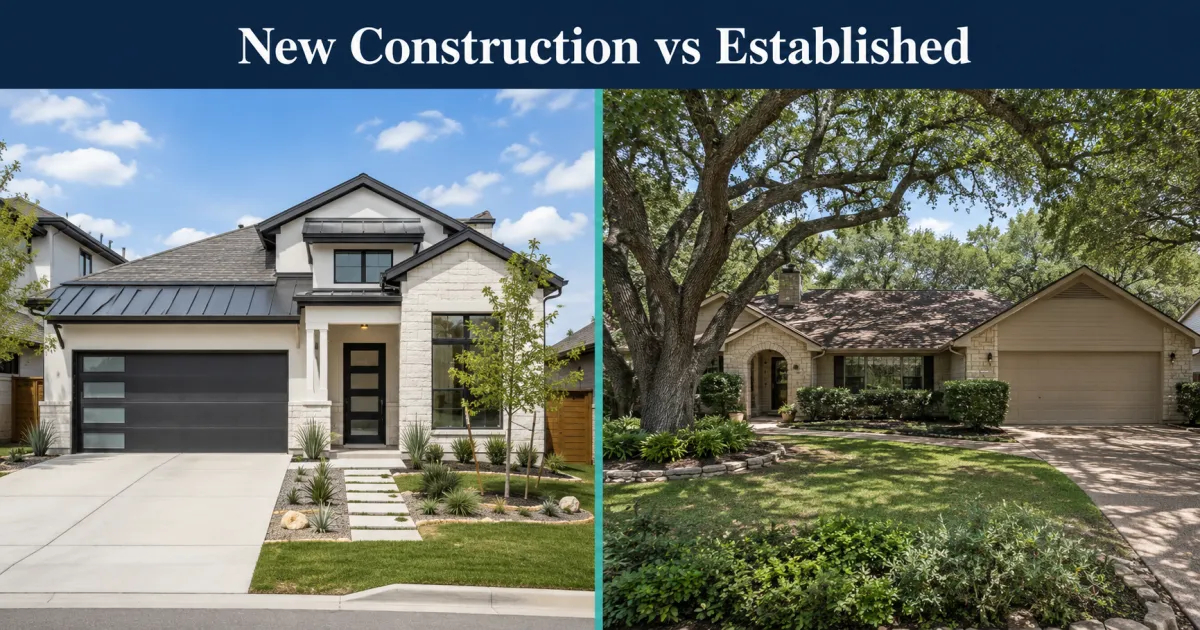
New Construction vs Established Homes in the Apple Corridor: What Buyers Are Weighing
If you work at Apple's Parmer campus, or anywhere along the north tech corridor, the first real fork in your home search is not a neighborhood. It is a decision about age. Do you buy new construction on the growing edge north and east of the campus, or an established home in the 1970s-to-1990s neighborhoods that sit closer in along MoPac and 183? Both put you within a reasonable drive of your desk. They are not the same purchase, and the buyers who are happiest a year later are the ones who understood the tradeoff going in instead of falling in love with a model home or a shade tree and backing into everything else.
I am James Brinkman, a broker who works Northwest Austin, and this is the conversation I have with corridor buyers almost every week. Here is how the two options actually differ once you get past the marketing, and how to figure out which one fits the way you live.
What "the Apple corridor" actually covers
Apple's campus sits on Parmer Lane near the intersection with MoPac, on the north edge of Austin proper. When people say they want to live near Apple, they are really describing a band of housing that stretches in several directions from that point, and the housing stock changes character depending on which way you go.
Go south and west from the campus, back toward MoPac and 183, and you are in established Northwest Austin: neighborhoods like Milwood, Balcones Woods, Great Hills, Mesa Park, and the broader 78750 and 78759 zip codes. These were built out largely between the 1970s and the 1990s. The trees are mature, the lots are often larger than anything being platted today, and the homes have been through at least one or two rounds of updating.
Go north and east, out toward and past Parmer, and you move into newer territory: master-planned sections, infill new construction, and communities that were still cow pasture twenty-five years ago. This is where you find true new construction and near-new resale, along with the amenity centers, uniform streetscapes, and open-concept floor plans that buyers coming from California and the Pacific Northwest often expect.
The commute math is close enough between the two that it rarely decides the question on its own. From the established 78750 and 78759 neighborhoods, the Parmer campus is a short, mostly predictable drive in normal conditions. From the newer communities farther north, you are often physically closer to the campus but feeding onto Parmer with everyone else, which can erase the distance advantage at peak times. If commute is your deciding factor, read our companion piece on what Apple corridor buyers should know about commute versus price tradeoffs before you narrow the map.
The lot: the difference you cannot renovate your way out of
This is the single biggest structural difference between the two options, and it is the one buyers underweight the most.
Established neighborhoods: bigger, greener, irregular
Homes built in the 1970s through the 1990s in Northwest Austin generally sit on larger lots than anything a builder plats today. You get more separation from your neighbors, mature oaks and elms that actually shade the house in July, and irregular lot shapes that produce cul-de-sacs, greenbelt backs, and interior lots with real yards. Mature tree canopy is not a cosmetic detail in Central Texas. It measurably lowers what you spend cooling the house in summer and it is the one thing a new community cannot buy back for fifteen or twenty years.
The tradeoff is that an older lot often comes with older infrastructure around it: aging cast-iron or clay sewer laterals, larger trees whose roots find those laterals, and drainage that was engineered to a 1980s standard. None of that is a dealbreaker, but it is a set of inspection items you take seriously.
New construction: smaller, flatter, uniform
Newer communities are platted tighter. Land near the corridor is expensive, so builders maximize the number of homes per acre. You get a smaller yard, less distance to the neighbor's window, and young landscaping that will not shade anything for a decade. What you get in exchange is a flat, square, predictable lot with modern drainage and utilities sized to current code.
If a big private yard and tree canopy are central to why you are moving to Texas, the established neighborhoods deliver that in a way new construction structurally cannot. If you would rather have a low-maintenance yard and a house that feels brand new, the newer communities are built for you.
Property taxes: check the rate on the specific address, every time
This is where corridor buyers get surprised, and it is worth being precise because it is a real dollar difference and because it is a market claim I will not estimate for you. Texas has no state income tax, and the tradeoff is relatively high property taxes funded at the local level. But the effective rate is not uniform across the corridor.
Many newer master-planned communities on the growing edge were developed using a Municipal Utility District, or MUD, or a Public Improvement District, or PID, to finance the roads, water, and drainage that made the raw land buildable. Those districts levy an additional assessment on top of the base city, county, and school taxes. The result is that two homes of identical price, one in an established neighborhood and one in a newer MUD community, can carry meaningfully different annual tax bills. The MUD portion typically declines over time as the district's bonds are paid down, but on the day you buy, it is real money in your monthly payment.
The established neighborhoods closer in are generally inside long-settled taxing jurisdictions without a separate MUD layer, though you should still confirm the exact rate rather than assume. The rule for every buyer, new or established: pull the actual tax rate and any district assessments for the specific address before you decide what you can afford, and ask your lender to escrow to the real number, not a rough guess. A one point difference in effective tax rate on a home in the mid-hundreds of thousands is a car payment. Confirm figures with the appraisal district and your lender, and treat tax and title questions as ones for a professional, not a blog.
Condition and what you are actually buying
The new construction promise, and its asterisks
The appeal of new construction is obvious: nothing to replace, modern insulation and windows, a floor plan designed around how people live now, and a builder warranty. For a buyer who does not want to manage a single project for a few years, that is genuinely valuable.
The asterisks are worth knowing. A brand-new house still needs an independent inspection. Production builders move fast, and a third-party inspector working for you, not the builder, routinely finds items worth correcting before closing. New communities are also often still under active construction, which means living next to framing crews, dust, and heavy trucks until the section finishes out. And the amenity centers, greenbelts, and tree canopy that will eventually define the community are frequently a promise on a site plan rather than something you can walk today.
The established home: condition is the whole game
With an established home, you are not buying a warranty, you are buying a specific house at a specific point in its maintenance life. The critical question is where it sits on the update curve. A 1985 home that has had its roof, HVAC, windows, sewer line, and kitchen brought current is a very different asset from the identical floor plan next door that still has original systems and a wall of dark cabinets. The two can list at prices that look similar and cost wildly different amounts to actually live in.
This is why condition tier matters more than list price in the established neighborhoods. A partially updated home priced as if it were fully renovated is the most common trap. If you want the full framework for reading condition, our sellers' guide on how to sell a partially updated Northwest Austin home without overpricing it lays out the same tiers from the other side of the table, which is useful to understand as a buyer.
Floor plans and how the two eras live differently
Homes from the 1970s and 1980s were designed around formal rooms: a living room, a separate family room, a dining room, a kitchen with walls around it. Many established Northwest Austin homes have been opened up over the years, but plenty still carry that compartmentalized layout. Some buyers love it, some find it dated, and it is genuinely a matter of taste rather than a defect.
New construction is built around the open concept: kitchen, dining, and living flowing into one great room, a downstairs flex space, and a primary suite scaled to modern expectations. If you have toured new homes and decided that is how you want to live, an established home usually gets you there only after a wall-removal renovation, which is doable but is a project with a budget and a timeline.
One underrated point in the established homes: ceiling height, primary bathroom size, and closet space were smaller standards in the 1980s. Relocating buyers from newer markets sometimes tour an established home, love the lot and the location, and then feel the primary bathroom is cramped by what they are used to. That is real, and it is worth being honest with yourself about which features you can live with and which you cannot.
Schools: verify the assignment, do not assume by distance
The Apple corridor straddles more than one school district and multiple attendance zones. Round Rock ISD covers a large share of the established Northwest Austin neighborhoods and feeds sought-after pathways like the Westwood High School feeder. Austin ISD covers other pockets. Newer communities north and east can fall into Round Rock, Pflugerville, or Leander depending on the exact location.
The mistake is assuming that because two homes are both "near Apple," they feed the same schools. They frequently do not. School assignment in Texas is set at the address level, and it does not move with price or with how close the campus looks on a map. If schools matter to your purchase, confirm the specific assignment for any address you are serious about, directly with the district, and understand that a newer home a few miles farther out may sit in an entirely different district than the established home you were comparing it to. We cover how much this can move price in how school zoning by address changes what you pay in Northwest Austin.
Resale: what each option does when you sell
Buyers rarely think about the sale on the way in, but the two options behave differently on the way out.
Established Northwest Austin neighborhoods have a long track record. The buyer pool is deep and it is not dependent on a builder's inventory. When you sell a well-located, well-updated established home, you are competing against a limited number of comparable resales, and the mature location and lot are assets that hold value. The risk is condition: an un-updated home in an established neighborhood sells at a discount that only widens as buyer expectations rise.
New construction resale is more complicated in the first several years. When you go to sell a three-year-old home, you may be competing not only against other resales but against the builder still selling brand-new homes down the street, sometimes with incentives you cannot match. In a fast-appreciating stretch that is not a problem. In a flat or soft stretch, being a lightly-used home next to a builder's new-home sales office is a genuine headwind. Once a community fully builds out and the builder leaves, that pressure lifts, but the timing of your sale relative to build-out matters.
For a fuller picture of how the corridor's established and newer neighborhoods fit together, the North Austin neighborhood guide for the MoPac, 183, and Parmer tech corridor maps the whole area.
Cost beyond the price: what each option asks of you monthly
The sticker price is only the start. New construction and established homes ask for money in different places.
New construction tends to carry: potentially higher effective taxes if there is a MUD or PID, HOA dues that fund the amenities, and low near-term maintenance because everything is new. Your predictable monthly cost is higher on the fixed side and lower on the surprise side, at least for the first several years.
An established home tends to carry: often lower effective taxes and lower or no HOA in some neighborhoods, but a real maintenance reserve you should be funding, because a 1980s home will eventually ask for a roof, an HVAC system, a water heater, and possibly a sewer line. Your fixed monthly cost can be lower, but your responsibility for capital items is higher and less predictable. Budget for it rather than being surprised by it.
So which one should you buy?
Here is the honest fit check I give corridor buyers.
Lean toward established Northwest Austin if: you want a big shaded lot and mature trees, you value a deep long-term resale market that does not compete with a builder, you are targeting a specific school feeder like Westwood, you want to be closer in with a shorter and more predictable drive to the Parmer campus, and you are comfortable either buying an already-updated home or managing a renovation to get the layout you want.
Lean toward new construction if: you want a house where nothing needs replacing for years, you prefer an open-concept floor plan and a larger modern primary suite without renovating for it, you are fine with a smaller yard and young landscaping, you want a builder warranty and low near-term maintenance, and you have confirmed the specific tax rate, any MUD or PID assessment, HOA dues, and school assignment for the exact home so there are no surprises in the payment.
Neither answer is universally right. The buyers who regret their choice are almost always the ones who optimized for one feature, a shade tree or a shiny kitchen, and ignored the taxes, the schools, the lot, or the resale profile that came attached. Walk both types of home, in person, before you decide. The comparison usually makes itself once you have stood in each.
Frequently Asked Questions
Is it better to buy new construction or an older home near Apple in Austin?
Neither is universally better. New construction gives you modern floor plans, low near-term maintenance, and a warranty, but smaller lots, young landscaping, and sometimes higher effective taxes from a MUD or PID. Established Northwest Austin homes give you bigger shaded lots, deeper resale markets, and often a shorter drive to the Parmer campus, but you take on condition risk and eventual capital maintenance. Match the choice to whether you value a private yard and location or a turnkey modern house.
Why are property taxes higher in some new Austin communities?
Many newer master-planned communities on the growing edge were built using a Municipal Utility District (MUD) or Public Improvement District (PID) to finance roads, water, and drainage. Those districts add an assessment on top of city, county, and school taxes, which raises the effective tax rate. The MUD portion usually declines over time as the bonds are paid down. Always pull the actual tax rate and any district assessment for the specific address before you commit, and confirm with the appraisal district and your lender.
Do new and established homes near Apple feed the same schools?
Often not. The corridor straddles Round Rock, Austin, Pflugerville, and Leander school districts depending on the exact location. A newer home a few miles north can be in an entirely different district than an established home closer in. School assignment is set at the address level, so confirm the specific feeder pattern with the district for any address you are serious about rather than assuming by distance to the campus.
Are established Northwest Austin homes a better long-term investment than new construction?
They tend to have a more stable resale profile because the buyer pool is deep and you are not competing against a builder still selling brand-new homes nearby. New construction can be harder to resell in its first several years if the builder is still active in the community and offering incentives. Once a community fully builds out, that pressure eases. Condition is the swing factor for established homes: an un-updated home sells at a widening discount, while an updated one in a strong location holds value well.
What should I inspect on a brand-new home before closing?
Hire your own independent inspector, not the builder's. Production builders move quickly and a third-party inspection working for you routinely finds correctable items before closing. Also confirm which amenities and greenbelts actually exist today versus what is promised on the site plan, and understand you may be living next to active construction until the section finishes. A warranty helps, but it does not replace an independent inspection.
Is the commute to Apple actually shorter from newer communities farther north?
Not always. Newer communities can be physically closer to the Parmer campus but feed onto the same roads as everyone else at peak times, which can erase the distance advantage. Established neighborhoods closer in along MoPac and 183 often have a shorter and more predictable drive. Drive both routes at the time you would actually commute before you let distance-on-a-map decide it for you.
Do I need a bigger maintenance budget for an older Northwest Austin home?
Yes. An established 1980s or 1990s home will eventually ask for capital items like a roof, HVAC, water heater, and possibly a sewer line. That does not make it a bad buy, it makes it a home you fund a maintenance reserve for. New construction shifts your cost toward fixed monthly items like HOA dues and potentially higher taxes, with low near-term repair surprises. Neither is free, they just ask for money in different places.
What is the biggest mistake buyers make choosing between new and established?
Optimizing for one feature and ignoring the rest. Buyers fall in love with a shade tree or a model-home kitchen and back into the taxes, the schools, the lot size, and the resale profile without weighing them. Walk both types of home in person, pull the real numbers on taxes and schools for the specific address, and choose the whole package rather than the one detail that caught your eye.
The bottom line
The Apple corridor gives you a real choice, not a false one. Established Northwest Austin buys you land, trees, location, and a proven resale market, at the cost of condition risk and future maintenance. New construction buys you a modern turnkey house and low near-term upkeep, at the cost of a smaller lot, potentially higher taxes, and a trickier early resale. The right pick is the one whose tradeoffs you can live with for years, not the one with the feature that photographs best. If you want to walk both against your specific commute, budget, and school priorities, that is exactly the conversation I have with corridor buyers, and it is worth having before you write an offer.
