What Relocating Buyers Should Know About RRISD vs AISD Boundaries Where the Two Districts Meet in Northwest Austin
Here is the mistake I watch relocating buyers make more than almost any other: they fall in love with a neighborhood name, read that it has "great schools," and assume every house on every street in that neighborhood feeds the same schools. In most of Northwest Austin that assumption is fine. But there are specific places where the Round Rock ISD and Austin ISD boundary runs straight through a neighborhood, and two houses a few streets apart go to entirely different districts. If schools matter to you, this is the detail that can make or break a purchase, and it is invisible from a listing photo.
This guide explains where the two districts meet in Northwest Austin, why a neighborhood gets split, what actually changes when you cross the line, and exactly how to verify the assignment for a specific address before you write an offer. If you are new to the area entirely, pair this with my broader Living in 78750 and 78759 guide and my overview of Round Rock ISD versus Austin ISD in Northwest Austin.
The short version: zip code does not equal school district
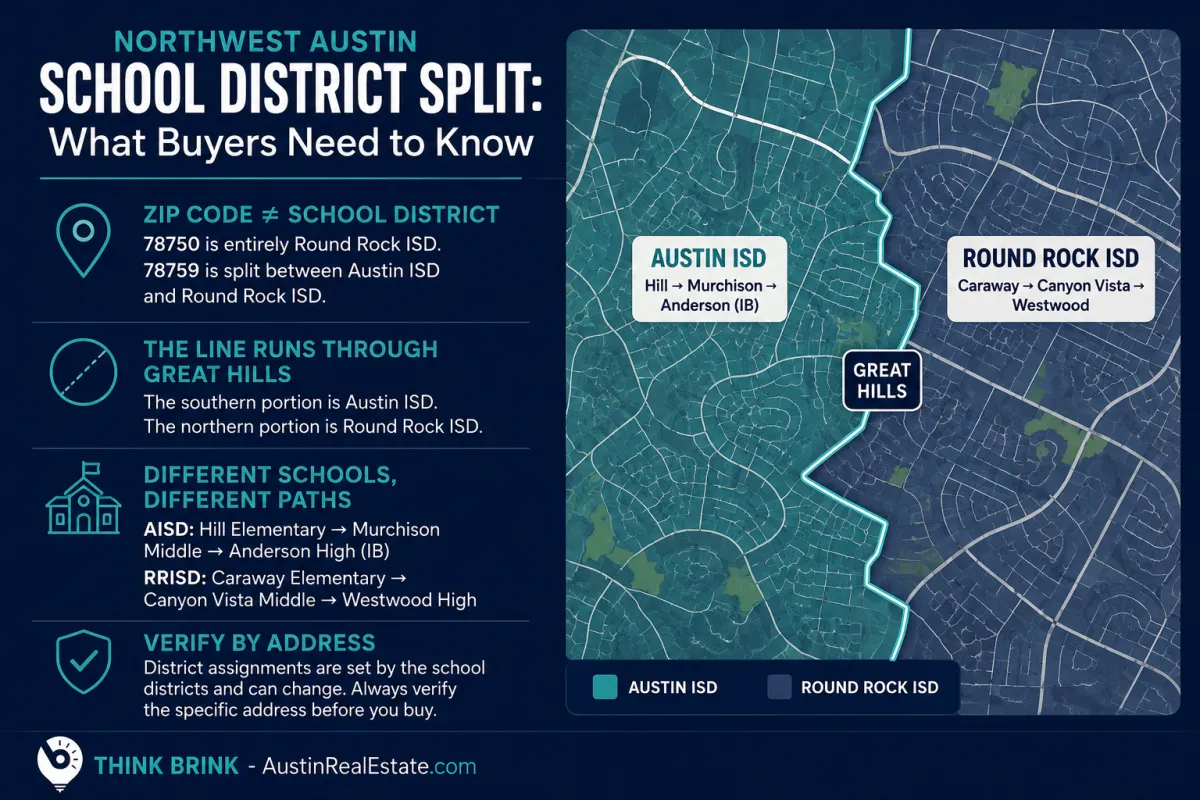
The cleanest way to hold this in your head is a simple rule. In Northwest Austin, 78750 sits entirely within Round Rock ISD. There is no district split to worry about inside that zip code. The complication lives in 78759, which is served by more than one district. Parts of 78759 are Austin ISD, parts are Round Rock ISD, and the western edge of the broader area even touches Leander ISD. So the moment a buyer tells me "we want to be in 78759 for the schools," my first question is: which schools, because 78759 does not have one answer.
Zip codes are postal delivery boundaries. School district boundaries are drawn by the districts and the state and follow completely different lines. They were never designed to match, and in the places where they cross, you get neighborhoods that are half one district and half another. That is not a glitch. It is just how two unrelated boundary systems overlap.
Where the line actually runs
The most important split for buyers to understand is in and around Great Hills. Great Hills is not a single-district neighborhood. The southern end sits in Austin ISD and the northern end sits in Round Rock ISD, and the line runs through the neighborhood itself.
The Austin ISD side
Homes on the southern portion, in the area nearer Great Hills Park and the Sierra Arbor Estates section, fall into Austin ISD. The AISD pathway there runs Hill Elementary to Murchison Middle School to Anderson High School. That is a strong, well-regarded Austin ISD feeder in its own right, and Anderson in particular carries a reputation and an International Baccalaureate program that many buyers actively seek out. If you want the full breakdown of that pathway, I covered it in the Anderson High School feeder guide.
The Round Rock ISD side
Homes on the northern portion of Great Hills fall into Round Rock ISD, where the pathway runs toward Caraway Elementary, Canyon Vista Middle School, and Westwood High School. That Canyon Vista to Westwood feeder is one of the most sought-after in my entire coverage area. So this is the striking part: within one named neighborhood, you can buy into either a top Austin ISD feeder or a top Round Rock ISD feeder depending on which side of the internal line your house sits. Neither is a downgrade. But they are genuinely different, and you should choose on purpose, not by accident.
Other pockets in and around 78759 sort the same way at the subdivision level. As a general illustration of how granular this gets, the Fairway at Great Hills area lands on the Austin ISD side while neighboring Barrington Oaks sits in the Round Rock ISD attendance zone. The lesson is not to memorize which subdivision is which, because those assignments can be adjusted over time. The lesson is that subdivision-level and even street-level differences are real here, and the only reliable answer comes from checking the specific address.
What actually changes when you cross the line
Buyers sometimes assume the district boundary is a quality line, with one side obviously better. In this part of Northwest Austin, that framing is wrong. Both Round Rock ISD and Austin ISD run highly regarded schools in this area, and the split here is more about which strong option you get than about good versus bad. Still, several real things change when you cross from one district to the other, and they are worth understanding.
The feeder pattern and the high school
The most concrete change is the schools your kids actually attend. Round Rock ISD side points you toward the Canyon Vista and Westwood pathway. Austin ISD side points you toward the Murchison and Anderson pathway. These are different schools with different cultures, programs, schedules, and communities. If you have a specific reason to prefer one high school, IB program, or feeder culture, the district line is the thing that delivers it. For a direct comparison of the two flagship high schools, see Westwood versus Anderson High.
District operations and calendars
The two districts operate independently, which means different school calendars, different transfer and enrollment policies, different transportation boundaries, and different bond and program priorities. None of that shows up in a home listing, but all of it affects daily family life. If you have a child already enrolled somewhere or a specific program need, the operational differences between the districts can matter as much as the ratings.
What does not change: your city and your taxing picture is its own question
One thing I want to be careful about: the school district your home is assigned to is a separate question from which county and which city services apply, and from the specific tax rate on the property. School district is one line on a Central Texas property tax bill, and district lines, county lines, and city lines do not move together. Do not assume that because you know the school district you know the full tax picture. Verify the actual tax rate and the actual taxing entities for the specific property. Property tax treatment is also a topic where you should confirm details with a CPA or the county appraisal district rather than relying on a general guide.
Why relocating buyers get caught by this
Local buyers who grew up here often already know Great Hills is split. Relocating buyers almost never do, and the way homes are marketed makes it easy to miss. A listing may say "highly rated schools" or name a district without specifying the actual feeder for that exact address. National real estate portals frequently attach nearby or approximate schools to a listing rather than the verified attendance zone. I have seen a portal show a home with one district's schools when the address was actually assigned to the other. Those portal school labels are a starting point, not a source of truth.
The stakes are highest for buyers who are moving specifically for schools, which describes a lot of the tech-industry families relocating into Northwest Austin from California and the Pacific Northwest. If you are moving your family across the country and the school assignment is a primary reason you chose the neighborhood, an unverified assumption is not a risk worth taking. For more on what relocating families tend to get wrong here, my guide for California and Pacific Northwest buyers covers the broader adjustment.
How to verify the school assignment for a specific address
This is the part that actually protects you. Do not rely on the listing, the portal, or even a neighborhood reputation. Verify at the address level, and do it before you are emotionally committed to a house.
- Go to the district directly. Both Round Rock ISD and Austin ISD publish address-based school lookups. First figure out which district the address is in, then use that district's official attendance lookup to get the exact elementary, middle, and high school assignment.
- If you are near a boundary, call the district. When a home sits close to the line, or when two sources disagree, call the district's enrollment or boundary office and confirm in writing. A phone confirmation with a name and date is worth having in your file.
- Ask about the timing. Attendance boundaries can be adjusted, and a home near a line today could theoretically be affected by a future rezoning. Ask the district whether any boundary changes are under consideration for the area.
- Do not let the assignment be a contingency you skip. If schools are the reason you are buying, treat verification as non-negotiable, the same way you would a foundation inspection.
I do this verification with every buyer I represent who is near one of these boundaries, because the cost of getting it wrong is a family that moved for a school their address does not actually feed.
Practical guidance if you are shopping near the boundary
If you have identified that your target area straddles the line, a few strategy points help. First, decide which district you actually want and why, rather than treating "either is fine" as a plan, because when you are comparing two homes on opposite sides, that decision breaks the tie. Second, understand that pricing does not always cleanly reflect the district split, so a well-bought home on your preferred side is sometimes available at a similar number to the other side. Third, keep in mind that both districts here are strong, so you are rarely forced to choose between a home you love and a school you trust. You usually can get both if you shop with the boundary in mind from the start.
Frequently asked questions
Is 78759 in Round Rock ISD or Austin ISD?
Both, depending on the address. The 78759 zip code is split among districts, with parts in Austin ISD, parts in Round Rock ISD, and the broader western edge touching Leander ISD. You cannot determine the district from the zip code alone. You have to verify the specific address.
Is all of 78750 in Round Rock ISD?
Yes. The 78750 zip code sits entirely within Round Rock ISD, so there is no district split to worry about inside that zip code. You should still confirm the exact elementary, middle, and high school feeder by address, since those assignments are set at the address level.
Which schools does the Great Hills area feed?
It depends on which part. Great Hills is split. The southern end, nearer Great Hills Park and the Sierra Arbor Estates area, is Austin ISD and feeds Hill Elementary, Murchison Middle, and Anderson High. The northern end is Round Rock ISD and points toward the Caraway, Canyon Vista, and Westwood pathway. Verify the specific address, because the line runs through the neighborhood.
Why would one neighborhood be in two different school districts?
Because zip code lines, city lines, county lines, and school district lines are drawn by different authorities for different purposes and were never meant to match. Where the Round Rock ISD and Austin ISD boundary crosses a neighborhood like Great Hills, homes on one side go to one district and homes on the other side go to the other, even though they share a neighborhood name.
Can I trust the schools listed on a real estate portal?
Treat them as a starting point only. National portals often attach nearby or approximate schools to a listing rather than the verified attendance zone, and I have seen them show the wrong district for a boundary-area home. Always confirm the assignment through the district's official address lookup before relying on it.
Is one district clearly better than the other here?
No. In this part of Northwest Austin, both Round Rock ISD and Austin ISD run highly regarded schools, and the split is more about which strong option you get than about good versus bad. The Canyon Vista and Westwood pathway on the Round Rock ISD side and the Murchison and Anderson pathway on the Austin ISD side are both feeders buyers actively seek. Choose based on program fit and family needs, not an assumption that one side is a downgrade.
How do I confirm the exact school assignment before I buy?
Determine which district the address is in, then use that district's official address-based attendance lookup to get the specific elementary, middle, and high school. If the home is near the boundary or sources disagree, call the district's enrollment office and get written confirmation, and ask whether any boundary changes are under consideration. If schools are your reason for buying, make this a firm step, not an afterthought.
Does the school district determine my property taxes?
The school district is one component of a Central Texas property tax bill, but it is not the whole picture. County lines, city lines, and any special districts are separate and do not always move with the school district boundary. Verify the actual tax rate and taxing entities for the specific property, and confirm any tax questions with a CPA or the county appraisal district rather than relying on a general estimate.
The bottom line
Northwest Austin is one of the places where the phrase "great schools" is not specific enough to act on. In 78750 you are cleanly in Round Rock ISD. In 78759, and especially in Great Hills, the district line runs through the neighborhood, and two nearby homes can feed entirely different, and both strong, districts. The good news is that this is a solvable problem. It takes one address-level verification with the district, done before you are attached to a house, to know exactly what you are buying.
If you are relocating and want help identifying which side of the line a specific home is on, or figuring out which district feeder actually fits your family, that is a core part of what I do for buyers here. Reach out through Think Brink and we will get the assignment nailed down before you fall for the photos.
This article is general real estate information, not legal, tax, or enrollment advice. Confirm school assignments directly with the relevant district and any property tax questions with a CPA or the county appraisal district.
