Anderson High School Feeder Guide: What the Austin ISD Pathway Means for Northwest Austin Buyers
The Anderson High feeder is one of the two or three school pathways that quietly set prices across a big slice of Northwest Austin, and most buyers do not understand how it actually works until they are already competing for a house inside it
If you are shopping in the 78759, 78757, and 78731 parts of Northwest and North-Central Austin, there is a good chance the Anderson High School feeder is influencing what you pay whether you have thought about it in those terms or not. Anderson is the anchor high school for a large, well-established, and geographically sprawling part of Austin ISD, and its reputation pulls buyers into a set of neighborhoods that would otherwise trade at very different prices. The problem is that the Anderson feeder is not one clean, uniform pathway. It is a high school fed by more than one middle school and a long list of elementary schools that vary widely in rating and character, and the difference between two homes a mile apart can be the difference between a top-tier elementary and a struggling one, even though both roll up to the same high school.
This guide explains what the Anderson feeder actually is, which schools sit inside it, how the pathways differ, what that means for the price you pay, and how to make sure the address you are about to offer on lands where you think it does. I am going to be honest about the parts that are strong and the parts that are uneven, because pretending a feeder is uniformly excellent is exactly the kind of thing that gets buyers into trouble.
What the Anderson High feeder is, and why it matters to your budget
Anderson High School sits in Northwest Austin and serves as the comprehensive high school for a broad attendance zone that stretches across several established neighborhoods on the west and north-central sides of the district. In Austin ISD, as in every Texas district, your child's school assignment is determined by your home's street address, not by the neighborhood's name or reputation. That single fact is the entire reason a school feeder shapes real estate prices. When a high school is desirable, demand concentrates on the homes assigned to it, and that concentrated demand shows up as a price premium on those specific addresses.
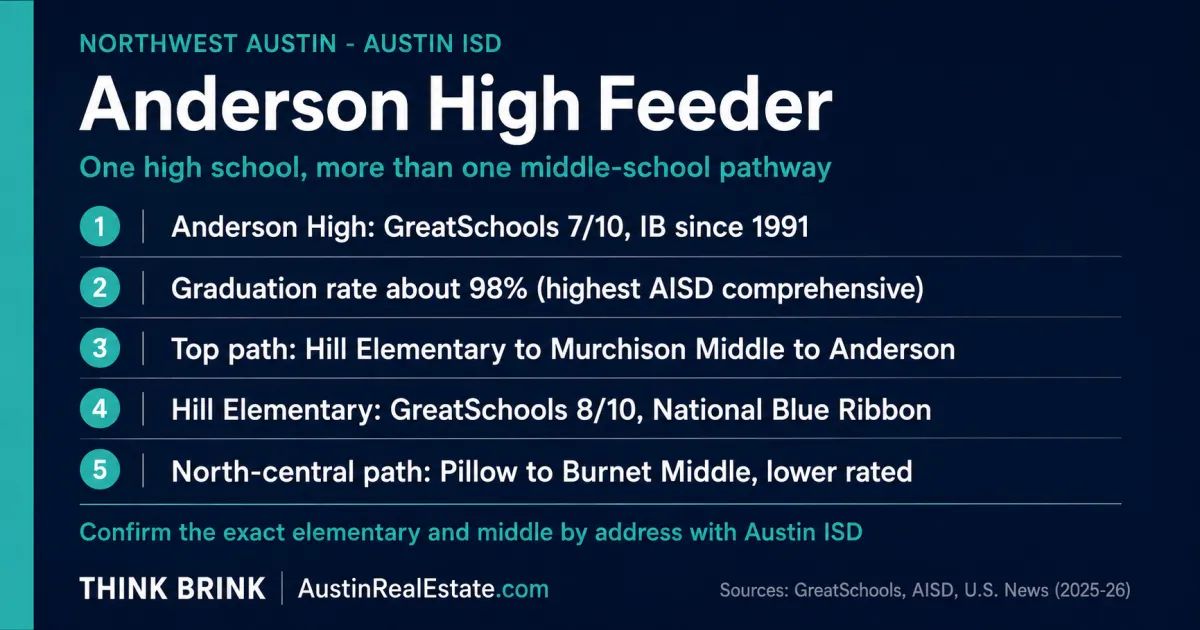
Anderson is desirable for reasons that hold up to scrutiny. It carries a GreatSchools rating of 7 out of 10 on current 2025-2026 data, its graduation rate runs about 98 percent, which is the highest among Austin ISD's comprehensive high schools and well above the Texas state average of roughly 90 percent, and it has run an International Baccalaureate program since 1991, making it the oldest IB program in central Texas and the only IB high school in Austin ISD. Those are not marketing claims. They are the kind of specific, verifiable facts that make a feeder a genuine value driver rather than a talking point.
What this means for you as a buyer is straightforward: part of the price on a home inside the Anderson zone is paying for the school assignment, and that part of the price does not disappear when the market softens, because the school assignment does not soften. It is one of the more durable components of value in this part of the city. Understanding that is the first step to buying intelligently inside the feeder, and it connects directly to a broader truth about this market that I covered in how school zoning by address changes what you pay in Northwest Austin.
The feeder is not one pathway - it runs through more than one middle school
Here is the single most important thing to understand about Anderson, and the thing that trips up the most buyers: Anderson does not sit at the top of one clean elementary-to-middle-to-high pathway. It draws from more than one middle school, and those middle school pathways are not equal.
The best-known and generally highest-rated pathway into Anderson runs through Murchison Middle School. Murchison carries a GreatSchools rating around 7 out of 10 on current data and is widely regarded as the primary Northwest Austin feeder into Anderson. The elementaries that feed the Murchison pathway include Hill Elementary, Doss Elementary, Davis Elementary, and Summitt Elementary. Hill Elementary in particular is a standout: it is a National Blue Ribbon School with a GreatSchools rating around 8 out of 10 and a Niche grade of A. When people talk about the strong version of the Anderson feeder, they usually mean the Hill to Murchison to Anderson pathway, and homes assigned to that specific chain command a real premium.
Anderson also draws students from other elementaries and, depending on the year and the specific boundaries, additional middle school assignments on the north-central side of its zone. Pillow Elementary, for example, feeds toward Burnet Middle School and on to Anderson from the North Shoal Creek area, and Pillow carries a materially lower GreatSchools rating, in the low single digits on current data, than Hill does. That is not a knock on the families or the teachers there. It is a factual statement about how test-score-driven ratings land, and it matters enormously to a buyer, because two homes both truthfully described as being "in the Anderson feeder" can sit on completely different elementary pathways.
Why "in the Anderson feeder" is not enough information
When a listing says a home is in the Anderson High feeder, that is a true statement that tells you almost nothing about the elementary and middle school your child would actually attend. A home feeding Hill and Murchison and a home feeding a lower-rated elementary and Burnet Middle are both, accurately, "Anderson feeder" homes. If your children are young, the elementary assignment will shape the next several years of your daily life far more than the high school will. So the question is never "is this in Anderson?" The question is "which elementary and which middle school does this exact address feed, on the current boundaries?" I will come back to how to confirm that, because it is the single highest-leverage thing you can do before you offer.
What the IB program at Anderson actually is, and who it serves
The International Baccalaureate program is the piece of Anderson's profile that gets mentioned most and understood least. IB is a rigorous, internationally recognized curriculum that emphasizes higher-order thinking, interdisciplinary connections, research, and community service, with an explicit global perspective. Anderson has run it since 1991, which gives it something most IB programs cannot claim: more than three decades of institutional experience, trained faculty, and a track record with universities that recognize IB coursework.
The honest nuance here is that IB is not automatically the right fit for every student, and it is not the only academic track at Anderson. The school also offers Advanced Placement coursework, and many strong students take a mix. IB is a full diploma program that is demanding and structured, and it rewards students who thrive in that environment. For a family whose student wants that kind of rigor and international framing, Anderson's long-established program is a genuine asset that is hard to replicate. For a family whose student would do better with the flexibility of an AP-heavy schedule, Anderson still delivers that. The point is that the IB designation is a real, differentiated academic offering, not a bumper sticker, and it is one of the reasons the feeder holds the reputation it does.
If you are weighing Anderson's Austin ISD pathway against the Round Rock ISD options a little to the west, which run through schools like Westwood and its own IB program, that comparison deserves its own careful look. I break down how the two districts differ for buyers in Round Rock ISD vs Austin ISD in Northwest Austin, because the choice between them drives which neighborhoods you should even be looking at.
Which neighborhoods sit inside the Anderson feeder
The Anderson zone covers a broad swath of established Northwest and North-Central Austin, and the neighborhoods inside it span a wide range of price points, housing stock, and character. On the stronger Hill-and-Murchison side of the zone, you find established, leafy, higher-priced neighborhoods with mid-century and later ranch and traditional homes. On the North-Central side, closer to the Burnet Road corridor, you find neighborhoods like North Shoal Creek with 1960s and 1970s single-story ranch stock at more attainable prices, feeding the Pillow-and-Burnet-Middle pathway.
That spread is the practical opportunity in the Anderson feeder. If your priority is the top-rated elementary pathway, you pay up for the Hill and Murchison side. If your priority is getting into the Anderson High feeder at an attainable price and you are comfortable with a weaker elementary rating, or you plan to use a private or magnet option for the early grades, the North-Central pockets give you a way in. Neither choice is wrong. They are different tradeoffs, and knowing which one you are making is the whole game. For a sense of how the more attainable end of the feeder lives day to day, my guide to what buyers should know about North Shoal Creek covers one of the neighborhoods that offers the Anderson high school pathway without the western hillside price.
The value pocket most buyers miss
The most overlooked value play inside the Anderson feeder is a home on the North-Central side that feeds Anderson High but sits at a price set by its more modest elementary rating. If the high school years are what matter most to your family, and you have a plan for the elementary years, you can capture the durable Anderson High premium while paying a price partly discounted by the elementary assignment. That is a legitimate and often smart strategy. The mirror-image mistake is paying the full Hill-and-Murchison premium for a home you assumed fed that pathway but actually does not. Both outcomes come down to confirming the exact assignment before you offer.
How the feeder shows up in price
I am going to keep the pricing here qualitative rather than quote a single median, because feeder-level price data blends too many neighborhoods, housing vintages, and condition tiers to produce an honest number, and a blended figure would mislead more than it informs. What holds true across the cycle is more useful than a snapshot that may be stale by the time you read this.
Inside the Anderson zone, three factors drive price more than almost anything else. The first is the elementary and middle school pathway, with the Hill-and-Murchison side commanding a premium over the North-Central pathways. The second is the neighborhood's housing vintage and lot quality, since a renovated home on a large established lot prices very differently from a dated ranch on a smaller one. The third is condition, which inside older Northwest Austin housing stock is often the single biggest swing factor on any individual home. A buyer who understands all three can read why one Anderson-feeder home costs far more than another and decide which premiums are worth paying for their situation.
What does not change with the market is the underlying reason the feeder holds value: a high school with a 98 percent graduation rate, a three-decade IB program, and a durable reputation does not lose its appeal when interest rates move. That is why school-driven premiums tend to be among the stickier parts of a home's value in this part of Austin, a point I make in more detail in the North Austin neighborhood guide.
Commutes and daily life from the Anderson zone
The Anderson feeder's geography is genuinely convenient for the employers most of my buyers care about, and that is part of why it draws the demand it does. The zone sits with strong access to MoPac and US 183, the two arterials that connect Northwest Austin to the rest of the region. From most of the Anderson neighborhoods, the North Burnet and Domain job core is a short drive, generally in the ten to twenty minute range depending on where in the zone you start and what time you leave. Apple's Parmer campus is a manageable drive north via MoPac or the surface routes. Downtown is typically a twenty to twenty-five minute drive via MoPac or Burnet Road outside of peak congestion.
The honest caveat is the same one that applies everywhere in this part of the city: MoPac and 183 both back up hard at rush hour, and the difference between a 7 a.m. departure and an 8:30 a.m. departure can be substantial. If your commute matters, drive your actual route at your actual commute time before you commit, rather than trusting an off-peak estimate. For a fuller picture of how these commutes really behave once you are living them, the guide to what relocating tech workers get wrong about Northwest Austin commutes is worth reading alongside this one.
On daily life, the Anderson zone benefits from being close to some of North Austin's best retail and dining corridors, including the Burnet Road strip and the Anderson Lane retail cluster, without most of its neighborhoods sitting directly on top of the traffic. You get amenity density nearby and quiet residential streets a few blocks in, which is a large part of the appeal of established Northwest Austin generally.
What to check before you offer on a home in the Anderson feeder
If a home in the Anderson zone is on your short list, here is the pre-offer checklist, ordered roughly by how expensive each item is to get wrong.
Confirm the exact elementary, middle, and high school assignment for the specific address. Do this directly with Austin ISD using the street address, not the neighborhood name. This is the single most important step, because "Anderson feeder" can mean Hill and Murchison or it can mean a lower-rated elementary and Burnet Middle, and the difference is worth a great deal of money and daily quality of life.
Verify the assignment near boundary edges especially carefully. Attendance boundaries can and do shift, and homes near the edge of the zone or near an internal elementary boundary are the ones most likely to feed something other than what you assume.
Understand which pathway premium you are paying. Decide whether you are paying for the Hill-and-Murchison side or getting Anderson High at a North-Central price, and make sure the price you are paying matches the pathway you are actually getting.
Read the home's true condition tier. Much of the Anderson zone is older established housing stock. Decide whether you are buying updated, partially updated, or dated, and price foundation, roof, HVAC, plumbing, and electrical honestly rather than paying an updated price for staged finishes over original systems.
Drive your commute at your real commute time. MoPac and 183 behave very differently at peak versus off-peak, so test the drive you would actually make.
Think about the full thirteen years, not just today. If your children are young, the elementary and middle assignments will matter for years before the high school ever does, so weigh the whole pathway rather than just the Anderson name.
Handle those six and the feeder will not surprise you after closing.
Frequently asked questions about the Anderson High feeder
What elementary and middle schools feed into Anderson High School in Austin?
Anderson High School draws from more than one middle school pathway. The best-known and generally highest-rated pathway runs through Murchison Middle School, fed by elementaries including Hill, Doss, Davis, and Summitt. Anderson also draws from other elementaries and, on the North-Central side of its zone, the Burnet Middle School pathway fed by schools such as Pillow Elementary. Because the pathways differ significantly in rating, always confirm the specific elementary and middle assignment for a given address with Austin ISD.
Is Anderson High School in Austin a good school?
By the measures buyers usually care about, yes. Anderson carries a GreatSchools rating of 7 out of 10 on current data, has a graduation rate around 98 percent that is the highest among Austin ISD comprehensive high schools, and has run an International Baccalaureate program since 1991, the oldest IB program in central Texas and the only one in Austin ISD. It is one of the stronger comprehensive high school profiles in the district.
What does the IB program at Anderson mean for my child?
The International Baccalaureate program is a rigorous, internationally recognized curriculum emphasizing higher-order thinking, research, interdisciplinary study, and community service. Anderson has offered it since 1991, giving it deep institutional experience. IB is demanding and suits students who thrive on structure and rigor. Anderson also offers Advanced Placement coursework, so students who prefer that flexibility are served too. IB is a genuine differentiated offering, not just a label.
Why do two homes both in the Anderson feeder cost such different amounts?
Because "in the Anderson feeder" describes only the high school. The elementary and middle school pathways inside the zone vary widely, with the Hill-and-Murchison side rated much higher than some North-Central pathways. Price also reflects each neighborhood's housing vintage, lot quality, and the individual home's condition. Two Anderson-feeder homes can therefore sit on entirely different elementary pathways at very different price points.
How do I find out which schools a specific address is zoned for?
Confirm it directly with Austin ISD using the exact street address, not the neighborhood name or a listing description. Attendance boundaries are set by address and can shift, so a broker's or listing's shorthand should never be your final answer. This is especially important near the edges of the zone and near internal elementary boundaries, where assignments are least predictable.
Can I get into the Anderson High feeder without paying top-tier prices?
Often yes. The North-Central side of the Anderson zone, in neighborhoods closer to the Burnet Road corridor, feeds Anderson High while sitting at prices partly set by more modest elementary ratings. If the high school years matter most to your family and you have a plan for the earlier grades, this can be a smart way to capture the durable Anderson High premium at a more attainable price. Confirm the assignment by address before you count on it.
Does the Anderson feeder cover Round Rock ISD schools too?
No. Anderson High School is part of Austin ISD. Some Northwest Austin neighborhoods a little to the west fall into Round Rock ISD instead, feeding schools such as Westwood High. The two districts are entirely separate, and which one a home belongs to depends on its address. If you are choosing between them, it is worth understanding how the districts differ before you narrow your neighborhood search.
Will a strong school feeder protect my home's value if the market softens?
School-driven premiums tend to be among the more durable parts of a home's value because the assignment does not change when interest rates or market conditions do. A high school with a 98 percent graduation rate and a three-decade IB program keeps its appeal through market cycles. That does not make a home immune to broader market moves, but the school-assignment component of value is generally stickier than most other factors.
The honest summary
The Anderson High feeder is a genuine value driver in Northwest and North-Central Austin, anchored by a high school with a 98 percent graduation rate, a three-decade International Baccalaureate program, and a durable reputation. But it is not one uniform pathway. It runs through more than one middle school and a wide range of elementaries, from the top-rated Hill-and-Murchison side to more modest North-Central pathways, and the difference between them is worth real money and years of daily life. The buyers who do well inside this feeder are the ones who stop asking "is this in Anderson?" and start asking "which elementary and which middle school does this exact address feed, on the current boundaries?"
If you know which pathway you want, whether that is paying up for the strongest elementary chain or capturing the Anderson High premium at a North-Central price with a plan for the early grades, the feeder can be one of the smartest places to buy in this part of the city. If you assume the name alone guarantees a uniform school experience, it can be an expensive misunderstanding. If you want help sorting which addresses feed which pathways, reading a home's real condition, and deciding which premiums are worth paying for your family's situation, that is exactly the conversation I am here to have.
