What California and Pacific Northwest Buyers Should Know Before Moving to Northwest Austin
California has been the single largest source of new Austin residents for years running, and that pattern continues into 2026. Bay Area tech workers, LA professionals, San Diego families, Seattle engineers - they show up in the Northwest Austin buyer pool consistently and for predictable reasons: Apple brought them here, or the math on their California equity finally tipped decisively, or they've been watching colleagues make the move and decided it was time.
Most of them arrive with good instincts about the broad strokes. They know Texas has no state income tax. They know Austin is cheaper than the Bay Area. They know the tech corridor is real and the schools in the neighborhoods they're targeting are strong.
What they consistently underestimate - or miss entirely until they're under contract - are the specifics that determine whether the move works the way they planned. The property tax reality. The summer. The car-dependency. What "established Northwest Austin neighborhood" actually means compared to what they're used to. And which of their California or Washington assumptions translate here and which ones need to be recalibrated before they buy.
This post is the version of that conversation you should be having before you make an offer, not after you've already closed.
Is Northwest Austin a Good Place to Live? What Buyers Should Actually Know
Why Northwest Austin Specifically
Most California and Pacific Northwest buyers searching Austin's tech corridor end up in a relatively concentrated geography. Apple's Parmer Lane campus anchors the search - it's the largest single private employer in the Austin metro and the reason a significant percentage of West Coast tech workers are making this move. The neighborhoods that put buyers within a reasonable daily commute of Apple while offering the school access, established character, and lot sizes that West Coast buyers are accustomed to are concentrated in 78750, 78759, and 78726.
Buyers from the Bay Area who valued the established-neighborhood character of neighborhoods like Palo Alto, Cupertino, Los Altos, and the hillier parts of Berkeley tend to respond strongly to the established Northwest Austin neighborhoods - Great Hills, Canyon Creek, Spicewood Estates, Balcones Woods. The winding streets, the mature oak canopy, the terrain variation, the community character - these things are recognizable in ways that the flat newer master-planned suburbs further north are not.
Buyers from Los Angeles - particularly the Westside, the South Bay, and the San Fernando Valley - often navigate toward Northwest Austin for the combination of lot sizes, school quality, and the kind of suburban residential character that Austin's central neighborhoods don't deliver.
Seattle and Pacific Northwest buyers, for whom no state income tax is already the baseline, tend to be focused specifically on the Apple commute, the school district, and the physical character of the neighborhoods. The financial argument is more specifically about housing cost and equity deployment than income tax savings.
Understanding why Northwest Austin specifically is the landing zone for so many West Coast relocators helps frame the specifics of what to look for and what to watch out for.
Northwest Austin vs Cedar Park: Which One Actually Fits Your Situation?
The Tax Math: The Real Numbers Most People Don't Calculate Correctly
The no-state-income-tax headline is real and for high earners it's significant. California's top marginal income tax rate is 13.3% - the highest in the nation. For a household earning $200,000, the annual Texas income tax savings compared to California is approximately $16,000 to $18,000. For a household earning $300,000, that grows to roughly $25,000 to $35,000 per year. Over 150,000 Californians moved to Texas in 2025, and the income tax calculation is one of the primary financial drivers.
Washington state buyers are in a different position. Washington has no state income tax on ordinary income - so that headline advantage doesn't apply the same way. What Washington does have is a 7% capital gains tax on long-term gains above $262,050 for 2026. For Seattle tech workers with significant equity compensation or appreciated stock, the Texas advantage on that specific tax can still be meaningful. But Washington buyers should run the specific math for their situation rather than assuming the Texas income tax advantage that California buyers are calculating.
Now the part that most relocation guides soft-pedal: Texas property taxes.
California's Proposition 13 caps assessed value increases at 2% per year and limits property taxes to approximately 1% of purchase price. A California family paying $8,000 per year in property taxes on a home they've owned for ten years may be paying taxes on an assessed value that is meaningfully below current market value. When they move to Texas, they get a fresh assessment at or near current market value, and the Texas rate is meaningfully higher than 1%.
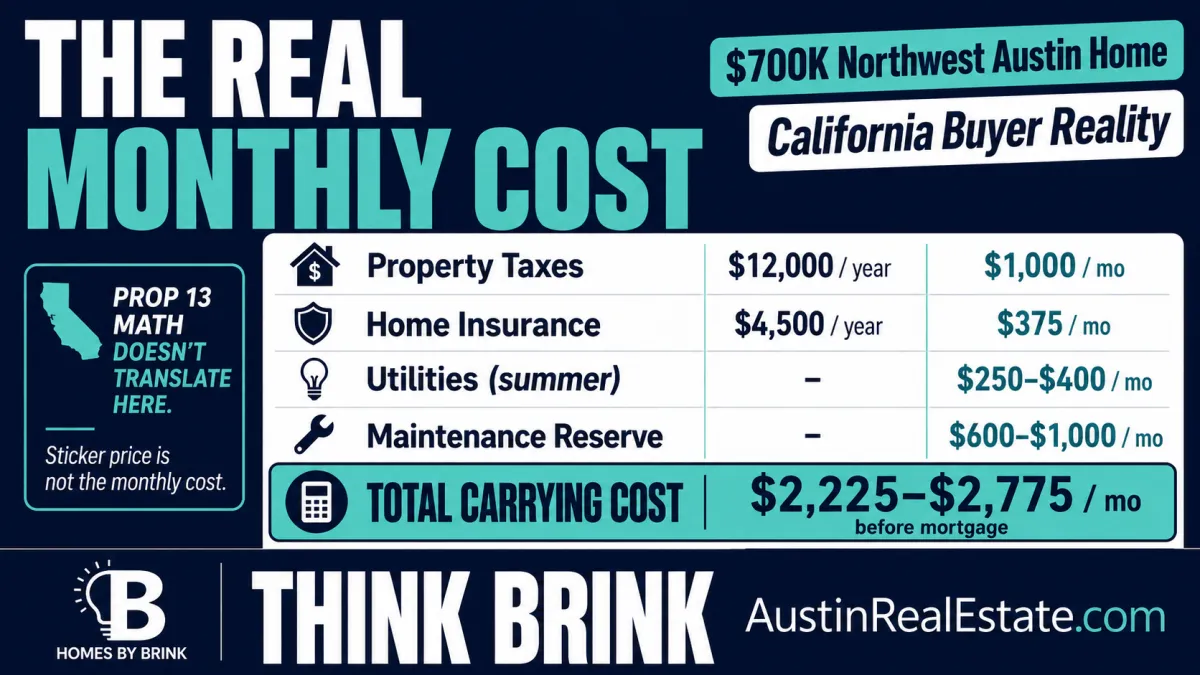
In 78750 and 78759, the combined effective property tax rate runs approximately 2.0% to 2.3% of assessed value depending on the specific taxing entities at the address. On a $700,000 home with the standard homestead exemption - which reduces taxable value by $140,000 for school district purposes - the annual tax bill runs approximately $11,000 to $13,500 per year. On an $800,000 home, budget $13,000 to $16,000.
The Texas homestead exemption applies from the first year of ownership and is free to file. As of 2026, it removes $140,000 from taxable value for school district purposes. The exemption also triggers a 10% annual cap on how fast the assessed value can increase in future years - protecting buyers from runaway appraisals in a rising market. File this immediately after closing - within 30 days is best.
For most California buyers earning above $150,000 in household income, the income tax savings still outpaces the property tax premium by a meaningful margin. At $150,000 household income, the net annual savings after accounting for higher Texas property taxes typically runs $10,000 to $25,000 per year. The higher your California income, the more decisively the math favors Texas. For Washington buyers, the math is more situation-specific and worth calculating with a CPA before relying on it as a primary rationale.
One important watch for: MUD and PID districts. Many newer suburban developments in the Austin metro sit inside Municipal Utility Districts or Public Improvement Districts that add 0.3% to 0.8% on top of standard property tax rates. The established Northwest Austin neighborhoods in 78750, 78759, and 78726 are generally not in MUD districts - this is one of their advantages over some of the newer far-north suburbs. But always verify for the specific address before assuming.
Northwest Austin vs Round Rock: Which One Actually Fits Your Situation?
The Housing Equity Conversation: What Your California Home Actually Buys Here
This is where the move becomes most tangible for buyers who are selling California real estate to fund a Northwest Austin purchase.
Austin's median home price is approximately 40% to 50% below equivalent California markets. A family selling a median-priced Bay Area home at $950,000 is entering a market where that equity can purchase a Northwest Austin home outright with proceeds to spare. A family selling a median LA home at $730,000 can buy a well-maintained Canyon Creek or Great Hills home and carry little or no mortgage. For buyers coming from San Diego, the San Jose suburbs, or the East Bay, the equity conversion experience is similarly favorable.
What that equity buys in Northwest Austin specifically depends on the budget range. At $600,000 to $750,000, you're looking at well-maintained single-family homes in the 2,000 to 3,000 square foot range in Balcones Woods, Great Hills, or the accessible sections of 78750, in original or partially updated condition. At $750,000 to $950,000, the range opens to updated homes in the core Northwest Austin neighborhoods, larger floor plans, and the beginning of the greenbelt-backing and view lot inventory in Great Hills and Canyon Creek. Above $950,000 and toward $1.5 million, you're accessing the premium lot positions in Canyon Creek's greenbelt sections, the hillside view lots in Great Hills, and Spicewood Estates' preserve-adjacent inventory.
One thing California buyers sometimes underestimate: the condition variation in Northwest Austin's housing stock. Homes from the 1970s through the 1990s with original finishes are common and priced accordingly. A home that looks gorgeous in listing photos but has original 1988 tile, oak cabinets, and brass fixtures throughout is not the move-in-ready experience Bay Area buyers are used to at equivalent price points. Be clear about what condition you're buying and what it implies before you fall in love with the location.
Living in 78750 and 78759: The Northwest Austin Zip Code Guide Buyers and Sellers Should Bookmark
The Summer Reality: The Most Common Post-Move Surprise
This is the one most California and Pacific Northwest buyers have heard about but not fully internalized until they experience it.
Austin summers are hot in a way that most California and Pacific Northwest climates don't prepare you for. Average high temperatures in July and August run 96 to 100 degrees Fahrenheit. Heat indexes pushing above 105 are common. The sun is intense. Days above 100 degrees happen 30 to 75 times per year depending on the year.
For buyers coming from the Bay Area or Seattle, where summer highs typically run 70 to 85 degrees, this is a genuine adjustment that affects how daily life works from roughly late June through early September. The outdoor activities that might be a regular weekday evening routine in California or the Pacific Northwest become early morning or late evening activities in Texas summers. Hiking the preserve trails, evening neighborhood walks, the kids playing in the backyard after school - these compress to the hours before 9am and after 7pm during peak summer months.
What this means practically for home selection: shade matters more than buyers from cooler climates initially appreciate. A Northwest Austin home with a mature canopy that shades the south and west faces is meaningfully more comfortable and meaningfully cheaper to cool than a comparable home on an exposed lot without tree coverage. Evaluate the tree coverage and lot orientation as seriously as you'd evaluate square footage. A home that backs to the Balcones Canyonlands Preserve or a greenbelt with established oak canopy is not just more scenic - it's functionally cooler in August.
Plan for summer electricity bills of $250 to $400 per month for a 2,500 square foot home, higher if the HVAC system is original or undersized for the current load. Budget this into your monthly cost of ownership before you finalize your price range.
The winters, by contrast, are mild and frequently beautiful - temperatures in the 50s and 60s from November through March with occasional cold snaps rather than sustained freezing. Spring and fall in Northwest Austin are genuinely exceptional, and most longtime residents describe October and November as the payoff for getting through August.
Is Northwest Austin Still Worth the Premium?
Car Dependency: The Adjustment From Urban or Transit-Accessible Living
Buyers relocating from San Francisco, Seattle, or any area where they've built a lifestyle around walkability or public transit need to recalibrate this expectation before they arrive.
Northwest Austin is car-dependent. Almost everything - grocery shopping, restaurants, errands, school pickup, gym - requires driving. There are no walkable commercial districts in the residential neighborhoods. The trails and greenbelts are beautiful for recreation, but they don't connect to commercial destinations. MoPac and 183 carry the traffic that gets you everywhere, and peak-hour congestion on MoPac in particular is real and requires planning around.
This doesn't make the area dysfunctional - the car-based infrastructure is efficient once you're accustomed to it, and the commercial infrastructure along 183, at the Arboretum, and near the Domain is genuinely well-developed. But buyers who moved from a walkable neighborhood in San Francisco or Capitol Hill in Seattle specifically because they didn't want to own a car will find that Northwest Austin requires owning a car, and probably two.
The practical implication: factor the garage and driveway into your home evaluation more seriously than you would have in a transit-accessible urban environment. A home without a two-car garage in a car-dependent neighborhood creates friction that compounds over time.
What California and Pacific Northwest Buyers Consistently Get Right
These are the instincts and assumptions that translate well from West Coast markets to Northwest Austin.
Lot and location research before the house. Bay Area and Seattle buyers are accustomed to markets where location creates permanent value differentials that no amount of renovation can close. That instinct is correct in Northwest Austin too. The greenbelt-backing lot, the preserve-adjacent position, the quiet cul-de-sac with Hill Country views - these are the lot attributes that hold value across market cycles in the same way that school-district premium locations do in California. Start with lot and location and evaluate the house second.
School district due diligence. California and Washington buyers are generally experienced at doing real school research rather than relying on surface-level rankings. That habit serves them well in Austin, where the difference between addresses matters more than the district label. Confirm the specific feeder chain for any specific address rather than assuming that a neighborhood name or zip code delivers a particular school.
Renovation thinking. Bay Area buyers in particular are accustomed to evaluating homes based on what they could become rather than what they currently are. That mindset applies in Northwest Austin's 1970s and 1980s housing stock - many of the best lots in the most established neighborhoods carry original or dated finishes that California buyers who understand renovation math are willing to look past in ways that buyers from other markets sometimes won't.
Home inspection discipline. California buyers who have been through earthquake retrofit requirements, sewer lateral compliance, and lateral seismic disclosure are accustomed to rigorous inspection processes. Texas inspections are thorough for different reasons - foundation monitoring in Central Texas clay soil, HVAC age and capacity, roof condition after hail events - but the discipline of taking inspection seriously rather than waiving it is well-suited to Northwest Austin's housing stock age.
What Locals Wish They Knew Before Buying in Northwest Austin
What California and Pacific Northwest Buyers Consistently Get Wrong
These are the assumptions that don't translate and that cause problems when buyers act on them before recalibrating.
Comparing sticker prices to California or Washington without factoring total carrying cost. The home that appears to be half the price of your Bay Area home may not have half the monthly carrying cost when you factor in Texas property taxes, Texas homeowner's insurance (which has increased significantly - budget $3,500 to $5,500 annually on a Northwest Austin home), summer utility bills, and the maintenance costs on a 35-year-old home. Run the full monthly number before you anchor on the purchase price.
Assuming the first Austin experience represents the full Austin summer. Many buyers do a scouting trip in March, April, or October - when Austin is genuinely beautiful - and make the summer decision based on a mild weather visit. The summer you'll be living through runs from late June through early September and is a different climate entirely. If you're visiting before you buy, make at least one trip in July or August.
Treating all Northwest Austin neighborhoods as equivalent. The internal variation within and between 78750, 78759, and 78726 is significant. A buyer who tours one Great Hills home and one Canyon Creek home and decides they're buying in Northwest Austin has seen a very small sample of what that label covers. The school district split, the lot hierarchy, the section-by-section differences in character and price - these require the same neighborhood-level research you'd do in any California or Washington market. Apply the same rigor here.
Underestimating how long remote school research takes versus in-person verification. The school assignments in these zip codes are address-specific and the online data is frequently inaccurate or outdated. The habit of verifying school enrollment by visiting the district website or calling the school that serves a specific address is more important in Austin than in most California districts where school zone boundaries are more consistently mapped online.
Expecting the same level of price transparency you're used to at home. Texas is a non-disclosure state - closed sale prices are not publicly reported the same way they are in California and Washington. Buyers don't have easy access to precise comparable sales data through public records the way they might in their home state. Working with an agent who has actual MLS transaction data in these specific zip codes matters more in Texas than in states with more transparent public sale records.
What Nobody Tells You About Buying Near Apple in Northwest Austin
The Northwest Austin Neighborhoods That Resonate Most With West Coast Buyers
Based on the consistent patterns of where California and Pacific Northwest buyers land in Northwest Austin, here is an honest mapping of which neighborhoods tend to fit which buyer profiles.
For Bay Area buyers who valued established hillside neighborhood character: Great Hills and the hillside sections of 78759 tend to be the strongest match. The terrain variation, the mature oak canopy, the winding streets and cul-de-sacs with views - these are recognizable to buyers who valued the established character of the East Bay hills or the western San Jose foothills. Great Hills specifically pulls buyers from Saratoga, Los Gatos, and the hillier sections of Marin.
For buyers who prioritized community identity and master-planned amenity infrastructure: Canyon Creek in 78726 is the closest Northwest Austin analog to the kinds of community-built master-planned neighborhoods that dominate the Bay Area and the better Los Angeles suburbs. The two community pools, the trail system connecting to the Balcones Canyonlands Preserve, the organized community events, and the HOA infrastructure that has been maintained for 35 years - these feel familiar to buyers who came from community-forward neighborhoods in their origin market.
For buyers who want preserve adjacency and are coming from areas where permanently protected open space was a primary value driver: Spicewood Estates in 78750 tends to resonate. The Balcones Canyonlands Preserve adjacency - 30,000-plus acres of permanently protected land that won't be developed - creates the kind of permanent open space backdrop that California buyers from areas near open space preserves respond to strongly. The lot sizes and the terrain character align with what these buyers are accustomed to valuing.
For buyers who want the best Apple commute in the established neighborhoods: The core 78750 neighborhoods - Spicewood Estates, Balcones Village, and the adjacent sections - put Apple at 10 to 15 minutes, which represents some of the best commute positioning available in the established single-family market relative to that specific employer.
For buyers on the entry tier who want to get into the established neighborhoods while staying at a lower price point: The accessible sections of 78759 - Mesa Park, Barrington Oaks, and the entry sections of Great Hills - offer a way into the established neighborhood character and school feeder at price points that are meaningfully below what the premium sections command.
The Practical Pre-Move Checklist for West Coast Buyers
Before you make an offer on a Northwest Austin home from out of state, work through this list:
Run the full monthly cost model, not just the purchase price. Property taxes at your specific address and assessment, homeowner's insurance quoted for that specific home's age and location, utilities at peak summer load, HOA dues if applicable, and maintenance averaged over time for the home's age. That total monthly number is what you're actually agreeing to, not the mortgage payment.
Visit in summer. If your timeline allows, make at least one trip to Northwest Austin during July or August before you commit. Understanding what your daily life will feel like during the three most challenging months is important information that no amount of research substitutes for.
Verify school assignment by specific address. Don't rely on the listing description, the portal school tags, or the neighborhood name. Call the relevant district with the specific address. The school district split in these zip codes is address-specific and the online data error rate is meaningful.
File your homestead exemption immediately after closing. This is free, saves $1,500 to $2,200 per year, and triggers the 10% annual assessment cap. Don't wait - file within 30 days.
Get insurance quotes before you go under contract, not after. Texas homeowner's insurance on a 30-to-40-year-old home in these zip codes can run meaningfully higher than California buyers expect. For homes near the Balcones Canyonlands Preserve, the wildfire risk component affects pricing specifically. Get quotes on the specific home before you remove contingencies.
Understand your Texas non-disclosure situation. Work with an agent who has actual MLS transaction data in these specific zip codes and can show you real comparable closed sales rather than estimated values from public records. The comparable analysis matters more here than in your home state.
Talk to a CPA about the specific tax implications before you finalize your timeline. The interaction between your California or Washington tax obligations, the capital gains exclusion on your primary residence sale, and the Texas property tax picture at your specific purchase price is situation-specific enough to warrant professional guidance rather than general estimates.
The Honest Summary for West Coast Buyers
Northwest Austin works well for California and Pacific Northwest buyers who came here for the Apple corridor or the Domain, who specifically want the established neighborhood character and school access that these zip codes deliver, and who go in with clear eyes about the summer, the car dependency, the property tax reality, and the condition variation in the housing stock.
The buyers who land well in Northwest Austin are almost universally the ones who did their homework on the specifics - who ran the full monthly cost model, who visited in summer before committing, who verified school assignments by address, who understood the lot hierarchy and neighborhood variation before they started making offers.
The buyers who have harder experiences are the ones who relied on the headline narrative - no income tax, cheaper housing, tech corridor access - without doing the address-level and neighborhood-level research that the Austin market specifically rewards. The same discipline that serves Bay Area and Seattle buyers well in their home markets serves them just as well here. Apply it and Northwest Austin delivers what it promises.
Frequently Asked Questions
How much do California buyers typically save by moving to Northwest Austin?
At a household income of $150,000, the net annual savings after accounting for Texas property taxes typically runs $10,000 to $25,000 per year compared to California. At $200,000 household income, the range grows to approximately $16,000 to $35,000 per year. The higher the California income, the more decisively the math favors Texas. Washington state buyers should run the specific math for their situation since Washington has no ordinary income tax, though a 7% capital gains tax on high earners can be a meaningful factor.
What is the property tax reality in Northwest Austin for a California buyer?
California's Proposition 13 typically results in property taxes of approximately 1% of purchase price. Texas property taxes in 78750 and 78759 run approximately 2.0% to 2.3% of assessed value after the homestead exemption. On a $700,000 home, that produces approximately $11,000 to $13,500 annually. This is higher than most California buyers are paying, but for high earners the income tax savings typically outpaces the property tax premium by a wide margin.
Is Northwest Austin comparable to established California neighborhoods?
The terrain, mature canopy, and established character of Great Hills, Canyon Creek, Spicewood Estates, and Balcones Woods specifically resonate with buyers from hillside or established neighborhoods in California. The comparison is not identical - these neighborhoods were built in a different era with different architectural conventions - but the combination of winding streets, mature trees, and preserve adjacency in the best Northwest Austin locations is the closest thing to that experience available at these price points this close to Austin's employment core.
What is the summer actually like and how do residents deal with it?
July and August average high temperatures of 96 to 100 degrees Fahrenheit with heat indexes above 105 common. Days above 100 degrees happen 30 to 75 times per year. Most residents shift outdoor activity to early morning and evening during peak summer months. Homes with mature tree coverage and proper HVAC sizing handle the summer more comfortably. Utility bills at peak run $250 to $400 per month for a 2,500 square foot home. Spring and fall are genuinely exceptional.
How car-dependent is Northwest Austin?
Fully car-dependent. Almost all errands, restaurants, school pickup, and daily activities require driving. This is a significant adjustment for buyers who built their California or Washington lifestyle around walkability or public transit. Two-car households are the norm. Build the commute math and parking situation into your home evaluation before you commit to a specific property.
Which Northwest Austin neighborhood is best for Apple employees from California?
The established 78750 neighborhoods - Spicewood Estates, Balcones Village, and adjacent areas - give Apple employees the most direct access, typically 10 to 15 minutes in normal conditions. The 78759 neighborhoods west of MoPac add a few minutes. The 78726 neighborhoods like Canyon Creek are 25 to 35 minutes from Apple. For a five-day-per-week Apple commuter, the 78750 positioning represents the strongest daily commute case in established single-family inventory.
Should I work with a local Austin agent or can I handle this from California or Washington?
Texas is a non-disclosure state, meaning closed sale prices aren't publicly reported the same way they are in California and Washington. Working with an agent who has actual MLS transaction data in these specific zip codes - and who can show you real comparable closed sales, not estimated values - is more important here than in your home state. The neighborhood-level variation in 78750, 78759, and 78726 also rewards working with someone who knows these specific neighborhoods rather than Austin broadly.
