Westwood vs Anderson High: The RRISD vs AISD Choice for Northwest Austin Buyers
A lot of Northwest Austin home searches quietly come down to one high school decision, even when the buyers do not frame it that way. They start looking at homes, they notice that some neighborhoods feed Westwood and others feed Anderson, and at some point they realize they are not just choosing a house, they are choosing between Round Rock ISD and Austin ISD. Both are strong. Both send large numbers of students to good universities. Both run an International Baccalaureate program. And yet they are genuinely different schools, in different districts, with different price and tax consequences attached to the addresses that feed them.
This is a broker's comparison, not a ranking. I am not going to tell you one school is better, because that is not a question a real estate agent should answer for your family. What I can do is lay out clearly how the two differ, where the feeder lines fall, and what the choice does to your home price and your tax bill, so you can make the call with your eyes open. If you want the deeper single-school treatment, I have written a full Anderson High feeder guide and a companion McNeil High feeder guide that round out the Round Rock ISD picture.
The Short Version
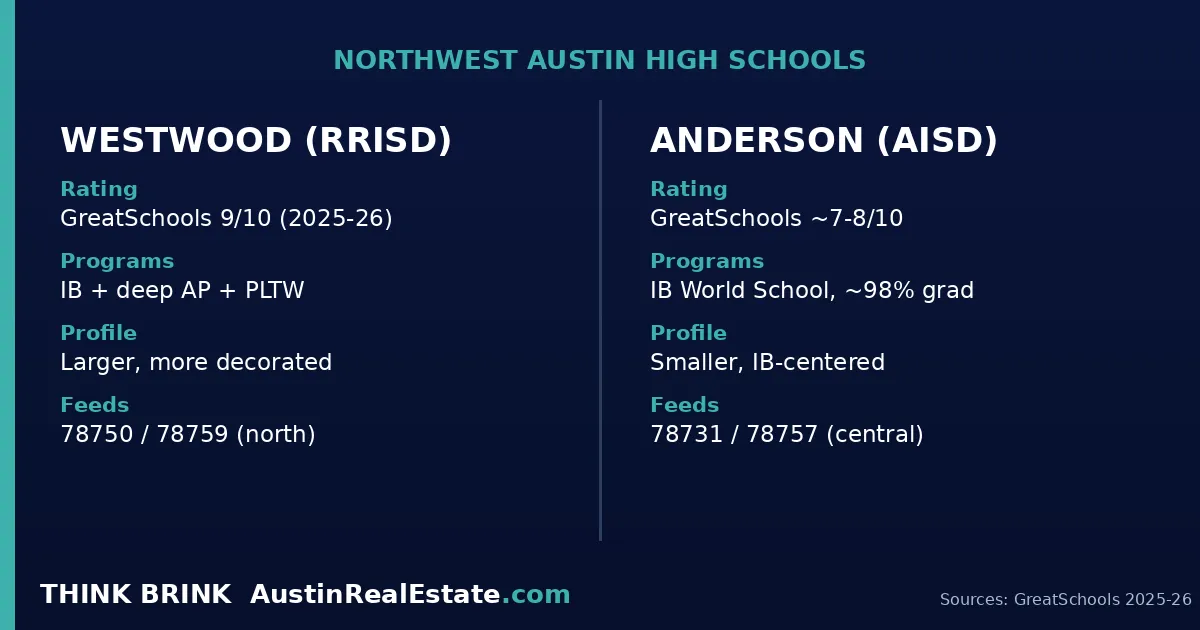
Westwood High School is in Round Rock ISD and anchors the most sought-after feeder in the 78750 and 78759 neighborhoods farther north, the Spicewood or Canyon Vista or Grisham pathway. Anderson High School is in Austin ISD and anchors the top feeder in the more central 78731 and 78757 neighborhoods closer to town, the Doss or Hill to Murchison pathway. Both are IB World Schools. Westwood tends to score a notch higher on the public rating sites and is the larger, more nationally decorated of the two. Anderson is smaller, closer to downtown, and offers the IB Diploma in a somewhat more intimate setting. Which one you end up with is almost entirely a function of where you buy, which is why this is really a home-search question.
The Districts Are the Real Story
Before comparing the two campuses, understand that you are choosing districts, and the districts differ in ways that outlast any single school year. Round Rock ISD covers much of the northern arc of the metro, including the newer and more suburban Northwest Austin neighborhoods, and it is widely regarded as one of the strongest large districts in Central Texas. Austin ISD covers the more central, older, and more urban neighborhoods closer to downtown. The full Round Rock ISD versus Austin ISD comparison gets into the district-level differences in depth; here I am keeping the focus on the two flagship high schools and what feeds them.
Ratings and Recognition
On the public rating sites, Westwood generally lands a step above Anderson. Westwood carries a 9 out of 10 GreatSchools rating as of the 2025-2026 school year, while Anderson lands around a 7, with some sources reporting an 8 depending on the methodology and the year. I want to be careful about how much weight to put on that gap. A single-digit difference on a proprietary rating scale is not the same as a difference in the education a particular student will receive, and both schools graduate students at very high rates. Westwood posts a graduation rate around 97 percent and Anderson around 98 percent, which tells you both are doing the fundamental job well.
Where Westwood clearly stands out is scale and decoration. It is a large, comprehensive high school with a long track record of academic and extracurricular honors, deep course catalogs, and the kind of nationally ranked programs that come with size. Anderson is a smaller campus, and some families specifically prefer that, because a smaller high school can mean more visibility for an individual student and less of the lost-in-the-crowd feeling that a very large school can create. Neither of those is universally better. A student who thrives on the breadth and energy of a big school may do best at Westwood, and a student who does better with a more contained environment may do best at Anderson.
The IB Question
Both Westwood and Anderson are International Baccalaureate World Schools, which is unusual and worth understanding, because IB is often the specific reason a family targets one of these feeders over a comparable one. The IB Diploma Programme is a rigorous, internationally recognized two-year course of study in the final years of high school, and its availability is a real differentiator against high schools that offer only Advanced Placement.
The practical difference between the two is one of context rather than the program itself. At Westwood, IB sits alongside a very deep Advanced Placement catalog and additional programs like Project Lead The Way, so a student can mix and match across a large menu, and the IB cohort is one strong track among several. At Anderson, the IB Diploma Programme is a more central part of the school's identity, and the program has a long, established reputation within Austin ISD. Families who want IB to be the defining framework of their child's high school experience sometimes prefer that centrality; families who want IB available but not necessarily the whole plan sometimes prefer Westwood's breadth. This is a genuine preference question, not a quality gap.
Where the Feeders Actually Fall
This is the part that turns a school comparison into a home search. The two schools pull from different sets of neighborhoods, and the geography is not random.
Anderson High feeds the central neighborhoods
Anderson sits closer to town and draws from the 78731 and 78757 neighborhoods and the more central pockets of Northwest Austin. Northwest Hills, with its Doss or Hill Elementary to Murchison Middle pathway, is the marquee Anderson feeder, and other central AISD neighborhoods feed in as well. If your center of gravity is downtown, UT, or the medical district, the Anderson feeder neighborhoods put you closer to work while still buying you a top feeder. I covered the flagship Anderson neighborhood in the Northwest Hills buyer guide.
Westwood High feeds the northern neighborhoods
Westwood sits farther north and draws from the 78750 and 78759 neighborhoods, the established Round Rock ISD tracts that dominate Northwest Austin's northern half. Spicewood Estates, the RRISD sections of Great Hills, Balcones Woods, and the neighborhoods along the Canyon Vista and Grisham middle school lines all point toward Westwood. If your commute runs toward the Apple and Parmer corridor or the northern tech employers, the Westwood feeder neighborhoods generally put you closer to work.
The clean way to think about it: Anderson is the central, closer-to-downtown top feeder, and Westwood is the northern, closer-to-tech top feeder. Your commute often makes this decision for you before the schools do.
What the Choice Does to Your Home Price
Both feeders carry a school premium, because a top high school pathway is priced into every home in the zone. What differs is the flavor of the housing stock and the tax footprint, not whether you pay a premium at all.
Anderson-feeder neighborhoods sit inside the City of Austin and Austin ISD, which is one of the higher combined-tax footprints in the metro, on the order of roughly 2.05 percent of taxable value for the 2025-2026 year once you stack the school district, city, county, and health and college levies. The homes in these central neighborhoods often trend older and more expensive on a per-home basis, especially in a place like Northwest Hills.
Westwood-feeder neighborhoods sit in Round Rock ISD and, depending on the exact location, may fall under different city and county line items, which can produce a different total tax rate. The housing stock in the northern feeder neighborhoods spans a wide range, from the more approachable established tracts to the higher-end hillside sections. The point is not that one is cheaper across the board, because that depends heavily on the specific neighborhood and home, but that the tax footprint and the character of the housing genuinely differ between the two districts. For how much the exact address moves the number, see how school zoning by address changes what you pay. Because tax rates and exemptions turn on your specific situation and residency, confirm the numbers for any particular home with a CPA or property tax professional rather than relying on a general rate.
Boundaries Move, So Verify at the Address
One warning that applies to both schools. Attendance boundaries are set by the districts, not by neighborhood names, and they can be redrawn. A neighborhood that everyone thinks of as a Westwood or Anderson neighborhood can have streets or sections that feed somewhere else, and boundaries occasionally shift when districts rebalance enrollment or open new campuses. Never buy a home on the assumption that it feeds a particular high school because the neighborhood has that reputation. Confirm the assignment at the exact address with the district, in writing, before you write an offer. This is one of the most common and most expensive assumptions I see buyers make.
Who Should Lean Which Way
Lean toward the Anderson feeder if you want to be closer to downtown, UT, or the medical district, you like the idea of a somewhat smaller high school where IB is central to the school's identity, and you are comfortable with the Austin ISD tax footprint and the older, often more expensive central housing stock. The Northwest Hills area is the flagship here.
Lean toward the Westwood feeder if your commute points north toward the Apple and Parmer corridor, you want the breadth and decoration of a very large comprehensive high school with a deep AP catalog alongside IB, and you are open to the range of Round Rock ISD neighborhoods from established tracts to hillside sections. The 78750 and 78759 neighborhoods are the flagship here.
And genuinely, for many families, the deciding factor is not the school at all, it is the commute and the house. Both feeders will serve a motivated student well. Let the school comparison break a tie rather than override a home that fits your life.
Frequently Asked Questions
Is Westwood or Anderson the better high school?
Both are strong, and I am not going to rank them for your family, because the right answer depends on your student. Westwood scores a notch higher on the public rating sites and is the larger, more nationally decorated school with a deeper course catalog. Anderson is smaller, closer to downtown, and offers the IB Diploma in a more intimate setting. A student who thrives on breadth may prefer Westwood; a student who does better in a more contained environment may prefer Anderson. Both graduate students at very high rates.
What district is Westwood High School in, and what district is Anderson?
Westwood High School is in Round Rock ISD, and Anderson High School is in Austin ISD. That district difference carries through to tax footprints, neighborhood character, and geography. Westwood anchors the northern 78750 and 78759 feeder neighborhoods, and Anderson anchors the more central 78731 and 78757 feeder neighborhoods.
Do both Westwood and Anderson offer IB?
Yes. Both are International Baccalaureate World Schools offering the IB Diploma Programme. The difference is context: at Westwood, IB is one strong track alongside a deep Advanced Placement catalog and other programs, while at Anderson the IB Diploma is more central to the school's identity and has a long established reputation within Austin ISD.
Which neighborhoods feed Westwood High School?
Westwood draws from the northern Round Rock ISD neighborhoods in the 78750 and 78759 zip codes, including Spicewood Estates, the RRISD sections of Great Hills, Balcones Woods, and the neighborhoods along the Canyon Vista and Grisham middle school lines. Always confirm the assignment at the specific address, because boundaries do not follow neighborhood names exactly.
Which neighborhoods feed Anderson High School?
Anderson draws from the more central Austin ISD neighborhoods in the 78731 and 78757 zip codes, with Northwest Hills and its Doss or Hill to Murchison pathway as the marquee feeder. If your commute points toward downtown, UT, or the medical district, the Anderson feeder neighborhoods are worth a close look. Verify the assignment at the exact address before offering.
Does buying into the Anderson feeder cost more than the Westwood feeder?
It depends heavily on the specific neighborhood and home, so there is no across-the-board answer. Anderson-feeder neighborhoods sit inside the City of Austin and Austin ISD, which is one of the higher combined-tax footprints in the metro at roughly 2.05 percent for 2025-2026, and the central housing stock often trends older and pricier. Westwood-feeder neighborhoods are in Round Rock ISD and span a wide price range with a potentially different tax footprint. Get neighborhood-specific comparables and confirm tax figures with a CPA before deciding.
Can attendance boundaries change after I buy?
Yes. Districts set and occasionally redraw attendance boundaries to rebalance enrollment or accommodate new campuses. A home you buy for a specific high school today could, in principle, be rezoned later, though established top feeders tend to be relatively stable. The important discipline is to confirm the current assignment at the exact address in writing before you buy, and to understand that the neighborhood reputation is not a guarantee.
Should I let the high school decide my home purchase?
Let it break a tie, not override a good fit. Both Westwood and Anderson will serve a motivated student well, so if a home fits your commute, budget, and life in every other way, the high school comparison should rarely be the thing that vetoes it. The most common regret I see is buyers stretching for a marginally higher-rated feeder into a home or commute that does not actually work for them.
The Honest Summary
Westwood and Anderson are two of the strongest high schools in Northwest Austin, and the choice between them is really a choice between Round Rock ISD to the north and Austin ISD closer to town. Westwood is the larger, higher-rated, more decorated school anchoring the 78750 and 78759 neighborhoods near the tech corridor. Anderson is the smaller, IB-centered school anchoring the central 78731 and 78757 neighborhoods near downtown. Both are IB World Schools, both graduate students at high rates, and the deciding factor for most families is commute and home fit rather than any gap in school quality. Whichever way you lean, confirm the assignment at the exact address, model your real tax bill for that district, and let the house and the commute carry more weight than a one-point rating difference. When you are ready to target a specific feeder, I can pull the neighborhoods and homes that fit.
