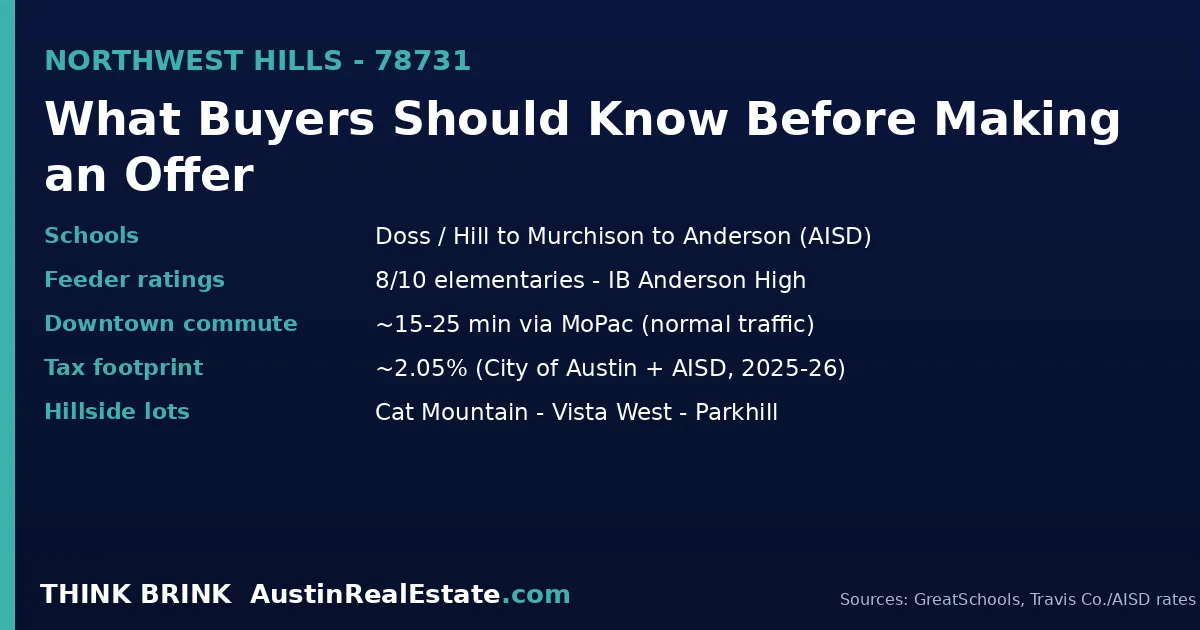
What Buyers Should Know About Northwest Hills Before Making an Offer (78731)
Most buyers find Northwest Hills after they have already looked at Great Hills, decided they liked the hillside feel, and then noticed that Northwest Hills sits several minutes closer to downtown for a different school district and often a different price. That is the honest starting point for this neighborhood. Northwest Hills is not a secret, it is not underpriced, and it is not for everyone. What it is, is one of the few established Austin ISD neighborhoods where you get true Hill Country topography, a top-tier Anderson High feeder pattern, and a location that is genuinely central to both downtown and the MoPac tech spine at the same time.
This is a guide for the buyer who is deciding whether to compete here. I am going to be specific about what your money buys, where the school lines actually fall, what the commute really looks like, and the handful of things about these hillside lots that catch people by surprise after they are already under contract. If you want the broader picture of how this fits against the rest of the area, the Anderson High School feeder guide covers the district pathway in full, and this post zooms into the neighborhood itself.
Where Northwest Hills Actually Is, and Why That Matters
Northwest Hills sits inside the 78731 zip code, west of MoPac (Loop 1) and generally south of Spicewood Springs Road, climbing up into the limestone mesas and glens between MoPac and Lake Austin. That geography is the whole point. The neighborhood was platted in waves from the 1950s into the 1980s, so streets wind rather than grid, lots follow the contour of the hills, and mature oaks and cedar elms shade most of the older sections. You are not going to find a flat, uniform master-planned layout here. You are going to find elevation changes, cul-de-sacs that dead-end into greenbelt, and homes that sit at very different levels from the street.
Northwest Hills is really a collection of subdivisions rather than one uniform tract. The names buyers run into most often are Cat Mountain, Cat Mountain Villas, North Cat Mountain, Vista West, Parkhill, Lakewood, Highland Hills, Shinoak Valley, and Meadow Mountain. Cat Mountain and North Cat Mountain sit at the higher elevations with the genuine hilltop views, and they price accordingly. Vista West and Parkhill tend to be the more approachable entry points into the zip code, still hillside, still zoned to the same schools, but without the top-of-the-ridge view premium.
The reason this matters for a buyer is simple. When someone tells you they want to be in Northwest Hills, the first question is always which part, because the spread in price and lot type from the entry pockets to the Cat Mountain ridge is large. Two homes a mile apart in the same zip code, feeding the same schools, can differ by hundreds of thousands of dollars almost entirely because of elevation, view, and lot. That is not unique to Northwest Hills, but it is more pronounced here than in a flat neighborhood, so it deserves attention before you fall in love with a listing.
What Your Money Buys in 78731 Right Now
I want to be careful with numbers here, because this publishes under my license and I would rather write honestly than throw out a precise figure I cannot stand behind. Northwest Hills is one of Austin's more expensive established zip codes. Recent third-party market trackers have put the 78731 median sale price somewhere in the range of roughly one million to one and a quarter million dollars over the past year, and that is worth taking with the usual grain of salt because 78731 is a large zip that stretches well beyond Northwest Hills proper, and a handful of very high-end sales up on the ridge can pull a median around. Treat that as a directional signal, not a quote. When you are ready to make a decision on a specific home, I will pull the exact comparable sales for that pocket and that price tier, because that is the only number that should drive an offer.
What I can tell you qualitatively is how the tiers stack. At the entry end of the zip code you are typically looking at original-condition or lightly updated single-story homes from the sixties and seventies, often on interior or downslope lots. In the middle you find the larger reworked homes and the tasteful full remodels of that same original stock. At the top you have the Cat Mountain and North Cat Mountain homes with real elevation, real views, and either significant renovation or newer custom builds. The gap between an original-condition home and a fully renovated one on a comparable lot is substantial, and it is one of the biggest levers you have. Buying condition versus buying bones is a real decision in this neighborhood, and I will come back to it.
The thing buyers relocating from California and the Pacific Northwest need to internalize is that the sticker price is only part of the cost of ownership here. Texas has no state income tax, but it makes up a good deal of that on the property tax side, and 78731 sits inside the City of Austin and Austin ISD, which is one of the higher combined-rate footprints in the metro.
Property Taxes: What the 78731 Footprint Actually Costs
A home inside Austin city limits and Austin ISD in Travis County carries a combined property tax rate of roughly 2.05 percent of taxable value for the 2025-2026 year. That total is built from several taxing entities layered together: Austin ISD at about 0.9252 per hundred dollars of value, the City of Austin at about 0.524, Travis County at about 0.376, Central Health at about 0.118, and Austin Community College at about 0.103. Add those up and you are in the low-two-percent range before any exemptions.
The exemptions matter and buyers routinely underestimate them. If Northwest Hills is going to be your primary residence, the Texas homestead exemption reduces your school-district taxable value and, just as importantly, caps how fast your assessed value can rise once the exemption is in place. On a home in this price range, running the tax math on the full purchase price without accounting for the homestead exemption will overstate your real annual bill, sometimes meaningfully. If you are buying as a second home or investment, you do not get that cap, and your carrying cost is genuinely higher. I always tell buyers to model the after-exemption number, not the headline rate, before they decide what they can carry. For the specifics of how exemptions and the appraisal cap apply to your situation, talk with a CPA or a property tax professional, because the details turn on your residency and filing timeline, not on anything I can generalize here.
The Schools: The Doss, Murchison, Anderson Pathway
The single biggest reason families pay to be in Northwest Hills is the Austin ISD feeder pattern, and it is a genuinely strong one. The core Northwest Hills pathway runs Doss Elementary to Murchison Middle School to Anderson High School. All three campuses rate well, and together they make up what many consider Austin ISD's strongest feeder in this part of town.
Doss Elementary carries an 8 out of 10 GreatSchools rating and has been recognized as a National Blue Ribbon School. Its distinctive feature is a Mandarin Chinese dual-language immersion program that runs from kindergarten, where students spend the day across both English and Mandarin. That program is a real draw for some families and simply a neutral fact for others, but it is worth knowing before you assume Doss is a traditional-track campus.
Hill Elementary, which sits nearby and also feeds Murchison and Anderson, likewise carries an 8 out of 10 GreatSchools rating and National Blue Ribbon recognition, and it runs a more traditional program with a foreign-language experience track rather than full immersion. Whether a given Northwest Hills address feeds Doss or Hill depends on the specific street, and that is exactly the kind of thing you verify at the address level rather than assume by neighborhood. I have written a full comparison of Doss and Hill for families weighing the two.
Murchison Middle School scores in the 8-plus range and is one of the more sought-after middle schools in Austin ISD. Anderson High School is an International Baccalaureate World School with a graduation rate around 98 percent and a strong record on college readiness, and depending on the year and the source it lands around a 7 to 8 on GreatSchools. If your children are IB-inclined, Anderson's IB Diploma Programme is one of the reasons families specifically target this feeder rather than a comparable Round Rock ISD one.
Here is the honest part. A top feeder pattern is priced into every home in the zone, whether or not you have school-age children. That is good if you have kids, because you are buying access to the pathway. It is something to think about if you do not, because you are paying the feeder premium either way and might get more house for the money in a strong-but-not-top feeder a few minutes north. The school premium does not discount itself for buyers who will never use the schools. For a fuller treatment of how much address-level zoning moves price, see how school zoning by address changes what you pay.
The Commute: Central to Everything, Perfect for Nothing
Northwest Hills has an unusual commute profile because it is roughly equidistant from two very different job cores, and that is its real selling point. Downtown Austin and the University of Texas sit to the southeast, reachable in the fifteen-to-twenty-five-minute range in normal conditions via MoPac south or the surface routes down toward the river. The MoPac tech corridor, the Domain, and the northern employers sit up MoPac to the north, also within a manageable drive. This is the neighborhood for the household where one person works downtown, at UT, or in the medical district, and the other works north.
Be honest about what MoPac is, though. MoPac at rush hour is one of the more congested stretches in the metro, and the express lane helps but is not free. A fifteen-minute midday run downtown can become a thirty-five-minute crawl at eight in the morning. The advantage of Northwest Hills is not that it beats traffic, it is that you are entering MoPac close to both destinations rather than fighting the whole length of it from a far suburb. If your commute is specifically to the Apple campus on Parmer or out to the far northwest tech sites, Northwest Hills is workable but not ideal, and neighborhoods farther up the corridor make more sense. For buyers whose center of gravity is the Apple and Parmer corridor, the Apple corridor commute and price tradeoffs guide is the better starting point.
The Lots: What Hillside Living Actually Involves
This is the section most buyer guides skip, and it is the one that saves people money. Northwest Hills is genuine hill country, and the topography that makes it beautiful also creates a specific set of things to check.
Slope and drainage
Many lots slope significantly, and homes are frequently built into the hillside with the back of the house well below street grade or perched above it. That creates drainage patterns you want to understand. Where does water go in a hard Central Texas downpour? Is there a downslope neighbor whose runoff crosses the property? Are there retaining walls, and what condition are they in? Retaining walls are expensive to replace and are easy to overlook during a quick showing. On a hillside lot, the retaining walls and the drainage are as important as the roof.
Foundations on Central Texas clay
Central Texas sits on expansive clay soils that swell when wet and shrink when dry, and that movement is the single most common source of foundation issues across the whole region, hillside or not. In Northwest Hills you add slope to that equation. I strongly recommend a structural or foundation-specific inspection on any older home here, not because problems are guaranteed, but because knowing the foundation's condition and history changes what a fair price is. A home with a documented, engineered foundation repair and a transferable warranty can actually be a safer buy than an untouched one, provided the work was done right.
Trees and access
The mature tree canopy is one of the neighborhood's best features and also a maintenance line item. Large heritage oaks near the house need periodic professional care, and the City of Austin has tree-protection rules that can affect what you are allowed to remove or build near. Steep or narrow driveways on the higher lots are worth walking in person, especially if you drive a larger vehicle or worry about ice on the handful of genuinely cold mornings each winter.
Original condition versus renovated
A lot of the housing stock dates to the sixties through eighties, which means you will see original kitchens, older HVAC and electrical, cast-iron or galvanized plumbing in the oldest homes, and single-pane windows. None of that is a dealbreaker, but it is money, and it is the core of the buy-condition-versus-buy-bones decision. If you are handy or planning to renovate anyway, an original-condition home on a great lot can be the best value in the zip code. If you need turnkey, budget for the premium that a done home commands here, because it is real. The greenbelt and view-lot premium is a related question, and I get into where the view premium is worth paying in the greenbelt and golf-course lots guide.
Who Northwest Hills Actually Fits
Northwest Hills is a strong fit if you want established Austin ISD schools at the top of the Anderson feeder, you value mature trees and hill country topography over a new, flat, master-planned feel, and you have at least one commute pointed toward downtown, UT, or the medical district. It fits the dual-commute household especially well, and it fits buyers who genuinely want character and are willing to either pay for a renovated home or take on a project.
It is a weaker fit if your whole professional life is oriented toward the Apple and Parmer corridor or the far northwest, in which case you are paying a central-location premium you will not fully use. It is a weaker fit if you want a flat lot, a newer build, a large uniform HOA with amenities, or a lower tax footprint, all of which you can find by looking a few minutes north into Round Rock ISD territory. And it is a weaker fit if the idea of retaining walls, slope drainage, and older-home systems stresses you out rather than intrigues you.
What To Do Before You Offer
Confirm the exact elementary zoning at the specific address, because Doss versus Hill turns on the street, not the neighborhood name. Walk the lot and look hard at slope, drainage, and any retaining walls. Budget for a foundation-specific inspection on any older home. Model your real tax bill using the after-homestead-exemption number, not the headline rate, and get a CPA's read on your specific exemption timing. Decide honestly whether you are buying condition or buying bones, and price your offer to that reality. And get the actual comparable sales for the specific pocket and tier you are targeting, because in a neighborhood with this much spread between the entry streets and the Cat Mountain ridge, the median tells you almost nothing about what a particular home is worth.
Frequently Asked Questions
Is Northwest Hills in Austin ISD or Round Rock ISD?
Northwest Hills in the 78731 zip code is in Austin ISD, feeding the Doss or Hill Elementary, Murchison Middle, Anderson High pathway. This is one of the main things that distinguishes it from the Great Hills and Spicewood Estates neighborhoods farther north, which are largely Round Rock ISD. If the district matters to you, verify the assignment at the exact address, because boundaries do not follow neighborhood names precisely.
What schools does Northwest Hills feed into?
The core pathway is Doss Elementary or Hill Elementary, then Murchison Middle School, then Anderson High School, all in Austin ISD. Doss and Hill both carry 8 out of 10 GreatSchools ratings and National Blue Ribbon recognition, Murchison rates in the 8-plus range, and Anderson is an International Baccalaureate World School with roughly a 98 percent graduation rate. Which elementary a home feeds depends on the specific street.
How much do homes cost in 78731 Northwest Hills?
Northwest Hills is one of Austin's more expensive established zip codes, and recent third-party trackers have placed the 78731 median sale price roughly in the one to one-and-a-quarter-million-dollar range over the past year, though 78731 is a large zip and high-end ridge sales pull the median up. Prices vary enormously by pocket and condition, from more approachable entry homes in Vista West and Parkhill to the Cat Mountain view homes. Get pocket-specific comparable sales before setting an offer.
What is the commute from Northwest Hills to downtown Austin?
Downtown Austin and UT are generally in the fifteen-to-twenty-five-minute range in normal conditions via MoPac south or the surface routes, which is one of the neighborhood's biggest advantages. At peak rush hour, expect that to stretch, since MoPac is one of the more congested corridors in the metro. The trade-off is that you enter the highway close to downtown rather than commuting its full length from a far suburb.
Can I commute to the Apple campus from Northwest Hills?
Yes, but it is not the neighborhood's strong suit. The Apple campus on Parmer sits up MoPac to the north, so the drive is workable but subject to MoPac congestion, and buyers whose lives center on the Apple and Parmer corridor often get a better commute-to-price trade a few minutes farther north. Northwest Hills shines most for households with at least one commute pointed toward downtown, UT, or the medical district.
Are the hillside lots in Northwest Hills a problem?
They are not a problem so much as a set of things to inspect. Sloped lots create drainage patterns and often involve retaining walls, both of which you want to evaluate carefully. Central Texas clay soils make a foundation-specific inspection wise on any older home. None of this should scare a buyer off, but it should shape which inspections you order and how you price an offer.
Why is Northwest Hills more expensive than neighborhoods just north of it?
You are paying for three things stacked together: a top Austin ISD feeder pattern, genuine hill country topography with mature trees and views, and a central location roughly equidistant from downtown and the northern job corridors. Neighborhoods a few minutes north often trade one or more of those for a lower price, a newer build, a flatter lot, or a lower tax rate. Whether the premium is worth it depends entirely on which of those three things you actually value.
What should I inspect before buying an older Northwest Hills home?
Prioritize the foundation given the clay soils and slope, the retaining walls and drainage on any hillside lot, the age and condition of HVAC, electrical, and plumbing in homes from the sixties through eighties, the roof, and the trees. A home with a documented engineered foundation repair and transferable warranty can be a safer buy than an untouched one. Order the inspections that match the specific home's age and lot rather than a generic checklist.
The Honest Summary
Northwest Hills is one of the few places in Austin where you get a top-tier Austin ISD feeder, real Hill Country character, and a central location all in one neighborhood. You pay for all three, whether or not you use all three, and the tax footprint is on the higher side. The homes reward buyers who understand hillside lots and who make a clear-eyed decision between buying condition and buying bones. If that description fits you, Northwest Hills is worth competing for. If your commute points hard toward the northern tech corridor or you want a newer, flatter, lower-tax home, you will likely do better a few minutes north. Either way, verify the school assignment at the address, inspect the lot as carefully as the house, and price your offer off pocket-specific comparables rather than a zip-code median. When you are ready to look at a specific home, that is exactly the work I do.
