Doss vs Hill: How the Two Top Anderson-Feeder Elementaries Differ for Buyers
When a family targets the Anderson High feeder in central Northwest Austin, they usually think of it as one decision. It is actually two. Above Murchison Middle and Anderson High, the elementary layer splits, and the two campuses most Northwest Hills buyers are choosing between are Doss and Hill. Both are excellent. Both carry National Blue Ribbon recognition. Both rate an 8 out of 10 on GreatSchools. And yet they are meaningfully different schools, and which one an address feeds can shape both your child's early education and, in some cases, what you pay for the house.
This is a comparison for the buyer who has already decided they want the Anderson pathway and now needs to understand the two front doors into it. I am going to be specific about how the programs differ, how the zones work, and what the choice means for a home search, without pretending one school is better than the other, because on the data they are remarkably close. For the full pathway above these two schools, the Anderson High feeder guide is the companion piece, and the Northwest Hills buyer guide covers the neighborhood these schools sit in.
The Headline: They Are Closer Than You Think
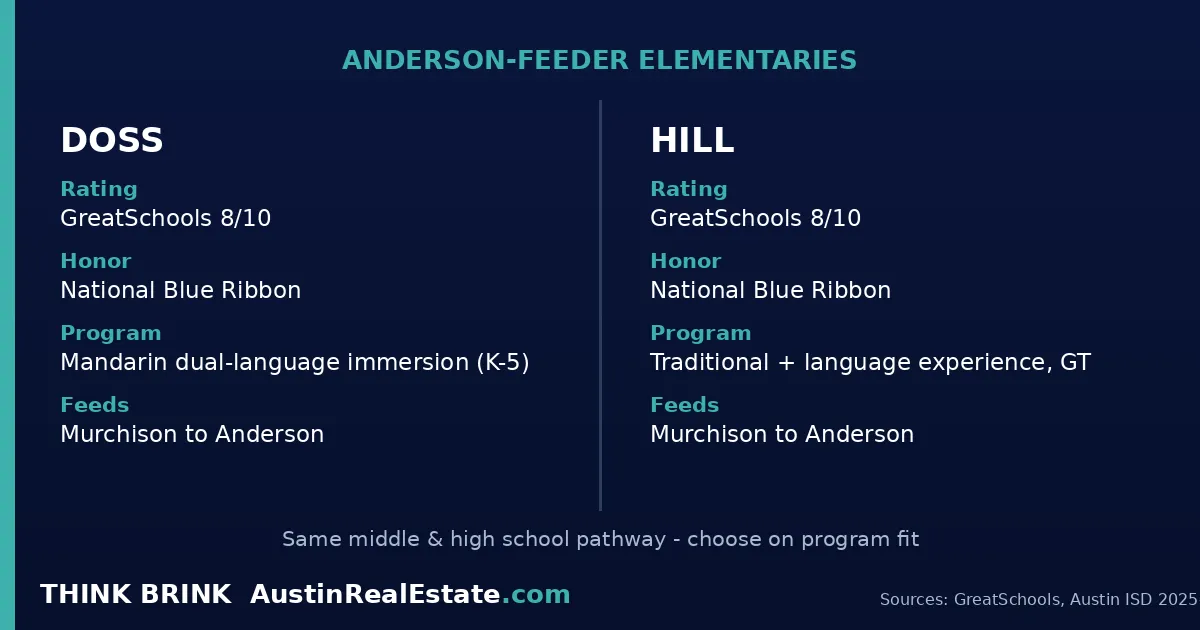
Start with what is the same, because it is most of the picture. Doss and Hill are both Austin ISD elementary schools in the Northwest Hills area. Both feed Murchison Middle School and then Anderson High School, so no matter which of the two your child attends, the middle and high school pathway is identical. Both hold an 8 out of 10 GreatSchools rating. Both have been named National Blue Ribbon Schools, which is a federal recognition tied to sustained high performance. In other words, the two campuses that Northwest Hills buyers agonize between are, on the measurable academics, effectively a coin flip. That should take some pressure off. You are not choosing between a strong school and a weak one. You are choosing between two strong schools with different personalities.
The Real Difference: Program Model
The most substantive difference between Doss and Hill is how they handle language, and it is a genuine fork.
Doss: Mandarin dual-language immersion
Doss runs a Mandarin Chinese dual-language immersion program that begins in kindergarten. In an immersion model, students spend a meaningful portion of the school day learning in Mandarin rather than simply taking a language class, so the language becomes a medium of instruction, not an add-on subject. The program began as a Mandarin immersion track and has developed into a dual-language program running through the elementary grades. For families who want their child to develop real second-language fluency early, this is a rare and valuable feature in a public elementary, and it is a specific reason some buyers target the Doss zone. For families who do not want immersion, it is simply a defining characteristic of the campus to be aware of going in, because it shapes the school day.
Hill: traditional program with language experience
Hill runs a more traditional elementary model, with a foreign-language experience track that exposes students to a language in the first through fifth grades rather than immersing them in it. It also offers gifted and talented services, as Austin ISD campuses do. If you want a strong, conventional elementary experience without the commitment that an immersion program represents, Hill fits that preference cleanly. Neither approach is better in the abstract. Immersion is a bigger commitment with a bigger potential payoff in fluency; a traditional model is more familiar and more flexible. This is a parenting-philosophy question, and it is the main thing that should drive a Doss-versus-Hill preference once you know the academics are comparable.
How the Zones Work
This is where a program preference collides with a home search, so it is worth understanding clearly. Doss and Hill each have their own attendance zone within the Northwest Hills area, and which school a home is zoned to depends on the specific street, not on the neighborhood name. Two homes that both feel like Northwest Hills, a short drive apart, can be zoned to different elementaries.
There is an important wrinkle with the Doss immersion program. Because immersion is a specialized program, some families outside the immediate zone try to access it, but Austin ISD does not provide bus transportation for students who transfer to another campus specifically for a dual-language program. Practically, that means if you want your child in the Doss Mandarin program and you are relying on it, the cleanest path is to buy a home actually zoned to Doss, rather than counting on a transfer you would then have to drive daily. Transfer policies also change from year to year and are subject to capacity, so they are not something to build a home purchase around. If the immersion program is a priority, treat the Doss attendance zone as a hard search criterion and confirm it at the address.
What the Choice Means for Home Price
Here is the honest real estate answer. Because Doss and Hill are both excellent and both feed the same top middle and high schools, the elementary split does not create a dramatic, reliable price gap the way a top-versus-weak elementary sometimes does elsewhere. Both zones sit inside the desirable central Northwest Hills area, both carry the same Austin ISD tax footprint of roughly 2.05 percent of taxable value for 2025-2026, and both benefit from the same Murchison and Anderson feeder premium above them.
Where you can see price differences, they tend to be driven by the homes and lots themselves, the elevation, the view, the condition, and the specific pocket, rather than by which of the two elementaries the address feeds. The Doss Mandarin program can create additional demand from immersion-focused families for homes specifically in the Doss zone, but that is a demand nuance layered on top of the usual lot-and-condition drivers, not a blanket premium. The takeaway for a buyer is reassuring: you generally do not have to overpay to get into one of these two schools versus the other. You choose based on program fit and the home, and the school quality comes along either way. For how zoning generally moves price in this area, see how school zoning by address changes what you pay.
Which One Should You Target?
Target the Doss zone if you want your child in a Mandarin dual-language immersion program from kindergarten and you value early second-language fluency enough to make the attendance zone a firm requirement of your home search. The program is a real, uncommon asset, and the way to secure it is to buy inside the zone rather than bank on a transfer.
Target the Hill zone if you prefer a strong, traditional elementary experience with language exposure rather than immersion, and you want to keep your home search flexible across the broader Northwest Hills area without organizing it around a specialized program. You are giving up nothing on the core academics or the feeder pathway.
And if you genuinely do not have a strong program preference, relax the elementary as a search constraint and let the home, the lot, and the price lead. Both schools deliver, both feed Murchison and Anderson, and you will do fine at either front door. The mistake I see is families ruling out a great home because it feeds the other one of these two very good schools. That is usually the wrong trade.
Frequently Asked Questions
Is Doss or Hill Elementary the better school?
On the measurable academics they are essentially even. Both carry an 8 out of 10 GreatSchools rating and National Blue Ribbon recognition, and both feed Murchison Middle and Anderson High. The meaningful difference is program model, not quality: Doss runs Mandarin dual-language immersion, and Hill runs a more traditional program with language experience. Choose based on which model fits your family rather than on a quality gap, because there is not much of one.
Do Doss and Hill feed the same middle and high school?
Yes. Both Doss and Hill feed Murchison Middle School and then Anderson High School in Austin ISD. So whichever elementary your child attends, the middle and high school pathway is identical. That is a big reason the elementary choice is lower-stakes than families often assume.
What is the Doss Mandarin immersion program?
Doss runs a Mandarin Chinese dual-language immersion program starting in kindergarten, in which students learn across both English and Mandarin during the school day rather than taking Mandarin as a single class. It is designed to build real second-language fluency early and is an uncommon feature in a public elementary, which makes the Doss zone a specific target for immersion-focused families.
Does Hill Elementary offer immersion?
No. Hill runs a more traditional elementary model with a foreign-language experience track in first through fifth grades, which exposes students to a language rather than immersing them in it. It also provides gifted and talented services. If you want a conventional strong elementary without the immersion commitment, Hill fits that preference.
Can I get my child into Doss immersion if I do not live in the zone?
It is not something to count on. Austin ISD does not provide bus transportation for students who transfer to another campus for a dual-language program, and transfers are subject to capacity and to policies that change year to year. If the Mandarin program is a priority, the reliable path is to buy a home actually zoned to Doss rather than to plan around a transfer you would have to drive daily and might not secure.
How do I know whether a home feeds Doss or Hill?
Zoning is set at the street level, not by neighborhood name, so two nearby Northwest Hills homes can feed different elementaries. Confirm the assignment at the exact address with Austin ISD in writing before making an offer. Do not rely on a listing description or a neighborhood's general reputation, because that is exactly where costly assumptions happen.
Does buying in the Doss zone cost more than the Hill zone?
Not in a reliable, across-the-board way. Both zones sit in the desirable central Northwest Hills area with the same Austin ISD tax footprint and the same Murchison and Anderson feeder above them, so price differences tend to come from the homes and lots themselves rather than the elementary. The Doss immersion program can add demand from immersion-focused families for in-zone homes, but that is a nuance on top of the usual lot and condition drivers, not a blanket premium.
Should the elementary school decide which home I buy?
Only if you have a firm program preference, particularly a desire for Mandarin immersion, which does argue for making the Doss zone a hard requirement. Absent that, let the home, lot, and price lead, because both schools are strong and both feed the same middle and high school. Ruling out an otherwise great home because it feeds the other of these two very good elementaries is usually the wrong trade.
The Honest Summary
Doss and Hill are two of the strongest elementary schools in Austin ISD, they both feed the same Murchison and Anderson pathway, and on the measurable academics they are close to a tie. The real difference is program model: Doss offers Mandarin dual-language immersion from kindergarten, and Hill offers a strong traditional program with language experience. That makes the choice a parenting-philosophy question far more than a quality question. Because both are excellent and share the same feeder above them, the elementary split rarely creates a big, dependable price gap, so you can usually choose on program fit and buy on the home. The one place to be disciplined is the Doss immersion program: if you want it, buy inside the zone rather than counting on a transfer, and confirm the zoning at the exact address. When you are ready to search with the right elementary as a filter, that is work I do address by address.
